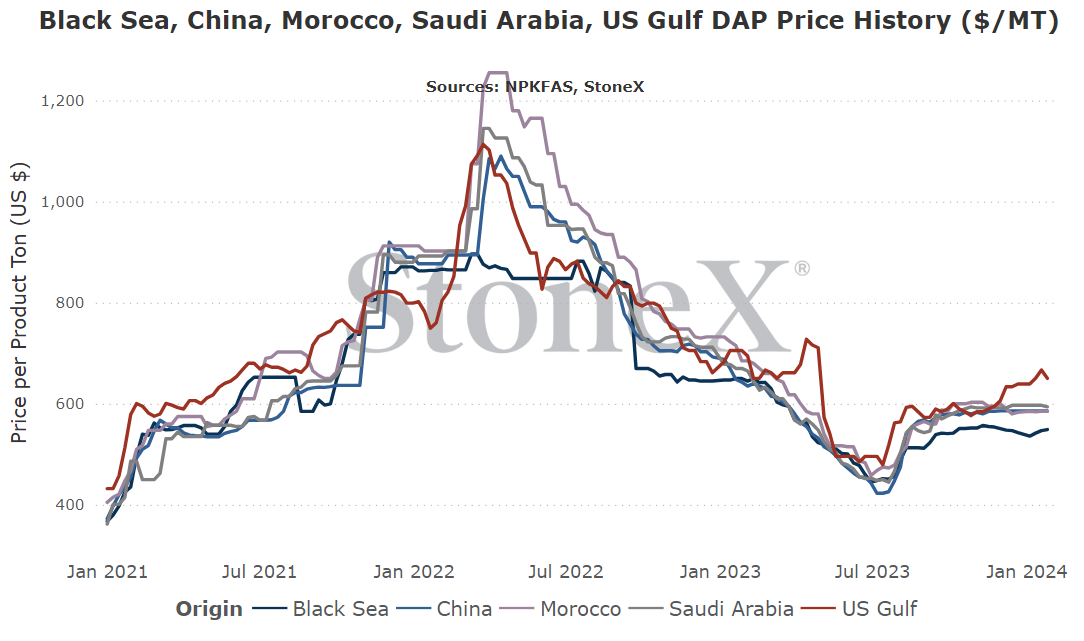
I'm starting to get a little skeptical of global phosphate values. There has been decent sales activity being reported and there is still the fear of Chinese exports being blocked...yet values are mostly flat. What happens when the buying dries up and/or China comes back to normal?
As the world prepares for coming application demand, values should hold but beware. I cannot help but have a gut feel that lower values are coming?
Unfortunately, I do not think the correction will happen in the next month or two. There is too much demand around the world. However, once things slow down, I'm worried about how the industry will handle it.
Commentary
Westward bound Saudi Arabian vessels dealing with Red Sea difficulties
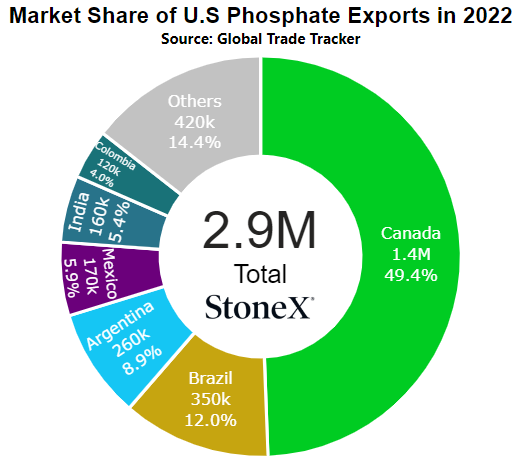
For a lot of phosphates heading to North/South America, the Red Sea situation has not been a major news story. However, that is not the case for Saudi Arabia who has been so very important an import partner for North America as one of the few major points without duties.
Fortunately, the attacks in the Red Sea which has discouraged some vessel lines to stay away does not mean it is impossible to reach the west. The route around the south tip of Africa is available...but it comes with costs. The freight rate per vessel goes up by hundreds of thousands of dollars. While less than stellar, that cost is not nearly as bad when spread across a 30 - 40K ton load.
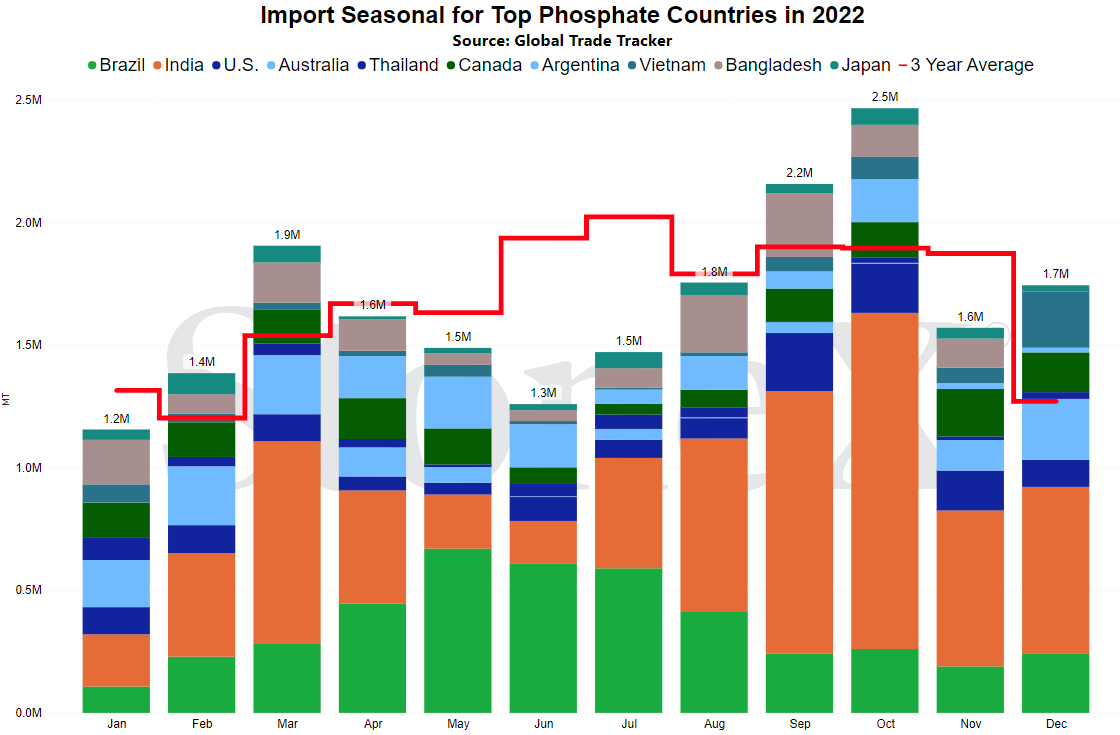
The worse issue is the timing with N.A. spring application coming quickly. The south route takes a reported 10 - 15 additional days. For most of the calendar, that isn't a big deal but in the lead up to spring following such a large fall run that emptied the system, this could cause issues.
Ultimately, the Red Sea is not shut down completely as vessels are mostly opting to transit. For those not willing to risk it, it changes things for them and for N.A.
Why does this matter for Australian farmers?
You might be reading that and think, "that reads like it was written for N.A.". Well, you would be right!!! There is a reason I left it as it is and it could/should be beneficial for Australia.
If Saudi Arabia is having difficulties shipping product west, why not target another area. Australia quickly moves up that list of destinations. South America and North America troubles could be an opportunity for Australia.
Still watching China for any changes to their export programs
As mentioned repeatedly in the past, China is typically the world's largest DAP/MAP exporter. That was when fertilizer markets were allowed to flow freely. However, with the last 3 years of massive price volatility and supply concerns, the central government is now paying attention and making demand to what does and does not happen.
In regards to their urea exports, the government stepped in and reduced their output by approximately 40% on average per month thru all of 2024, until March 2025. China represents about 10% of global exports (normally) so this was seen as a decent loss of available tonnage in the world which helps keep values higher. The fear is that big cuts will be made to phosphate exports as well. If it is a big deal for the urea market, it would be huge for phosphate.
Unfortunately, it is China. That means it is very difficult to impossible to figure out fact from fiction. Even when announcements are made, we have to always watch for changed. We have seen China say that they will not provide much urea to an India tender and then shock the world by selling 1M ton. The next tender we expected them to play a major part...just to back peddle and largely not participate.
Hopefully we will see them play a normal role and keep the world decently supplied. Unfortunately, we need to keep an eye on them.
Why does this matter for Australian farmers?
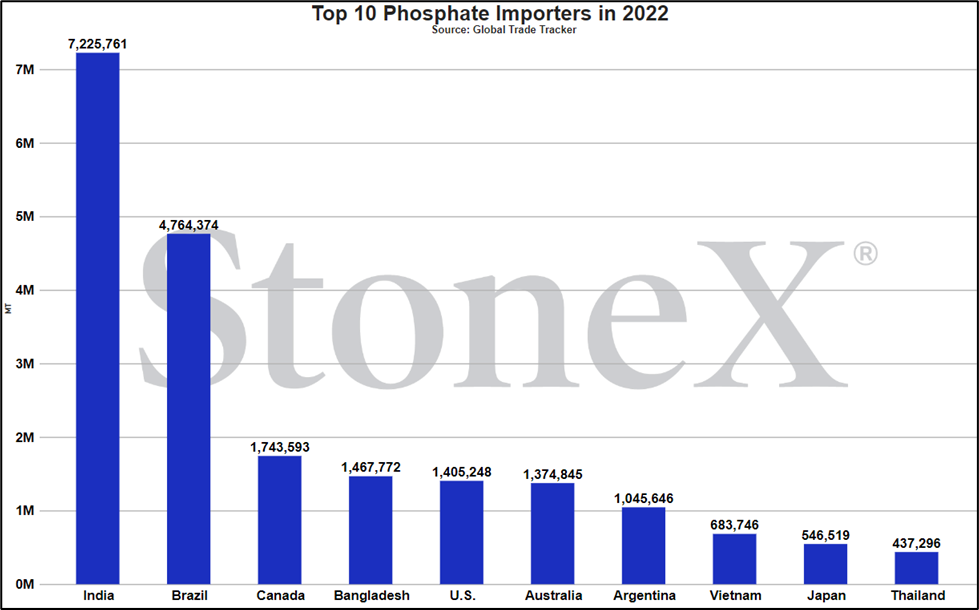
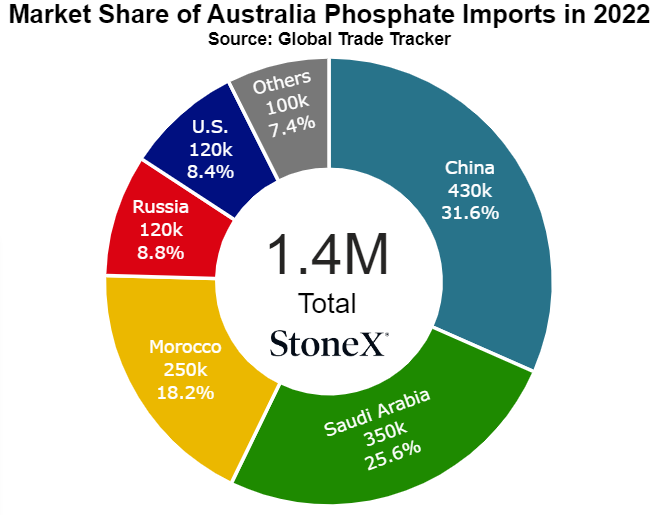
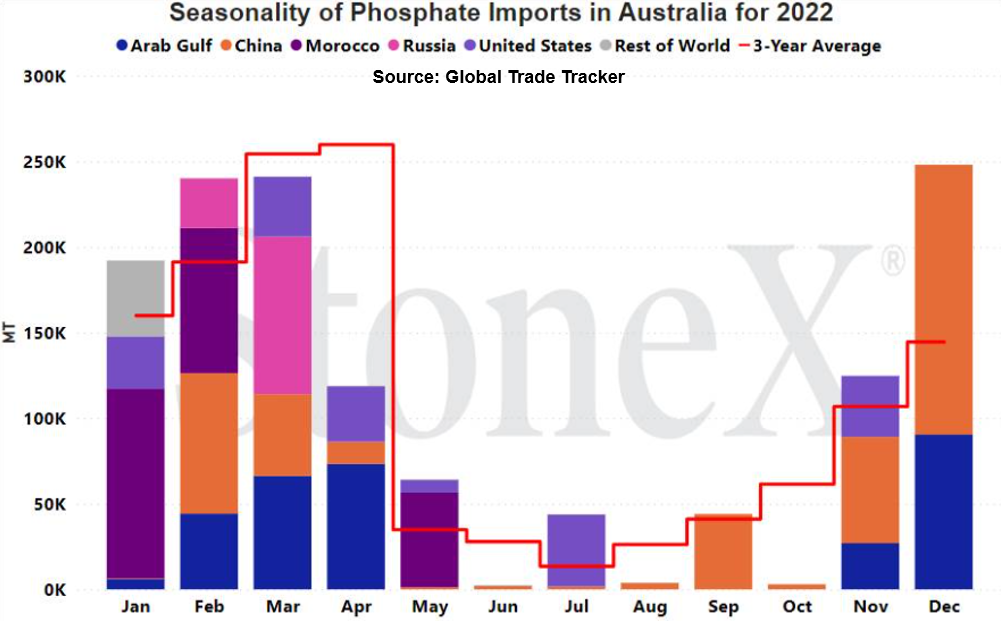
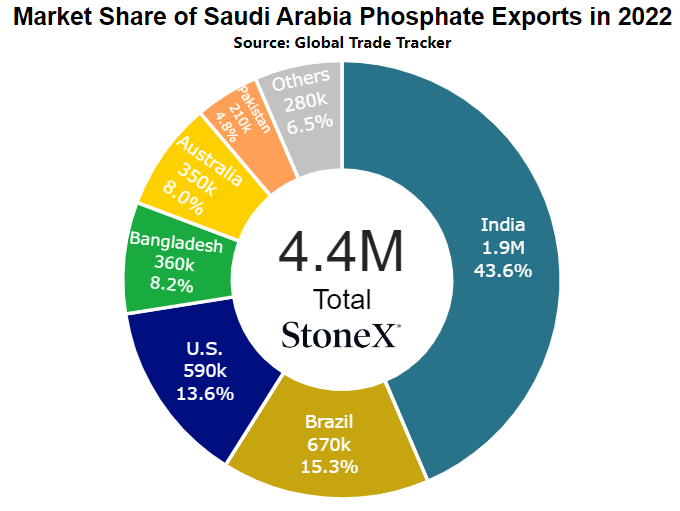
For all but December of 2023, China was nearly tied with Saudi Arabia as Australia's largest phosphate provider. It is certainly the closest.
So what China does or does not do matters a great deal. If we suddenly see even stricter export restrictions put in place, importers will be forced to pivot and try to find alternative origins which will bring longer sail times and higher freight costs. If China allows full and free exports (doesn't appear likely), Australia should see a windfall of "nearby" tonnages suddenly available.
Price comparisons
Vs 30 days ago -
Vs 90 days ago -
Vs 6 months ago -
Vs 1 year ago -
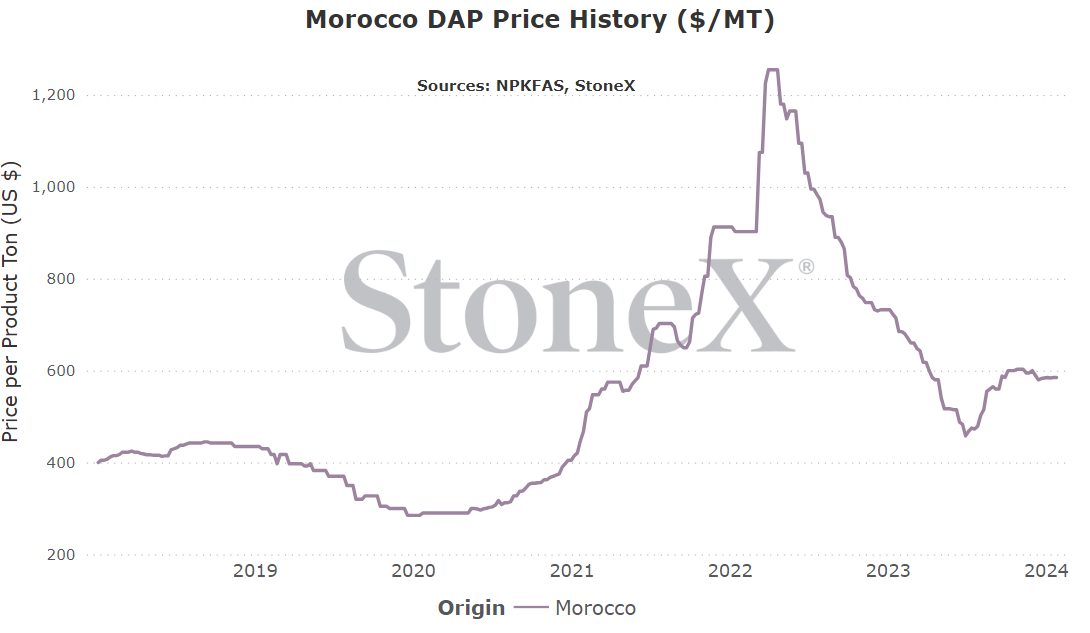
Morocco DAP price comparison
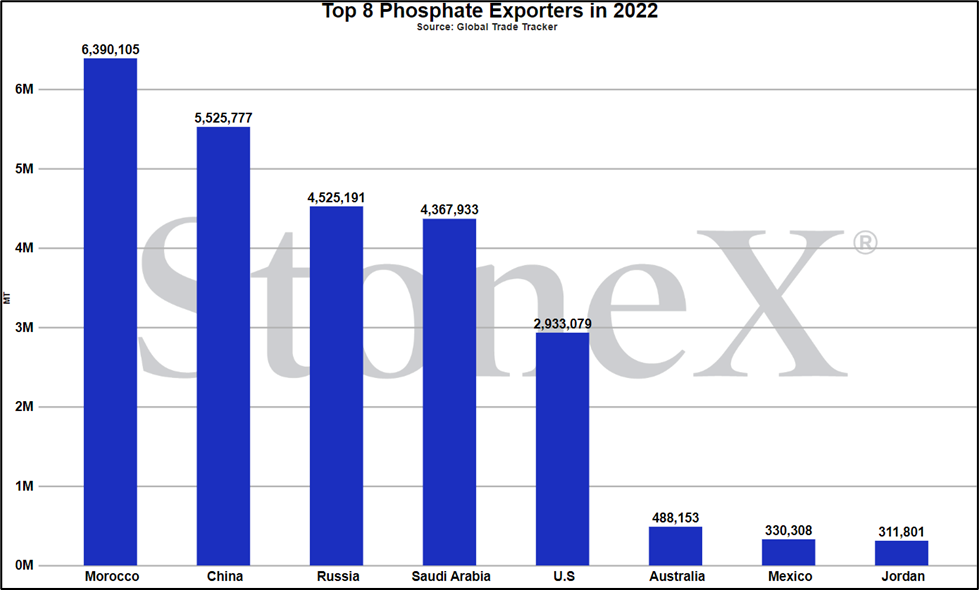
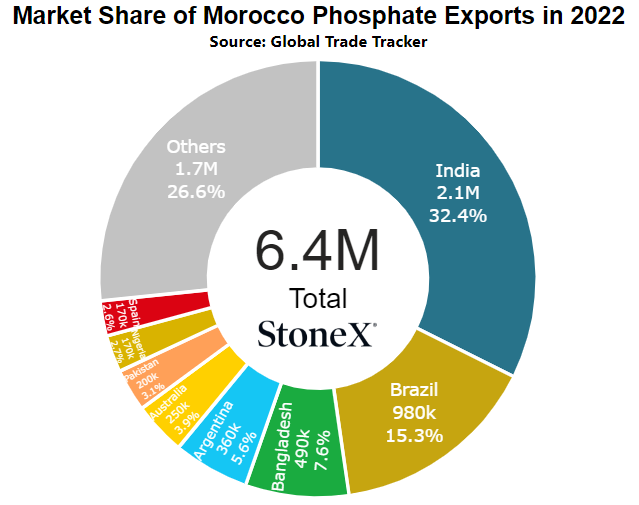
Number 1 global exporter in 2022
Price comparisons:
Vs 30 days ago -
Vs 90 days ago -
Vs 6 months ago -
Vs 1 year ago -
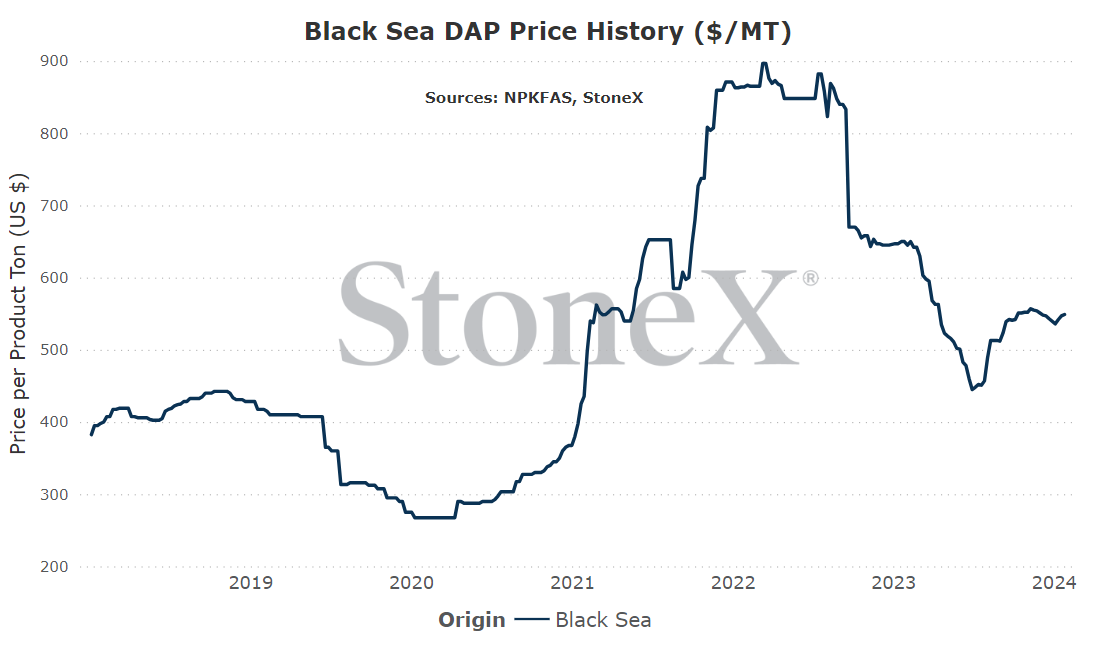
Black Sea DAP price comparison
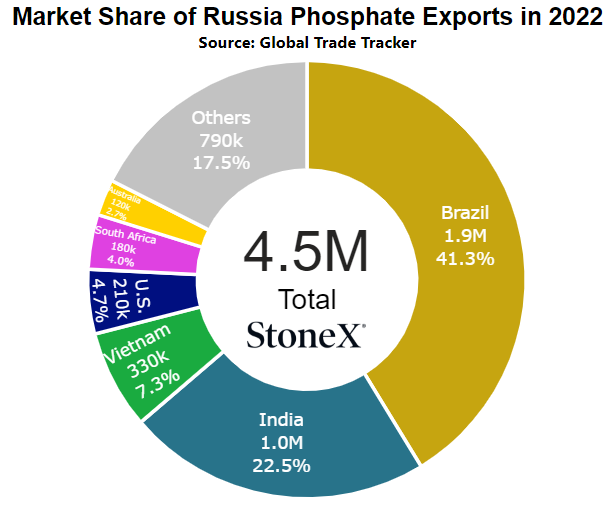
Number 3 exporter of DAP/MAP in 2022
Price comparisons
Vs 30 days ago -
Vs 90 days ago -
Vs 6 months ago -
Vs 1 year ago -
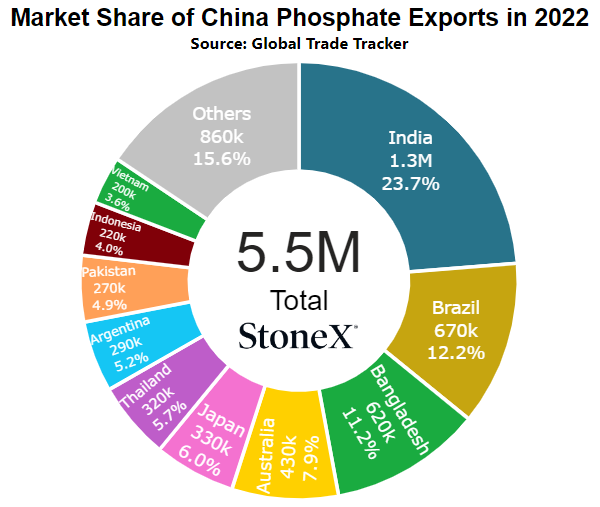
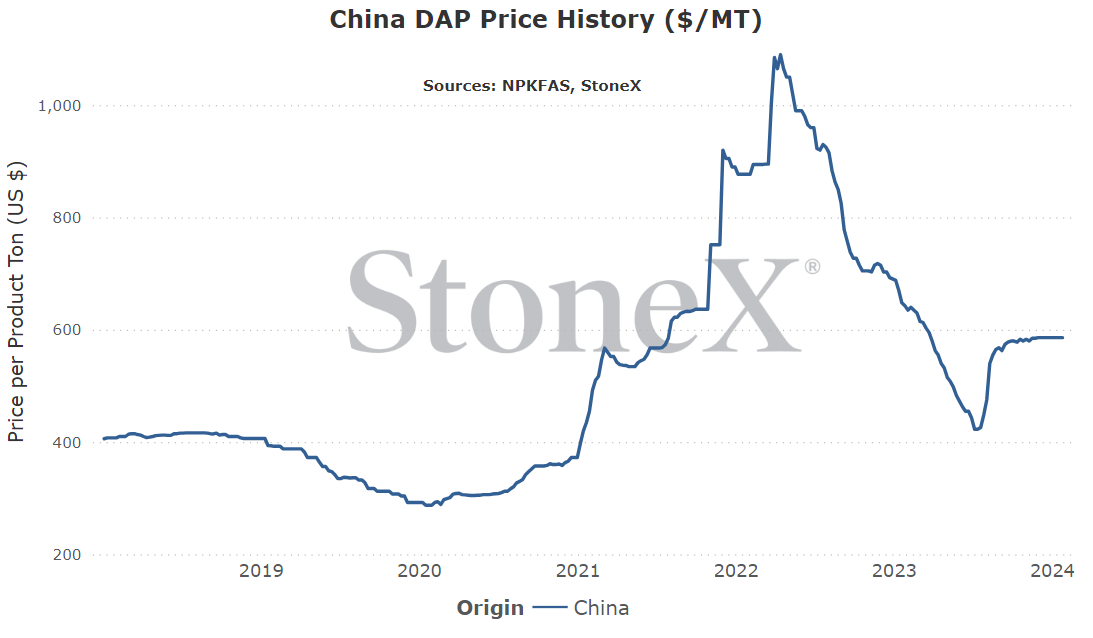
China DAP price comparison
Number 2 global exporter in 2022
Price comparisons
Vs 30 days ago -
Vs 90 days ago -
Vs 6 months ago -
Vs 1 year ago -
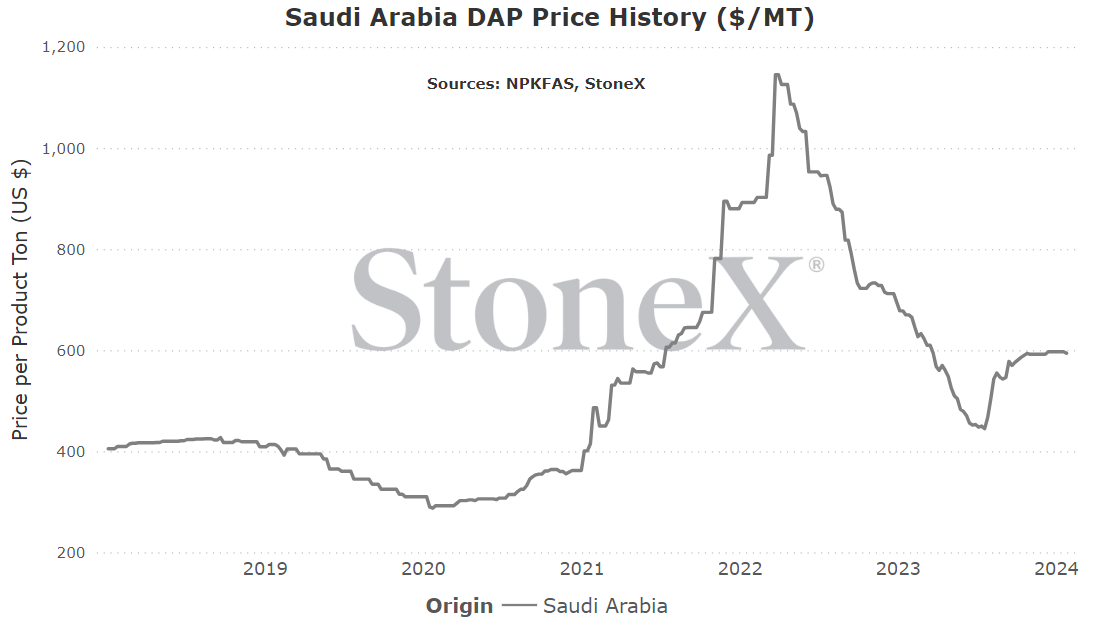
Saudi Arabia DAP price comparison
Number 4 global exporter in 2022
Price comparisons
Vs 30 days ago -
Vs 90 days ago -
Vs 6 months ago -
Vs 1 year ago -
- China continues to follow thru with export cuts – China is typically the largest producer and exporter of DAP/MAP in the world. If they continue to follow thru with cuts, it will leave a supply hole in the world of phosphate which will likely be filled with higher pricing. It is China so we never know what the government will decide to do but so far, we need to proceed with the expectation that they are going to restrict exports.
- Further attacks in the Middle East further impede vessel traffic – North America has become a large receiver of phosphate from Saudi Arabia following U.S. duties. However, Houthi rebel attacks on vessels transiting the Red Sea have caused some lines to opt for war time conditions in contracts and sail south around Africa. This adds a couple week's sail time...and adds a lot of additional cost on logistics that eventually find their way to the end user.
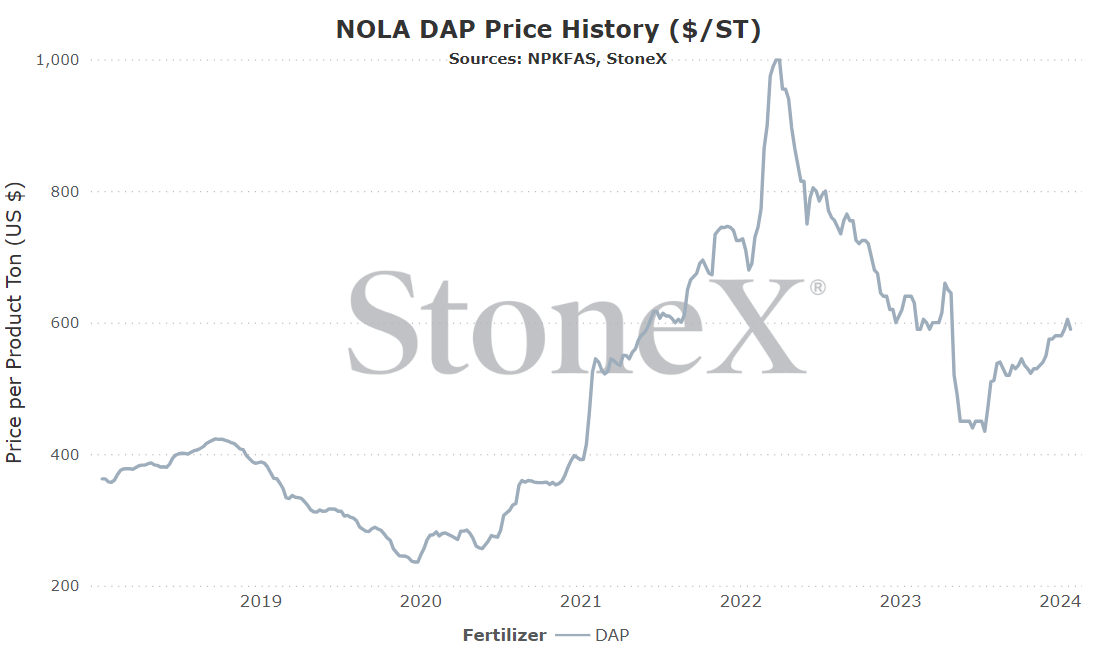
- Importers are less willing to take price risk by bringing big imports – there is a fair bit of price risk in today's phosphate values. Of all the major fertilizers, phosphate has done the least to correct from the high's set in early 2022. While it doesn't look likely that a major price correction is coming in the short term, it does seem like something is looming further out. Importers bear the price risk of product until it is sold. The current setup could cause some to become more cautious on their approaches. If enough do this, inventories get tight and price reflect it quickly.
- China exports at a heavier pace than expected – I do not know what the Chinese government is going to do. Most others do not know what they are going to do. It is conceivable that we could find out that they have changed their minds and start exporting at normal/heavy paces. If that happens, the world market is going to take notice and it will be very difficult for prices to hold.
- Importers surprise the market with much heavier lineups – this does not seem likely, but it is still something to watch. If Australia suddenly figures out that there is an armada of vessels en route, importers will be forced to do what they can to move product. Demurrage costs on vessels is extremely expensive so most times it is better to firesale some product to make room. Again, not likely but worth watching for.
- Poor weather does not allow applications to begin – just because the calendar says it is time to go does not mean mother nature has to agree. Vessels are en route in anticipation of a "normal" start to spring. What happens if suddenly the weather turns and farmers are unable to get into the fields? Those vessels are still coming and need to be unloaded.
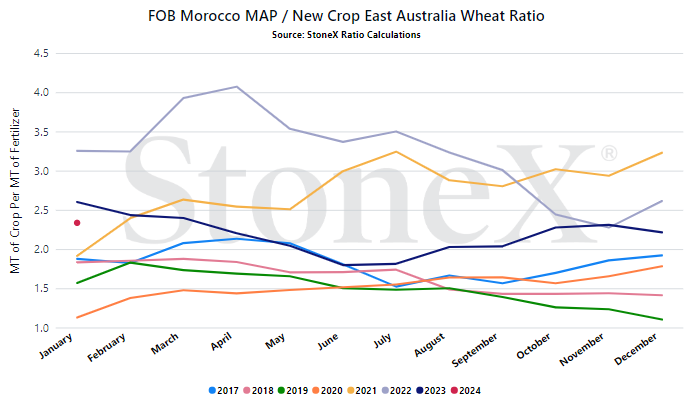
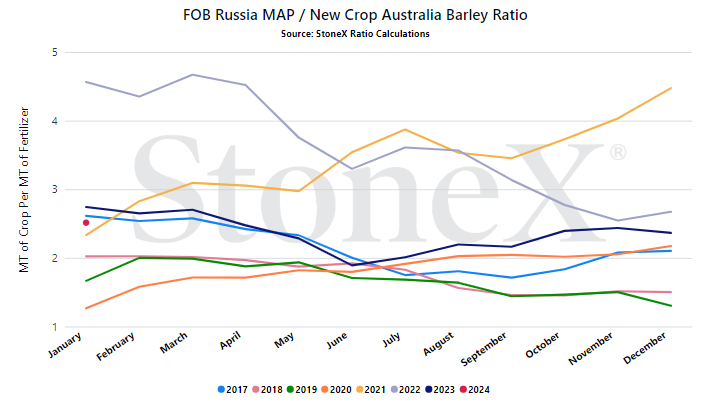
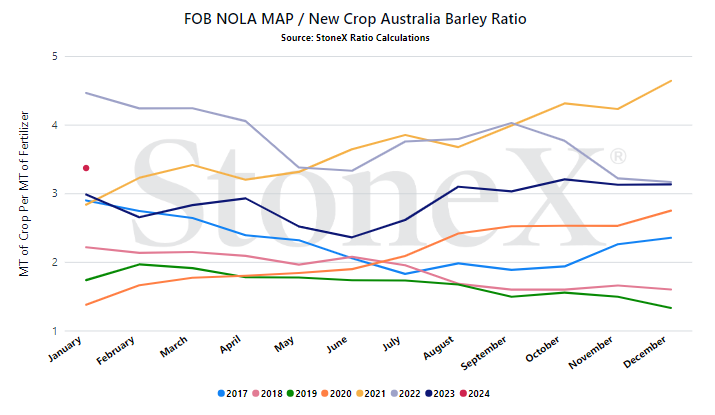
We believe that only looking at the flat price of either grains or fertilizer can be misleading:
-
Only selling grain can hurt you if fertilizer prices rise substantially
-
Only buying fertilizer can hurt you if grain prices fall
We look at the ratio "value" to get a better indication of where we are or how many bushels of X does it take to pay for 1 ton of fertilizer.
Would you rather:
-
Spend 4 ton of grain to pay for 1 ton of MAP
-
Spend 1.5 ton of grain to pay for 1 ton of MAP
When we compare the current ratio value against recent years, we start to see if we are high or low.
YOUR VALUES MAY LOOK DIFFERENT
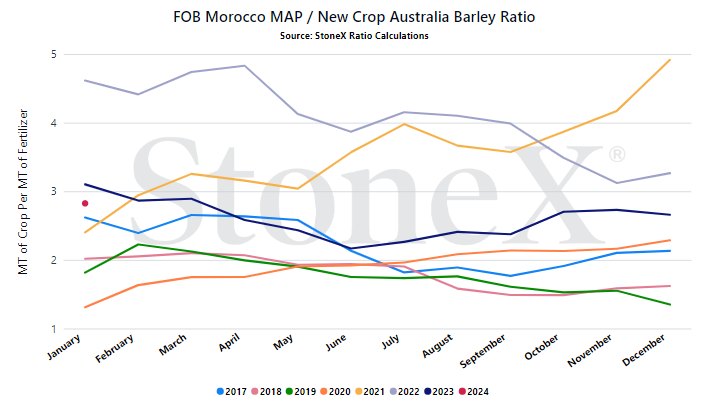
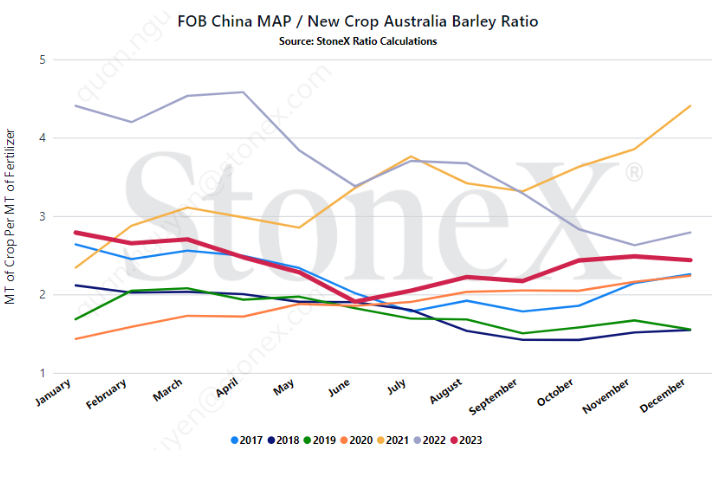
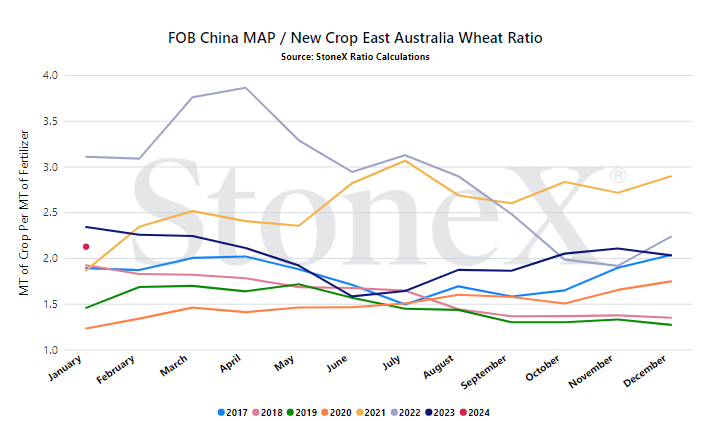
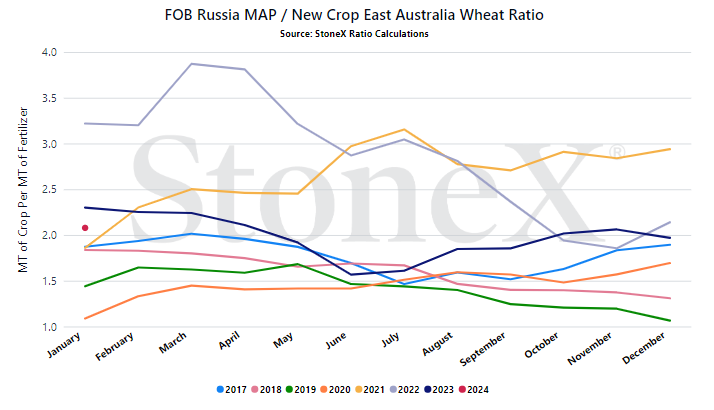
- Red Sea vessel shipment ability - this isn't nearly as important as it is for urea, but for those in the west, it is still important given Saudi Arabia's location. If the Red Sea continues to a risk option for sailing, vessels may continue to opt to go south around Africa. That means larger freight rates as well as long sail times. Those timelines and price increases ultimately make their way down the supply chain.
- Middle East tension - the Middle East is currently on edge following the attack on U.S. service members in Jordan which resulted in 3 dead and 30+ injured. The region is holding its breath to see how the U.S. will retaliate. Will it stay focused on Syria? Will Iran be targeted given their backing of the group? If the latter, will the region be plunged into a wider war...which could affect phosphate production in the region.
StoneX Ratio Calculation
The ratio calculation is derived from Bloomberg historical grains values as well as fertilizer values from StoneX, NPKFAS, and Argus.
The calculation is simply dividing the fertilizer price by each grain price.
All data was sourced from StoneX unless otherwise noted.