The Federal Reserve is changing leaders at a controversial time in the monetary policy cycle with strong exogenous pressures and under tremendous pressure from the US President. What does the central bank look like further into 2026 and beyond?
Talking Points:
A leadership change at the Fed may increase political tension and internal dissent rather than deliver a clean policy reset
The Fed has shown a greater tolerance for higher inflation above 2 percent and that may persist moving forward – but it looks unlikely to accelerate rate cuts
A less credible or more divided Fed could weaken confidence in the “Fed put,” raising uncertainty for both fixed income and equity markets
To sign up for the Trading Global Macro podcast, find it on your preferred podcast platform: Apple Podcasts, Spotify, or YouTube.
Federal Reserve Chairman Jerome Powell’s term at the head of the central bank is coming to an end; and the White House seems to have dropped its investigation into the policymaker to clear the way for President Trump’s pick, Kevin Warsh, to take over the role. While some harbor the belief that new leadership at the world’s largest central bank will bring about a significant change for the group – an aggressive shift towards easing, a degradation in credibility and other meaningful evolutions – the reality may prove more a relative continuity with difficult decisions against a shifting economic and financial landscape.
To discuss some of the pressing questions around what the Federal Reserve looks like under new leadership heading further into 2026 and with a unique mix of intense exogenous factors (including the clearly expressed expectations of the US President), StoneX’s Director of Global Macro Strategy, Vincent Deluard, joined John Kicklighter and Matt Weller for a discussion on the Trading Global Macro podcast.
What is Expected from a Chairman Warsh
There is a spectrum of expected extremes surrounding the new, incoming Federal Reserve Chairman, Kevin Warsh. Many of these assumptions, however, seem to be drawn from the aggressive views voiced by US President Donald Trump – his sponsor. Warsh has a practical background in both the financial markets and monetary policy. He began his career with Morgan Stanley as an associate working on mergers and acquisitions. Later, he would be named to the George W. Bush’s National Economic Council where he had experience dealing with a range of key American regulatory bodies, the central bank, the US Treasury and Wall Street. His exposure to the central bank was founded in his tenure as the youngest appointee to the Board of Governors in 2006. After his five year term, he would go on to work with the Duquesne Family Office under Stanley Druckenmiller.
Throughout his evolving career in the public and private sectors, Warsh has been upfront on his views around proper monetary policy. In his voting record, he did not meaningfully dissent from then-Chairman Ben Bernanke; however, he did question the efficacy of the large scale asset and later quantitative easing programs that extended beyond the reduction of the benchmark interest rate to zero. He was also generally hawkish leaning when it came to inflation risks – though he was an important voice in the rescue of Wall Street during the Great Financial Crisis.
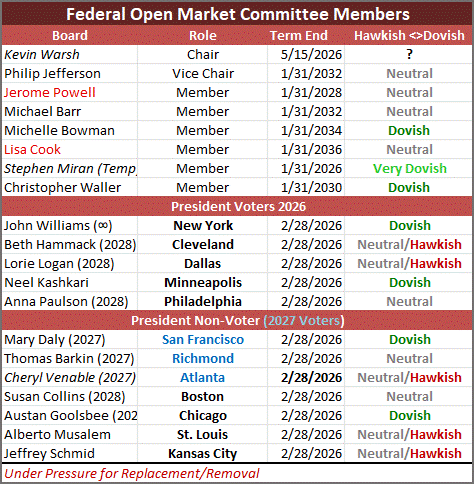
Table of FOMC Members, Roles, Term and Bias Source: John Kicklighter
Will the Fed Finally Deliver the Sharp Rate Cuts Trump Wants?
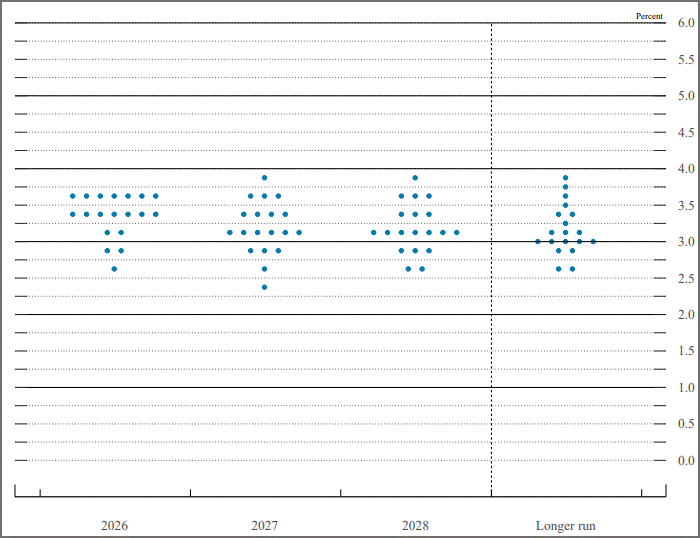
In policy disposition, Kevin Warsh’s history does not seem to track with the extreme hawkish calls that President Trump has called for – and repeatedly criticized Powell for not championing. The calls for the White House seem to center on an aggressive – and even off-meeting emergency meeting – cut to the benchmark range of down to 1.00 percent. That would be an aggressive reduction from the current 3.75 to 3.50 range. Deluard doesn’t see the Federal Reserve fast tracking such a reduction under the leadership of Warsh. Between his historical policy leanings and against the backdrop of the Fed’s limited policy forecasts via the Summary of Economic Projections, he sees the same wait-and-see stance that was maintained through the previous months.
The ‘Dot Plot’ from the FOMC’s March Summary of Economic Projections on Rates Source: Federal Reserve Summary of Economic Projections; John Kicklighter
A Tolerance for Higher Inflation and Aim to Reduce the Fed Balance Sheet
Weller highlighted a view from Deluard’s analysis that flagged an inflation tolerance from the Federal Reserve that seemed to contradict an academic read and expectation for monetary policy next steps. Despite inflation running consistently above the central bank’s 2.0 percent target and a backdrop whereby unemployment still remains exceptionally low, the group has maintained its generally neutral policy stance. This has led to the belief that the Fed has unofficially raised its tolerance band on price pressures up to 3 percent. Seeing how persistent that allowance is against a traditional ‘hawk’s perspective like Warsh will be important.
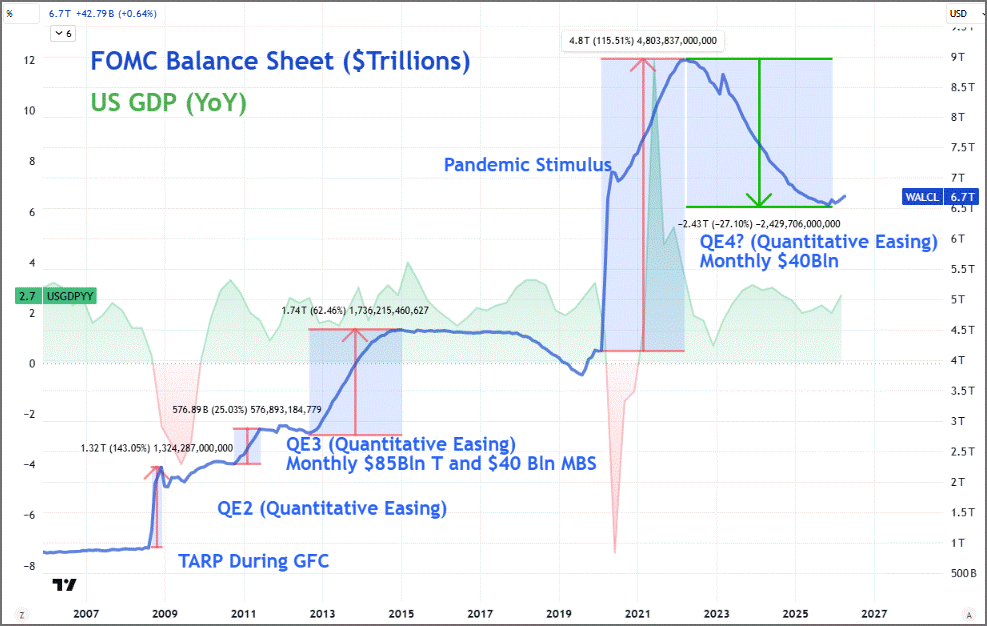
On the point of extraordinary monetary policy tools like the quantitative easing programs that have persisted since the Great Financial Crisis, there is more belief that Warsh will encourage a more progressive effort to significantly reduce these efforts. That will be interesting against the backdrop of a recent restoration of the short-term Treasury purchases to the tune of $40 billion per month. Deluard believes that rate cuts may be considered in the context of a transition away from the large central bank balance sheet.
Chart of the Federal Reserve Balance Sheet Overlaid with US Annualized GDP (Monthly) Source: TradingView.com; US Bureau of Economic Analysis; John Kicklighter
The Fragility of the Fed Put and Where the Fed Rate Will End 2026
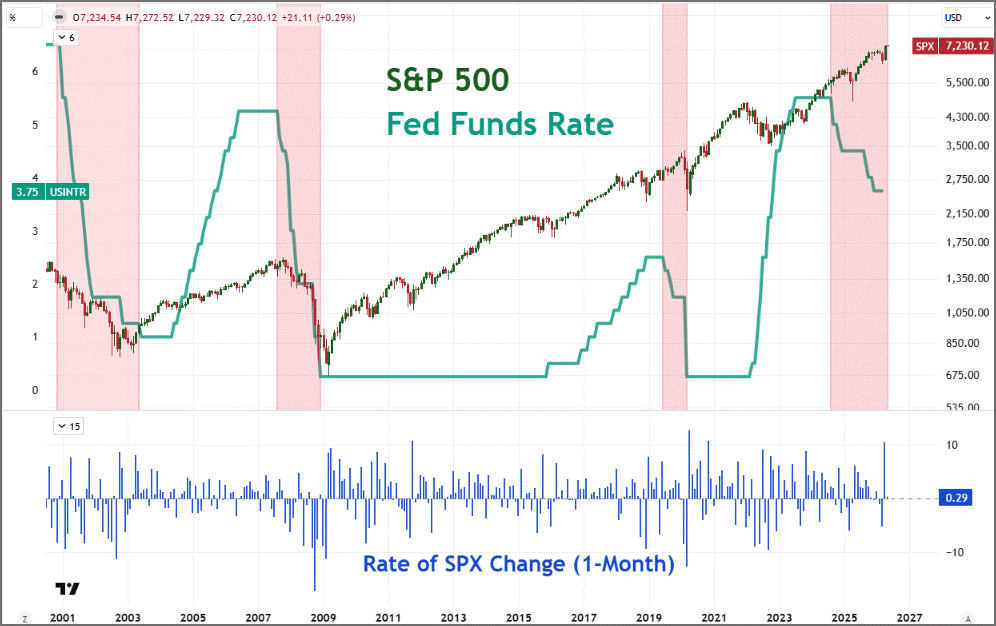
From a markets perspective, one of the more prominent concerns with the changing of the guard at the Chair level is the strength of the ‘Fed Put’. This is a term that references a belief that, despite the stated dual mandate of full natural employment and 2 percent target inflation, the central bank will significantly loosen its policy stance in response to a significant capital market downturn. There are plenty of points of evidence to this view in recent history. However, the questions over Fed independence, the stated ambitions of Warsh to reduce the balance sheet and his history as an inflation hawk offer a tangible foothold for concern that market strength will be a leading factor in the dictation of monetary policy going forward.
S&P 500 and US Federal Funds Rate (Monthly) Source: TradingView.com; Federal Reserve
Sign Up for Vincent’s Global Macro Insights
Sign up for a suite of reports providing big-picture commentary and analysis of the socio-economic and political trends and dynamics that move markets globally, written by well-known StoneX commentator Vincent Deluard.
Access More Global Macro Insights, Forecasts and Tools
Stay connected to timely global macro analysis designed to help market participants navigate shifting economic conditions and evolving risk. Gain access to regular market commentary, updated quarterly forecasts, a comprehensive two-week forward economic event calendar, and specialized tools built to support informed trading and risk management decisions.
StoneX TV content is created, produced, and distributed solely by StoneX Media Ltd (“StoneX TV”) and is provided for informational and educational purposes only. StoneX TV does not provide investment, financial, legal, or tax advice and does not make any recommendation or endorsement of any investment strategy, transaction, or financial instrument. Nothing in this content constitutes, or should be construed as, investment advice or a recommendation to buy, sell, or hold any financial instrument, including securities, futures, derivatives, digital assets, foreign exchange products, or CFDs. This content does not constitute an offer, invitation, or solicitation to engage in any investment activity. The information presented is general in nature and is not tailored to the financial situation, investment objectives, or risk tolerance of any specific person. You should not rely on this content as a substitute for independent professional advice. Investing and trading in financial instruments involves significant risk of loss and is not suitable for all investors. Past performance is not indicative of future results. Any views or opinions expressed are those of the presenter at the time of publication and are subject to change without notice. Such views may not necessarily reflect those of StoneX Media Ltd or its affiliates. StoneX Media Ltd and its affiliates, including StoneX Group Inc., may from time to time have positions in, or engage in transactions involving, the financial instruments referenced. This content may include general market commentary and opinion. It does not constitute independent investment research and has not been prepared in accordance with legal requirements designed to promote the independence of investment research. StoneX Media Ltd is not authorised or regulated to provide investment services and does not act in a fiduciary capacity. StoneX Media Ltd is incorporated in Ireland and operates in accordance with applicable Irish law. It is a wholly owned subsidiary of StoneX Group Inc. and is a separate legal entity from other subsidiaries within the StoneX Group, which may be regulated in various jurisdictions. StoneX Media Ltd does not act on behalf of, or provide services for, any regulated affiliate. This content is not directed at, and may not be distributed to, any person in any jurisdiction where such distribution would be contrary to local laws or regulations. Supporting documentation for any claims, comparisons, statistics, or technical data may be made available upon reasonable request, where applicable.
Discover more insights
Our subscribers have access to comprehensive market analysis from StoneX spanning commodities, equities, currencies and more.
Our market expertise, advanced platforms, global reach, culture of full transparency and commitment to our clients’ success all set us apart in the financial marketplace.
Reach
With access to 40+ derivatives exchanges, 180+ foreign exchange markets, nearly every global securities marketplace and numerous bi-lateral liquidity venues, StoneX’s digital network and deep relationships can take clients anywhere they want to go.
Transparency
As a publicly traded company meeting the highest standards of regulatory compliance in the markets we serve; our financials and record of accomplishment are matters of public record. StoneX’s commitment to “doing the right thing over the easy thing” sets us apart in the industry and helps us build respect, client trust and new partnerships.
Expertise
From our proprietary Market Intelligence platform, to “boots on the ground” expertise from award-winning traders and professionals, we connect our clients directly to actionable insights they can use to make more informed decisions and achieve their goals in the global markets.