FX Weekly Overview: The week's main events
- Bearish factors
- The pace of growth for the US labor market and economic activity in June is expected to slow from May and reduce fears of inflation persistence in the country, contributing to increased bets of rate cuts by the Fed and weakening the dollar globally.
- Bullish Factors
- A domestic situation of negativity and doubt about the credibility of Brazilian economic policies is likely to keep investors' risk premium requirements high and contribute to weakening the BRL.
- FOMC decision minutes should reaffirm the Federal Reserve's cautious stance and temper investors' bets on cuts to the US interest rate, strengthening the USD.
- Elections in France and the United Kingdom are expected to keep European assets under pressure and volatile, indirectly strengthening the USD.
The week in review
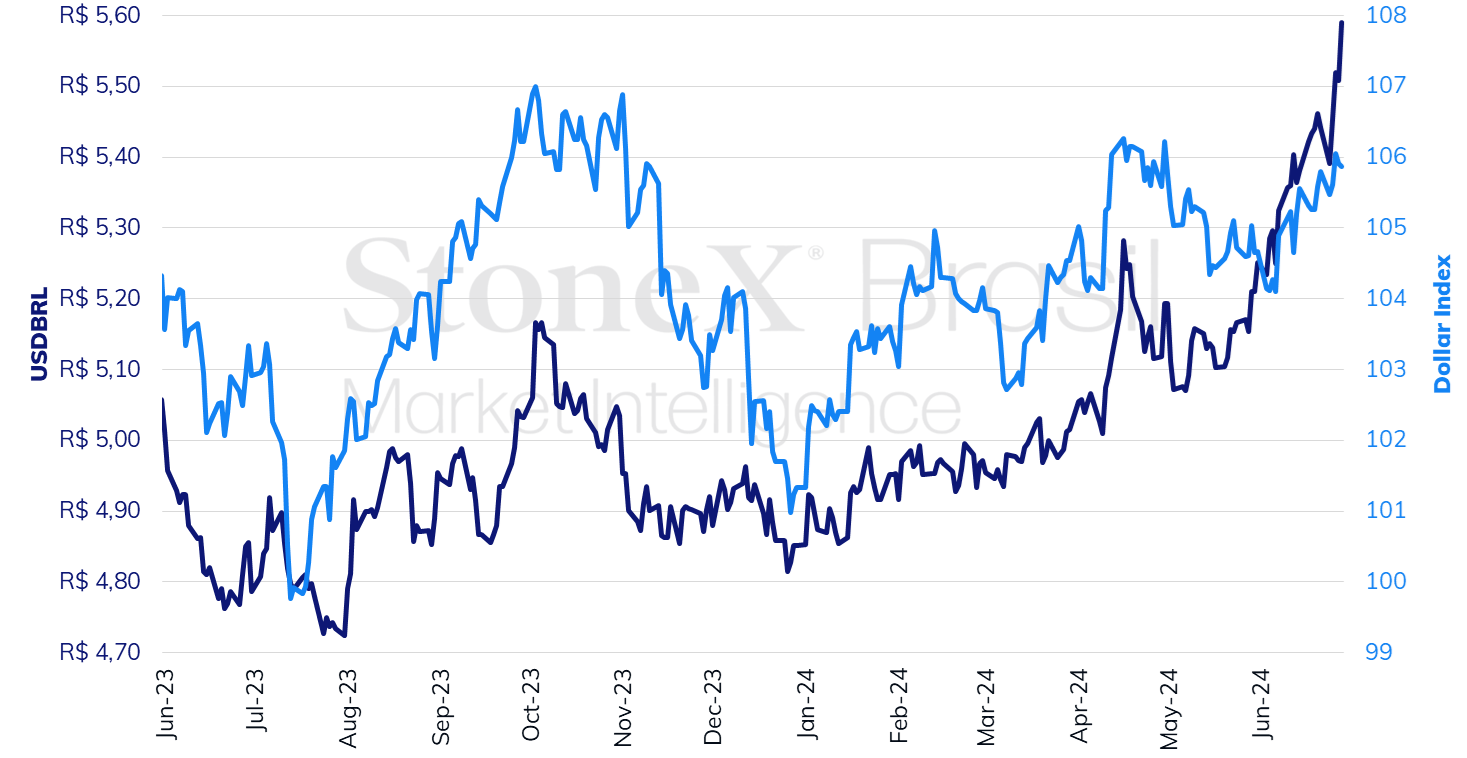
The week was marked, once again, by a sentiment of pessimism and distrust among investors regarding the management of Brazilian fiscal and monetary policies, penalizing the performance of national assets and leading the exchange rate to its highest value since January 11, 2022.
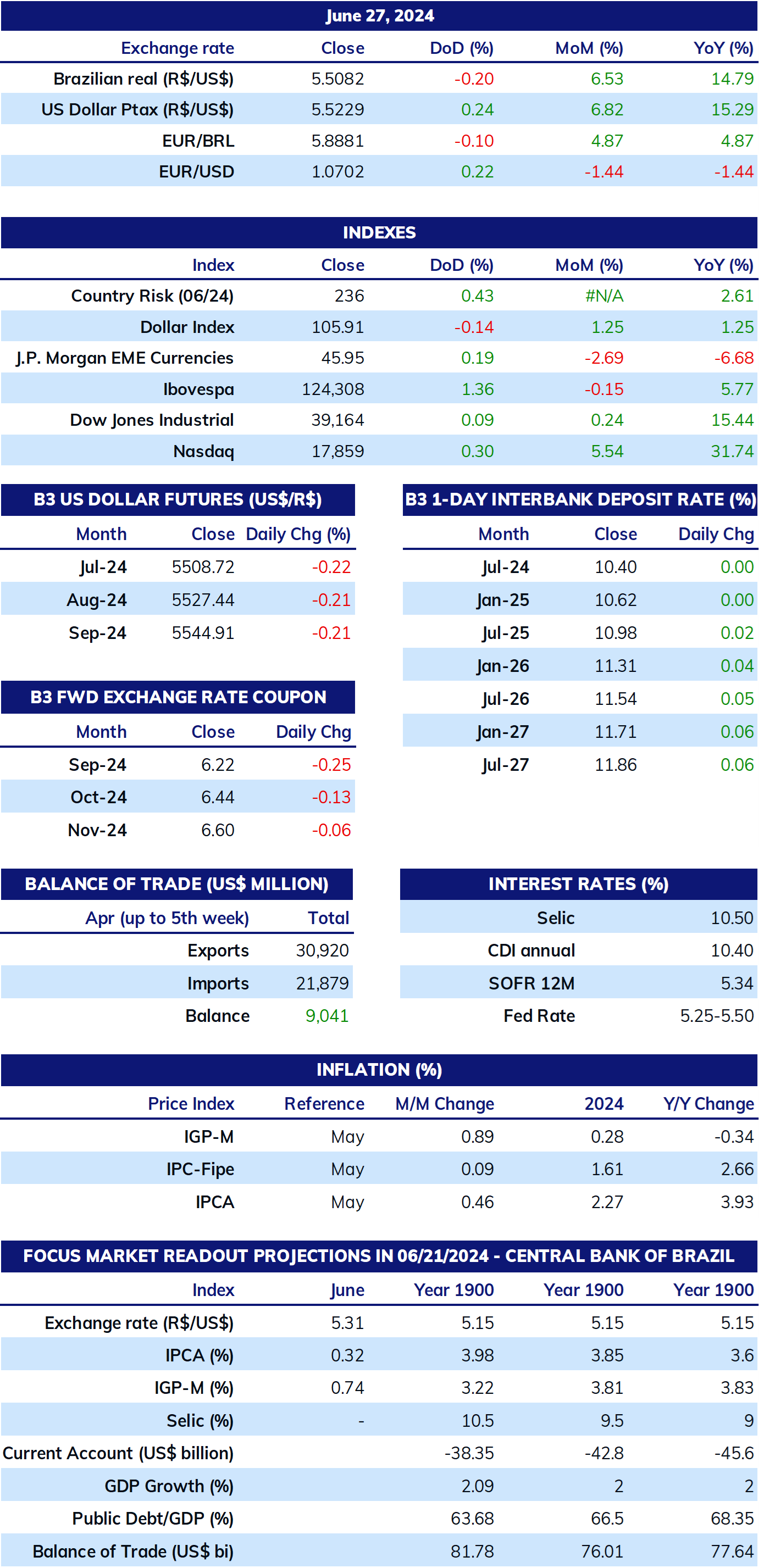
The USDBRL ended the week higher for the sixth consecutive week, closing Friday's session (28) at BRL 5.591, a weekly increase of 2.7%, a monthly increase of 6.5%, and an annual increase of 15.2%. The dollar index closed Friday's session at 105.9 points, a change of +0.1% for the week, +1.1% for the month, and +4.5% for the year.
USDBRL and Dollar Index (points)
Source: StoneX cmdtyView. Design: StoneX.
KEY EVENT: Widespread pessimism about Brazilian assets
Expected impact on USDBRL: bullish
The USDBRL accumulated depreciation of 6.5% in June (and 15.2% in the year) due to the increasing pessimism and skepticism of investors with the conduct of fiscal and monetary policies in Brazil, even though the fundamentals of the external accounts have not changed significantly in this period. Although there is a global trend of USD strengthening, the negative performance of the Brazilian currency in the last two months was more associated with domestic factors, particularly the rapid increase in the demand for risk premiums by investors, who continue to bet on the worsening of the country's macroeconomic evolution. Additionally, the Brazilian President, Luiz Inácio Lula da Silva, has repeatedly criticized both the monetary policy, the President of the Central Bank (BC), Roberto Campos Neto, and the financial market operators, as well as downplaying the need for adjustments in public spending, which, in turn, reinforces agents' concerns about the sustainability of public debt, the balance of the federal budget, and the autonomy of the Central Bank, reinforcing the worsening of expectations and the demand for risk premiums. The worsening of investors' expectations should be evidenced once again in the publication of the Focus bulletin this Monday (01), which is expected to worsen its projections for the main Brazilian macroeconomic variables. This trend should prevail as long as perceptions do not change, which seems unlikely without concrete measures presented by the Planalto for expense adjustments.
Economic activity and labor market data in the USA
Expected impact on USDBRL: bearish
The higher-than-expected reading for the US payroll in May, with a balance of 272 thousand new jobs, stood out from most economic indicators for the month, which generally pointed to a softer performance. Thus, analysts' estimates for job creation in June anticipate a softening compared to the previous month, with a range of projections between 150,000 and 240,000 and a median of 190,000. The impressive performance of the American labor market includes 41 consecutive months of increased employment and 30 consecutive months with an unemployment rate lower than or equal to 4.0%. This success raises concerns about potential inflation, especially in the services sector, due to rising income and personal consumption. Therefore, moderate growth is seen positively by investors as it increases hopes of price stabilization and raises expectations for interest rate cuts by the Federal Reserve, contributing to a weakening of the USD. In the same vein, the figures for the Purchasing Managers' Index (PMI) for industrial and services in June are expected to indicate a slight increase and contribute to an interpretation of the country's "soft landing."
FOMC Minutes
Expected impact on USDBRL: bullish
The minutes of the Federal Open Market Committee (FOMC) monetary policy decision at the Federal Reserve (Fed) should reinforce the institution's recent message, that is, that it will continue to rely on data-dependence to guide its decisions and that a higher degree of confidence in price stabilization is needed before starting a monetary easing process. The document should be relatively outdated to the most recent scenario, as it was only released three weeks after the decision, but it will be interesting to see if its members discussed the publication of the Consumer Price Index (CPI) for May, which took place on the morning of June 12, and if this affected in any way the macroeconomic projections of any of its members.
Elections in Europe
Expected impact on USDBRL: bullish
Although the global strengthening of the USD is indeed largely due to internal factors in the US, such as the prospect of higher interest rates for longer, this trend was reinforced last week by the poor performance of European assets under the stress of national elections in France (30) and the United Kingdom (04). This week, European assets are expected to remain volatile and fluctuate according to the outcome of these elections.

INDICATORS