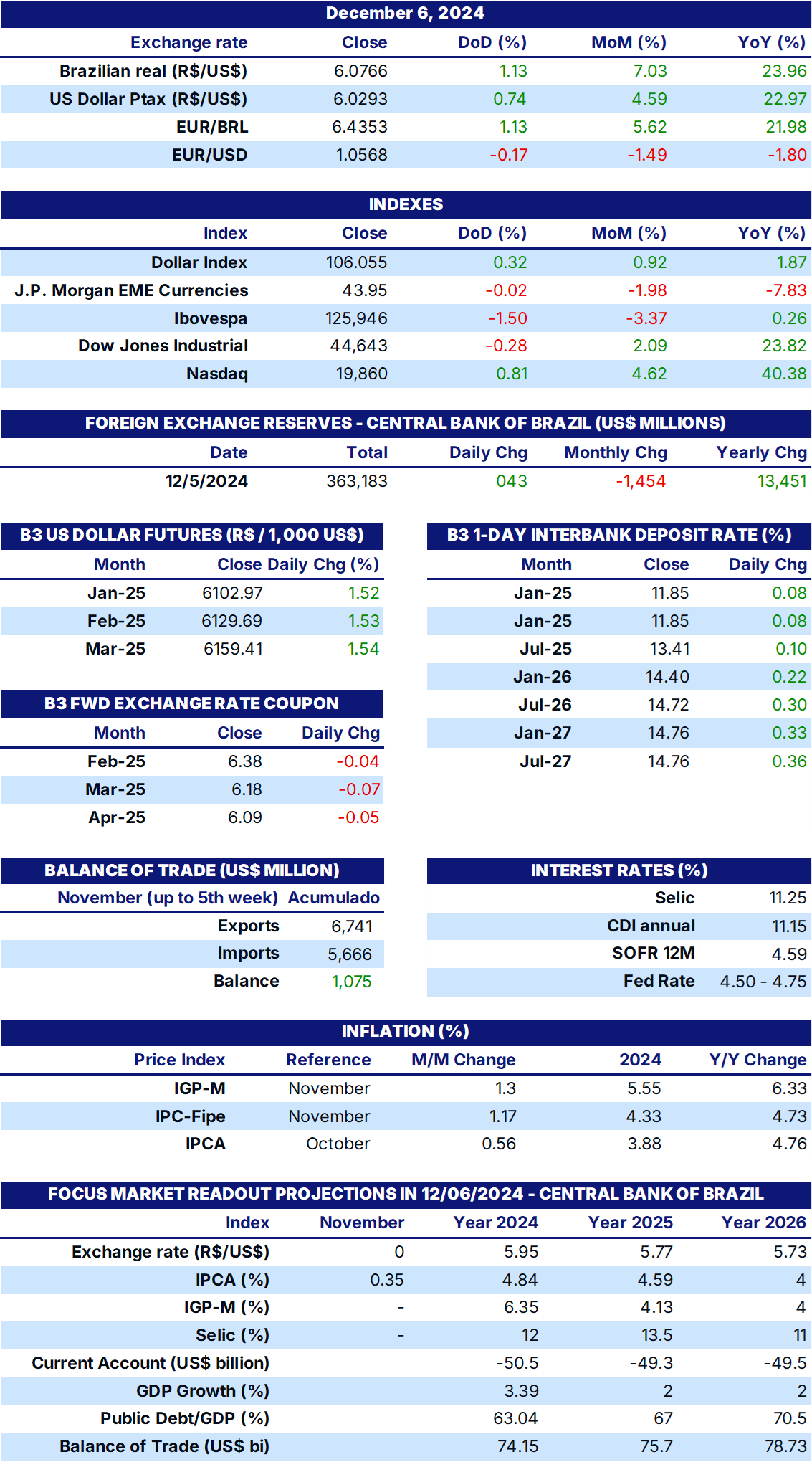
FX Weekly Overview: Key Events of the Week
- Bearish Factors
- The Copom is expected to accelerate its pace of increases to the benchmark interest rate (Selic), which should reinforce the outlook for higher interest rates for longer and attract foreign investment, strengthening the real.
- The new annual increase in the IPCA helps consolidate higher inflation expectations, which should reinforce the outlook for higher interest rates for longer and attract foreign investment, strengthening the real.
- Bullish Factors
- A new hotter reading for the US CPI is expected to reinforce the perception that the Federal Reserve will be cautious in its interest rate cut cycle, favoring the yield of dollar-denominated securities and contributing to the global strengthening of the currency.
The week in review
The week was marked by currency market volatility following the release of mixed economic data for the US, without altering perceptions that the Federal Reserve is likely to cut rates this month. In Brazil, investors followed news about the progress of the government's economic measures package in Congress.
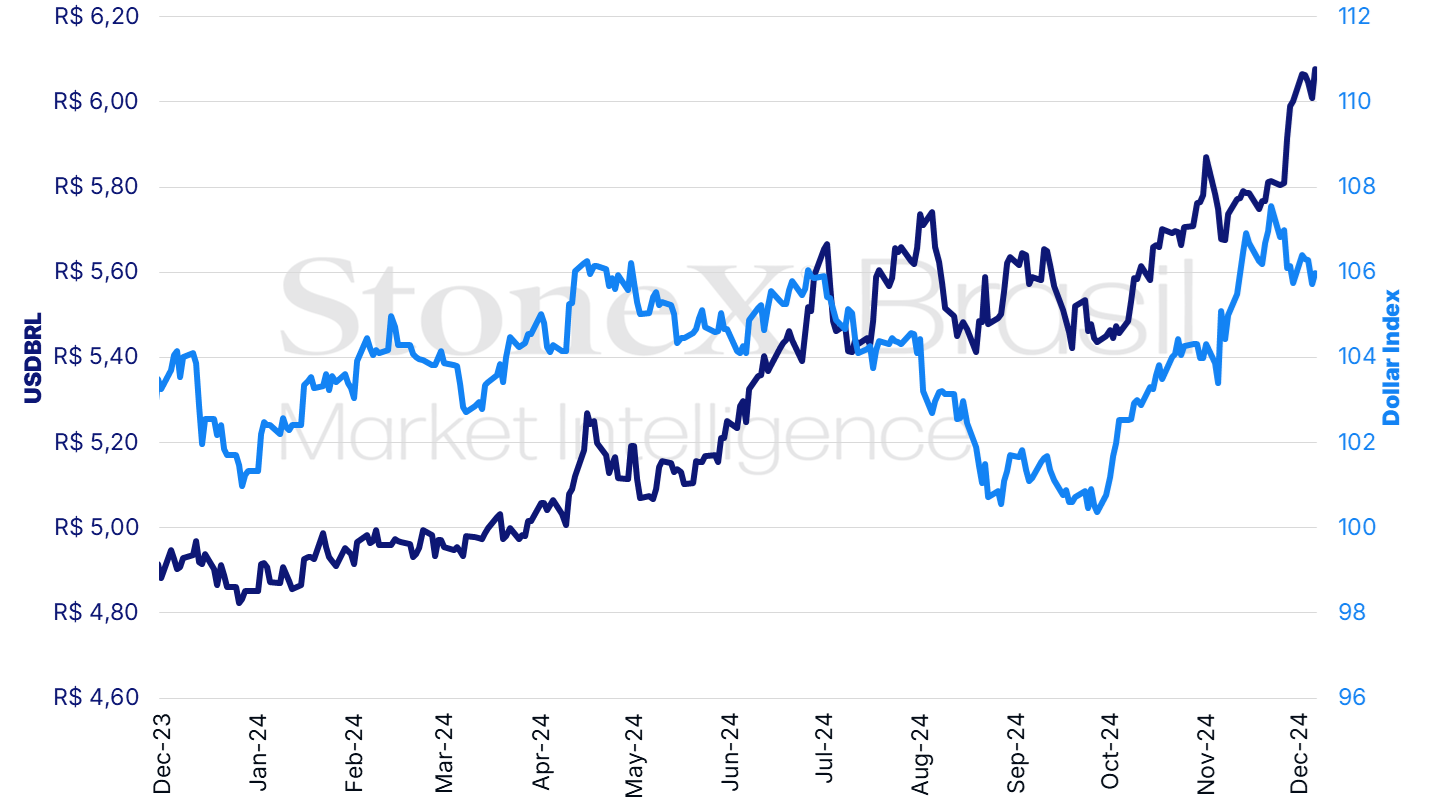
The USDBRL ended Friday's session (06) at BRL 6.077, a weekly gain of 1.26%, a monthly increase of 1.26%, and an annual rise of 25.5%. Meanwhile, the dollar index closed Friday's session at 106.0 points, varying +0.2% for the week, +0.2% for the month, and +4.6% for the year.
USDBRL and Dollar Index (points)
Source: StoneX cmdtyView. Preparation: StoneX.
THE MOST IMPORTANT: IPCA and Copom Monetary Policy Decision
Expected Impact on USDBRL: Bearish
The recent worsening of Brazilian assets, such as the exchange rate of the real and the rate of future interest contracts (DI), mainly reflects pessimistic expectations for the country's macroeconomic evolution rather than its recent performance, which has only slightly worsened compared to the beginning of the year. There is a serious credibility crisis regarding the management of Brazil's fiscal policy among investors, who anticipate greater stimulus from public spending to domestic demand, which consequently poses risks of accelerating inflation and worsening the country's debt trajectory.
This scenario makes it more challenging for the Central Bank's Monetary Policy Committee (Copom) to act, as it faces a more asymmetric inflationary risk balance with a greater upward bias than a few months ago. The continuous process of increasing long-term inflation expectations indicates to the Committee that a greater and more prolonged monetary tightening is necessary to ensure price stability in Brazil. In this sense, the release of the November Broad Consumer Price Index (IPCA) is expected to help consolidate higher inflation expectations, as the median projections point to a monthly increase of about 0.35%, but an annual acceleration to about 4.85%.
Furthermore, the performance of economic activity and the labor market continues to surpass estimates, increasing the chances of higher inflationary pressures due to heated demand. Additionally, the real's depreciation, which weakened by 10.1% between October and November and by 23.7% between January and November, may also pressure price levels by causing a rapid increase in the costs of imported goods and services. Finally, the external scenario also appears more challenging, with higher-than-anticipated US interest rates and the global strengthening of the dollar.
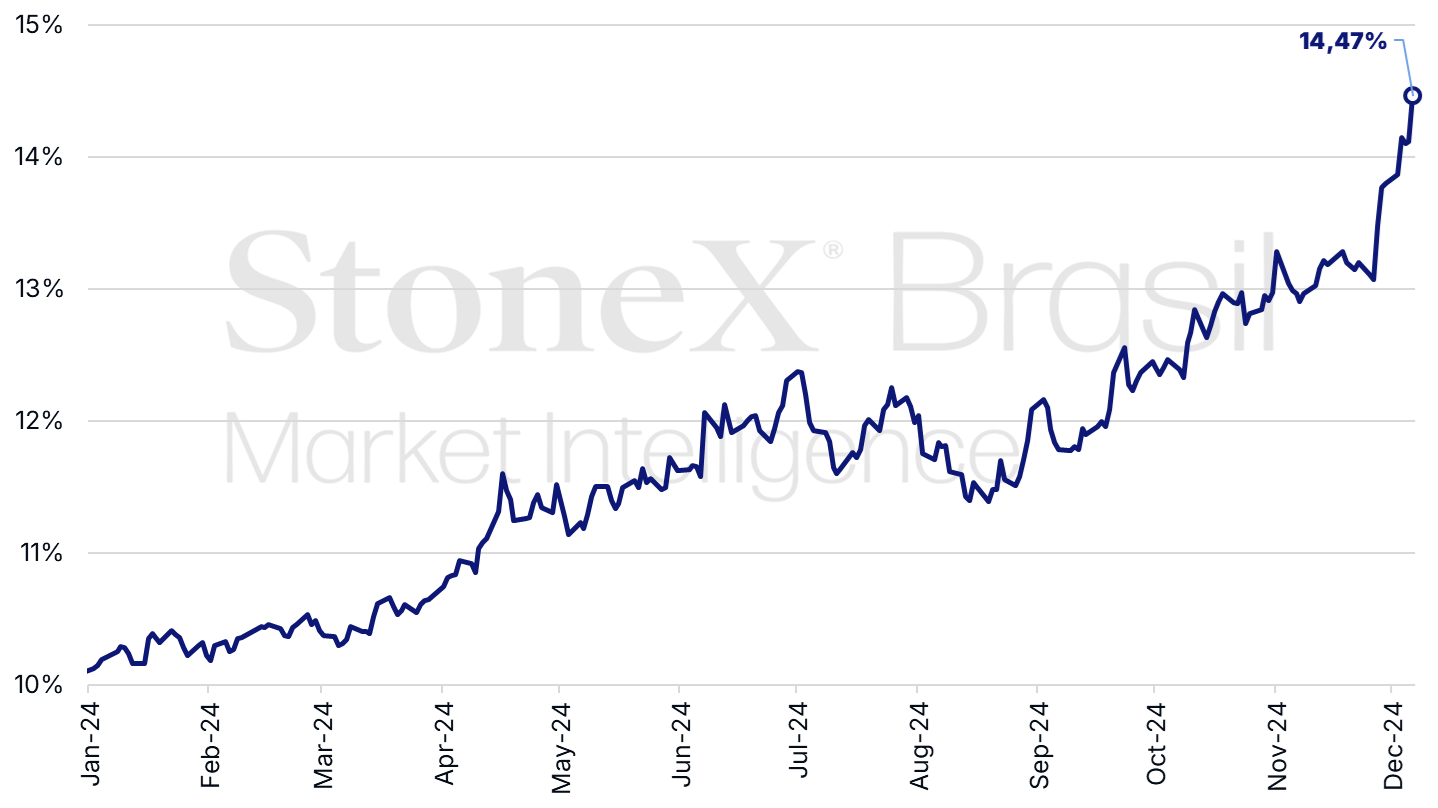
Most bets in the Copom's futures market and the median projections of the Focus bulletin anticipate that the Copom will increase the benchmark interest rate (Selic) from 11.25% p.a. to 12.00% p.a., with a significant portion betting on an even larger increase of 1.00 p.p. Regardless of the size of the hike, it seems certain that the Copom will promote a longer and larger rate hike cycle than previously imagined, and the statement tone is expected to be firm about the risks of prolonged worsening in exchange and interest rate expectations in the country. This perspective of stricter monetary tightening in the coming months may, in turn, favor the expected return on domestic bonds and attract foreign investment, strengthening the real.
Brazil: Interest Rate for January 2029 Interbank Deposit Contracts (DI) (% p.a.)
Source: Refinitiv. Preparation: StoneX.
US CPI
Expected Impact on USDBRL: Bullish
The Consumer Price Index (CPI) is expected to show another strong reading in November, with the median estimates pointing to a fourth consecutive 0.3% increase in its core, excluding the volatile food and energy components. This result would maintain the annual advance at 3.3% for the third consecutive month, suggesting that US inflation has stalled at a level far from the Federal Reserve's target of 2% annually. Thus, the CPI release is expected to reinforce the perception that inflation risks are higher than anticipated by the Fed when it began its rate-cutting cycle in September, and that a longer monetary tightening will likely be needed to ensure price stability in the country.
This scenario aligns with recent comments from members of the Federal Reserve's Federal Open Market Committee (FOMC), who have argued that there is no urgency for the FOMC to reduce rates, as the risks of an abrupt slowdown in economic activity have decreased and are more balanced relative to the risks of more persistent inflation in the US. Moreover, the most recent data for the US generally point to a more heated economy, reinforcing the perception that the Fed will be patient and gradual in its rate-cutting cycle. Most bets for the December 18 meeting still anticipate a 0.25 percentage point cut. However, given the expanding economy, above-target inflation, and uncertainty associated with the economic measures of Donald Trump's new government, the outlook for further cuts in 2025 remains uncertain.
Bets for the Federal Reserve's December 18 Rate Decision
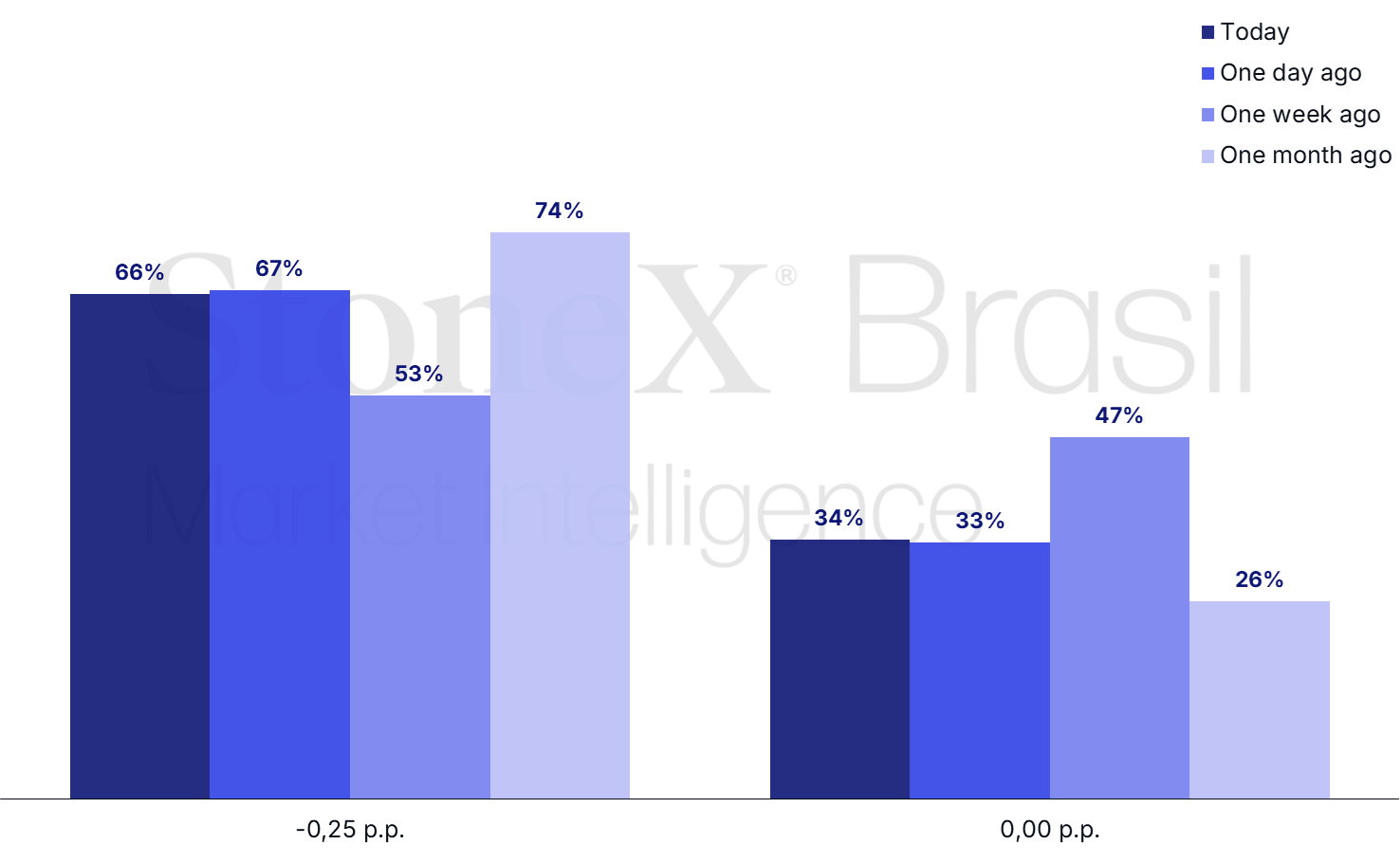
Source: CME FedWatch Tool. Preparation: StoneX. Probabilities in the futures interest market as of December 6, 2024.
Progress of the Economic Measures Package
Expected Impact on USDBRL: Undefined
In Brazil, investors are expected to continue monitoring developments related to the fiscal package announced by the federal government's economic team at the end of last month. After the approval of the urgency regime for two proposals of the package last week, the House of Representatives should define the responsible parties for reporting the texts. Despite advances in Congress aimed at accelerating the process, there is still a perception of risk regarding broader acceptance of the measures among parliamentarians. The urgency regime was approved by 260 votes in favor, just slightly above the 257 votes required, and the calendar limits the time available for significant advances to be made this year, considering that the parliamentary recess runs from December 23 to February 2.

INDICATORS