The most important: Federal Reserve's decision
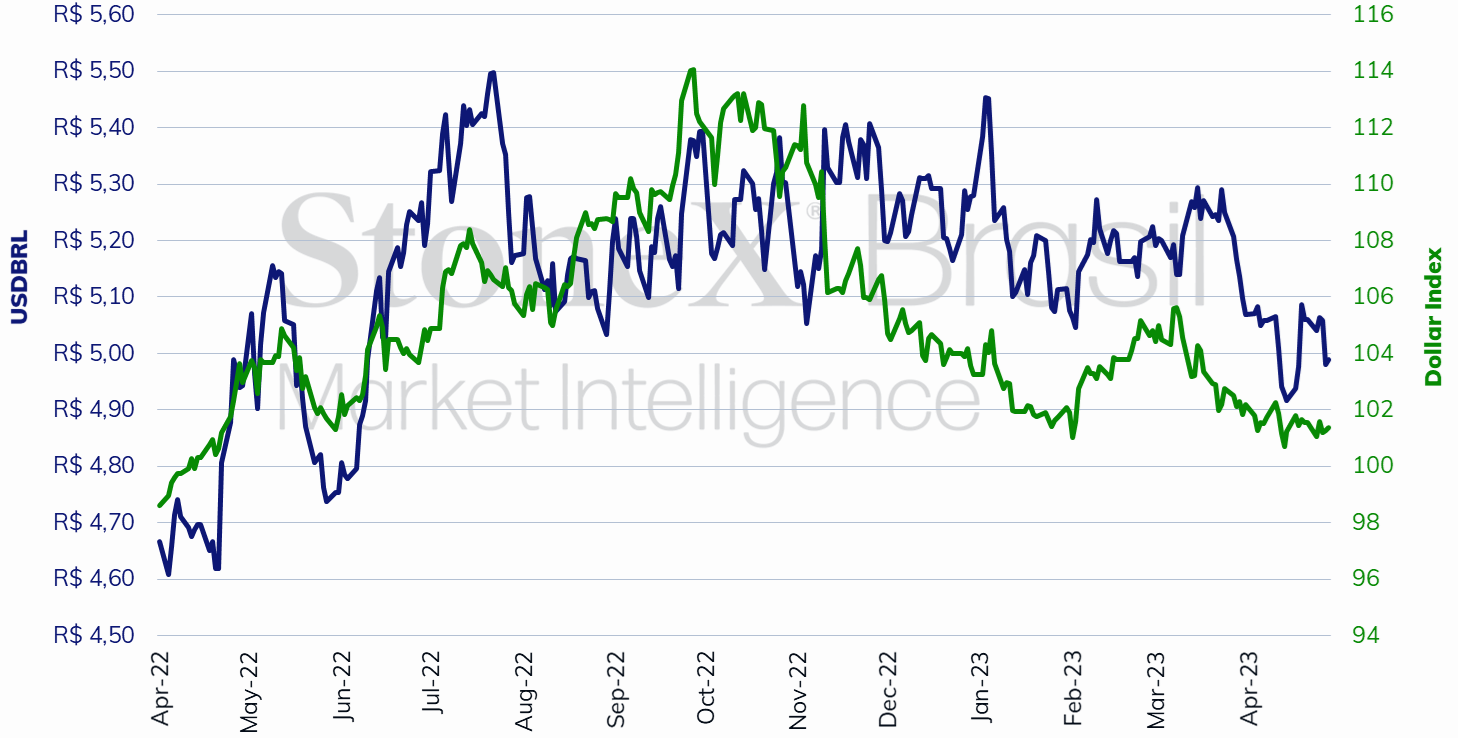
Expected impact on USDBRL: bullish
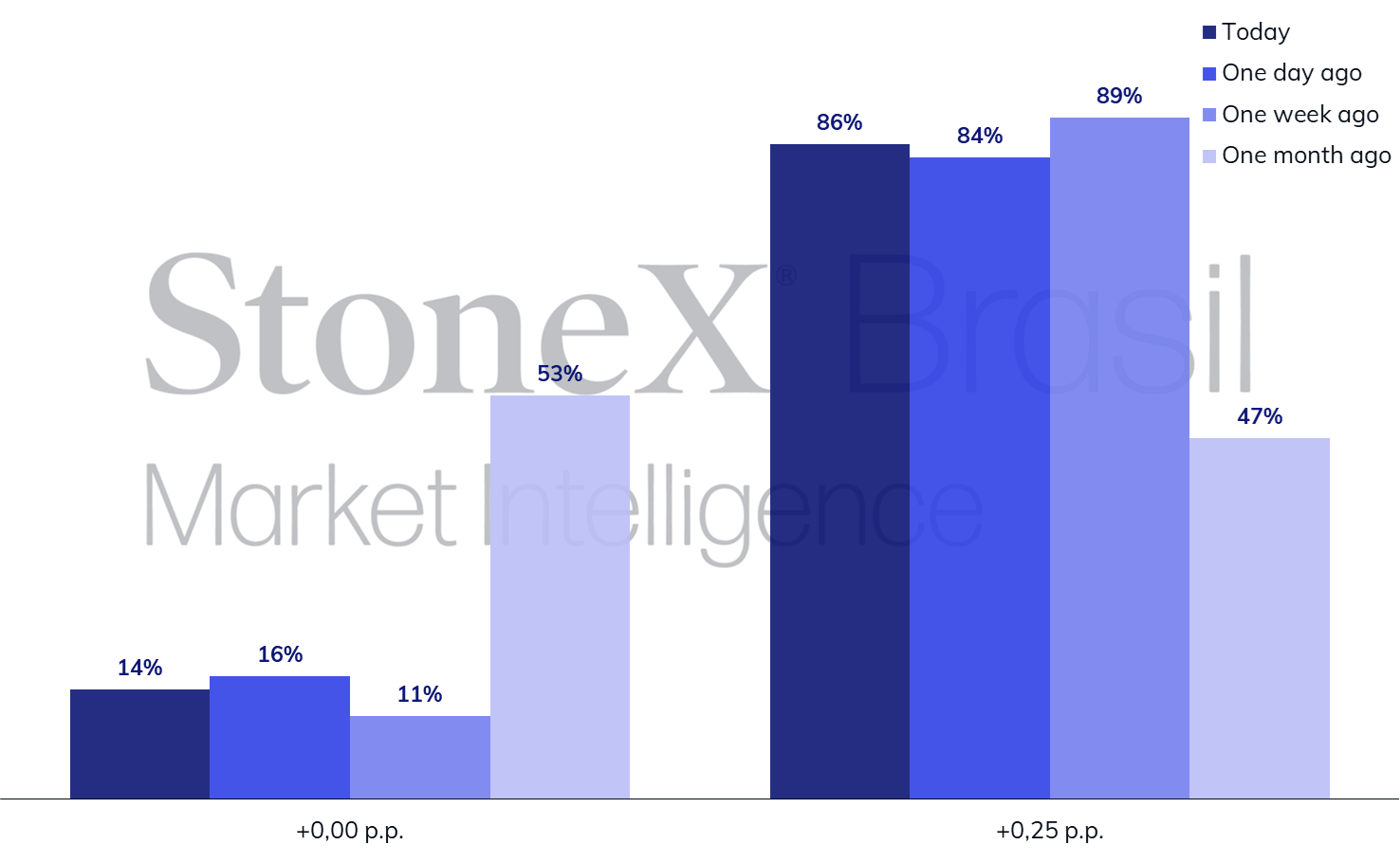
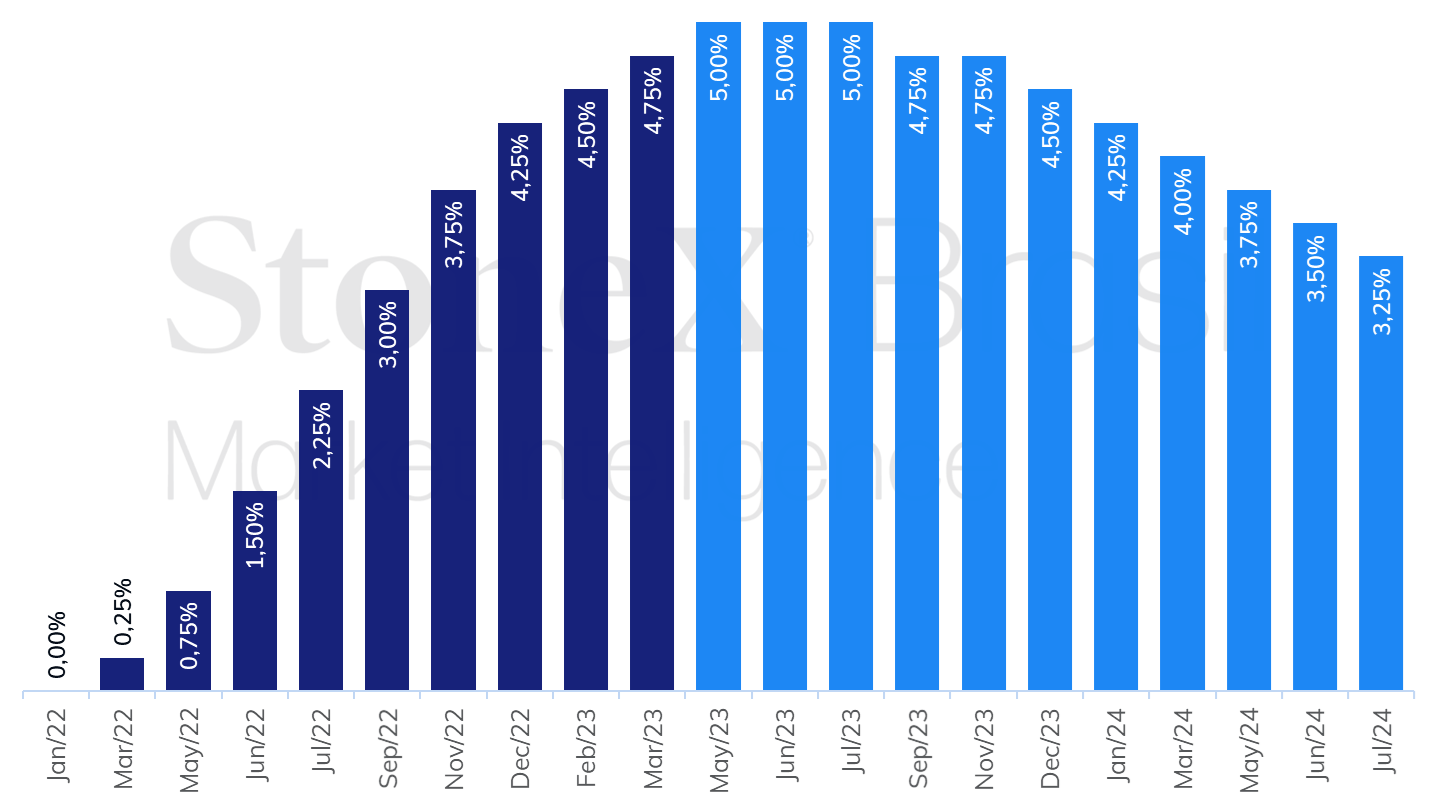
The investors' attention should be on the monetary policy decision of the Federal Open Market Committee (FOMC) on Wednesday (03), whose bets on the interest futures market point to a high probability of a 0.25 p.p. readjustment to the US key interest rate, raising it to the range between 5.25% and 5.50% p.a. There is greater doubt, however, about what the committee's stance will be in its decision, that is, whether the FOMC will adopt a more aggressive stance and indicate the need to persist in further interest rate increases to fight the acceleration of prices in the US or whether it will adopt a softer stance and open the possibility of interruption in interest rate readjustments from June. Nevertheless, most analysts believe the Fed will hold its last rate hike this week and will decide to end the cycle of hikes in the June 14 decision.
Bets on the Federal ReseMay's May 03 interest rate decision
Source: CME FedWatch Tool. Design: StoneX. Probabilities in the interest futures market as of April 28, 2023
US interest rate history and higher probability bets on the futures market
Source: CME FedWatch Tool. Design: StoneX. Probabilities in the interest futures market as of April 28, 2023
It is worth noting that there is a divergence between the official communication of the Federal Reserve and market bets. Before the quiet period for this week's meeting, most Fed officials were open to continuing interest rate adjustments in June, citing the need to ensure a consistent path of falling core inflation. In addition, in the decision of March 22, Fed Chairman Jerome Powell was quite explicit in mentioning that the members of the FOMC did not foresee any interest rate cuts in 2023, while bets on the future interest market believe in two reductions (September and December, respectively). On the other hand, the Fed members who defend the interest rate pause in June mention that monetary tightening has a delayed effect on macroeconomic variables and that it would be prudent to observe the reaction of productive activity, the labor market and prices to the rapid rise in US interest rates rather than maintaining the current upward trajectory. To help understand future decisions, two key questions will be noted by investors in the FOMC statement and Powell's press conference: firstly, what is the size of the inflationary challenge that remains to be faced; and secondly, what is the expected economic slowdown from a possible reduction in the volume of credit for consumption and investment due to the financial turbulence of March.
US economic data
Expected impact on USDBRL: bearish
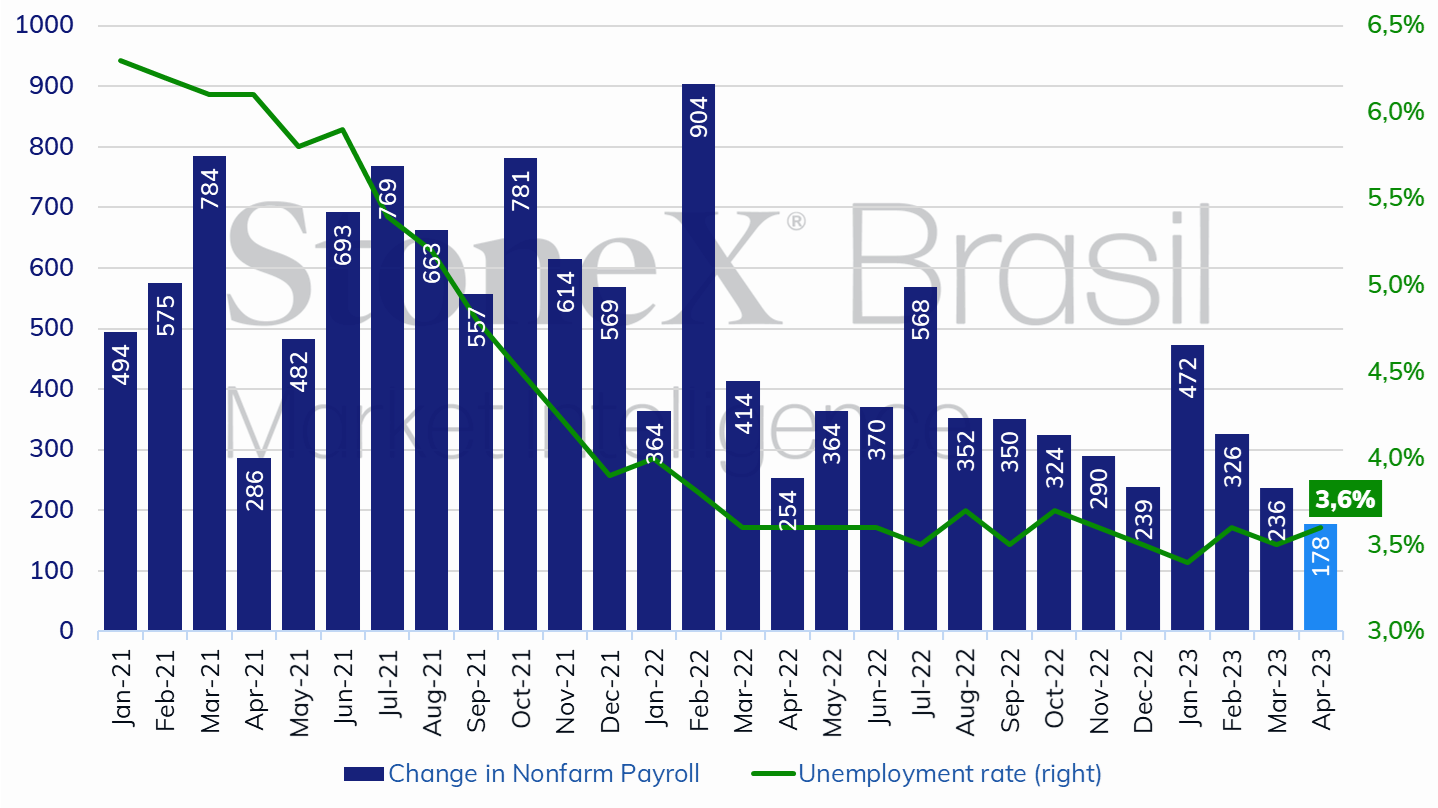
In addition to the FOMC decision, the week brings important indicators on economic activity and the labor market in the United States. The ISM Institute releases the April Purchasing Managers' Indices (PMI) for manufacturing on Monday (01) and for services on Wednesday (03), with a negative bias after regional indicators of economic activity during April suggested mostly a weakness in the productive sector. The median of expectations points to a reading of 46.8 points for the industrial PMI, indicating a contraction (below 50 points), and 51.7 points for the services PMI, consistent with the interpretation that services activity can sustain its level of activity and, probably, should maintain pressure on the price level of the segment. In addition, the Employment Situation Report for April is expected to moderate the creation of new jobs throughout the month, with a balance of 178 thousand new vacancies. Still, it would be the 28th consecutive month of net job expansion in the United States, suggesting that the labor market remains firm and that wage gains, too, should keep pressure on accelerating prices in the country, particularly on service segments highly correlated with personal consumption expenditures.
Change in total urban jobs in the United States (in thousand people) and unemployment rate (%)
Source: Federal Reserve Bank of St. Louis. Design: StoneX.
US debt default risk
Expected impact on USDBRL: bullish
Another point of attention that has provoked caution and risk aversion in global asset markets is the need to extend the public debt limit in the United States and the possibility of an unprecedented default on US Treasury bonds. The debt limit law established in 1917 establishes the maximum debit the US Treasury Department can issue to pay its expenses. Since 1960, Congress has authorized raising or temporarily suspending the debt limit on 80 occasions. The last debt limit increase came in December 2021, extending the US borrowing limit until January 2023. In testimony to the country's parliament, Treasury Secretary Janet Yellen warned US members of Congress that the US risks defaulting for the first time unless the debt limit is raised or suspended by mid-June.
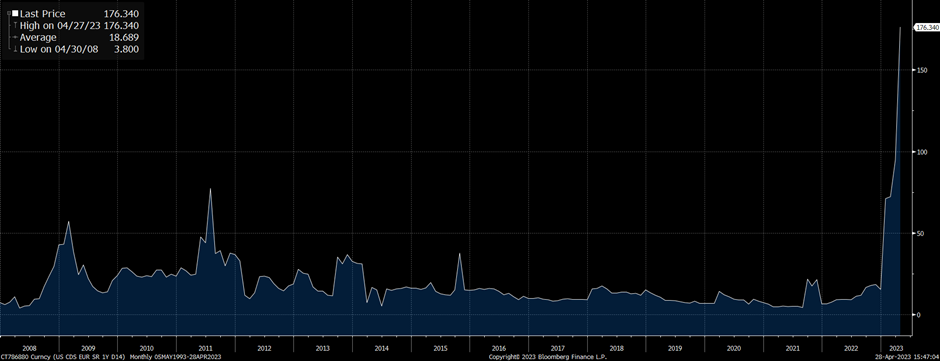
After the November legislative elections, the Democrats, the party of President Joe Biden, managed to maintain their majority in the Senate but lost control of the House to the Republicans. In a context of deepening political polarization in the country, both parties are in an impasse, as Republicans are seeking to extract political concessions from Democrats by conditioning strategic programs on the president's agenda to be abandoned for the House to approve the new public debt limit – something that Democrats consider unacceptable. Accordingly, the spread of Credit Default Swap (CDS) contracts for US Treasury bonds – in theory, among the safest in the world – are at their highest historical value; that is, they reveal that those who agree to insure such securities are demanding high premiums due to the increasing probability of a non-receipt. Last Friday (28), a payment of 1.76% of the value of the security was required each year as a premium for the CDS.
Economists on all theoretical fronts agree that a default on the country's sovereign debt would produce severe financial turmoil in virtually all global asset markets. However, neither side seems willing to resolve the impasse. And, as Fitch noted well in a warning to investors, small short-term extensions will only reproduce new impasses soon. This limitation is unique to the American reality, which needs a new fiscal and financial regime to avoid these sources of tension for financial markets.
Spread of 1-year US Credit Default Swap (CDS) contracts (basis points):
Copom decision
Expected impact on USDBRL: bearish
Despite the high volume of criticism by the executive and parliamentarians of the government base, it is practically a consensus among analysts that the Central Bank of Brazil's Monetary Policy Committee (Copom) will keep the basic interest rate (Selic) unchanged on Wednesday (03), at 13.75% a. a. Participating in two sessions to discuss monetary policy in the Federal Senate last week, the Central Bank of Brazil's president Roberto Campos Neto practically justified the need to sustain monetary tightening for a longer period by outlining for congressmen an analysis of inflation projections (especially of inflationary cores, which exclude the volatile components of food and energy), a perspective of the degree of idleness of the economy ("output gap") of inflation expectations of financial institutions, the financial market and the Central Bank itself and carried out a balance of risks between inflation, economic activity and inflation, labor market and financial stability. Therefore, investors will focus on signals of when a possible interest rate cut cycle could begin or what conditions need to be met for the start of interest rate reduction in the country.
European Central Bank Decision
Expected impact on USDBRL: bullish
In the eurozone, on Thursday (04), there will be a great debate on whether the European Central Bank (ECB) will readjust its key interest rate by 0.25 p.p. or by 0.50 p.p., with an explicit division among its members depending on inflationary resilience and clearer signs of weakening productive activity. However, although there are doubts about the pace of readjustments, there is still a consensus that the ECB needs to extend its interest rate hike cycle for another period as it started its monetary tightening late compared to its peers, which should favor the strengthening of the euro against the dollar in the coming months.