FX Overview: Key Events of the Week
- Bearish Factors
- Skepticism about the possibility of improving US-China trade relations is expected to keep concerns high about a slowdown in the US economy and contribute to a global weakening of the dollar.
- Bullish Factors
- Fears of a prolonged military conflict between Israel and Iran may increase global risk aversion and stimulate demand for “safe-haven” assets, which tends to harm the real.
- Expectations of a cautious stance by the Federal Reserve in its monetary policy decision tend to reduce bets on rate cuts this year, favoring the attraction of financial investments and strengthening the dollar.
- The possibility of ending the cycle of rate hikes for Brazil's benchmark interest rate (Selic) may hinder the attraction of foreign investments into the country and contribute to a weakening of the real.
- Resistance by Congress to measures that would reduce the recent increase in the Financial Operations Tax (IOF) could worsen the perception of fiscal risks of Brazilian assets and contribute to a weakening of the real.
The week in review
Highlights of the week included the preliminary agreement between the United States and China to reduce export controls, Israel's direct strike on Iran's military and nuclear infrastructure, inflation in the US coming in milder than expected, and the deadlock between the Brazilian government and Congress over alternative measures to the IOF increase.
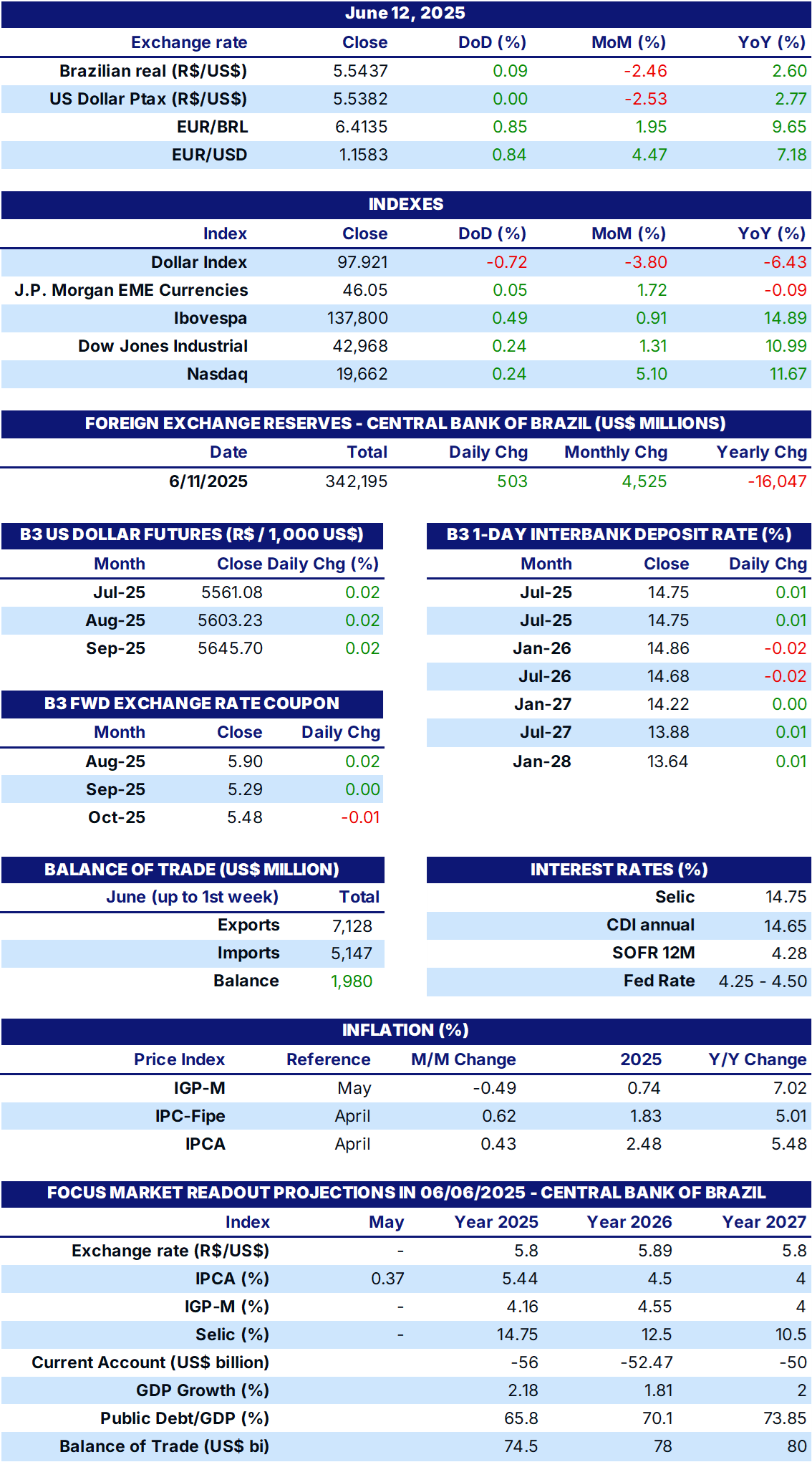
The USDBRL closed this Friday (13) at R$ 5.5413, a weekly decline of 0.5%, monthly decline of 3.1% and annual decline of 10.3%. Meanwhile, the Dollar Index (DXY) closed the week at 98.2 points, a variation of -1.0% for the week, -1.2% for the month and -9.2% for the year.
USDBRL and Dollar Index (points)
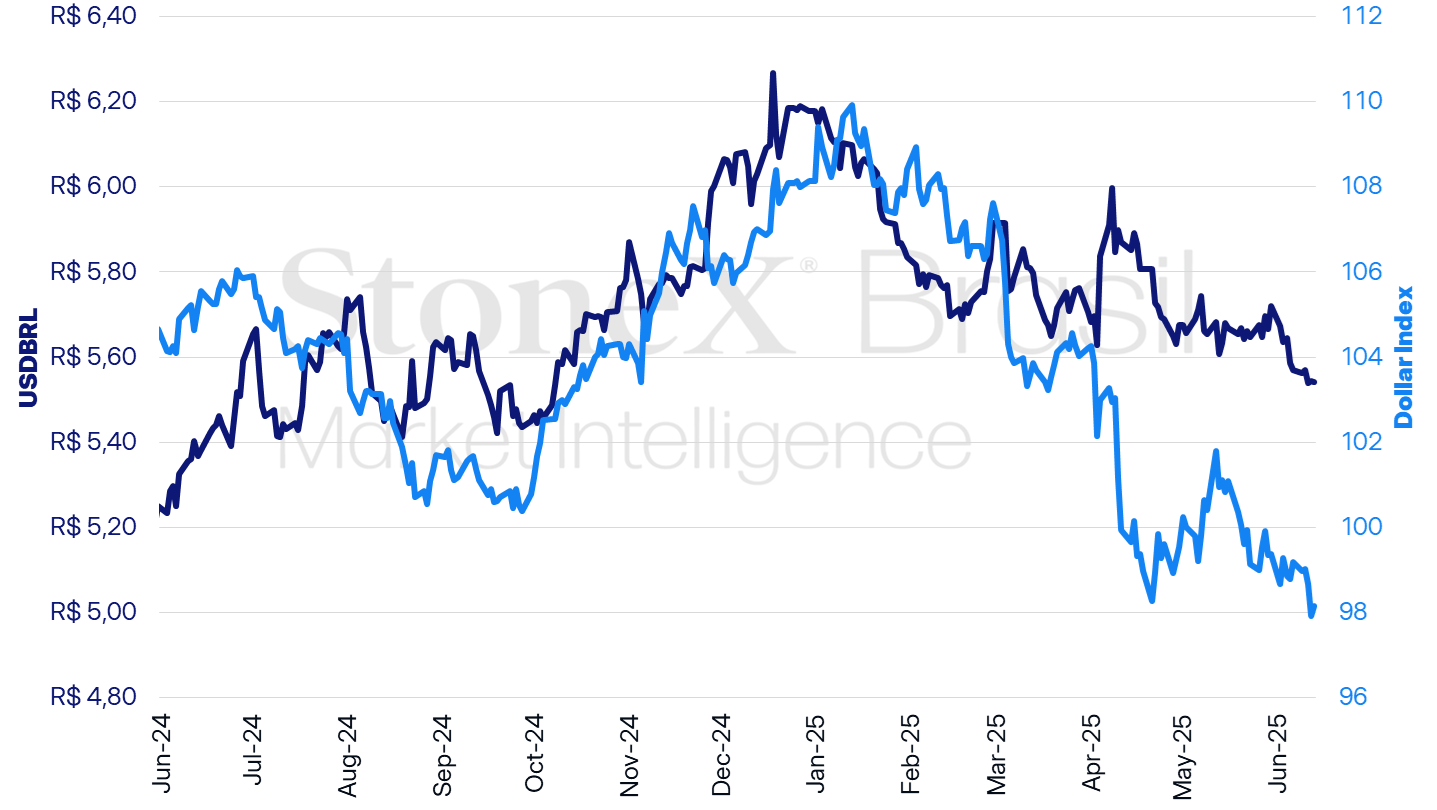
Source: StoneX cmdtyView. Compiled by: StoneX.
KEY EVENT: Fears of conflict between Israel and Iran
Expected impact on USDBRL: bullish
Amid an environment of elevated geopolitical tensions in the Middle East and concerns that Iran might develop a nuclear bomb, Israel launched a large-scale surprise attack in the early hours of Friday, June 13, bombing military and nuclear installations and assassinating the country's military leaders and scientists. On Friday morning, reports indicated that 20 of the country's military officials had been killed, including the Chief of Staff of the Iranian Armed Forces, General Mohammad Bagheri, and the commander of Iran's special forces, the Islamic Revolutionary Guard Corps, General Hossein Salami. It is now highly likely that Tehran will seek to retaliate in kind, possibly by launching ballistic missiles.
Unfortunately, initial signals following the attacks point to the possibility of a prolonged conflict. Israeli Prime Minister Benjamin Netanyahu stated that “this operation will take as long as necessary,” Iranian Foreign Minister Abbas Araghchi said that the Israeli attack is “a declaration of war,” and US President Donald Trump stated that “[the situation] will only get worse,” that “the next planned attack will be even more brutal,” and that “Iran needs to make a [nuclear] deal before nothing is left.”
The attack heightened fears of a prolonged, large-scale conflict between Israel and Iran, as well as concerns that the global oil supply could be reduced due to retaliation by Middle Eastern countries, attacks on the region’s oil infrastructure and/or blockades of strategic logistical routes. This scenario tends to increase the perception of geopolitical risks and drive demand for assets considered “safe havens” in times of stress and unpredictability, such as the Swiss franc, the Japanese yen, the euro and the US dollar, harming the performance of the real.
Unpredictability of U.S. Trade Policy
Expected impact on USDBRL: bearish
Last week, US and Chinese authorities agreed on a basic framework to implement the “Geneva Consensus” and remove export controls between the two countries; however, the financial markets’ reaction was quite muted. The statements from both countries did not provide many details, did not indicate any discussion on import tariff rates, and suggested that the central point of the discussions was export controls applied by both the US and China. In particular, Washington demanded that China allow more exports of rare earth minerals in exchange for lifting recent restrictions on American exports, such as advanced chips, chip design software, jet engine parts, chemicals and nuclear materials. These delegations took the negotiated proposal back to their respective leaders for ratification before implementation.
The apparent lack of substantive progress toward a broader US-China trade agreement has generated skepticism among investors about the possibility of a formal deal between the countries. Trade agreements usually take years to formalize, as they cover a vast range of products and many points of interest for the nations. Even during the 90-day “truce” until August 12, import tariffs applied by both sides remain substantially higher than last year's levels, keeping concerns high about a slowdown in both economies. Moreover, investors were worried about new threats from President Trump last Wednesday (11) to unilaterally increase import tariffs on most US trading partners “in two to three weeks,” a threat he had already made but did not carry out on May 16. Therefore, it is highly likely that uncertainty and unpredictability surrounding the evolution of US import tariffs will continue to drive down the weight of US assets in investors’ portfolios, which tends to weaken the dollar globally and, indirectly, favor the performance of the real.
FOMC Interest Rate Decision
Expected impact on USDBRL: bullish
There is broad consensus that the Federal Open Market Committee (FOMC) of the Federal Reserve (Fed) will keep its key interest rate unchanged, currently in the range of 4.25% to 4.50% per annum. The Committee is also expected to emphasize a cautious and patient stance in its statement, in line with recent comments from Fed officials adopting a “wait-and-see” approach. This prudent stance stems from two main factors. The first relates to the uncertain and unpredictable economic policy direction of President Donald Trump, particularly regarding trade measures whose contours are not yet fully defined. The second factor concerns the most recent economic data, which have not yet shown clear impacts from the protectionist measures adopted. Despite initial expectations that such measures could intensify inflationary pressures and slow economic activity, the indicators released so far have not confirmed this scenario. In fact, the latest inflation data released this week surprised to the downside, pointing to inflation below expectations for May. In this context, the FOMC is likely to argue that it needs more time to assess the evolution of macroeconomic variables and better understand the possible effects of the measures proposed by the federal government.
In this scenario, the Summary Economic Projections—which accompany the FOMC decision—gain importance. These projections present the Committee’s estimates for economic growth, unemployment, inflation and interest rates from 2025 to 2027, with special emphasis on the “dot plot,” which shows individual members’ expectations for the future path of interest rates. In the last projection, released in March, the document indicated an expectation of two rate cuts still in 2025, a perspective that, given the uncertainties, tends to be maintained. Thus, by signaling a cautious stance by the Federal Reserve, the FOMC decision may reduce investors’ bets on US rate cuts, which tends to support the dollar globally.
COPOM Interest Rate Decision
Expected impact on USDBRL: bullish
In Brazil, investors remain divided on what the next move by the Monetary Policy Committee (Copom) of the Central Bank (BC) will be at the meeting on Wednesday (18). On one hand, some bets indicate that the Committee will raise the benchmark Selic rate again, from 14.75% to 15.00% per annum, extending the cycle of rate hikes that began in September 2024. These investors believe the BC should align with the firmer stance it has adopted in recent months, especially given inflation rates persistently above the target and resilient data for domestic economic activity. On the other hand, some investors believe the BC may opt to keep the Selic unchanged at 14.75% per annum. This view was strengthened after the release this week of the Extended National Consumer Price Index (IPCA) for May, which showed a smaller-than-expected increase for the index that month. Despite remaining significantly above the BC’s target, the greater moderation of the index raised doubts about the continuation of monetary tightening by the BC. In this sense, maintaining rates unchanged or including in the statement that the hike cycle may have ended could harm the outlook for domestic bond yields and hinder the attraction of foreign capital, weakening the real.
Fiscal Package in Brazil
Expected impact on USDBRL: bullish
Investors will monitor strong resistance from Brazilian lawmakers to the Provisional Measure published by the federal government to partially reduce the IOF increase by raising taxation on online betting houses, fintechs, financial investments and Interest on Equity, as well as to linearly cut tax benefits by 10%. Although the government had agreed with party leaders on which actions would be taken, tensions with Congress escalated during the week, and the President of the Chamber of Deputies, Hugo Motta, scheduled the urgency request for Legislative Decree Project (PDL) 314/25 for Monday (16), which would annul the effects of this provisional measure. If lawmakers indeed nullify the government’s proposals, it is likely that the perception of fiscal risks among investors will rise, which tends to weaken the real against the dollar.

ECONOMIC INDICATORS TABLE