Dollar expected to reflect Fed interest rate decision, US negotiations with Brazil and China, government shutdown, and end-of-month Ptax rate
- Bullish
- End-of-month Ptax rate formation and increased intraday exchange rate volatility on Friday (31).
- Bearish
- Potential meeting between Lula and Trump with expectations for reduced commercial and diplomatic tensions between Brazil and the US.
- New round of trade negotiations between the US and China, with prospects of reduced trade barriers between the two nations.
- Expected interest rate cut by the Federal Reserve during the meeting on Wednesday (29).
- Continued US government shutdown and increased risk perception regarding US assets.
The week in review
- Ongoing trade uncertainties between the US and China maintained caution among investors.
- US sanctions on Russian oil companies boosted commodity prices, shares of energy firms, and the currencies of oil-exporting countries, including the Brazilian real.
- US consumer inflation for September increased less than expected, reinforcing expectations for an interest rate cut by the Federal Reserve next week.
- Anticipation of the meeting between Donald Trump and Luiz Inácio Lula da Silva, scheduled for this Sunday, kept investors in a wait-and-see mode.
USDBRL and dollar index (points)
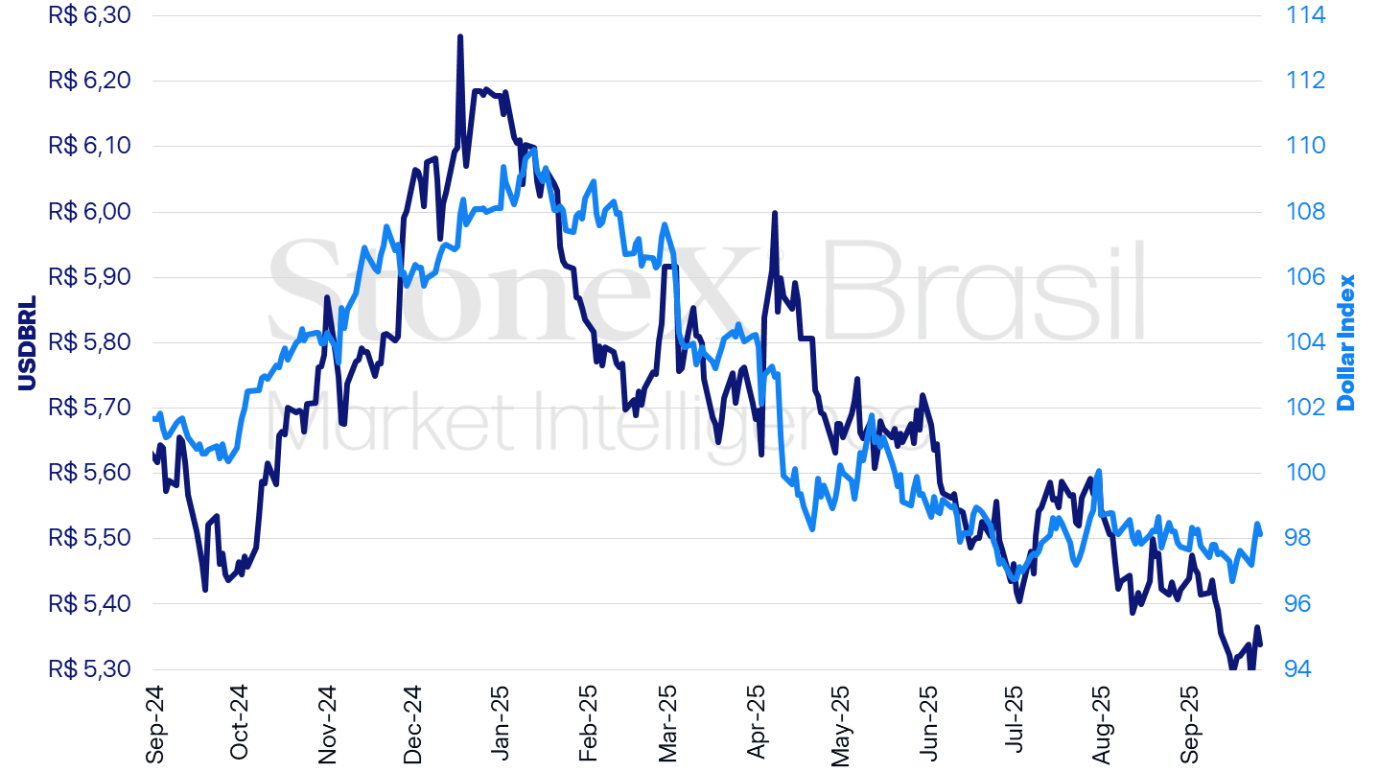
Source: StoneX cmdtyView. Design: StoneX.
Commercial Dollar Variations | Daily: +0.13% | Weekly: -0.24% | Monthly: +1.32% | Year-to-Date: -12.70% | Last 12 Months: -5.28% |
Dollar Index Variations | Daily: +0.00% | Weekly: +0.52% | Monthly: +1.18% | Year-to-Date: -8.50% | Last 12 Months: -5.26% |
Key Event: Lula-Trump Talks
Expected Impact on USDBRL: Bearish
There is significant anticipation surrounding the potential meeting between the presidents of Brazil and the United States, expected to take place on Sunday (26) during an international event held in Malaysia.
Why this matters: Although it is too early to predict the outcome of the discussion, the prospect of the meeting heightens expectations for reduced trade and diplomatic tensions between the two nations.
- This, in turn, could reduce the perception of risk related to Brazilian assets and bolster the performance of the BRL.
Overview: If the meeting takes place, it would mark the first formal bilateral meeting between the two heads of state since the US imposed a 50% tariff on Brazilian goods in August, following a brief encounter at the UN General Assembly in September in New York.
- Since then, diplomats from both countries have worked on rebuilding communication channels, suggesting mutual willingness for a gradual rapprochement.
- The US may aim to advance agreements granting access to strategic minerals like lithium, niobium, and rare earths, a topic gaining significance due to restrictions imposed by China, which processes about 90% of the global supply of these minerals.
- Conversely, Brazil is likely to push for tariff reductions or eliminations on certain imports to the US and discuss lifting sanctions imposed on Brazilian officials.
- In a statement on Friday, the Brazilian president expressed optimism about the potential progress of the dialogue but emphasized that the negotiation process would be gradual, stating that the agreement “will not be made tomorrow or the day after, but by negotiators who will sit down with the US government to advance discussions.”
Meeting Between Chinese and US Officials
Expected Impact on USDBRL: Bearish
Reports indicate that Chinese and US officials will hold a new round of trade negotiations in Malaysia this weekend, aiming to restore diplomatic dialogue and reduce bilateral tensions between the two countries.
- The delegations will be led by US Treasury Secretary Scott Bessent, US Trade Representative Jamieson Greer, and Chinese Vice Premier He Lifeng.
- The talks are expected to pave the way for a highly anticipated meeting between the leaders of the two nations, Trump and Xi Jinping, scheduled for next Thursday in South Korea.
Why this matters: The prospect of easing tensions between the two countries generates optimism about reducing trade barriers between the world’s two largest economies, potentially preventing a deeper slowdown in their growth.
- This scenario could reverse global risk aversion among investors, benefiting the performance of risk assets such as the Brazilian real.
Overview: In May, the two countries reached a temporary truce after weeks of intense trade conflict, which was extended and remains in place until November 10.
- However, tensions have escalated in recent weeks due to the adoption of new restrictive measures by both sides, reversing the relatively stable scenario.
- Earlier this month, China announced new restrictions on rare earth exports, citing the decision as a response to increased US controls on technology exports.
- In response, President Trump expressed his intention to impose additional 100% tariffs on Chinese goods and expand controls on software exports, even threatening to cancel his meeting with Xi Jinping.
- Given this backdrop, the US president’s inconsistent rhetoric, alternating between signs of skepticism and optimism about a potential agreement, has contributed to heightened volatility in global financial markets.
US Interest Rate Decision
Expected Impact on USDBRL: Bearish
US: historical and wxpected interest rate decision – updated October 17, 2025
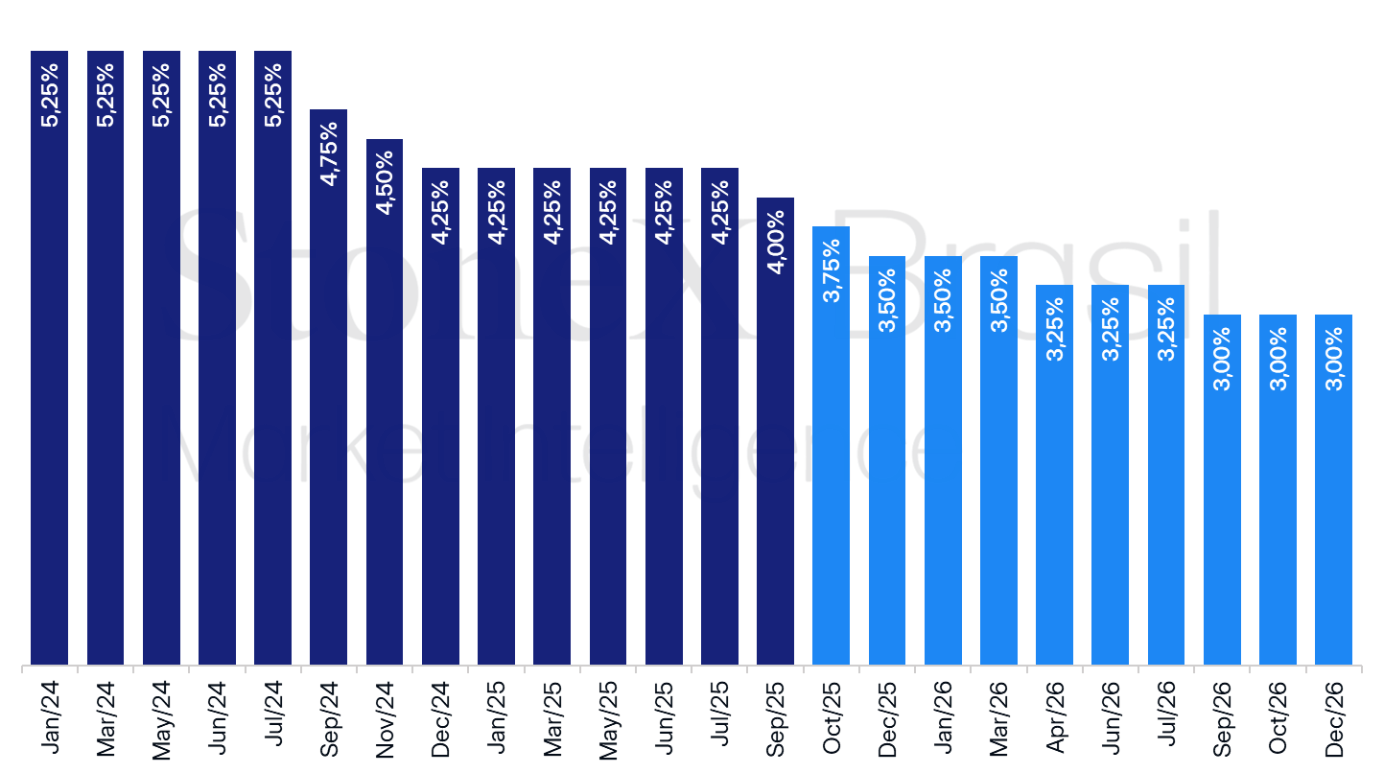
Source: CME FedWatch Tool. Design: StoneX. Refers to the highest-probability market forecast for the indicated date.
There is broad consensus that the Fed's Federal Open Market Committee (FOMC) will lower its interest rates in its decision on Wednesday (17), from the range of 4.25%-4.00% to the range of 4.00%-3.75% annually.
Why this matters: The expectation for another interest rate cut by the Federal Reserve reduces the potential returns on US Treasury securities and diminishes foreign investment appeal, which tends to globally weaken the dollar.
Overview: Despite the “data blackout” currently impacting the United States, market participants believe the Fed has sufficient information to justify a moderate rate cut, particularly in the absence of evidence of inflationary acceleration linked to new import tariffs.
- This sentiment was reinforced by the delayed release of the Consumer Price Index (CPI) on Friday (24), which showed a smaller-than-expected rise in prices.
- Moreover, recent economic activity indicators signal a slowdown, particularly in the labor market, amplifying expectations for a less restrictive monetary policy.
- For these reasons, the FOMC is likely to justify its interest rate cut by pointing to a scenario that does not align with inflationary acceleration and reflects higher risks of a weakening labor market.
- However, more than the decision itself, investors will closely monitor the press conference by Fed Chair Jerome Powell, scheduled after the decision.
US Government Shutdown
Expected Impact on USDBRL: Bearish
The US government shutdown reached its 24th day on Friday, with no resolution in sight after prolonged gridlock between Republicans and Democrats over passing the new budget in Congress.
- At this time, the shutdown is expected to last at least another week.
Why this matters: The shutdown affects most of the US public sector, including departments responsible for collecting and publishing economic statistics, which have suspended data releases since October 1.
- This is likely to exacerbate risk perception for US assets throughout the following week, as it complicates investors’ ability to gauge the country’s economic outlook, potentially weakening the dollar globally.
Further data delays: The shutdown threatens to disrupt the release schedule of US economic indicators this week, making it highly likely that the initial reading of Q3 2025 GDP and the Personal Consumption Expenditures (PCE) Index for September—an inflation metric closely monitored by the Federal Reserve—will be postponed.
- These data points are crucial in the current context, as they help the Fed balance risk perceptions between demand slowdown and inflation persistence, forming the basis for monetary policy decisions.
- As of now, key September reports, including the Employment Situation Report (“Payroll”), Producer Price Index (PPI), Retail Sales, and Industrial Production, have not been published.
- The only exception was the Consumer Price Index (CPI), released late on Friday (24) due to legal requirements related to adjusting Social Security payments by November 1.
- While the statistical blackout may have limited impact on the October 29 meeting—given the Fed’s prior indications of another rate cut and the lower-than-expected September CPI—the prolonged shutdown could hinder the Fed's ability to assess future economic and inflation trends, increasing uncertainty for the December meeting.
Economic impacts: As the US budget impasse continues, investors are beginning to evaluate the short- and long-term economic consequences of the “shutdown.”
- Economists estimate that the shutdown is subtracting 0.1 to 0.2 percentage points from US annualized GDP growth each week, largely due to slowed consumer spending and reduced public sector efficiency.
- Approximately 700,000 federal employees remain furloughed, while others are working without pay, curbing domestic spending and causing delays in government projects and contracts.
- The White House has also reiterated its stance against retroactive pay for employees, which further dampens consumer spending and exacerbates the impact on aggregate demand for these households.
- However, some investors believe the net effect will be limited, given the relatively small weight of the federal government in total GDP and employment. In previous shutdowns, direct losses were largely recovered once the shutdown ended, though rising uncertainty and the lack of official data increase the risk of erratic movements in financial markets.
End-of-Month Ptax Rate
Expected Impact on USDBRL: Undefined
End-of-month Ptax rate – sell (BRL/USD)
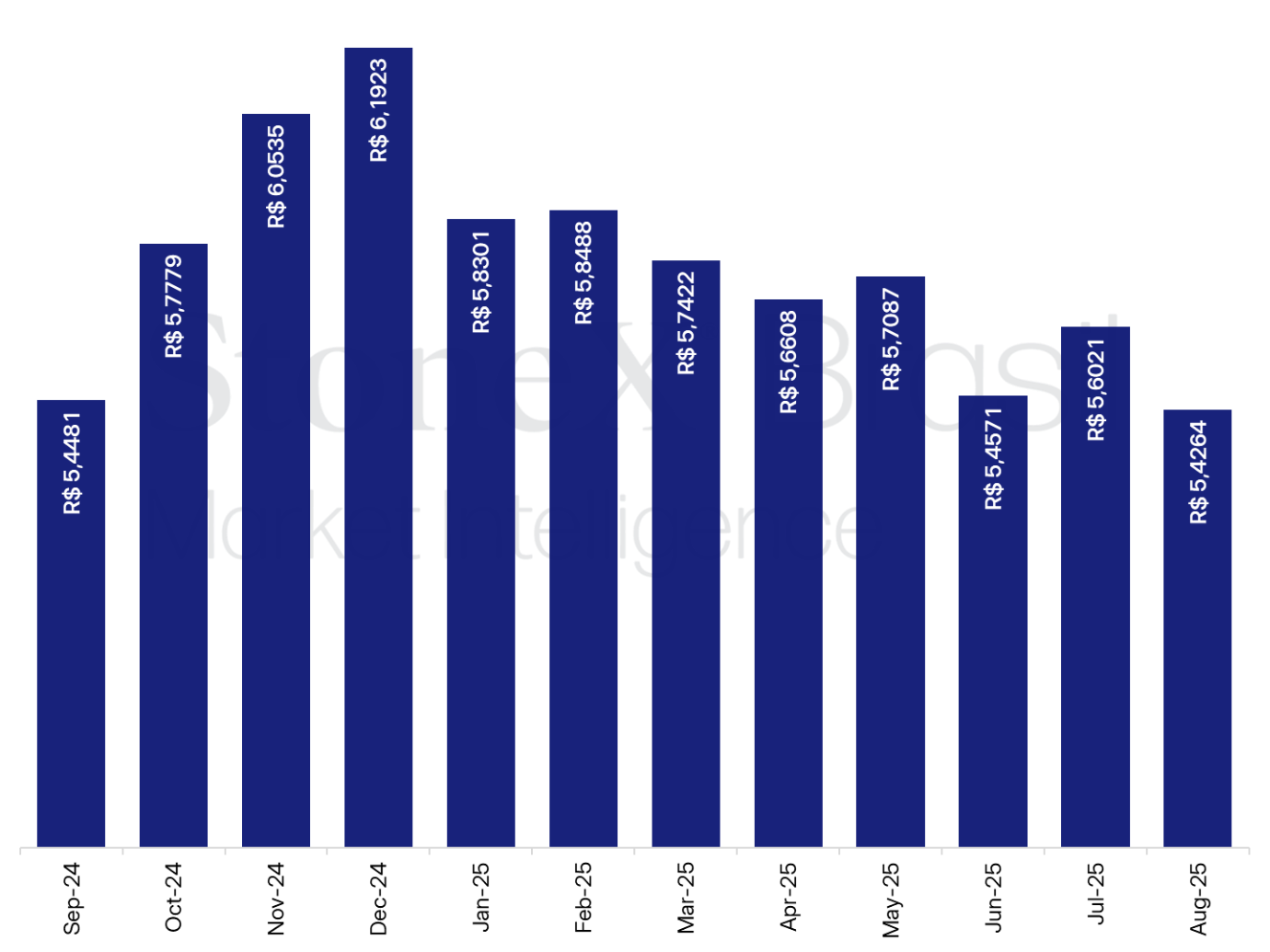

Source: Central Bank of Brazil. Design: StoneX.
The Ptax rate, published daily by the Central Bank, is widely used in currency and derivative contracts, with its end-of-month value being particularly important.
Why this matters: Financial market operators increase activity during the interval when the last Ptax rate of the month is calculated, making it harder to interpret movements in the BRL on that day.
- Trading volume and volatility typically rise during the time slots designated by the Central Bank for calculating the end-of-month Ptax rate, between 10 am and 1:10 pm.

INDICATORS
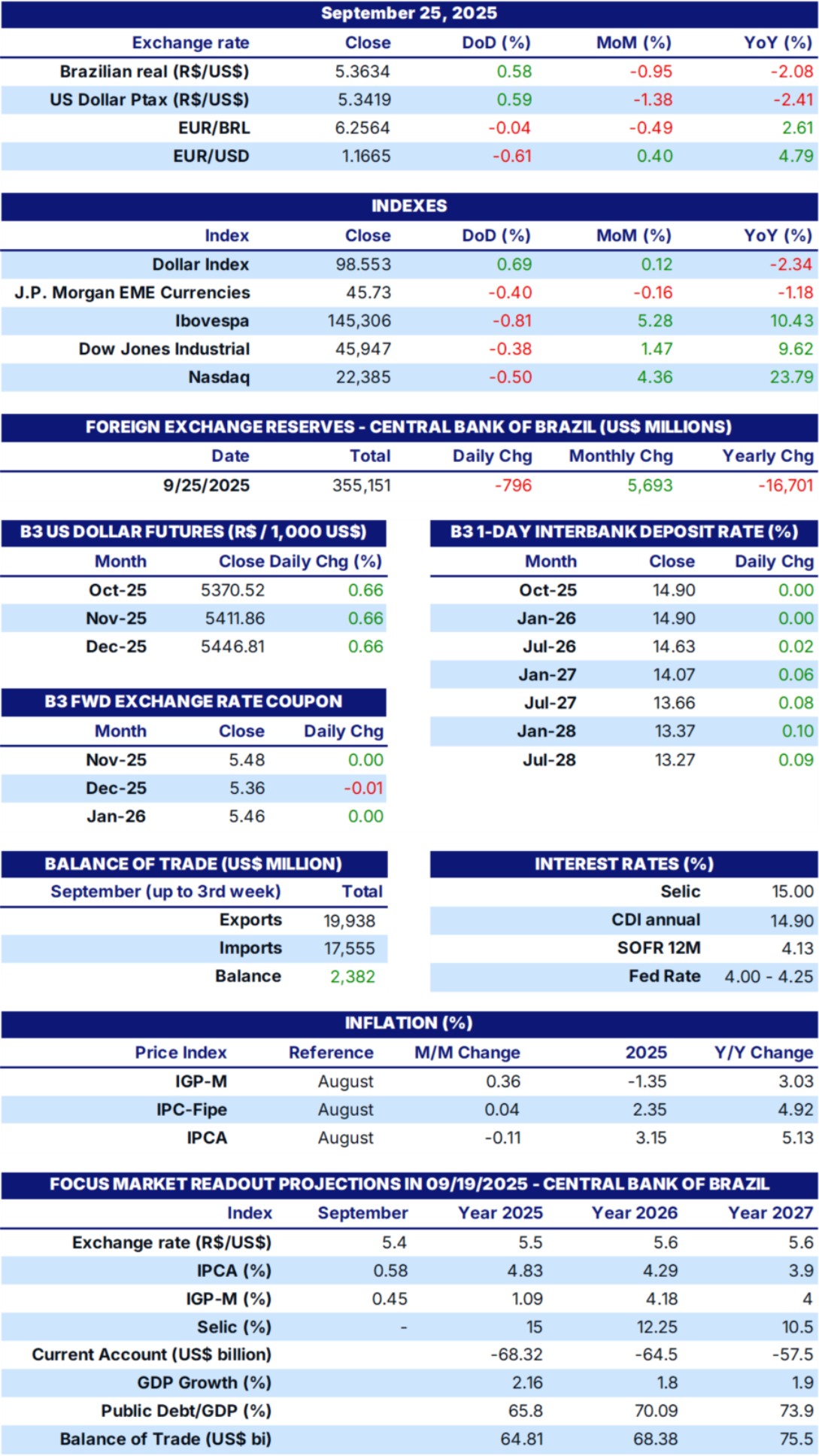
Sources: Central Bank of Brazil; B3; IBGE; Fipe; FGV; MDIC; IPEA and StoneX cmdtyView.