Dollar to reflect Copom interest rate decision, US PMI, expectations for US interest rates, and concerns over trade tensions
- Bullish
- US manufacturing and services PMI indices are expected to rise in October, suggesting robust economic activity in the US. This could lower investor expectations for Fed rate cuts and strengthen the dollar globally.
- Statements from Federal Reserve officials may heighten concerns about inflation risks in the US and reduce bets on rate cuts in December.
- Fears of a potential breakdown in the "tariff truce" between the US and China in the short term could lead to increased global risk aversion, negatively affecting the performance of risk assets like the Brazilian real.
- A Supreme Court hearing on the legality of White House tariffs could create greater uncertainty regarding the future of US trade policy, heightening global risk aversion and negatively impacting risk assets like the BRL.
- Bearish
- Copom is expected to maintain the benchmark interest rate (Selic) unchanged, favoring foreign investment inflows and strengthening the Brazilian real.
The week in review
- Trump and Lula met to advance commercial and diplomatic re-engagement between the US and Brazil.
- Trump and Xi met and agreed to extend the trade truce for another year, disappointing investors hoping for a more definitive easing of tensions between China and the US.
- The Federal Reserve cut its benchmark interest rate by 0.25 percentage points but cast doubt on the possibility of another reduction in December's decision.
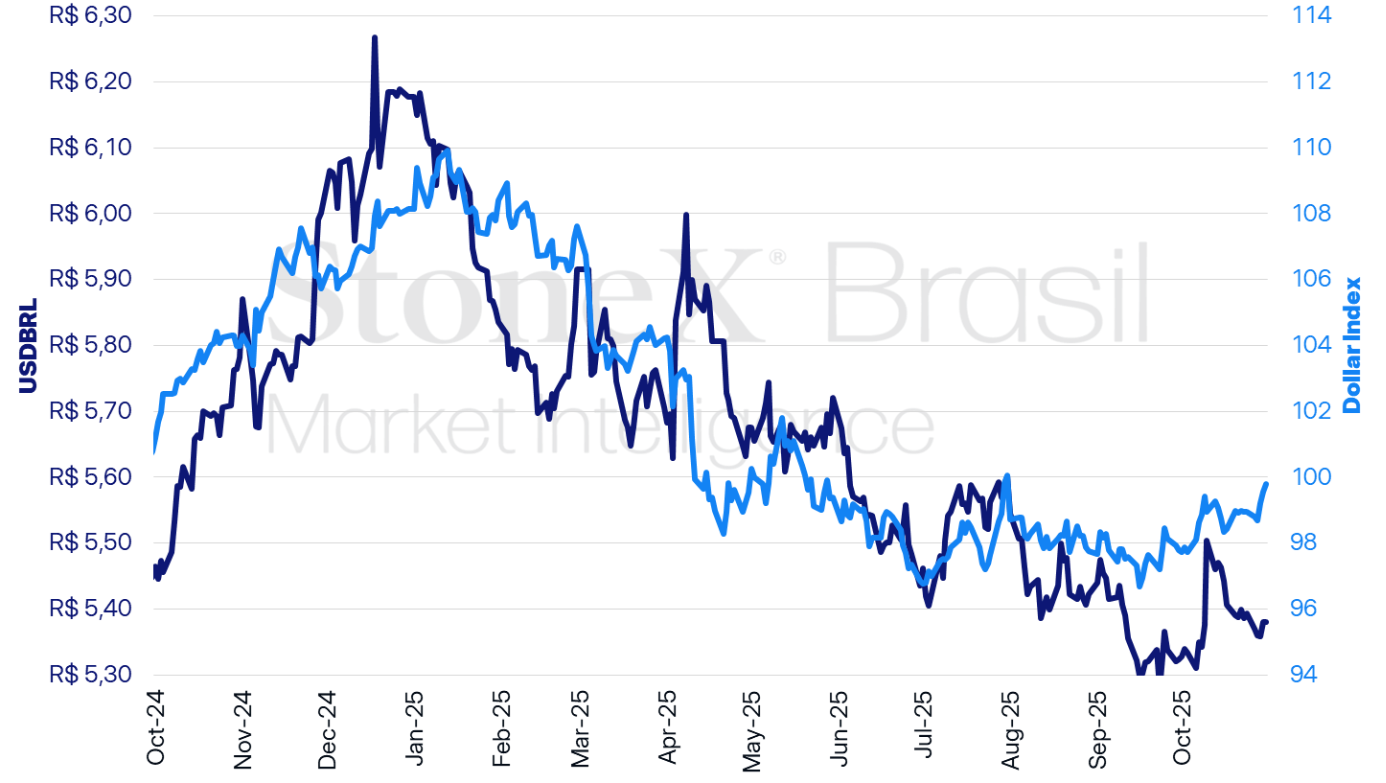
USDBRL and dollar index (points)
Source: StoneX cmdtyView. Design: StoneX.
Commercial Dollar Variations | Daily: -0.00% | Weekly: -0.25% | Monthly: +1.07% | Year-to-date: -12.92% | 12 months: -6.95% |
Dollar Index Variations | Daily: +0.24% | Weekly: +0.85% | Monthly: +2.05% | Year-to-date: -7.71% | 12 months: -4.02% |
Key Event: Copom interest rate decision
Expected Impact on USDBRL: Bearish
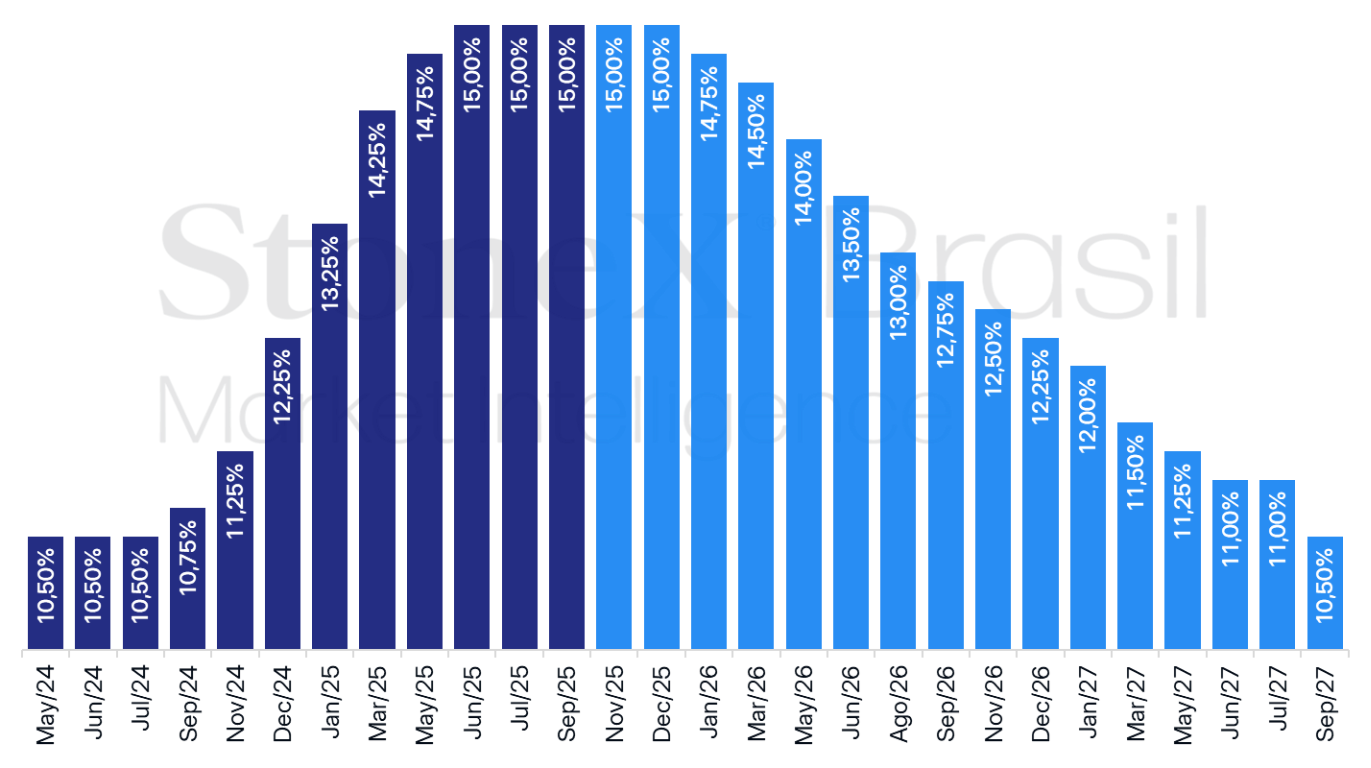
Brazil: History and median expectations for interest rates – Focus bulletin of October 24, 2025
Source: Brazilian Central Bank. Design: StoneX.
The Monetary Policy Committee (Copom) of the Brazilian Central Bank (BC) is expected to keep the basic interest rate (Selic) unchanged at its meeting next Wednesday (5), maintaining it at 15.00% per annum.
- More than the decision itself, investors will be paying close attention to the signals in the statement, especially regarding the duration of the “fairly prolonged period” of Selic rate stability and the factors that may lead the Committee to revise its risk assessment at upcoming meetings.
Why this matters: The prospect that the Selic rate will remain high for an extended period tends to raise projections for returns on Brazilian government bonds.
- This, in turn, increases the attractiveness of domestic assets, especially after the recent interest rate cut in the United States, widening the rate differential and contributing to the appreciation of the Brazilian real.
Overview: If confirmed, this will be the third consecutive meeting in which Copom has kept the Selic rate unchanged, maintaining restrictive financial conditions.
- The Committee bases its strategy on investors' high inflation expectations and a very tight labor market, even though inflation dynamics have improved slightly and economic activity is showing its first signs of slowing down.
- In the latest decision on September 17, the statement highlighted “unanchored expectations, high inflation projections, resilience in economic activity, and pressures in the labor market,” reinforcing that there is no rush to change interest rates.
Economic monitoring: With the Central Bank on hold, economic indicators continue to be decisive for bets on the trajectory of interest rates in the country.
- On Friday, the IBGE's PNAD showed that the unemployment rate remains at its lowest level in the historical series (5.6%), reinforcing the perception of a dynamic labor market.
- Next week, investors will be watching industrial activity data on Tuesday and the Purchasing Managers' Indices (PMIs) for services and manufacturing, which offer signals about the level of activity and confidence in the private sector.
US PMI
Expected impact on USDBRL: Bullish
Next week, investors' attention is likely to focus on the release of the US manufacturing and services Purchasing Managers' Index (PMI) for October, published by the ISM institute.
Why this matters: PMIs should suggest resilience in productive activity and acceleration in price components, reinforcing the perception that the economy remains stronger than anticipated.
- This, in turn, tends to reduce bets on faster interest rate cuts by the Federal Reserve, which favors US bond yields and contributes to the appreciation of the dollar globally.
Data expectations: The median of analysts' projections indicates that the industrial PMI should rise from 49.1 points in September to 49.2 points in October, while the services PMI should advance from 50.0 to 51.0 points in the same period.
- The figures released in recent months have signaled a sharp rise in the prices paid component and a slight decline in the employment component, raising fears of possible “stagflation” in the economy, i.e., an economic slowdown combined with accelerating inflation.
Data blackout: PMI releases take on greater importance amid the US government shutdown, which has suspended the release of official data and increased the relevance of private and regional indicators in assessing the economic situation.
- For example, the main publication on the US labor market, the Employment Situation Report, will not be released for the second consecutive month.
- The shutdown will reach one month on November 1 with no signs of a short-term solution, given the rigid impasse between Republicans and Democrats over approving a new budget in the US Congress.
Expectations for US interest rates
Expected impact on USDBRL: Bullish
US: Interest rate history and outlook – updated October 31, 2025
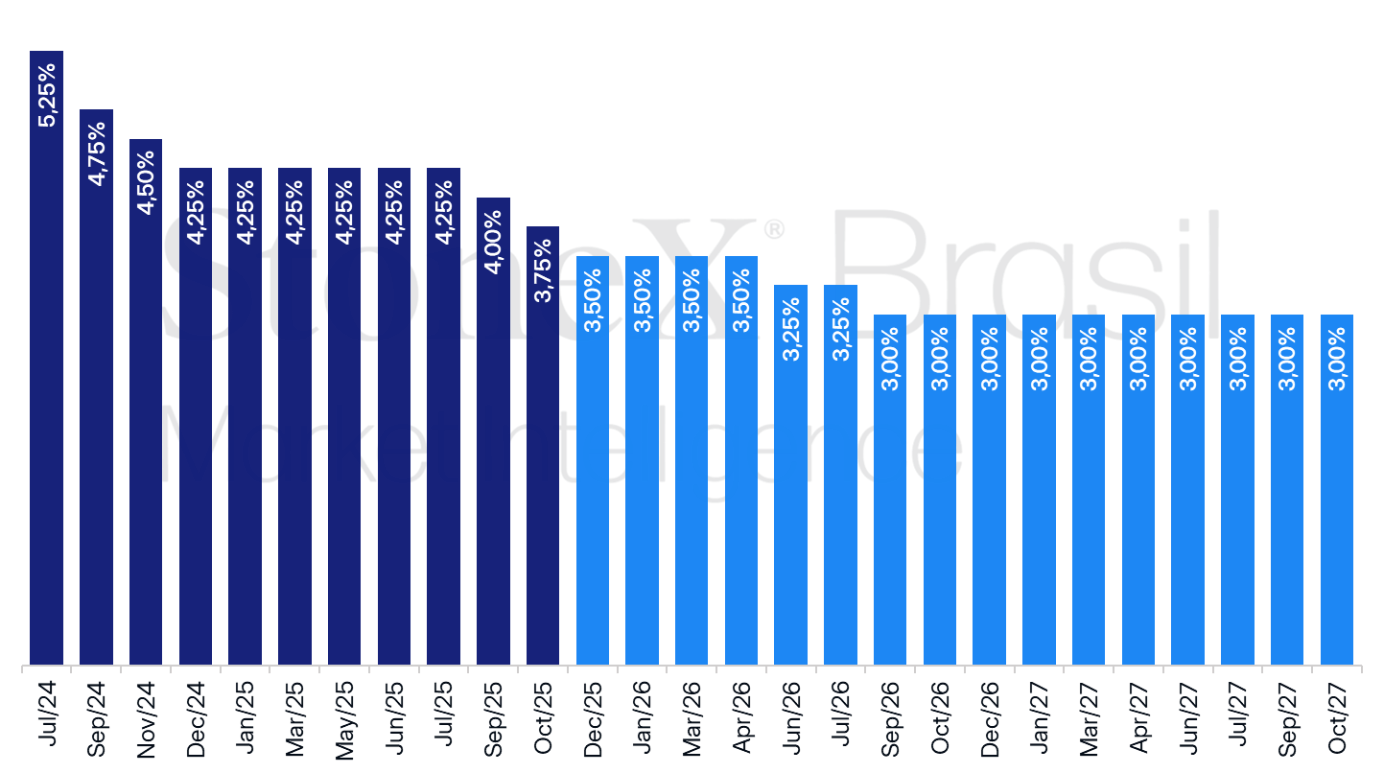
Source: CME FedWatch Tool. Design: StoneX. Refers to the most likely bet in the interest rate futures market on the date indicated.
Following last week's interest rate decision by the Federal Open Market Committee (FOMC) of the Federal Reserve (Fed), investors anticipate a slower pace of decline in US interest rates in the coming months.
Why this mattered: The perception that US interest rates will fall at a slower pace boosts the profitability of US Treasury bonds and attracts foreign investment, strengthening the dollar globally.
Overview: Last week, as widely anticipated, the FOMC reduced its benchmark interest rate by 0.25 percentage points, from a range of 4.25% to 4.00% per annum to a range of 4.00% to 3.75% per annum.
- Dez dos doze membros com direito a voto no FOMC votaram pela redução de 0,25 p.p. na taxa básica de juros, com um voto pela manutenção da taxa e outro voto por um corte de 0,50 p.p.
- Contudo, durante a coletiva de imprensa, o presidente do Fed, Jerome Powell, se esforçou para diminuir as expectativas de um novo corte de juros na decisão de 10 de dezembro, revelando um grau de dissenso maior que o esperado no Comitê.
- Como resultado, as apostas de investidores para uma nova queda na taxa de juros em dezembro caíram de cerca de 90% na quarta-feira, antes da última decisão, para cerca de 60% na última sexta-feira (31).
Divergent opinions: At the start of the press conference, before opening the floor to questions from journalists, Powell stated that “in the Committee’s discussions at this meeting, there were strongly differing views about how to proceed in December. A further reduction in the policy rate at the December meeting is not a forgone conclusion—far from it. Policy is not on a preset course."
- The statement suggests that a significant portion of FOMC members are concerned about inflationary risks and are likely to be uncomfortable with further cuts without evidence of a more rapid weakening of the labor market or greater inflation stabilization.
Change in risk balance: In this regard, despite the absence of official data, the Fed chairman listed a set of regional and private data suggesting that the labor market appears stable or that "it's not clearly declining quickly in any case", suggesting that the risks of a weakening labor market appear to be lower.
- In addition, he noted that US manufacturing activity is stronger than anticipated, which tends to contribute to higher inflationary pressures and greater demand for workers by companies.
- In this way, Powell seemed to suggest that the opposing risks between inflation and employment are more or less balanced, a situation in which keeping interest rates stable would be more appropriate.
- In his words, "If the two goals are sort of equally at risk, then you ought to be at neutral. (…) So if that got back into balance, then you'd want to be roughly at neutral. So in that sense it was a risk management, and I would say the same about today. Sort of the same logic. But as I mentioned, going forward is a different thing."
- In this regard, Powell also suggested that if the suspension of official data due to the current US government shutdown hinders the reading of the evolution of the US economic situation and the balance of risks in December, this should encourage a more cautious stance by the Committee and favor a pause in interest rate cuts.
Fragile “truce” between China and the USExpected impact on USDBRL: Bullish
Although the United States and China have agreed to extend the trade “truce” between the two countries for another year, investors fear that the agreement is fragile and that trade tensions could escalate again soon.
Why this matters: Investors fear that heightened trade tensions between the world's two largest economies could trigger a sharper slowdown in global growth, reducing risk appetite among investors and hurting the performance of risky assets such as the Brazilian real.
Overview: Last Thursday (30), the presidents of the United States and China, Donald Trump and Xi Jinping, met in person for the first time in almost six years and reached an agreement to extend the tariff truce, ease export controls, and reduce trade barriers.
- Despite the possibility of stabilization in trade and diplomatic relations between the two countries, investors were frustrated by the lack of more permanent solutions to the dispute between them.
- In both May and August, authorities from both countries had already announced similar agreements on similar issues, but these were quickly abandoned.
Back to the past: In practice, the new agreement merely removes most of the trade barriers that have been in place throughout the year.
- The current tariff “truce,” in which both countries have agreed to mutually reduce import tariffs, will be extended for one year, until November 2026.
- Additionally, the United States will reduce tariffs on Chinese products from 30% to 20% due to progress in combating opioid smuggling into the US.
- The two countries will suspend the application of port surcharges on ships from both countries for one year.
- China will suspend the tightening of export controls on rare earth minerals for one year in exchange for a stabilization of US export controls on Chinese companies, although restrictions already applied by both sides will remain in place.
- In addition, China has committed to resuming purchases of US agricultural products, particularly soybeans.
- Finally, Trump will visit Beijing in April, and Xi is expected to travel to the US later.
Court hearing on Trump's tariffs
Expected impact on USDBRL: Bullish
Next Wednesday (5), the US Supreme Court will hold a hearing to hear arguments regarding the legality of the White House's application of “reciprocal” import tariffs.
Why this matters: If the US Supreme Court rules that “reciprocal” tariffs are illegal, uncertainty about US trade policy could increase, which would result in greater global risk aversion and hurt the performance of risky assets such as the Brazilian real.
Overview: At the end of May, a panel of three judges from the United States Court of International Trade ruled that US President Donald Trump had exceeded the legal limits of his authority by imposing import tariffs through a declaration of a state of emergency under the International Emergency Economic Powers Act (IEEPA), a law passed in 1977.
- The decision did not question the declaration of a state of emergency itself, but rather that the law used, the IEEPA, does not allow the unilateral imposition of import tariffs on almost all nations worldwide at the same time.
- This decision was upheld in an appeal to the United States Court of Appeals by seven votes to four.
- Subsequently, the US government appealed to the country's Supreme Court, which ruled that the injunction should be suspended while the Supreme Court reviews the merits of the case.
- The oral arguments of the attorneys for the parties involved are one of the final stages in the review of the merits of the case, but it is unclear when the Supreme Court will announce its decision.
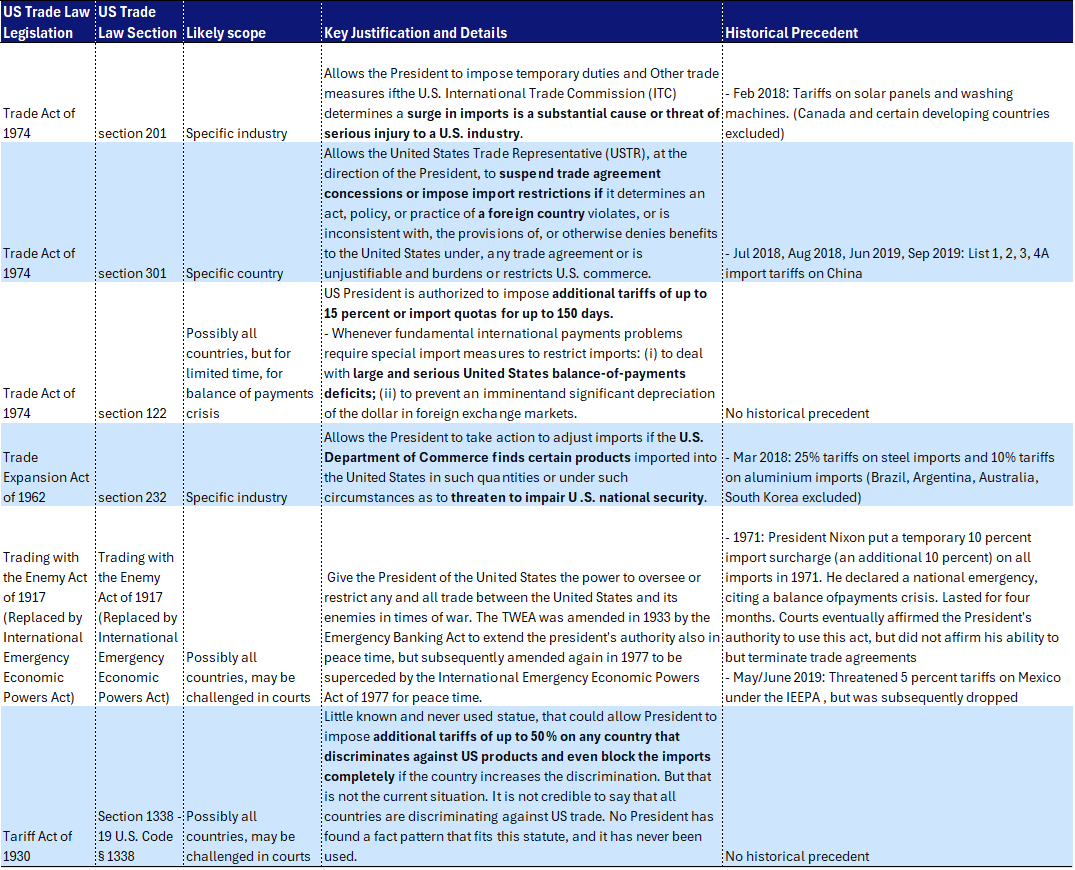
Legal alternatives: If the Supreme Court reaffirms the illegality of “reciprocal tariffs,” it is quite likely that the White House will seek alternatives to apply them.
- Additionally, a decision against the White House could allow importers to request reimbursement of these tariffs, estimated by Bloomberg at US$ 195 billion, or more than half of the customs revenues obtained this year.
Possible legal alternatives for implementing tariffs in the US
Source: MUFG. Design: StoneX.

ECONOMIC INDICATORS
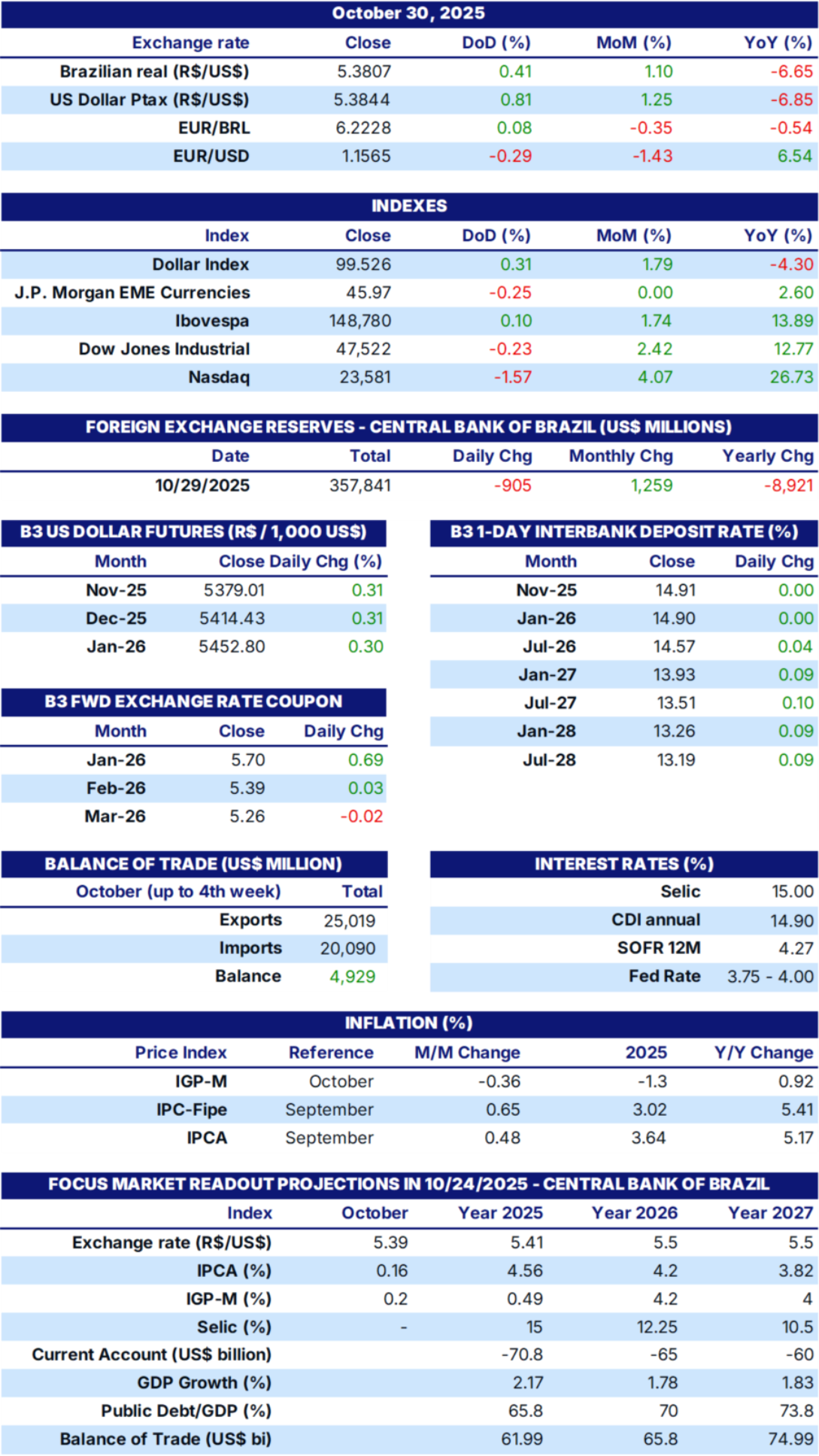
Sources: Brazilian Central Bank; B3; IBGE; Fipe; FGV; MDIC; IPEA and StoneX cmdtyView.