Last week, in the Jackson Hole Symposium in Wyoming, Fed Chairman Jerome Powell advocated a cautious strategy for reducing monetary stimulus to the US economy. Although he acknowledged that the current acceleration in price levels is worrisome, Powell stated that he does not want to tackle inflation that "is likely to prove temporary," since such a fight could harm the economic recovery and the employment rebound. In his assessment, the present inflation rates are due to narrow groups of goods and services that have been impacted by the pandemic lockdown measures, the reopening of sectors at misaligned paces, and a strong rebound in demand as durable goods and the energy sector. In addition, feedstock shortages and other logistical bottlenecks also contributed to this price increase, which Powell believes will slow down over time.
On the other hand, the Fed chairman argued that "it would be appropriate to start reducing the pace of asset purchase… this year," one of its main liquidity-injection tools, if the economy continues to move toward the "substantive progress" the Fed is targeting. However, without specifying a date, the Fed "will be carefully evaluating new data and evolving risks" before making this decision, looking not only at economic indicators but also at the impacts caused by the delta variant of the coronavirus. Above all, Powell said the central bank is prepared to adjust course in the face of new information.
Foreign Scenario
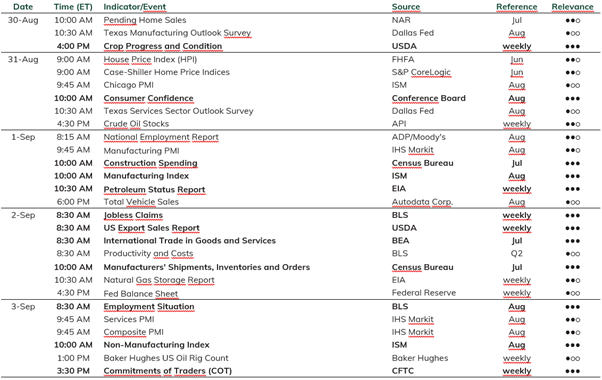
Powell's stance of carefully assessing the economy before promoting changes calmed the anxieties of the currencies market at the end of last week. Several relevant indicators will be released this week, allowing to analyze the Fed's targets progress better, highlighting the Employment Situation Report to be published on Friday. Due to the surge in Covid-19 new cases in the US, caused by the delta variant, market analysts expect a slight slowdown in the pace of job growth, with the median of expectations pointing to 740,000 new jobs created in August, down from 943,000 in July. A reduction in the unemployment rate from 5.4% in July to 5.2% in August is also expected. Similarly, for the weekly first-time claims for unemployment benefits released on Thursdays, the median of expectations point to 350,000 new claims, roughly at the same level as the previous week when 353,000 new claims were recorded.
Another leading indicator for the week will be the composite index, measured by the ISM agency, for manufacturing activity and the service sector. Also, due to the surge in new coronavirus cases, a slower expansion in economic activity is expected in August, especially in the service sector. If these forecasts are confirmed, one can imagine a more cautious position before starting a contraction in its monetary policies, despite the disagreement of some members of the Federal Open Market Committee (FOMC) as they want to reduce the stimulus at a faster pace.
On Monday, the United States began evacuating its diplomatic corps from Afghanistan, signifying that the withdrawal of Americans from the country was moving into its final stages. The abrupt and chaotic end of the United States military presence, with the return of the group that ran the country before the attacks on the Twin Towers, combined with a violent terrorist attack that killed 13 Americans and 90 Afghans, have brought pessimism to the global financial markets and a search for safe-haven assets, such as dollar-denominated bonds.
In the US Congress, the Democrats seek to take advantage of the approved budget worth of USD 3.5 trillion to propose bills within this amount and pass it with only the party's votes, which holds a small majority, in a maneuver known as "reconciliation." The focus will be on the committees responsible for drafting the bills, the deadline for which is September 15. The Democratic Party will need to align its base on the fiscal spending and tax revenue numbers it will try to pass in the House since the initial proposal of USD 3.5 trillion in fiscal spending is thought unlikely. Analysts cite spending at approximately USD 3 trillion and tax revenue at approximately USD 1.2 trillion as more likely numbers.
Finally, the continued increase in new Covid-19 cases and hospitalizations on a global level is noteworthy. Despite the immunization pace – 39.7% of the global population has received at least one dose of the vaccine – the number of those infected is again a cause for concern, with Israel, the United States, the United Kingdom, Thailand, Japan, the Philippines, and Vietnam standing out among the growth in the weekly moving average. In addition, the discovery of a contaminated batch of Moderna vaccine in Japan – reaching up to 2.6 million doses – was also a cause of concern and suspected to have caused two deaths. Market apprehensions are also justified by the high number of cases today compared to August last year, creating uncertainty about the disease dynamics during the northern hemisphere's fall and winter.
Domestic Scenario
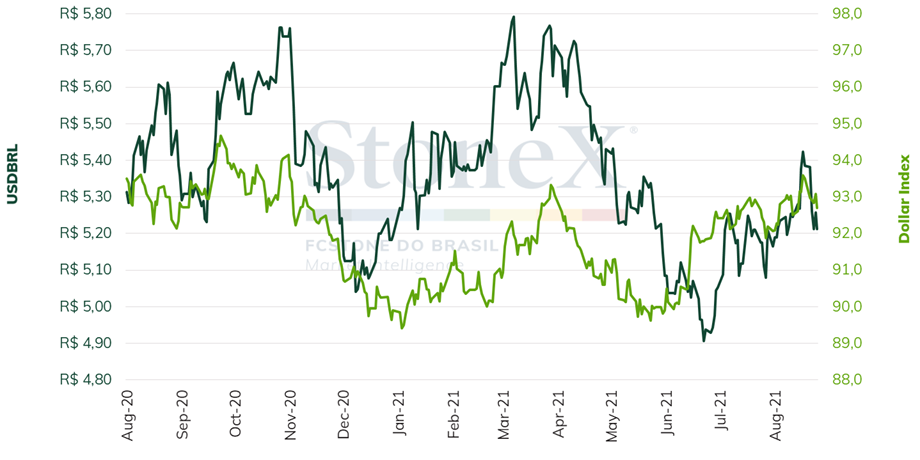
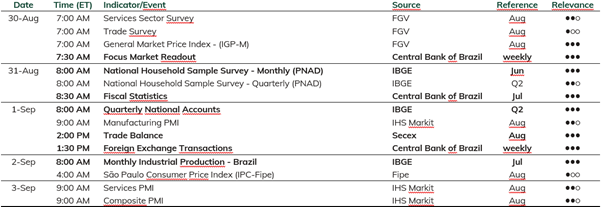
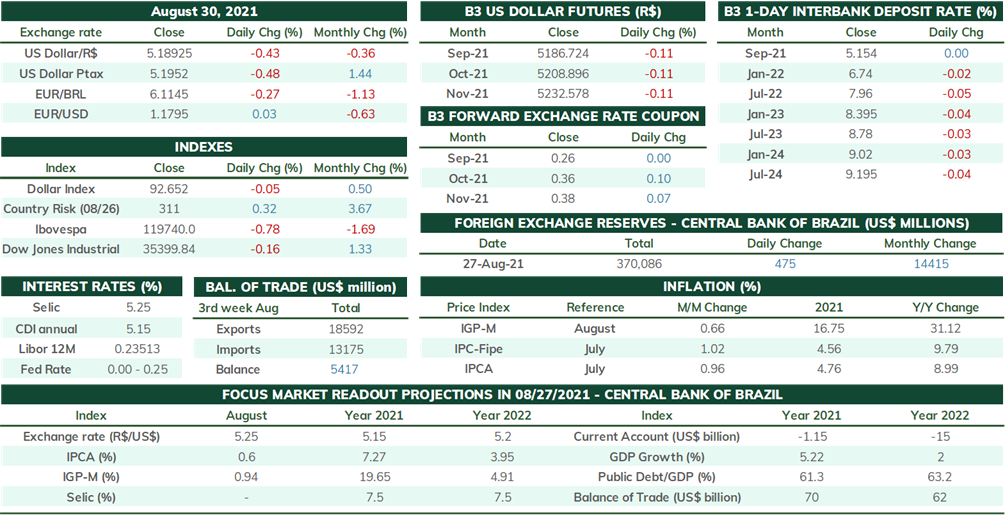
In Brazil, the exchange rate oscillated on Monday (30), ending the day quoted at BRL 5.189, down by 0.1% from Friday. The agenda of foreign and domestic indicators will be full, and the week holds important domestic indicators on the price level (IGP-M) on Monday, on the labor market on Tuesday, on GDP and national accounts on Wednesday, on industrial activity on Thursday, and on economic activity (PMI) on Friday.
Once again, the week begins with high tension between the Powers in Brazil. The governors' initiative for a joint meeting with representatives does not seem to bear fruit since only the president of the Senate, Rodrigo Pacheco (DEM-MG), confirmed his presence so far. On Saturday, in a speech to evangelical leaders, President Jair Bolsonaro once again criticized the president of the Superior Electoral Court and Supreme Court Minister Luis Roberto Barroso and warned of supposed limits that he would not be willing to tolerate. "We have a president who does not wish nor provokes ruptures, but everything has a limit in our life. We cannot go on living with this," he said. The president listed three possibilities about the future: "being arrested, killed, or declared winner. You can be sure: the first alternative, prison, does not exist." Absent from the list of possibilities is electoral defeat. On Monday, in an interview broadcast on his social networks, the president linked his speech directly to the inquiries he answers at the STF. "I meant that there is a lot of pressure. You can see, talking about electronic voting or printed ballots has become a crime. Talking about early treatment has become a crime," he said.
The Planalto leader's calls for protests on September 7 (Independence Day in Brazil) after the arrest of supporters who called for that day with anti-democratic agendas, such as the closing of the STF with the active participation of the armed forces, contribute to the uncertainty and uneasiness atmosphere. In addition, Bolsonaro is being criticized for constantly attacking the credibility of elections, the fairness of the judiciary and its judges, and threatening not to respect an eventual defeat in elections.
This weekend, the Federation of Industries of the State of São Paulo (Fiesp) sought to organize a note calling for political pacification and harmony among the three branches of government. Furthermore, Fiesp wanted the document to be signed by several entities. However, Caixa Econômica Federal and Banco do Brasil, controlled by the Union, threatened to leave the Brazilian Federation of Banks (Febraban) if it was published, for evaluating that it marked a political position contrary to the Jair Bolsonaro government. Due to the resistance, Fiesp postponed the publication of the manifesto.
The instability in the political scenario, as a whole, increases uncertainty in the business environment, which may result in investors demanding higher risk premiums. As a consequence, the attractiveness of the Brazilian currency may be negatively affected.
The legislative agenda should be one of the highlights this week. At the Chamber of Deputies, after the failure to advance with the Income Tax reform (bill 2337/2021), the Finance and Taxation Committee should discuss the extension of the payroll tax exemption for the 17 sectors that benefited during the pandemic through bill 2541/2021. Government leaders hardly insist on proposals that lose in the plenary, preferring to devote themselves to new proposals. At the moment, there is no consensus with the current text of the income tax reform, nor with the proposed constitutional amendment (PEC) that creates the Value Added Tax (PEC 110/2019). For this reason, analysts assess that the exoneration project has a better chance of being approved.
The president of the Chamber of Deputies, Arthur Lira (PP-AL), is trying to put the Electoral Code Complementary Law (Law No. 112/2021) on the schedule this week. The law under discussion since February has several controversial points, such as the removal of the Ficha Limpa (Clean Record) law that makes ineligible the politician who resigns to avoid impeachment, a five-year quarantine for the candidacy of police officers, judges, prosecutors and public security officials, as well as the imposition of interference measures on social media companies.
The Parliamentary Commission of Inquiry (CPI) of the Covid-19 pandemic is moving toward its closure in the Senate, targeting Senator Renan Calheiros's (MDB-AL) presentation report, which should come out next month. The document should focus on alleged corruption schemes that would have happened in the purchase of Covid-19 vaccines and tests and the existence of a parallel advisory office to President Bolsonaro in the fight against the pandemic, which would have resulted in the choice of the "herd immunity" strategy.
Today, Economy Minister Paulo Guedes said that the solution proposed by the STF president Minister Luiz Fux for the judiciary bonds issue is considered "extremely effective" and has the support of the Ministry of Economy. Fux presented a solution that would limit the payment of the judiciary bonds hefty bill in 2022 according to the same dynamics of the spending cap rule, i.e., government debts could not grow more than the inflation measured by IPCA in the 12 months until June of the previous year. According to Reuters, the formal proposal is for the calculation basis to go back to 2016 when the ceiling rule came into force, which would lead the maximum payment of judiciary bonds in 2022 to about USD 40 billion, a cut of USD 49.1 billion from the USD 89.1 billion expected for next year. This Tuesday, Guedes, Fux and the presidents of the Chamber and Senate, Deputy Arthur Lira (PP-AL) and Senator Rodrigo Pacheco (DEM-MG), will meet to progress on the legal text of the proposal.
It is also worth noting that Bolsonaro Administration needs to send August 31 the Annual Budget Law (PLOA) draft that details all federal government spending for 2022. So far, the expectation is that the draft is sent with the current value provided for the Bolsa Família, without the increase provided for the Auxílio Brasil, and with the real value of judiciary bonds (R$ 89 billion).