

FX Weekly Overview (Brazil Issue)
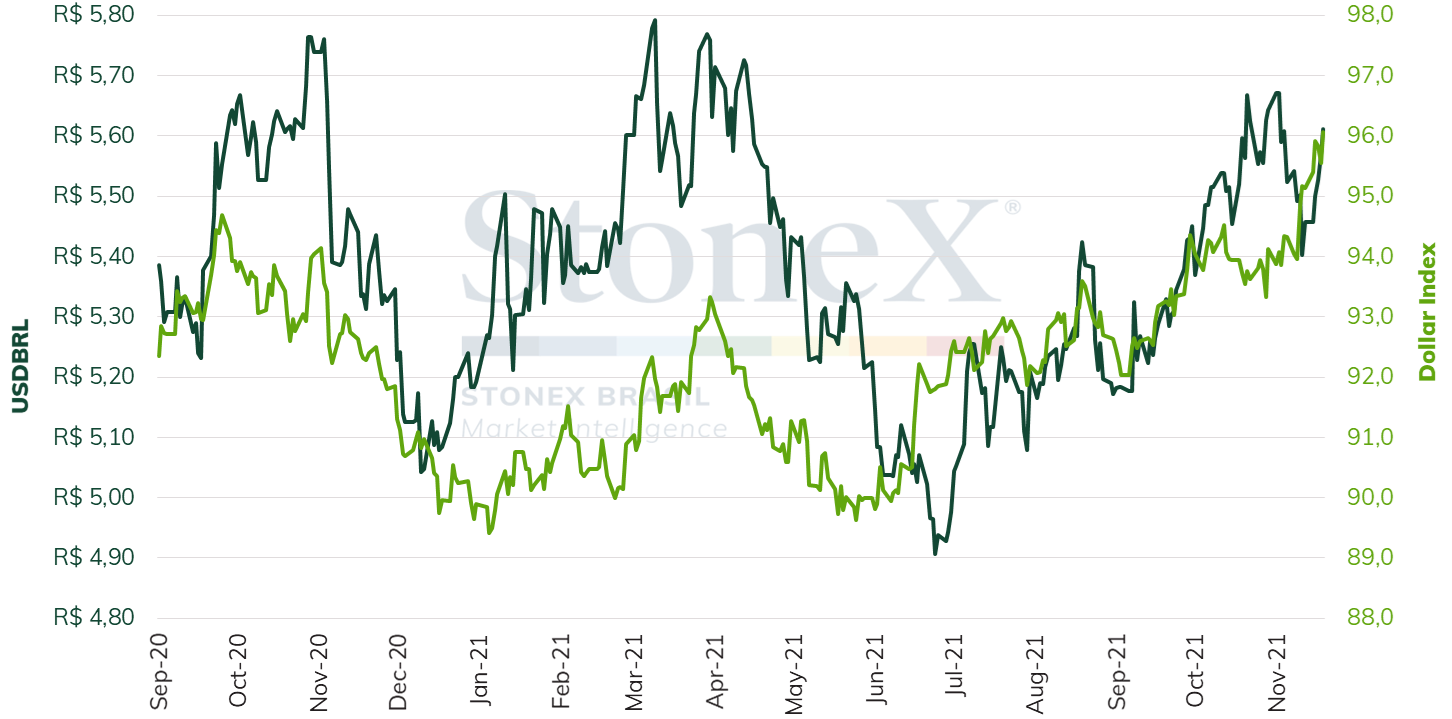
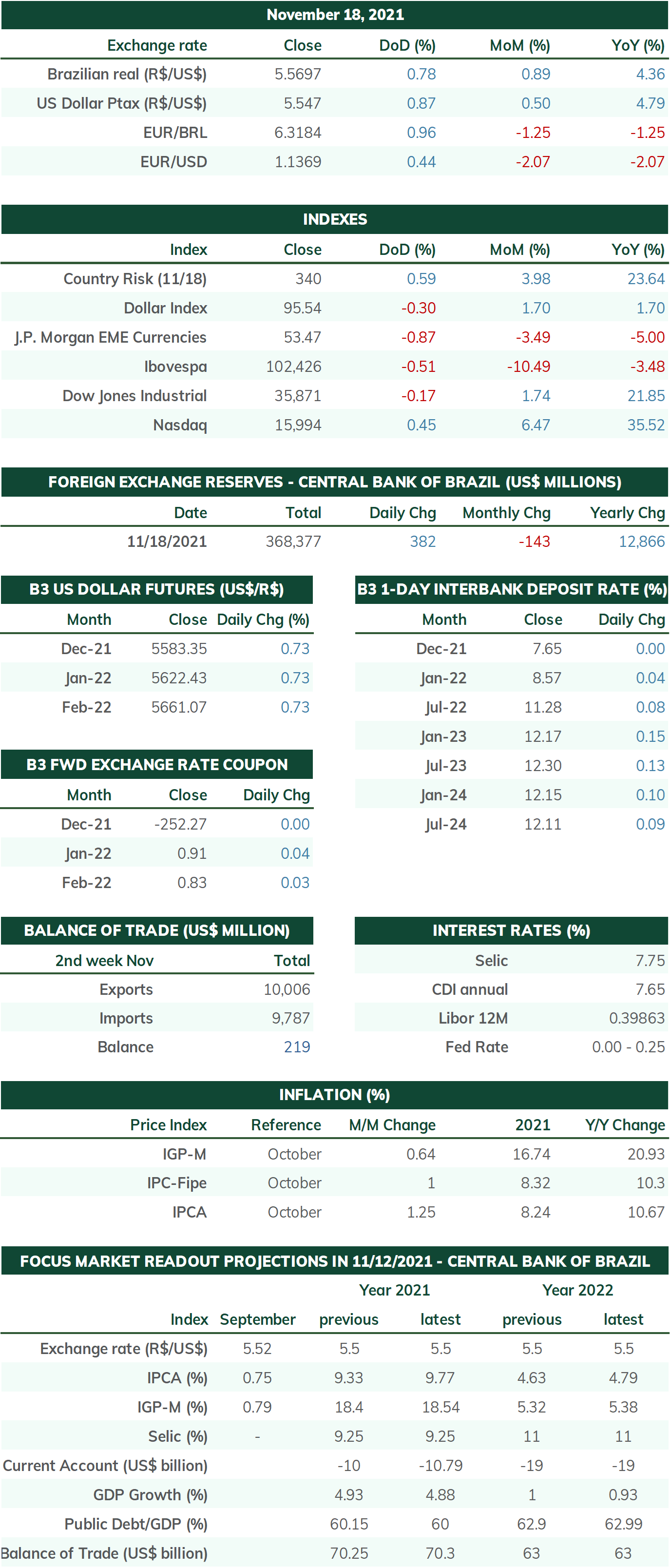
Dollar to reflect US economic data, Central Bank minutes, inflation in Brazil, and the Middle East

Leonel Mattos
- Currencies
Quarterly Commodities Outlook is available for free now. Download your report →
By: StoneX Intelligence Brazil, StoneX Intelligence Brazil


Foreign scenario
In the coming week, attention will turn to President Joe Biden's expected announcement for a new term as chairman at the Federal Reserve (Fed). The White House has indicated that the decision should be made by next week. Most analysts believe in the reappointment of Jerome Powell to the leadership post, although Fed Governor Lael Brainard has been interviewed for the position. Although she adopts a slightly more worrying stance on growth and employment than he does, their views on monetary policy are quite close. In addition to the chairmanship vacancy, Powell is expected to point names for other Fed positions, including the vice chairmanship in Banking Supervision, a position Brainard is expected to be nominated for if she is not chosen as chair of the institution. Biden's nominees are also believed to have a special concern for the labor market's strength, as are Powell and Brainard.
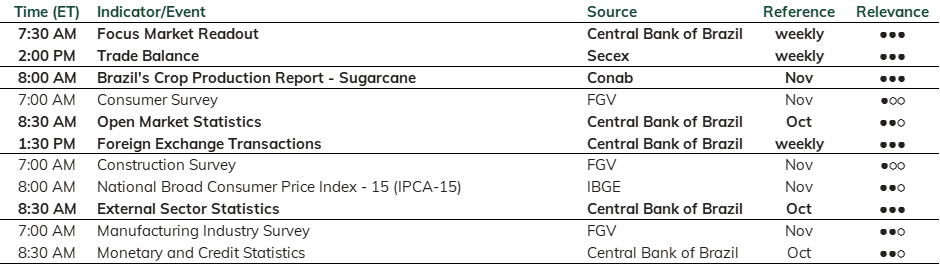
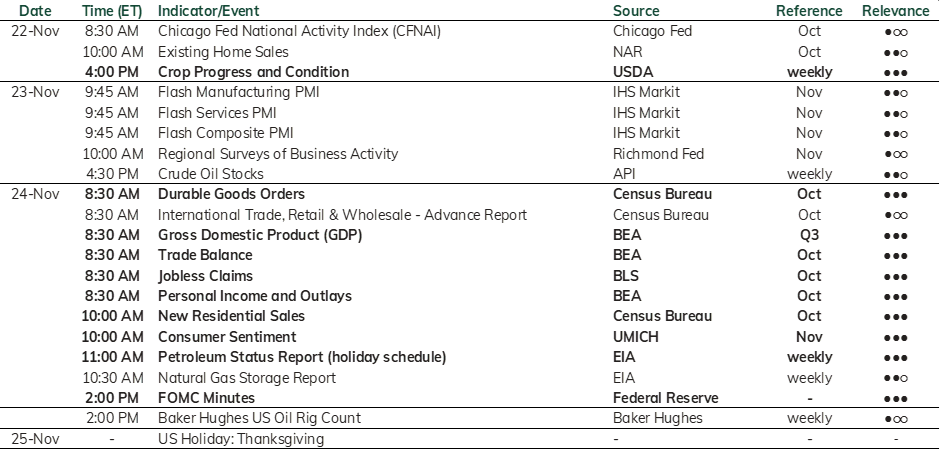
In addition to the appointment to the monetary authority positions, the minutes of the Federal Monetary Policy Committee (FOMC) decision will be released next Wednesday (24). It should put into context how the members decided to start the tapering – a gradual reduction in its bond-buying program. The US Central Bank buys USD 120 billion of securities from market agents monthly, with USD 80 billion in US Treasury bonds and USD 40 billion in mortgage-backed securities. The FOMC defined in its meeting on November 3 that it would make cuts in the volume purchased, reducing by USD 10 billion the purchases of Treasury bonds and by USD 5 billion in mortgage-backed securities in November and December. Comments on its members' view of the employment, growth and inflation scenario in the United States will receive press attention. It is also important to note whether the document describes conditions under which this reduction process can be accelerated and over a possible time horizon for the increase in interest rates in the economy. There is a great debate currently about the right time for such interest rate adjustments, but Powell has signaled that he should only act in this direction after the "tapering" ends in the second half of 2022.
The US House of Representatives passed the "Build Back Better" law, one of Biden's legislative priorities. The USD 1.75 trillion package funds the expansion of public health care, daycare centers, housing, and renewable energy production.
The score was 220 versus 213, with all the Republican members and one Democrat voting against. Despite the important victory, the Democrats still need to pass it in the Senate, where a 50-per-party split and a minimum of 50 votes are needed to pass it. No Republican senators are expected to vote for the measure, and Democratic senators are hoping to find harmony within the party after the Congressional Budget Office, a technical and non-partisan analytical department, estimated that the bill is expected to have a net impact of USD 367 billion on the US federal debt between 2022 and 2031, its term. Next week the US Congress will be in recess because of the Thanksgiving holiday on Thursday, so a possible vote will not happen until November 29.
Finally, it is noteworthy that the Japanese Congress has approved an economic stimulus package worth ¥55 trillion (USD 480 billion) to alleviate the effects of the Covid-19 pandemic on the country and revive the economy, the largest in the country's history. "We will implement these economic measures quickly to rebuild the economy damaged by the pandemic. We will promote the resumption of socioeconomic activities and put the economy on a growth path as soon as possible," Prime Minister Fumio Kishida said.
The highest priority is to strengthen the health care system to anticipate the possibility of new waves of coronavirus and establish a financial support system for companies impacted by the pandemic and families with young people under the age of eighteen. There will also be the establishment of oil subsidies to contain the rising fuel costs and other derivatives. Other areas to benefit from will be tourism, university research, and the national production of semiconductors.
Domestic scenario
This week's schedule will be empty of domestic indicators. However, the highlight of the week should be the vote on the proposed constitutional amendment of judiciary bonds (PEC 23/21) by the Commission on Constitution, Justice and Citizenship (CCJC) of the Federal Senate, scheduled for next Wednesday (24). The basic text approved by the Chamber of Deputies provides additional space in the 2022 Budget of BRL 91.6 billion, BRL 47 billion from the change in the calculation of the spending cap and BRL 44.6 billion from the postponement of the commitment to honor the government's judicial commitments. However, this week, senators presented several alternatives to the text through substitute texts and amendments, which generated fear in the financial market of delays in approval or changes in the proposal that worsen fiscal responsibility in an election year.
Among the projects presented, there is the approval in "slices" of the PEC, the payment of judicial debts outside the spending cap, the extinction of the amendments of the general rapporteur, which makes definitive the increase to BRL 400 of the Auxílio Brasil basic income transfer program, the linking of a tax revenue source to the program and the creation of an audit or commission to assess the evolution of judiciary bonds. The government leader in the Senate and rapporteur of the PEC of judiciary bonds in the House, Senator Fernando Bezerra Coelho (MDB-PE), said on Thursday that the government is open to modifying points of the proposal and welcome suggestions from senators so long as they speed up its approval. "The government admits welcoming a series of suggestions that are being brought. (...) Our effort is to reach an understanding that will allow this matter to be enacted as soon as possible. We have a social urgency", said the reporter in an interview.
If there are any changes in the text and approved in the Senate, new ratification by the Chamber of Deputies will be necessary. Bezerra Coelho said that, in a meeting with the presidents of the Chamber and Senate, Congressman Arthur Lira (PP-AL) and Senator Rodrigo Pacheco (PSD-MG), a strategy was defined for a separate vote on parts that do not contain changes and the parts that do. Accordingly, part of the text can go for presidential ratification immediately, and the deputies would only consider the modifications. The rapporteur expressed optimism that the PEC will be approved until November 30 in two rounds in the Senate, ensuring the payment of the Auxílio Brasil program before Christmas.
Lira, in turn, rejected the promise of the President of the Republic, Jair Bolsonaro, that the government will readjust the salary of all federal servers, "without exception," if the PEC of judiciary bonds is approved in the Senate, arguing that there is no budget available for this. " I didn't see that space; I don't know that space.
The numbers presented to the Chamber of Deputies did not foresee this increase, and I think that that cost portfolio that was widely disclosed to the press can be honored so that we have the reliability of what was agreed upon in the plenary discussions," said the President of the Chamber in an interview this week.
Unlike the proposal to temporarily increase (until December 2022) the average benefit of the Auxílio Brasil program, a salary adjustment would cause a permanent increase in expenses. According to the Fiscal Responsibility Law, it would require the indication of a revenue, or expense cut, to finance it.
Even if the PEC is approved, there will be little budgetary room for such a promise. With the new Secretariat of Economic Policy projection, released this week, for the 2021 National Consumer Price Index (INPC) (10.04%), the mandatory expenses adjusted by inflation will also increase in 2022. Thus, according to the calculations made by the Independent Fiscal Institution of the Federal Senate, if the government effectively increases the average benefit to BRL 400, only BRL 1.8 billion will be left in the 2022 budget for other expenses. However, this has not prevented Bolsonaro from committing to use the fiscal space resulting from the PEC with other promises for the next year, such as the salary adjustment for federal servers, a benefit for the purchase of domestic gas bottles and a BRL 400 aid for the purchase of diesel by truck drivers.
The StoneX Group Inc. group of companies provides financial services worldwide through its subsidiaries, including physical commodities, securities, exchange-traded and over-the-counter derivatives, risk management, global payments and foreign exchange products in accordance with applicable law in the jurisdictions where services are provided. References to over-the-counter (“OTC”) products or swaps are made on behalf of StoneX Markets LLC (“SXM”), a member of the National Futures Association (“NFA”) and provisionally registered with the U.S. Commodity Futures Trading Commission (“CFTC”) as a swap dealer. SXM’s products are designed only for individuals or firms who qualify under CFTC rules as an ‘Eligible Contract Participant’ (“ECP”) and who have been accepted as customers of SXM. StoneX Financial Inc. (“SFI”) is a member of FINRA/NFA/SIPC and registered with the MSRB. SFI is registered with the U.S. Securities and Exchange Commission (“SEC”) as a Broker-Dealer and with the CFTC as a Futures Commission Merchant and Commodity Trading Adviser. References to securities trading are made on behalf of the BD Division of SFI and are intended only for an audience of institutional clients as defined by FINRA Rule 4512(c). References to exchange-traded futures and options are made on behalf of the FCM Division of SFI . StoneX is a trading name of StoneX Financial Ltd (“SFL”). SFL is registered in England and Wales, Company No. 5616586. SFL is authorized and regulated by the Financial Conduct Authority [FRN 446717] to provide to professional and eligible customers including: arrangement, execution and, where required, clearing derivative transactions in exchange traded futures and options. SFL is also authorised to engage in the arrangement and execution of transactions in certain OTC products, certain securities trading, precious metals trading and payment services to eligible customers. SFL is authorised & regulated by the Financial Conduct Authority under the Payment Services Regulations 2017 for the provision of payment services. SFL is a category 1 ring-dealing member of the London Metal Exchange. In addition SFL also engages in other physically delivered commodities business and other general business activities which are unregulated and not required to be authorised by the Financial Conduct Authority. StoneX Group Inc. acts as agent for SFL in New York with respect to its payments services business. StoneX APAC Pte. Ltd. acts as agent for SFL in Singapore with respect to its payments services business. ‘StoneX’ is the trade name used by StoneX Group Inc. and all its associated entities and subsidiaries.
Trading swaps and over-the-counter derivatives, exchange-traded derivatives and options and securities involves substantial risk and is not suitable for all investors. Past performance of any futures or option is not indicative of future success. Indicators are not a trading system and are not published as a specific trade recommendation. The information herein is not a recommendation to trade nor investment research or an offer to buy or sell any derivative or security. It does not take into account your particular investment objectives, financial situation or needs and does not create a binding obligation on any of the StoneX group of companies to enter into any transaction with you. You are advised to perform an independent investigation of any transaction to determine whether any transaction is suitable for you. No part of this material may be copied, photocopied or duplicated in any form by any means or redistributed without the prior written consent of StoneX Group Inc.
© 2026 StoneX Group Inc. All Rights Reserved.
Our subscribers have access to comprehensive market analysis from StoneX spanning commodities, equities, currencies and more.
Dollar to reflect US economic data, Central Bank minutes, inflation in Brazil, and the Middle East

US indices have led sentiment to fresh highs this past week even as the fundamental backdrop struggles to present a solid foothold. Will thin liquidity aid or hamper the swell and what does the event risk ahead propose?


A softer run of U.S. data is doing more to move the U.S. dollar than any chart, with a jobs report and an inflation print set to land back to back. A cooler U.S. CPI report would hand the Federal Reserve room to ease, and that prospect is already loosening the dollar's grip.

Our market expertise, advanced platforms, global reach, culture of full transparency and commitment to our clients’ success all set us apart in the financial marketplace.
Reach
With access to 40+ derivatives exchanges, 180+ foreign exchange markets, nearly every global securities marketplace and numerous bi-lateral liquidity venues, StoneX’s digital network and deep relationships can take clients anywhere they want to go.
Transparency
As a publicly traded company meeting the highest standards of regulatory compliance in the markets we serve; our financials and record of accomplishment are matters of public record. StoneX’s commitment to “doing the right thing over the easy thing” sets us apart in the industry and helps us build respect, client trust and new partnerships.
Expertise
From our proprietary Market Intelligence platform, to “boots on the ground” expertise from award-winning traders and professionals, we connect our clients directly to actionable insights they can use to make more informed decisions and achieve their goals in the global markets.