Foreign Scenario
This week should be empty of indicators. Attention should turn to the release of the May Consumer Price Index (CPI) for the United States. The median of analysts' estimates points to a monthly rise of 0.5%, maintaining the accumulated increase in 12 months at 8.3%. This week, the labor market data for April exceeded investors' expectations and revealed that the labor market, and therefore economic activity, remains vigorously heated in the country. Thus, consumer prices should remain high and widespread in the economy, with the core indicator (excluding the volatile food and energy sectors) also growing by 0.5%. Such readings should corroborate that the Federal Reserve (Fed) will need to act hard and fast in its monetary tightening to try to curb inflation rates in the country, which, in turn, should exacerbate fears of a possible economic recession in the next 12 months.
It will also be important to follow the monetary policy statement from the European Central Bank (ECB) and public statements from representatives of the European monetary authority. In recent times, even though the Fed has already started its policy of raising interest rates in March, the ECB had publicly talked about continuing to support economic growth in the bloc and avoiding monetary tightening due to a diagnosis that recent inflation was related to supply disturbances and that the war between Russia and Ukraine brought a lot of instability to the local economy. However, two consecutive months of much higher than expected consumer price acceleration - the CPI in the European Union reached 8.1% in May - provoked a change in stance, and ECB President Christine Lagarde stated that we should see the region with "positive" interest rates by the end of the third quarter (September). Given that today the reference interest rate is at -0.50% per annum, this implies adjustments in the magnitude of at least 0.50 p.p. in the July and August meetings. In June, a stimulus program through the purchase of assets ends, and few are betting on any readjustment. Thus, the decision and communications will be very important to map out which monetary path the Central Bank of the single currency bloc intends to apply throughout 2022.
Finally, it is worth noting that the war between Russia and Ukraine has reached its 100th day at a new pace. While its news no longer moves the markets as much, the supply of commodities remains heavily constrained by the conflict scenario. Last week, the United States announced a new military aid package to Ukraine that contains precision missiles (M142 HIMARS) with a range of up to 80 km. The US Secretary of State Antony Blinken said the Ukrainians have pledged not to use weapons on targets inside Russia. Still, Moscow reacted with a statement condemning the decision, saying it risks "dragging a third country" into the conflict and holding nuclear weapons exercises in Ivanovo, northeast of Moscow. The exercise used RS-24 Yars intercontinental ballistic missiles with a range of up to 12,000 km. On the battlefront, Russian troops are making an arduous advance through Luhansk province, concentrating ground artillery, missiles, and aerial bombardments in the region. In the coming days, they are likely to conquer the city of Severodonetsk, which would allow almost complete control of Luhansk. However, the advance towards Donetsk should be more difficult due to the damage caused by these latest battles and the Siverskyi Donets River that separates the regions, which should require a new regrouping, according to military analysts.
Domestic Scenario
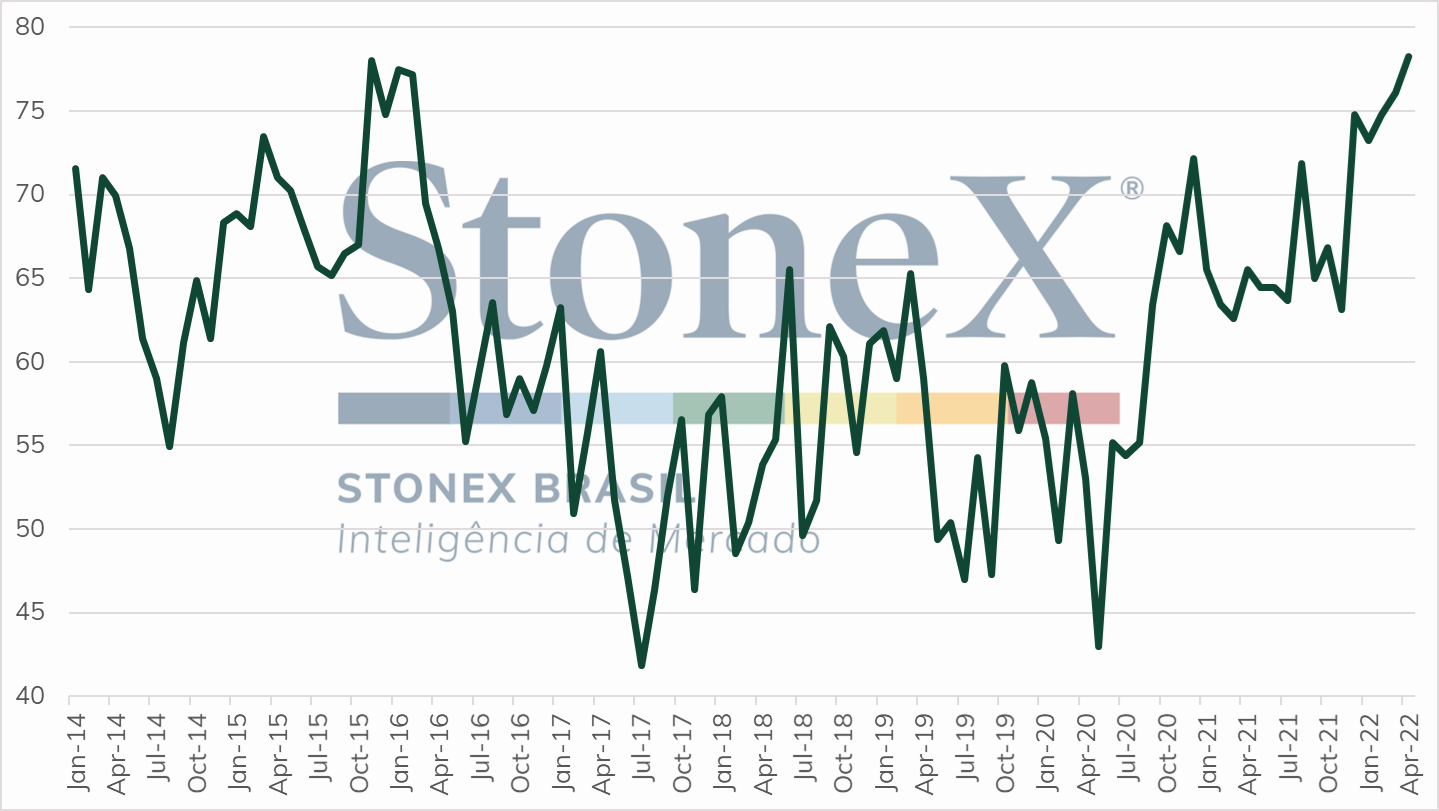
This week, the focus should be on the National broad Consumer Price Index (IPCA) for May by the Brazilian Institute of Geography and Statistics (IBGE). The indicator used by the Central Bank to monitor consumer prices continues to accelerate month after month and has already accumulated a 12.2% increase in 12 months. Moreover, its diffusion index, that is, how many goods in the total basket had price increases in April, stood at 78.25%, its highest level since January 2003. In speeches a few weeks ago, the president of the Central Bank, Roberto Campos Neto, had indicated that he wanted the increase in the Selic rate in June to be the last of the current monetary tightening cycle. However, it is hard to imagine the monetary authority ending its adjustments while the IPCA is accelerating. Accordingly, the inflation reading in the coming months will be very important to evaluate the country's possible trajectory of monetary policy.
Source: Central Bank of Brazil. Design: StoneX.
It will also be important to note proposals that may increase the perception of fiscal risk associated with Brazil. During the week, several reports mentioned the search for solutions by Jair Bolsonaro's government to bring short-term relief to inflation, especially fuel prices. This week, Senator Fernando Bezerra (MDB-PE), rapporteur in the Senate of the bill that sets a ceiling on the Tax on the Movement of Goods and Services (ICMS) of fuel and electricity, said that the proposal might be voted on as early as next Tuesday or Wednesday (June 7 or 8). Last week, the Chamber of Deputies approved a bill that classifies fuel, natural gas, electricity, communications, and public transportation as "essential and indispensable sectors," limiting the ICMS rate - a state tax - to 17%. The text also establishes that there will be, until December 31 of this year, compensation paid by the federal government to the states for the loss of revenue through discounts in installments of debts refinanced by the entities together with the Union. There is strong resistance from governors, who protest for having their revenue reduced and claim that the law is unconstitutional. According to the Constitution, it would be up to the states to define which goods and services are essential and which are not. It is also worth remembering that Congress had already approved another bill that altered the ICMS rate on fuels to fixed values in March of this year.
Also, last week, the Minister of the Civil House, Ciro Nogueira, said in an interview that the federal government might declare a state of public calamity "depending on the country's situation" due to fuel prices, without specifying what this situation would be. The state of public calamity would authorize the Executive to evade the prohibitions imposed by electoral legislation and the spending "ceiling" (constitutional spending limit) to be able, for example, to offer subsidies for fuel and electricity or increase the value of Auxílio Brazil (income transfer program) benefits. However, the Fiscal Responsibility Law impedes salary increases or hiring new employees during a state of calamity. On Friday (3), there were reports that the economic team at the Presidential Palace was even studying the possibility of a proposed constitutional amendment (PEC) that allows the government to exceed the spending ceiling with measures to reduce fuel prices, similar to the Covid-19 emergency PEC, which allowed the financing of emergency aid during the pandemic.
Moreover, on Wednesday, the President Jair Bolsonaro (PL) modified once again his proposal for a possible increase in the civil service, backing off from the promise of a 5% linear readjustment to all public servants and requesting an evaluation from the technicians of the Executive branch for a BRL 600 increase in these employees' meal tickets. Since November of last year, the president has oscillated between promises of a linear readjustment for the entire federal service, only the federal security personnel or nobody.
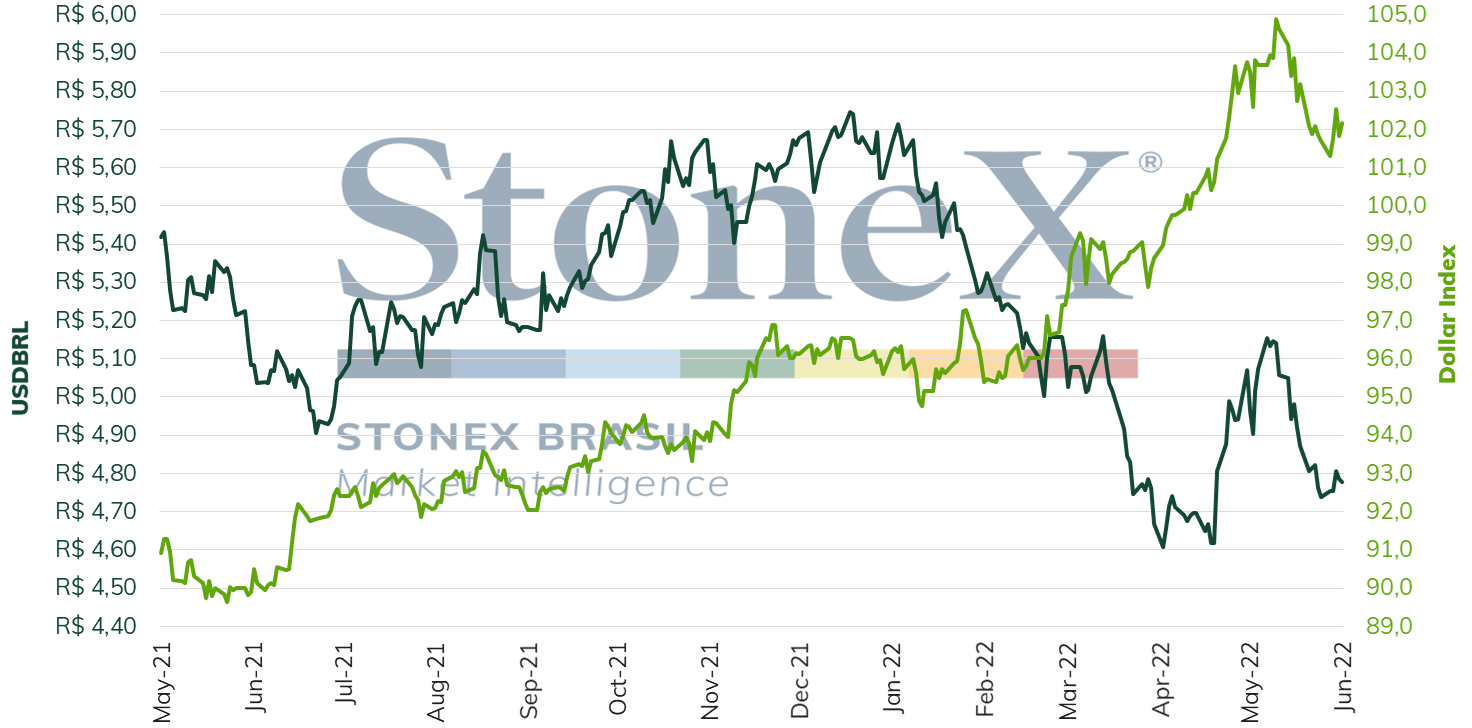
The constant improvisations and changes in the 2022 Budget that represent an increase in spending or a reduction in tax collection, the pressure for intervention in fuel prices and the risks of a possible shortage of diesel oil may raise the perception of fiscal risk associated with Brazil, raising the demand for a risk premium by investors, which, in turn, could reduce the foreign capital flow into the country and weaken the BRL.