Foreign Scenario
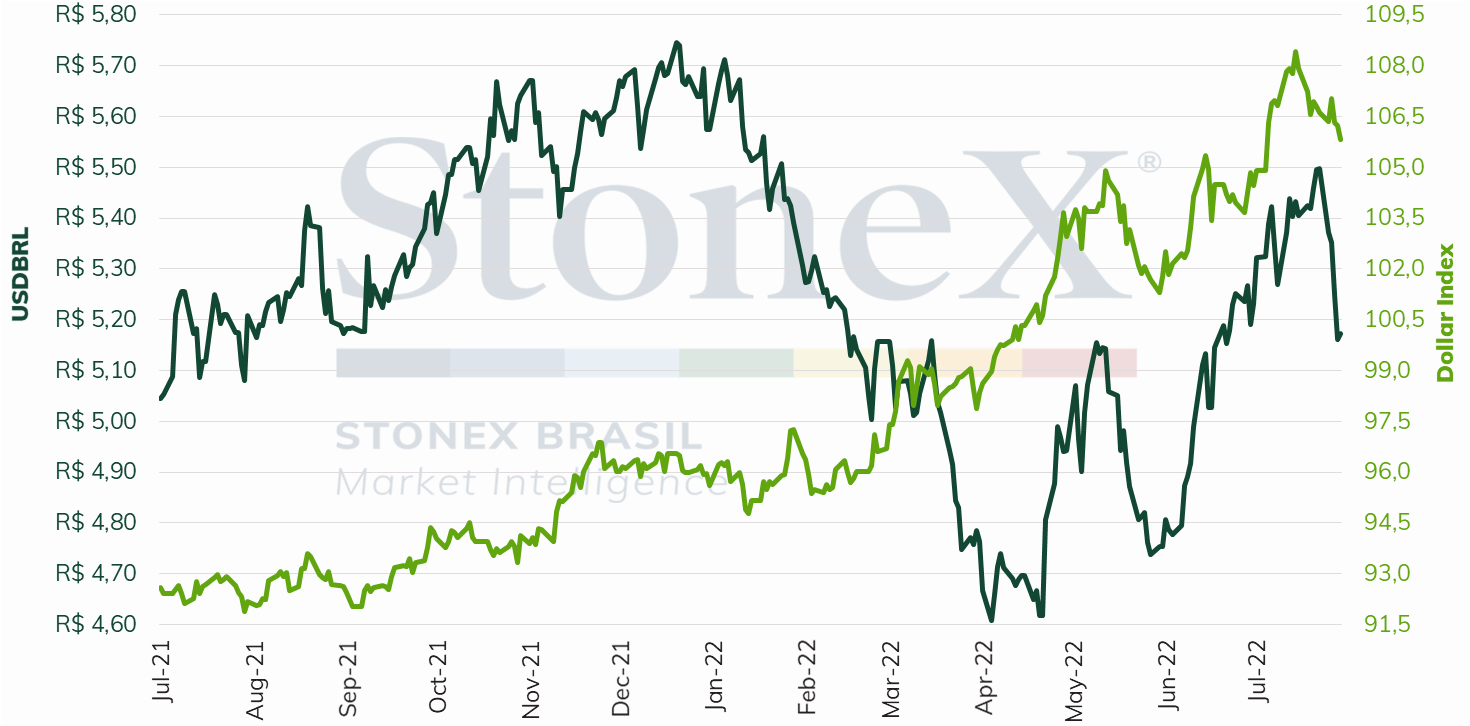
The focus of attention this week will be the degree of the global economy's vitality, particularly the US economy. Last week was marked by strong portfolio repositioning after interpretation of some hesitation from the Federal Reserve (Fed) in sustaining an aggressive pace of increases in the US interest rate and the information that the US GDP contracted for the second consecutive quarter. Likewise, weekly unemployment claims had a slight upward trend since May, with an average of 249,250 claims in the last four weeks. As such, in the coming week, both the employment situation report for the month of June and the ISM Institute's Purchasing Managers Indices (PMI) are expected to signal a slower pace (although no abrupt drop is expected), consistent with the interpretation that an economic recession is starting in the country.
During the week, there was a debate among analysts whether the Federal Open Market Committee (FOMC) would be prepared to act more forcefully in the fight against inflation rates. Even though the central bank reaffirmed its “strong commitment” to price retortion and readjusted the federal interest rate (Fed funds rate) by 75 basis points for the second consecutive decision, a comment by Fed Chair Jerome Powell was ill-received by investors and interpreted as an unwillingness to repeat a third 0.75 BP adjustment at the next meeting. Therefore, it is believed that the members of this Committee should seek to realign the public perception of the Federal Reserve's willingness to remain aggressive in its rate of interest hikes and to be alert to the risks of inflation continuing to surprise beyond of expectations. Chicago Fed Chair Charles Evans, St. Louis Fed Chair James Bullard and Cleveland Fed Chair Loretta Mester are scheduled to speak this week.
In Europe, one week after Moscow and Kyiv signed an agreement with Turkey and the United Nations (UN) to allow grain exports through three Ukrainian ports, no ships have actually managed to leave the port. Issues such as cargo insurance, the crew's return disposition and, mainly, the guarantee of safety for the vessels are still being discussed. Furthermore, Russia once again showed that it had no intention of honoring its agreements by attacking the port infrastructure at the port of Odesa less than 24 hours after signing the agreement. Apparently, for Moscow, the greatest interest is to maximize pressure on Western nations to reduce sanctions on their economy.
In addition to showing little interest in contributing to the global grain trade, the Kremlin further reduced the supply of natural gas to Europe via the Nordstream 1 pipeline from 40% of total capacity to 20% of total capacity, claiming that recent sanctions from Western countries prevent Russia from replacing faulty turbines. The European Union (EU) dismisses this argument. As a result, the EU approved a plan to ration the use of natural gas, providing that all countries in the bloc voluntarily reduce their consumption by 15% from August to March, compared to the average for the period between 2017 and 2021, except for Malta and Ireland, which are not connected to the bloc's gas network. Even so, analysts believe that this reduction cannot completely rule out the possibility of a serious energy crisis on the continent, which would likely exacerbate both inflationary acceleration and economic slowdown in the region.
Domestic Scenario
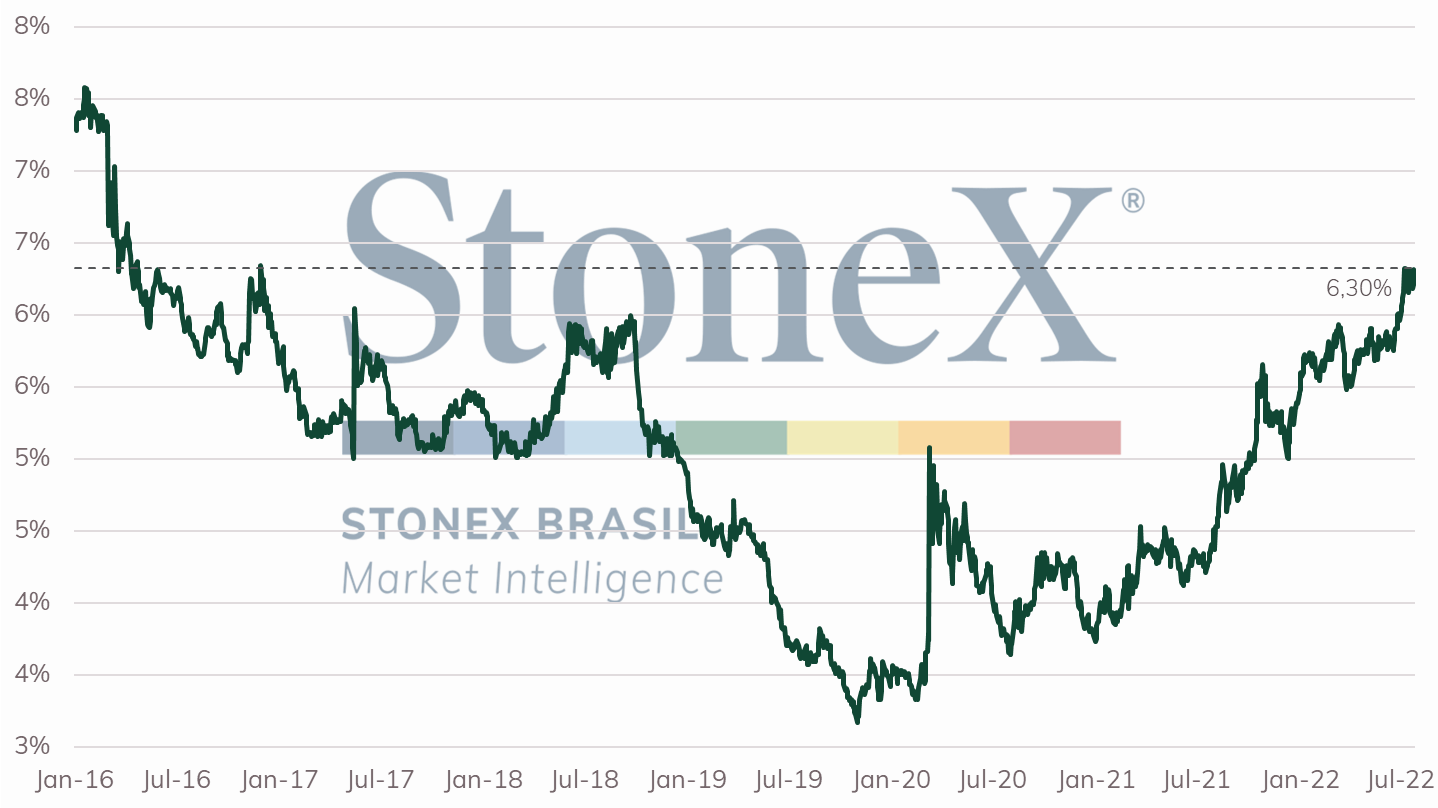
This week's focus will be the meeting of the Brazilian Central Bank's Monetary Policy Committee (Copom). The Committee is faced with a contradictory scenario for its decision on the basic interest rate (Selic). On the one hand, there are factors that make it possible to smooth the current process of monetary tightening. Recent federal government subsidies for fuel and electricity are expected to substantially alleviate the IPCA (Broad National Consumer Price Index) in the coming months, and there is a substantial inflow of foreign funds due to a realignment of expectations about the interest rate trajectory in the United States. On the other hand, there is a forecast of a worsening situation for public accounts due to the large benefits granted by the federal government in recent months, an expectation of inflationary increase from 2023 onwards, and interest rates for financing public debt securities that remain at a very high level. The long-term NTN-B, which pays at real interest (IPCA already offset), remains close to the highest level since December 2016. Although there is no consensus, most estimates point to the Copom increasing the Selic rate from 13.25% p.a. to 13.75% p.a. next Wednesday (3).
PURCHASE RATE OF NTN-B EXPIRING ON 05/15/2045 (% P.A.)
Fonte: Tesouro Direto. Elaboração: StoneX.
With the elections just over two months away, the uncertainties and volatilities related to the domestic environment also tend to accelerate. One of last week's highlights was the organization of members of civil society to sign a broad manifesto in favor of democracy and the Brazilian voting system, pointing out the existence of an "immense danger to democratic normality". In the document, the signatories also mention "unfounded and evidence-lacking attacks" against the electoral system and "insinuations of contempt for the results of the elections". Despite the obvious inferences to the President of the Republic, Jair Bolsonaro, the text does not mention him by name. Among the signatories are presidents and CEOs of large banks and publicly traded companies, former ministers of the Federal Supreme Court, jurists, artists, among others.
Finally, this week's release of conjunctural indicators will allow for an updated reading of the current condition of the Brazilian economy. More recently, estimates for Brazilian GDP have been revised upwards, largely due to the excellent performance of foreign trade and the resilience of domestic consumption. Last week, the unemployment rate surprised analysts with a sharp monthly drop for the third month in a row, going from 11.1% in the quarter ending in March to 10.5%, then 9.8% and now 9.3% in the quarter ending in June. This week, growth is expected compared to the previous month, both for industrial production in June, from the Brazilian Institute of Geography and Statistics, and for the Purchasing Managers Indices (PMI), from S&P Global.