Foreign Scenario
In a week shortened by the Thanksgiving holiday in the United States, the focus should be on public comments from the Federal Reserve (Fed) authorities. Over the past week, the members of the US central bank sought to counter the optimism and appetite for risk that was consolidated after the October Consumer Price Index (CPI). Accordingly, they reinforced the message that, although the Fed should reduce the pace of monetary tightening from this point on, the final level of interest rates will be higher than previously anticipated. Additionally, they stressed the need to keep interest rates at a restrictive level for a sufficiently long time and warned about the risks of prematurely starting a movement of cuts. This message should also be further resonated by the release of the minutes of the latest Federal Open Market Committee (FOMC) monetary policy decision, which is likely to focus on the risks of inflation persistence and the Committee's strategy to mitigate those risks. In addition, Cleveland Fed President Loretta Mester, Kansas City Fed President Esther George, and St. Louis Fed President James Bullard are scheduled to speak next week.
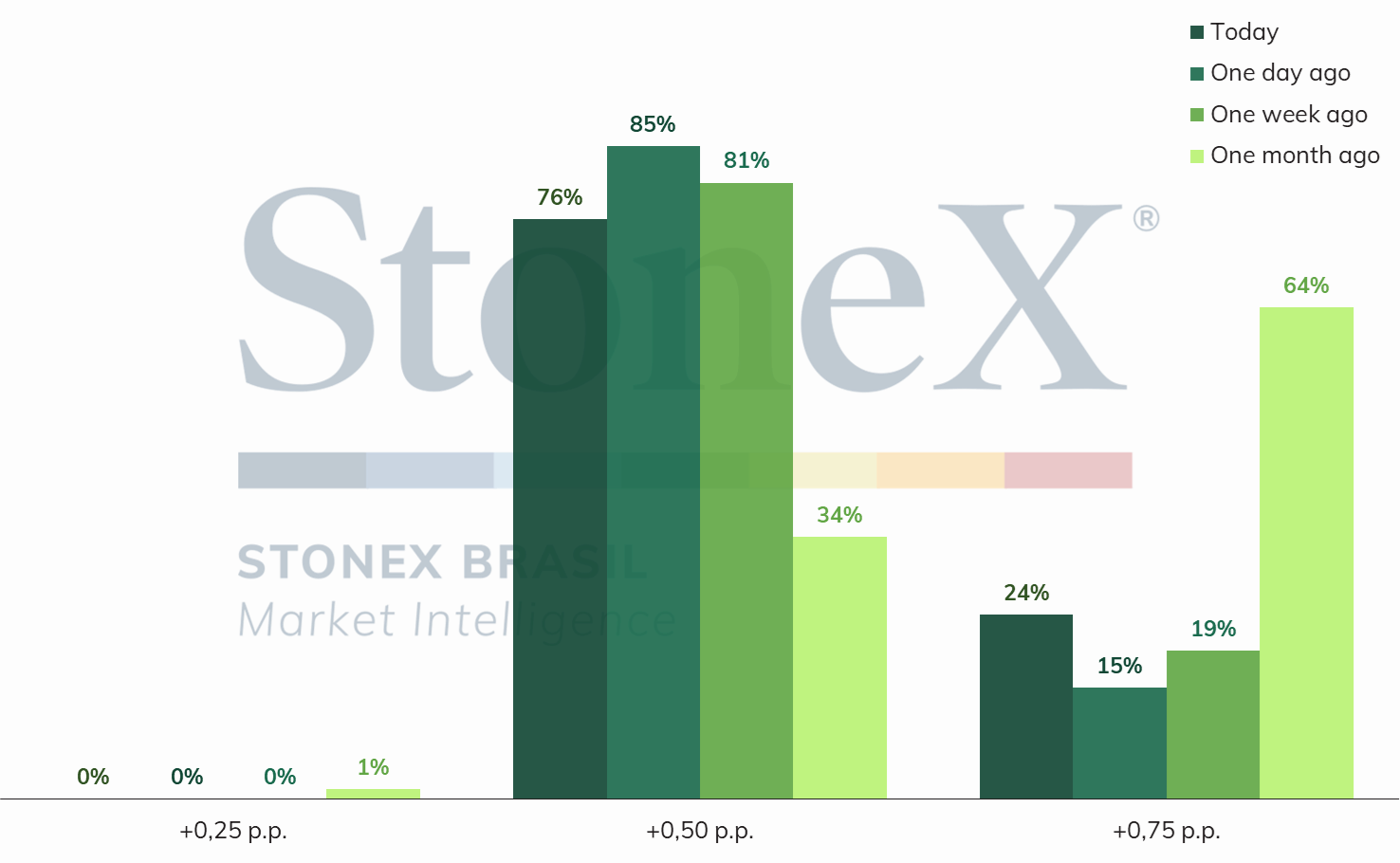
Bets for the Federal Reserve's interest rate decision on December 14
Source: CME FedWatch Tool. Design: StoneX. Futures market interest rate probabilities as of November 18, 2022.
The business environment has stabilized after a week of strong optimism and a search for risky assets. On the one hand, the gaining of a tenuous majority in the House of Representatives by the Republicans encourages a wait-and-see behavior by investors as they await the discussions over fiscal policy deadlines to evaluate the new Congress' capacity for bipartisan articulation. The fear is that the high degree of political polarization in the country will stimulate destructive behavior from the opposition, threatening to refuse to extend the public debt limit in the country and force an unprecedented paralysis of the American state. In addition, the bankruptcy of crypto assets broker FTX, the second largest in the industry, has strongly depressed crypto assets and mildly moderated risk appetite.
The week's leading indicators will be released on Wednesday (23), such as the November services, manufacturing, consolidated Purchasing Managers' Indexes (PMI) and the October Durable Goods Orders for the United States. The average expectation is that the reading of these indicators will point to low monthly growth, consistent with an economy whose activity is moving from expansion to stagnation but not yet fully in retraction.
Finally, it is worth mentioning that the number of Covid-19 cases in China continues to alarm analysts given the concerns that the Asian nation may re-establish the costly quarantines adopted at the height of the zero-tolerance policy that, at one time, provoked an intense slowdown in Chinese economic growth and deteriorated global production and supply chains for industrial products. In the past week, the number of disease cases multiplied from a daily average of 3,731 to 16,016 cases. Yet, at the moment, cities experiencing increased infection, such as Guangzhou, have prioritized district-based measures to restrict mobility without using rigid lockdowns of entire cities, as seen in the past.
Domestic Scenario
In Brazil, the investors’ focus should remain on the sustainability of public accounts after a week of intense mistrust and fears that the next government of Luiz Inácio Lula da Silva will abruptly increase the level of spending and, consequently, public sector debt. The formalization of the draft of the so-called Transition PEC alarmed investors by proposing the permanent removal of the Bolsa Família income transfer program, the constitutional spending limit, which would represent an estimated additional expenditure of BRL 175 billion by 2023. After the Brazilian asset's initial negative reaction, comments made by President-elect Lula, contemporizing the devaluation of the stock market and the national currency, indicating little willingness for any course correction, contributed to aggravating traders' fears.
Only last Thursday (17), the vice-president-elect and coordinator of the transition team, Geraldo Alckmin, risked his political capital and tried to nod to analysts by declaring that the next government will seek to rebalance revenues and expenses. In response to journalists about the investors' reaction to the Proposal of Amendment to the Constitution (PEC) and the high volume of expenses beyond the spending cap, Alckmin classified it as a "momentary" stress and stated that "there will be a primary surplus, there will be a debt reduction, but this cannot be done in 24 hours. This is done over time.” According to the future vice-president, "it is good to make it clear that the [next] government of president Lula is committed to fiscal responsibility, [but that] this cannot be an argument not to attend to social issues," and that the priority now was to approve the PEC. "We have 30 days to approve a PEC, one step at a time. The emergency is now the PEC and LOA [Annual Budget Law]. (...) A new fiscal framework will be discussed, but we have an emergency to solve.
With Lula's return to Brazil this week, analysts will follow the evolution of negotiations about the PEC to see if, in discussion with members of Congress, the proposal will be altered in value or in time. There is an expectation that the validity of the expenses excluded from the spending cap will be limited to four years during the negotiations with members of Congress, which may or may not be confirmed.
It is also worth mentioning the release of the Broad Consumer Price Index 15 (IPCA-15) for November, whose average estimate points to an increase of 0.55% for the month and 6.20% for the year to date, driven by a rise in fuel prices. Additionally, the president of the Central Bank of Brazil, Roberto Campos Neto, is expected to participate in an event on Monday (21) and may emphasize the need to expand the current monetary tightening due to the growth prospects of the public debt in Brazil.