|
South American production to draw the market's attention in Q1 2021
Concerns about the weather and politics affect the development of soybean and corn crops in Argentina, turning attention to Brazil.
In a season marked by planting delays, drier weather, and lack of continuous rainfall, the market's attention is turned to South American due to the La Niña phenomenon's influence.
Estimates point to reduced soybean and corn crops in Argentina compared to the previous cycle. According to the Buenos Aires Grain Exchange, the country is set to harvest 47 million tonnes of corn in 2020/21, representing a drop of 4.5 million tonnes from the previous year. The country is expected to produce 45.5 million tonnes of soybean, a decline of 2.5 million tonnes.
Thus, weather forecasts should continue to be closely monitored in the coming months. Currently, long-term forecasts indicate that the drier climate with high temperatures will persist in the northeastern and central regions of Argentina for the next few months, keeping soil moisture below ideal levels. The most worrying scenario is where most of the soybean and corn production is concentrated in the country and during the grains' filling, maturation, and harvesting stages.
Weather forecasts for northern Argentina and southern Brazil in Q1 2021
 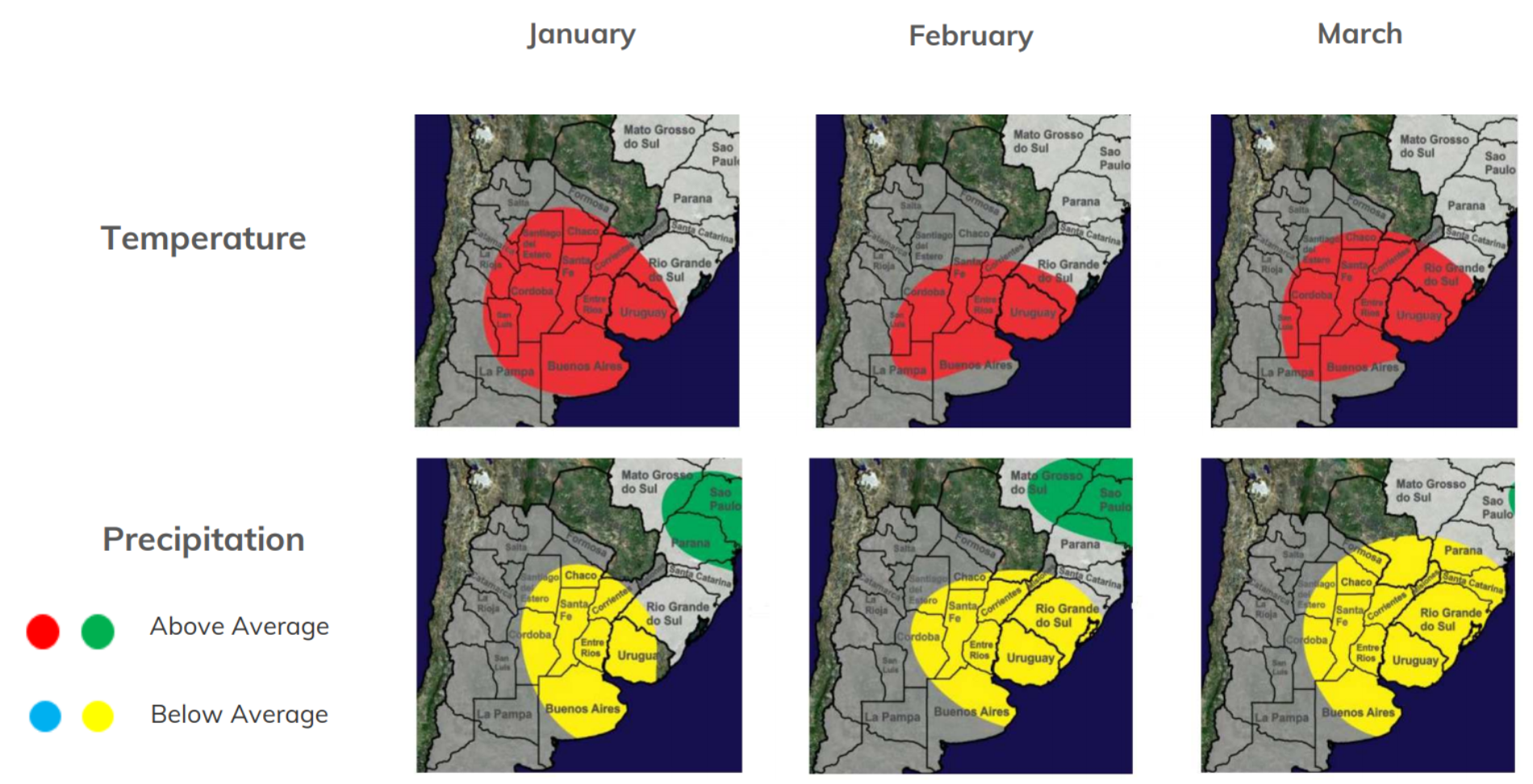
Source: Weather Desk and StoneX.
Concerns about production in South America increased this year as soybean supply and demand balance in the US is tight in the face of continuously heated demand.
In the case of Argentina, in addition to the adverse weather that may still affect soybeans and corn production potential, other factors are also of concern.
SOYBEAN
As 2021 begins, the tariff on soybean exports (retenciones) should return to the 33% level, increasing 3 p.p. compared to the reduction recorded in October last year, raising the market's uncertainties. In addition to affecting the producers' planting decision throughout the year, it is important to note that many international companies operating in Argentina and the higher tax may be a disincentive to activity.
Another point that needs to be monitored is the implications of strikes by workers linked to soybean agribusiness in December. Although the strike has already come to an end, crushing and shipping paused, and more than 160 ships could not be loaded during the period. The situation, which will take a while to be normalized, impact the demand for Argentinian products, competition in the soybean meal and oil markets, such as Brazil, which saw its demand for oil products grow during the strike period.
CORN
On Monday (10), Argentina's government reversed its decision to suspend all corn exports to guarantee domestic supply until February 28.
Last week's decision was revised after harsh criticism and the announcement of a new strike, this time, by farmers, which would start today (11). In response, the Argentine government stated that the country would have a daily quota of exports, totaling 30 thousand tonnes.
The country has already authorized 34.23 million tonnes of cereal from an exportable total of 38.5 million tonnes.
Although it is a less radical decision, it does not eliminate concerns on the supply side. It is important to highlight that in addition to the possibility of this decision increasing the demand for corn in other important players, such as Brazil, there is concern about the impact on Brazilian cereal imports, which, in recent years, has surpassed the 1 million tonnes mark.
Brazil should have its corn supply tight to consumption in the first half of the year, with the first harvest at 25 million tonnes and carryout at 10 million tonnes.
This scenario tends to make imports possible, mainly for the southern states, where the grain is most consumed since Argentina would no longer be a possible origin in the first quarter of 2021.
Thus, the grains' market, which already faces greater volatility, with demand remaining heated and concerns on the production side, needs to consider other factors that directly impact the main market players' supply and demand balance.
|