Quarterly Commodities Outlook is available for free now.  Download your report  →

StoneX logo

Grains Weekly Analysis

By: StoneX Intelligence Brazil, StoneX Intelligence Brazil

Price paid for animals does not follow the grains appreciation 
 
Ana Luiza Lodi
Felipe Sawaia
João Pedro Lopes
 
THE EXCHANGE RATIO WORSENS FOR LIVESTOCK FARMERS IN A SCENARIO MARKED BY WEAKENED DOMESTIC DEMAND FOR PROTEINS AND RESTRICTED SOYBEAN AND CORN SUPPLY

Corn and soybean meal are the main inputs for animal feed, highlighting the preponderance of the cereal, which is around 60% of the components used.

In 2021, the significant corn crop failure maintained a scenario of restricted availability and high prices. This situation weighs on meat production costs, resulting in less favorable exchange ratios between the protein and the input.
Thus, there were high expectations for the 2021/22 crop, bearing in mind that the carryout and the summer harvest mostly guarantee the grain supply in the first half of the year. Unfortunately, however, the South of Brazil suffered from a lack of rainfall in the crop development and production period estimated at 25 million tonnes by StoneX, a volume below that recorded in the previous cycle and the more than 30 million tonnes previously expected for the current summer crop. Given this scenario, corn prices remain very strong, a situation that the highs in Chicago have also reinforced due to the conflict between Russia and Ukraine.

Therefore, the hope for relief on the supply side falls on the "safrinha," whose harvest only starts in the middle of the year.

Thus, when comparing the exchange ratio between corn, pork, chicken, and beef in São Paulo, it can be seen that 2022 started with very unfavorable results. Before talking about the numbers, it is important to remember that the exchange ratio informs how many kilos of input could be acquired by selling 1 kg of a live animal. This is one of the main indicators to understand how the variation in grain prices impacts the operation. 

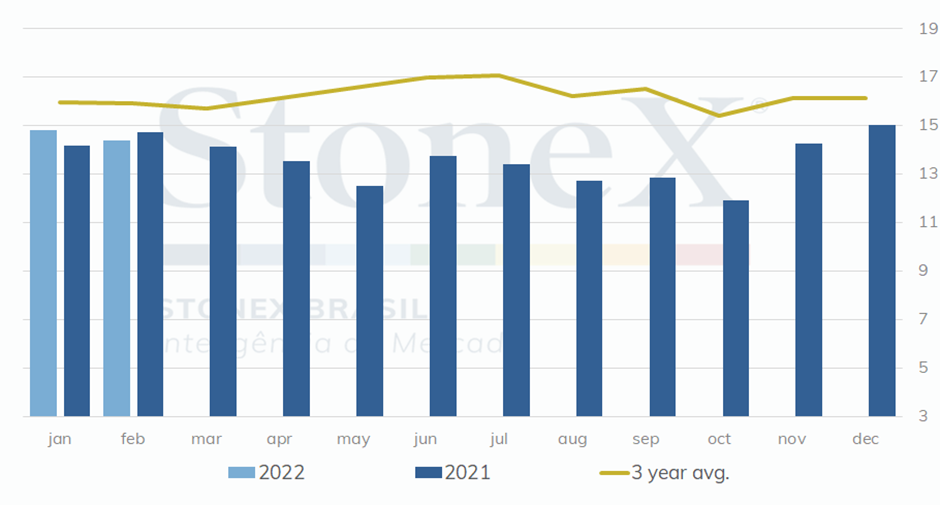
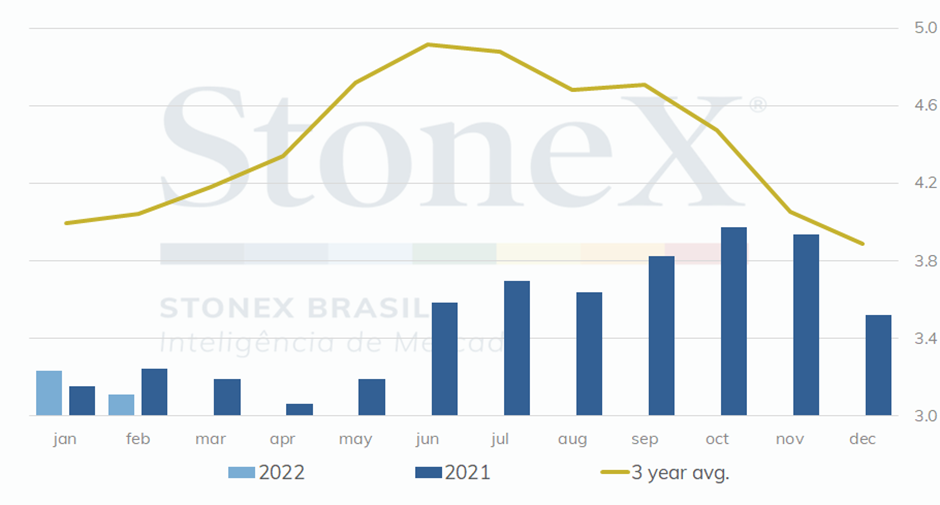
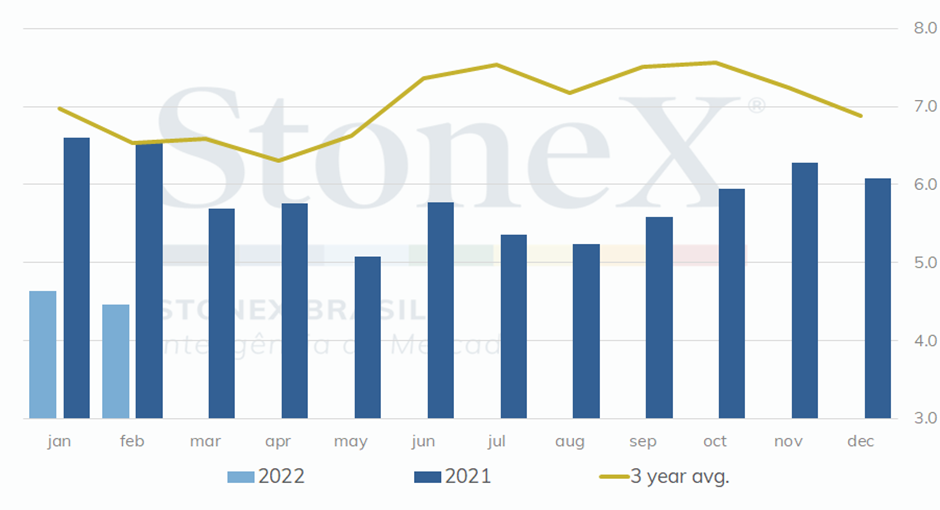
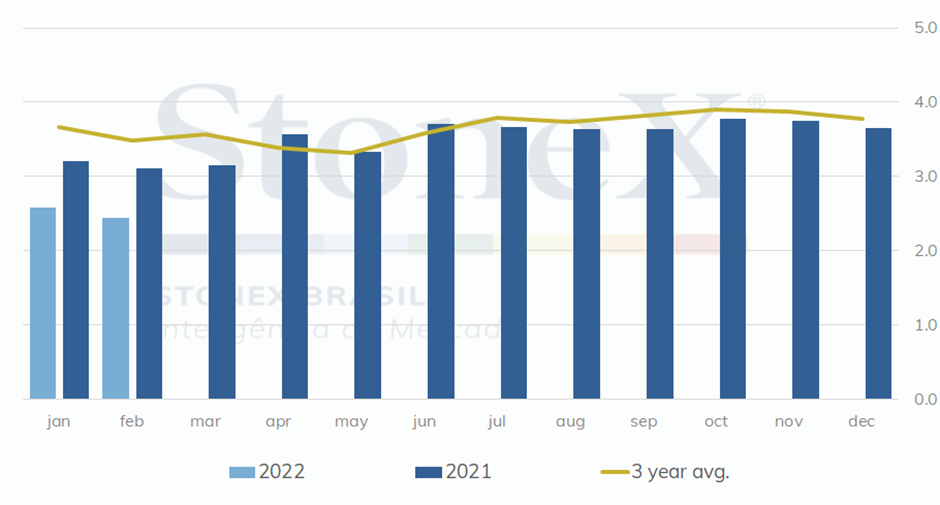
Accordingly, in February 2022, 1 kg of the live hog was equivalent to only 4.5 kg of corn, a ratio lower than the one observed in all of 2021 and far below the 3-year average. As for the chicken, the exchange ratio with corn in February was at 3.1, a level close to, but lower than, the one registered in the same month of 2021, when it reached 3.2. The results have also remained well below the 3-year average. As for cattle, 1 kg of animal in February is equivalent to 14.4 kg of corn, a level in line with a year before but below the average for the period.
 

Live cattle and corn exchange ratio in SP (kg/kg)
image 32484
Source: StoneX and Cepea. Design: StoneX.


Live chicken and corn exchange ratio in SP (kg/kg)
image 32485
Source: StoneX and Cepea. Design: StoneX.
Live hog and corn exchange ratio in SP (kg/kg)
image 32486
Source: StoneX and Cepea. Design: StoneX.

For soybean meal, the picture since last year differs from that observed for corn, but prices have also strengthened.

In 2021, Brazil harvested a record soybean crop exceeding 135 million tonnes, which eased the supply of the oilseed and byproducts after a tight second half of 2020. Initial estimates for the 2021/22 crop currently being harvested indicated another year of absolute record, with production possibly exceeding 145 million tonnes. However, the drought in the South of Brazil has strongly affected this perspective, with significant losses mainly in Rio Grande do Sul and Paraná. Thus, StoneX estimates that production will reach only 121.17 million tonnes, a situation that fuels the possibility of tightening the global balance sheet and supporting grain prices, with impacts on byproducts.

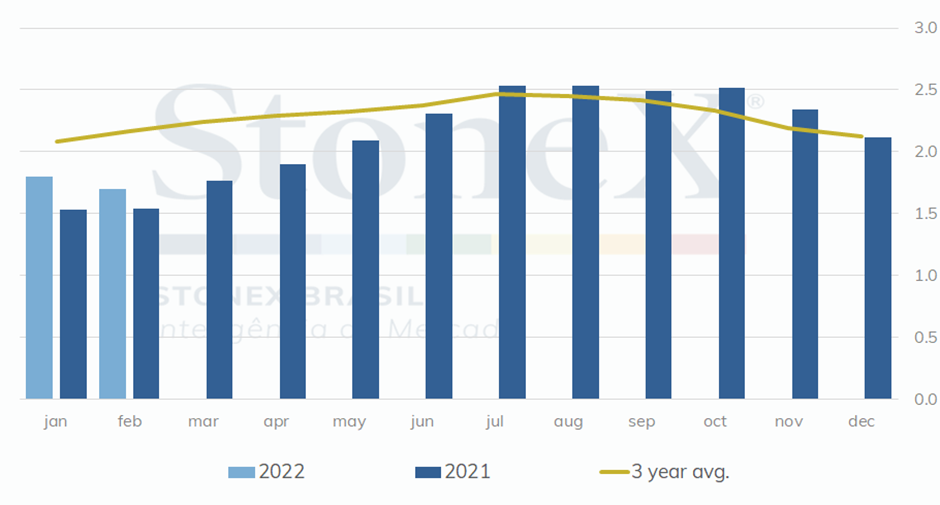
With this, the exchange ratio between hog and meal was only 2.4 in February this year, a considerably lower level than a year before, when it was over 3. The ratio between live chicken in São Paulo and meal presented the same behavior, staying at only 1.7, which was still higher than the one registered in February 2021, but remained below the 3-year average for the month. 

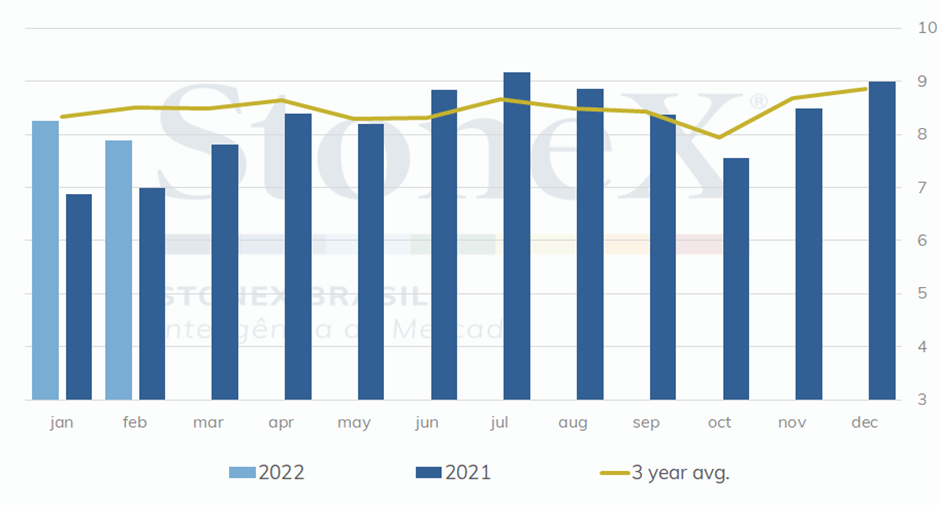
The ratio between live cattle and soybean meal has also been falling in recent months, standing at 7.9 in February this year, a level below the average.

Live cattle and soybean meal exchange ratio in SP (kg/kg)
image 32487
Source: StoneX and Cepea. Design: StoneX.


Live chicken and soybean meal exchange ratio in SP (kg/kg)
image 32488
Source: StoneX and Cepea. Design: StoneX.
Live hog and soybean meal exchange ratio in SP (kg/kg)
image 32489
Source: StoneX and Cepea. Design: StoneX.

In addition to a significant increase in the prices of inputs used by livestock farmers, especially corn, an important factor to understand the deterioration of the purchasing power of animal protein producers is the difficulty they face in passing on the increase in costs to the end of the chain. 

It is important to remember that the country has come from a turbulent period due to the pandemic. The high unemployment rate, high inflation, reduction of the wage mass, and purchasing power act against new significant increases in meat prices. Even though exports, especially beef, continue at high levels, this has not been enough to compensate for the resistance of the domestic market, which is the main destination of the protein produced in the country.

Between February 2021 and 2022, the prices of soybean meal and corn advanced, respectively, 14.6% and 15.2% in São Paulo, the prices paid for chicken and beef advanced 10.5% and 12.8% in the same period. In the case of hog farmers, this scenario is even more alarming since, in the interval analyzed, the price of the animal in São Paulo fell about 21.5%.

Furthermore, it is worth mentioning the beef sector. Contrary to pork and chicken production, the use of feed is not so widespread in this market, predominantly feeding on pasture. In this context, the acquisition of corn and soybean meal gains more importance only in the inter-crop period – approximately between June and December – when some farmers opt for confinement production. Therefore, the analysis of the exchange ratio for beef brings important perspectives for the supply of this protein in the second semester.

As previously highlighted, the exchange ratio between beef and corn and beef and meal is below the last 3-year average, indicating that the livestock farmer suffered from the relative increase in feed prices. This factor could inhibit the confinement activity, reducing the volume of animals available for slaughterhouses in the second semester.

However, feed is only a part of the producer's costs. Only 20% of the expenses with the feedlot are with feed.

The main factor is the purchase of animals for fattening, the so-called feeder cattle.
In recent years, the supply of this animal was quite lean, which made its acquisition difficult and expensive. However, in 2022, after a long period of withholding cows, there are signs that the availability of feeder cattle has increased. According to StoneX's follow-up, the average premium of the feeder cattle price over the live cattle price in the state of São Paulo in March of the last three years was 11.8%. Currently, this premium practically does not exist, with the arroba of cattle before and after fattening trading at the same value.

This cheapening of the replacement is characterized as a great opportunity for the confiner, representing a large reduction in expenses. Therefore, even with the increase in feed prices, there may be an increase in the volume of animals fattened in intensive systems since the total costs in 2022 should be lower than in recent years.

  • Grains & Oilseeds

The StoneX Group Inc. group of companies provides financial services worldwide through its subsidiaries, including physical commodities, securities, exchange-traded and over-the-counter derivatives, risk management, global payments and foreign exchange products in accordance with applicable law in the jurisdictions where services are provided. References to over-the-counter (“OTC”) products or swaps are made on behalf of StoneX Markets LLC (“SXM”), a member of the National Futures Association (“NFA”) and provisionally registered with the U.S. Commodity Futures Trading Commission (“CFTC”) as a swap dealer. SXM’s products are designed only for individuals or firms who qualify under CFTC rules as an ‘Eligible Contract Participant’ (“ECP”) and who have been accepted as customers of SXM. StoneX Financial Inc. (“SFI”) is a member of FINRA/NFA/SIPC and registered with the MSRB. SFI is registered with the U.S. Securities and Exchange Commission (“SEC”) as a Broker-Dealer and with the CFTC as a Futures Commission Merchant and Commodity Trading Adviser. References to securities trading are made on behalf of the BD Division of SFI and are intended only for an audience of institutional clients as defined by FINRA Rule 4512(c). References to exchange-traded futures and options are made on behalf of the FCM Division of SFI . StoneX is a trading name of StoneX Financial Ltd (“SFL”). SFL is registered in England and Wales, Company No. 5616586. SFL is authorized and regulated by the Financial Conduct Authority [FRN 446717] to provide to professional and eligible customers including: arrangement, execution and, where required, clearing derivative transactions in exchange traded futures and options. SFL is also authorised to engage in the arrangement and execution of transactions in certain OTC products, certain securities trading, precious metals trading and payment services to eligible customers. SFL is authorised & regulated by the Financial Conduct Authority under the Payment Services Regulations 2017 for the provision of payment services. SFL is a category 1 ring-dealing member of the London Metal Exchange. In addition SFL also engages in other physically delivered commodities business and other general business activities which are unregulated and not required to be authorised by the Financial Conduct Authority. StoneX Group Inc. acts as agent for SFL in New York with respect to its payments services business. StoneX APAC Pte. Ltd. acts as agent for SFL in Singapore with respect to its payments services business. ‘StoneX’ is the trade name used by StoneX Group Inc. and all its associated entities and subsidiaries.
 
Trading swaps and over-the-counter derivatives, exchange-traded derivatives and options and securities involves substantial risk and is not suitable for all investors. Past performance of any futures or option is not indicative of future success. Indicators are not a trading system and are not published as a specific trade recommendation. The information herein is not a recommendation to trade nor investment research or an offer to buy or sell any derivative or security. It does not take into account your particular investment objectives, financial situation or needs and does not create a binding obligation on any of the StoneX group of companies to enter into any transaction with you. You are advised to perform an independent investigation of any transaction to determine whether any transaction is suitable for you. No part of this material may be copied, photocopied or duplicated in any form by any means or redistributed without the prior written consent of StoneX Group Inc.
 
© 2026 StoneX Group Inc. All Rights Reserved.

Satellite view of Earth at night showing illuminated cities across Asia and the Middle East

Discover more insights

Our subscribers have access to comprehensive market analysis from StoneX spanning commodities, equities, currencies and more.

Related articles for Grains & Oilseeds

Perspective: Morning Commentary for August 6

August 6 – This morning’s stronger-than-expected U.S. labor data offered markets some relief, reinforcing confidence in the economy while giving the Fed greater flexibility to raise rates should inflationary pressures reaccelerate in next week’s July data. Stock futures are pointing to a mixed open to start the day, with the tech-heavy Nasdaq showing the most weakness. The VIX has fallen notably from yesterday’s spike above 18.4 as it starts the day hovering just below the 16-mark. The dollar is quietly higher as it trades just above 99.8, holding in the tight range seen thus far this week as traders continue to digest data to shape expectations for the Fed’s next move, which we’ll dive into in more depth below. Long-term treasury yields have relaxed slightly from their recent spike, with 30-year yields starting the day trading just above 5.19%, while 10-year yields trade above 4.64%, and 2-year yields sit below 4.22%. Crude oil is modestly higher to start the session after sharp declines earlier in the week, with nearby WTI up 1.8% to trade at $76.40 and nearby Brent up 2.4% to trade at $81.40. Meanwhile, the ags are quietly mixed to start the day.

Mike Castle
Mike Castle
  • Grains & Oilseeds
  • Energy
  • Dairy
  • Renewable Fuels
  • Cocoa
  • Coffee
  • Cotton
  • Sugar
  • Meats & Livestock
  • Forest Products

Perspective: Morning Commentary for August 5

August 5 – U.S. equities markets are on fire this week, with both the Dow Jones and S&P 500 setting new all-time highs yesterday with futures indicating further gains again today; the marketplace remains optimistic over a deal with Iran despite no evidence of such as of yet. Crude oil is working on a lower high and low today but remains slightly on the high side on the session, while the dollar is retreating back towards Monday’s nearly two-month low. The ten-year note is steady-to-lower this morning (though solidly lower so far this month) at 4.605%, while the VIX index continues to rebound into mid-week at almost a 17-point reading this morning.

Matt Zeller
Matt Zeller
  • Grains & Oilseeds
  • Energy
  • Dairy
  • Renewable Fuels
  • Cocoa
  • Coffee
  • Cotton
  • Sugar
  • Meats & Livestock
  • Forest Products

Perspective: Mid-Day Commentary for August 4

August 4 – The Dow Jones is absolutely piling on gains today, adding a similar number that led to yesterday’s record, with the benchmark index now nearing the 54k-point mark through mid-morning. The S&P also hit a new record, while the NASDAQ is exceeding both those gains on a percentage basis. The marketplace is optimistic on a U.S.-Iran trade deal, though the proposed resolution is still being “circulated between the parties”.

Mike Castle
Mike Castle
  • Grains & Oilseeds
StoneX: We open markets

Our market expertise, advanced platforms, global reach, culture of full transparency and commitment to our clients’ success all set us apart in the financial marketplace.

Reach

With access to 40+ derivatives exchanges, 180+ foreign exchange markets, nearly every global securities marketplace and numerous bi-lateral liquidity venues, StoneX’s digital network and deep relationships can take clients anywhere they want to go.

Transparency

As a publicly traded company meeting the highest standards of regulatory compliance in the markets we serve; our financials and record of accomplishment are matters of public record. StoneX’s commitment to “doing the right thing over the easy thing” sets us apart in the industry and helps us build respect, client trust and new partnerships.

Expertise

From our proprietary Market Intelligence platform, to “boots on the ground” expertise from award-winning traders and professionals, we connect our clients directly to actionable insights they can use to make more informed decisions and achieve their goals in the global markets.