The USDA released its Planting Intentions report at the end of March, bringing the first estimates based on qualitative information collected from producers. The numbers were surprising, with an expected area for soybean in 2022/23 at 36.8 million hectares, considerably above the market’s average expectations, at 35.9 million, and 36.2 million hectares for corn, 1 million hectares less than expected by the market.
The planting intentions survey was indeed carried out in a period that did not fully capture the conflict between Russia and Ukraine. However, since the end of February, when the war started, corn prices in Chicago advanced proportionally more than soybean prices, which would favor the grain over the oilseed when comparing Chicago contracts for the end of 2022, when the new North American crop will enter the market.
Amid a scenario of great uncertainty, with the break of the 2021/22 soybean crop in South America and the conflict between Russia and Ukraine impacting the availability of corn and wheat, the progress of the North American crop will be another issue that may bring changes to the final grains acreage in the country in the 2022/23 cycle. In addition, the market has been closely following weather issues and the progress of spring crop planting in the US, as there may be last-minute migrations between crops.
In this initial period of work for the sowing of soybeans and corn in the US, the wetter and colder weather in important parts of the country has not favored the advance of the sowing of grains, especially corn. As a result, the soybeans planting reached 8% by May 1, 5 percentage points below the 5-year average and 14 percentage points less than last year.
For corn, the delay observed is even sharper. By the beginning of this month, 14% of the cereal area had been sown, 19 p.p. less than the 5-year average and 28 p.p. less than that observed in 2021.
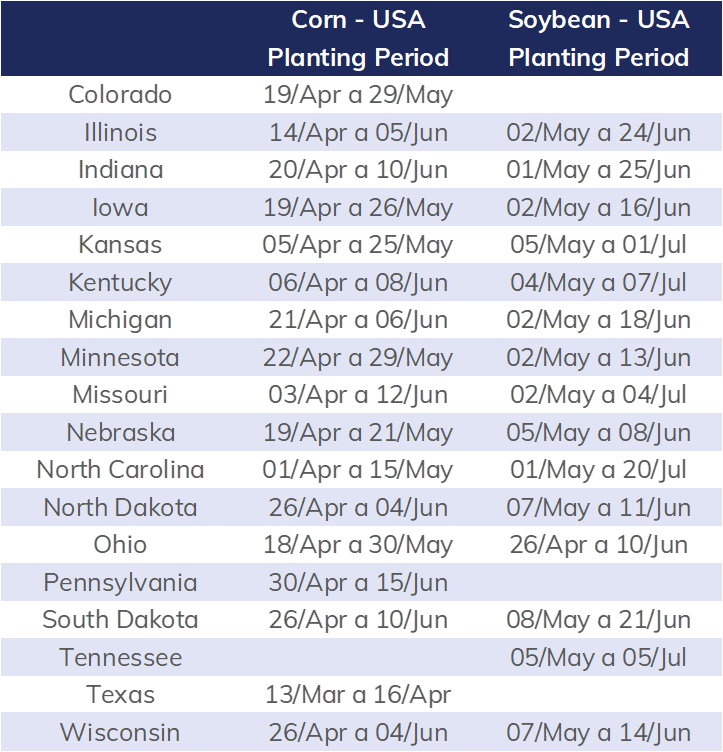
Thus, these delays bring more uncertainty to the final North American grain area. If corn planting continues to be delayed, there may be some incentive to redirect part of the corn area to soybean planting since the ideal planting window for the oilseed closes a little later than corn's ideal period.
Corn and soybean planting periods* by state - US
Source: USDA. NOTE: Planting windows may have variations of a few days and also related to different areas of each state.
Weather models pointed to more favorable weather for the grain planting progress in the US in the first week of May. Thus, the crop follow-up released by the USDA on Monday, May 9, will be very important, as it will inform whether the planting pace in the country benefited from the weather last week.
The weather issue in the US and O&D fundamentals in important players should continue to affect the dynamics of grain prices, which may lead to advances in the area dedicated to grains as a whole and/or the reconfiguration of the area dedicated to each crop.
The Black Sea conflict and its impacts on logistics and the 2022/23 spring crop planting should continue to influence the market and, consequently, may still generate some change in the planting decision of US farmers. In addition, the concern with the surge in Covid-19 cases in China and a negative impact on the country's economy and the low crushing margins and pig farming bring some questions about the Chinese demand for grains. Accordingly, as the country's imports have much greater relevance in the international soybean market than corn, the perception of a lower Chinese demand could favor the corn planting in the US in this case.
One cannot fail to also comment on the second 2021/22 corn crop in Brazil, which, despite presenting record production estimates, is also surrounded by uncertainties since the lack of rainfall in the Center-West region may significantly impact its performance.
Another point that has been followed is the situation of the vegetable oils global market, which was no longer calm, and the conflict in Ukraine brings many doubts on the supply side since the country, along with Russia, is the main producer and exporter of sunflower oil. In addition, faced with escalating inflation worldwide, Indonesia has banned exports of palm oil, remembering that the country is the world's largest producer and exporter. It is not known when this measure will be in force, but these vegetable oil issues are a positive factor for planting more soybeans.