Quarterly Commodities Outlook is available for free now.  Download your report  →

StoneX logo

Grains Weekly Analysis

By: StoneX Intelligence Brazil, StoneX Intelligence Brazil

Concern over recession remains prominent; WASDE has little impact on the market
 
Ana Luiza Lodi
Isabela Garcia
João Pedro Lopes
  Nuria Brito
YIELD REVISIONS FOR THE NEW CORN AND SOYBEAN CROPS WILL ONLY BE ADJUSTED STARTING IN AUGUST
The USDA's July WASDE report usually does not bring significant changes, highlighting that the US new crop yield will only be adjusted from August. Yield adjustments are already expected for the country's wheat, which has an earlier season. For cotton, it is worth mentioning that, despite the increase in the planted area and the average yield, the estimated production for the US fell due to the predominance of unfavorable weather in the main areas, and the USDA cut the harvested area.
Soybean

For the US, the USDA incorporated the lower planted area for the 2022/23 cycle, according to the 06/30 report, keeping yields unchanged. Accordingly, the total production estimate was reduced to 122.61 million tonnes. Although further area revisions may still occur, yield is the variable that has the greatest potential to bring further changes to production, with the weather in the coming weeks being very important as the oilseed will enter the grain filling stage.

Even with this decrease in production, carryout fell less than expected, standing at 6.27 million tonnes, since there were some cuts on the demand side for the new crop. 

For the 2021/22 crop, the USDA brought a slight cut in crushing, which stood at 60 million tonnes, reflected in a proportional increase in ending stocks. 

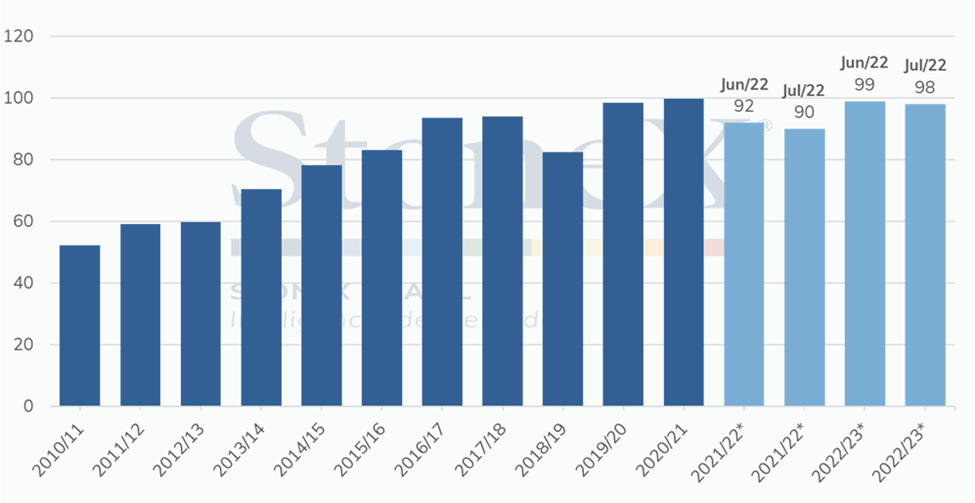
The report highlighted the cut in Chinese 2021/22 imports to 90 million tonnes, while the 2022/23 volume was reduced to 98 million. There are many questions about Chinese demand, which has not reacted as expected after lockdowns to fight Covid-19 were suspended, and its crush margin is often negative. Another point that the market follows is hog prices in the country, which are under pressure, a situation that increases concerns about the demand for feed.

In the global balance, expectations continue pointing to a more comfortable situation, with production exceeding consumption by 13.65 million tonnes.
 

Evolution of soybean imports - China (MMT)

image 44042
Source: USDA. Design: StoneX. *USDA estimate.
 
Corn

Like the soybean market, the July WASDE did not bring any major surprises for corn, with the main changes in the corn balance linked to the incorporation of the US planted area figures released by the USDA at the end of June.

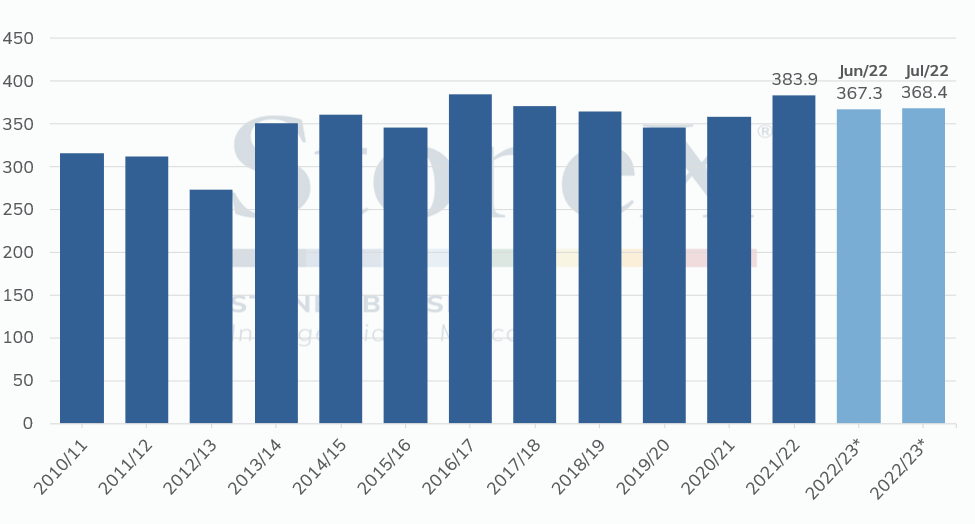
The country's production was raised by 1.1 million tonnes to 368.4 million tonnes. However, due to a slight decrease in domestic consumption for the 2021/22 crop, from 316 million to 315.4 million tonnes, ending stocks for the new crop increased slightly more than production, by 1.8 million tonnes to 37.3 million tonnes. Thus, the country's stock-to-use ratio increased by 0.5 p.p. compared to the June report, to 10.1%.

Despite the weakening pace of US corn shipments over the past few weeks, the USDA did not change its estimate for the 2021/22 crop, which remains at 62.2 million tonnes. 

According to the USDA's export inspection report, as of July 7, the US had shipped 49.2 million tonnes of corn, 13 million tonnes below the Department's estimate for the current crop. Thus, to reach the USDA projection, the country would need to ship about 1.6 million tonnes of corn per week by August, about 20% above the average of the last ten weeks (1.3 million tonnes). Thus, there is room for the USDA to revise its number for US corn exports in 2021/22 in the next WASDE.

In addition to a possible change in the export number, it would not be surprising if the Department again revised its production estimate for the US 2022/23 crop, this time with the change occurring on the yield side. Since the first estimate released for the new crop, the USDA has brought in an average yield of 177 bu/acre, or 11.1 t/ha, a number consistent with "normal" crop conditions. However, according to NOAA's Drought Monitor tracking, considerable portions of the US Midwest had drier than normal conditions at the end of the second week of July. In addition, the models point to a continued dry and hot pattern through the end of this week, which could hurt the country’s crop yields. 
 

US corn production trend (MMT)

image 43899
Fonte: Source: USDA. Design: StoneX. *USDA estimate.. Elaboração: StoneX. *Estimativa USDA..
 
Wheat

Wheat got the attention of the grain market after an increase in production and stock estimates for the new crop in the United States, which, despite lower production globally, guided the downward movement in prices on the CBOT last week.

For the domestic market in the United States, the 2022/23 wheat crop was estimated at 48.47 million tonnes, an increase of 8% over the previous crop and 2% compared to the June estimate. Stocks were also revised upwards by 34,000 tonnes to 17.39 million tonnes. It is worth remembering that the winter wheat harvest was 63% complete by Sunday (10). This is up from 54% a week earlier and indicates progress at a good pace, higher than the five-year average, at 61%.

The scenario for world wheat was more conservative, with a small drop in production and consumption. As a result, world production in the 2022/23 crop was reduced to 771.64 million tonnes, and consumption reached 784.22 million tonnes, a variation of -0.2% compared to the previous estimate for both. 

As for Brazil, production was maintained at 8.5 million tonnes, still below the 9 million tonnes estimated by Conab but above the 7.7 million tonnes of the 2021/22 crop. Stocks were also higher than the previous crop, reaching 1.11 million tonnes. Exports also showed a subtle rise to 3 million tonnes.

US wheat production trend (MMT)
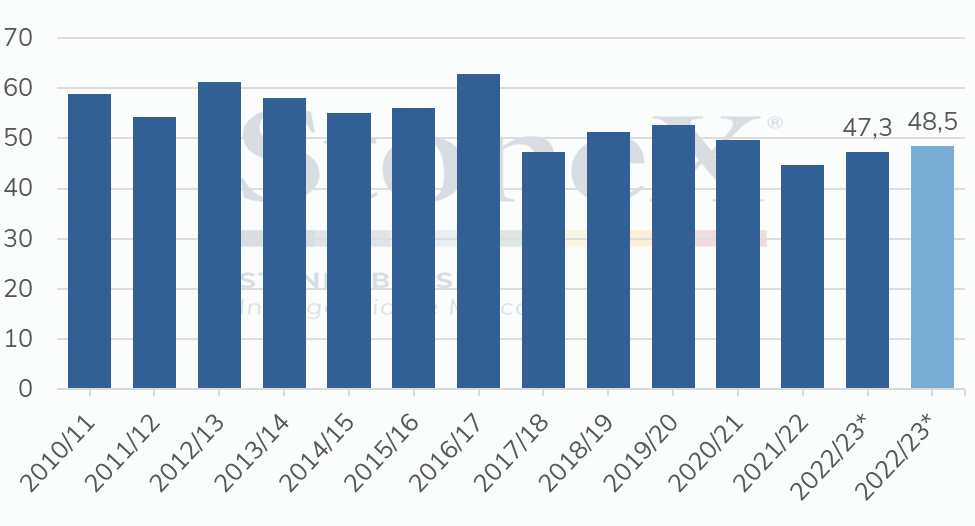
image 43900

Source: USDA. Design: StoneX. *USDA estimate.

Cotton

The July WASDE report brought changes to global supply and demand indicators for the 2022/23 crop season, reflecting the changing growth outlook for the world economy. In recent weeks, the increased inflation and announcements of contractionary adjustments by several central banks, especially the Fed, led to the expectation that household incomes will fall, reducing the consumption of textile derivatives to 26.1 million tonnes (-400,000 from June). In addition, global supply has also been revised up, but to a lesser extent than demand, and the S&D balance is now more balanced, with consumption slightly lower than production.

The biggest supply adjustments were in the United States and Brazil. In the US, production for the 2022/23 cycle was further reduced from 3.59 million tonnes in June to 3.37 million this month (-6.1%). With this, the country's exports were also reduced by 3.4% and ending stocks are now evaluated at 0.52 million tonnes, a drop of 17% from June and almost 30% when compared to the figure for 2021/22. Furthermore, with these results, it is admitted that the abandonment rate is approximately 31%, a value above the average for the country (20%) and a direct consequence of the unfavorable weather that prevails in the Cotton Belt, especially in Texas, with the exceptional drought and hot temperatures threatening the crops.

In Brazil, the production revision for the next cycle (from 2.9 million to 2.8 million tonnes) does not annul the perspective of growth of this indicator between crops, being 5.7% higher than in 2021/22. Moreover, Brazilian exports should be around 2 million tonnes, well above the 1.7 million tonnes expected for the current crop.

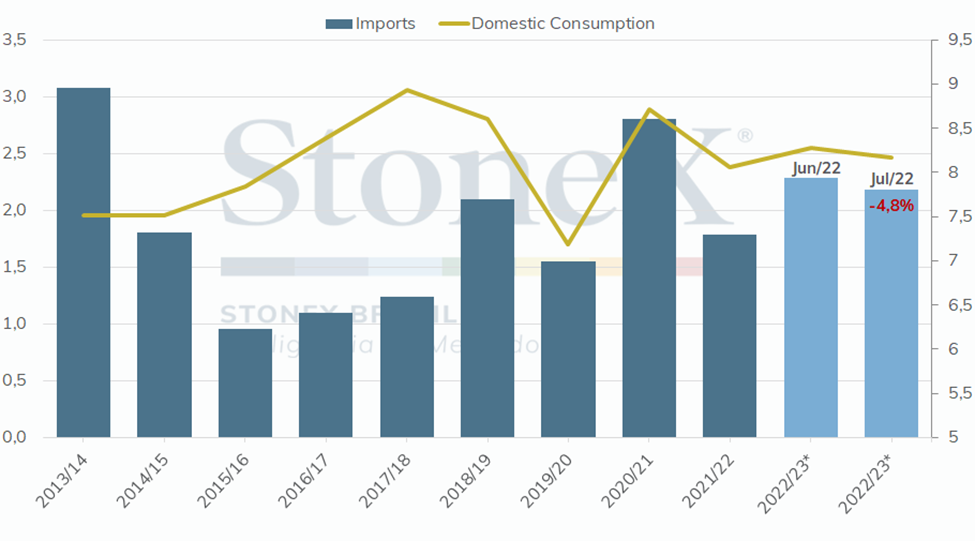
Despite these bullish factors, the WASDE report showed significant, though expected, revisions in demand. Countries such as China, Bangladesh, and Vietnam, the largest plume demanders, had their consumption and imports reduced. In China, for example, domestic consumption fell to 8.2 million tonnes (-100,000 from June), which explains a similar drop in imports. Despite these revisions, the annual variation of these indicators remains positive but may not be able to sustain itself with the prospect of stagflation.  
Overall, the report assumed a neutral/bearish tone, given that the agents were already expecting the revisions made by the agency. Thus, it helped partially explain the drops in cotton prices in NY last week, but the speculative factor continues to have greater weight on the downward trajectory of cotton in the short term.
 

Evolution of cotton imports and consumption in China (MMT)

image 44044
Source: USDA. Design: StoneX. *USDA estimate.
 
  • Grains & Oilseeds

The StoneX Group Inc. group of companies provides financial services worldwide through its subsidiaries, including physical commodities, securities, exchange-traded and over-the-counter derivatives, risk management, global payments and foreign exchange products in accordance with applicable law in the jurisdictions where services are provided. References to over-the-counter (“OTC”) products or swaps are made on behalf of StoneX Markets LLC (“SXM”), a member of the National Futures Association (“NFA”) and provisionally registered with the U.S. Commodity Futures Trading Commission (“CFTC”) as a swap dealer. SXM’s products are designed only for individuals or firms who qualify under CFTC rules as an ‘Eligible Contract Participant’ (“ECP”) and who have been accepted as customers of SXM. StoneX Financial Inc. (“SFI”) is a member of FINRA/NFA/SIPC and registered with the MSRB. SFI is registered with the U.S. Securities and Exchange Commission (“SEC”) as a Broker-Dealer and with the CFTC as a Futures Commission Merchant and Commodity Trading Adviser. References to securities trading are made on behalf of the BD Division of SFI and are intended only for an audience of institutional clients as defined by FINRA Rule 4512(c). References to exchange-traded futures and options are made on behalf of the FCM Division of SFI . StoneX is a trading name of StoneX Financial Ltd (“SFL”). SFL is registered in England and Wales, Company No. 5616586. SFL is authorized and regulated by the Financial Conduct Authority [FRN 446717] to provide to professional and eligible customers including: arrangement, execution and, where required, clearing derivative transactions in exchange traded futures and options. SFL is also authorised to engage in the arrangement and execution of transactions in certain OTC products, certain securities trading, precious metals trading and payment services to eligible customers. SFL is authorised & regulated by the Financial Conduct Authority under the Payment Services Regulations 2017 for the provision of payment services. SFL is a category 1 ring-dealing member of the London Metal Exchange. In addition SFL also engages in other physically delivered commodities business and other general business activities which are unregulated and not required to be authorised by the Financial Conduct Authority. StoneX Group Inc. acts as agent for SFL in New York with respect to its payments services business. StoneX APAC Pte. Ltd. acts as agent for SFL in Singapore with respect to its payments services business. ‘StoneX’ is the trade name used by StoneX Group Inc. and all its associated entities and subsidiaries.
 
Trading swaps and over-the-counter derivatives, exchange-traded derivatives and options and securities involves substantial risk and is not suitable for all investors. Past performance of any futures or option is not indicative of future success. Indicators are not a trading system and are not published as a specific trade recommendation. The information herein is not a recommendation to trade nor investment research or an offer to buy or sell any derivative or security. It does not take into account your particular investment objectives, financial situation or needs and does not create a binding obligation on any of the StoneX group of companies to enter into any transaction with you. You are advised to perform an independent investigation of any transaction to determine whether any transaction is suitable for you. No part of this material may be copied, photocopied or duplicated in any form by any means or redistributed without the prior written consent of StoneX Group Inc.
 
© 2026 StoneX Group Inc. All Rights Reserved.

Satellite view of Earth at night showing illuminated cities across Asia and the Middle East

Discover more insights

Our subscribers have access to comprehensive market analysis from StoneX spanning commodities, equities, currencies and more.

Related articles for Grains & Oilseeds

Perspective: Mid-Day Commentary for August 7

August 7 – Stocks are looking to end a strong week on a strong note, with the major indexes all in the green at the time of writing. The VIX touched a nearly seven-month low earlier in the session and remains muted as it hovers just below the 15-mark as this morning’s ugly labor market data helps ease hawkish Fed jitters. The dollar has rebounded from its nearly two-month low earlier in the session but remains in the red on the day, trading at 99.55 at the time of writing. Treasuries have had a very volatile day, with yields tanking following this morning’s Non-Farm Payrolls release but bouncing back into midday, with 30-year yields now trading at 5.209%, 10-year yields trading at 4.654%, and 2-year yields trading at 4.204%. Crude oil has risen from the morning lows as traders eye the weekend market closure for potential geopolitical developments, with nearby WTI now down only 0.2% on the day to trade around $78.10 and nearby Brent breaking into the green, up 1.25% on the day to trade above $83.50. The ags are largely mixed, with the grains and oilseeds mostly in the green, save for a mixed picture in the soy complex, while live and feeder cattle futures move in opposite directions, with the former adding to yesterday’s sharp losses and the latter attempting a rebound.

Mike Castle
Mike Castle
  • Grains & Oilseeds

Perspective: Morning Commentary for August 7

August 7 – The U.S. economy unexpectedly lost 23k jobs in July, dramatically below market expectations of an 80k increase and marking the worst Non-Farm Payrolls print since February. Furthermore, May and June were both revised sharply downward, with combined revisions showing 103k fewer jobs than previously reported. Outside of the healthcare sector, which added 22k jobs in July, the losses were very broad-based. Government payrolls saw the largest decline, shedding 53k jobs in July, the largest seen since October 2025, while June was revised down to show a loss of 10k jobs as well. The private sector at least saw growth, adding 30k jobs in July, now matching the month prior after it was revised down from the 49k initially reported, and substantially missing forecasts of 78k jobs being added. This is a sharp reversal in course from the largely better than expected U.S. labor data seen earlier this week.

Mike Castle
Mike Castle
  • Grains & Oilseeds
  • Energy
  • Dairy
  • Renewable Fuels
  • Cocoa
  • Coffee
  • Cotton
  • Sugar
  • Meats & Livestock
  • Forest Products

Morning Grain Comments 8-7

Morning Grain Market Comments - Matt Zeller

Matt Zeller
Matt Zeller
  • Grains & Oilseeds
StoneX: We open markets

Our market expertise, advanced platforms, global reach, culture of full transparency and commitment to our clients’ success all set us apart in the financial marketplace.

Reach

With access to 40+ derivatives exchanges, 180+ foreign exchange markets, nearly every global securities marketplace and numerous bi-lateral liquidity venues, StoneX’s digital network and deep relationships can take clients anywhere they want to go.

Transparency

As a publicly traded company meeting the highest standards of regulatory compliance in the markets we serve; our financials and record of accomplishment are matters of public record. StoneX’s commitment to “doing the right thing over the easy thing” sets us apart in the industry and helps us build respect, client trust and new partnerships.

Expertise

From our proprietary Market Intelligence platform, to “boots on the ground” expertise from award-winning traders and professionals, we connect our clients directly to actionable insights they can use to make more informed decisions and achieve their goals in the global markets.