The US-Iran war is entering its third week without a clear path towards resolution. That leaves a serious cloud of uncertainty that will accumulate economic consequence as long as it persists. Meanwhile, the Fed – and many other central banks – will reflect on the risk with rate decisions.
Talking Points:
The reality of the US-Iran conflict are sinking in and now the economic implications of the protracted military engagement is gaining greater prominence
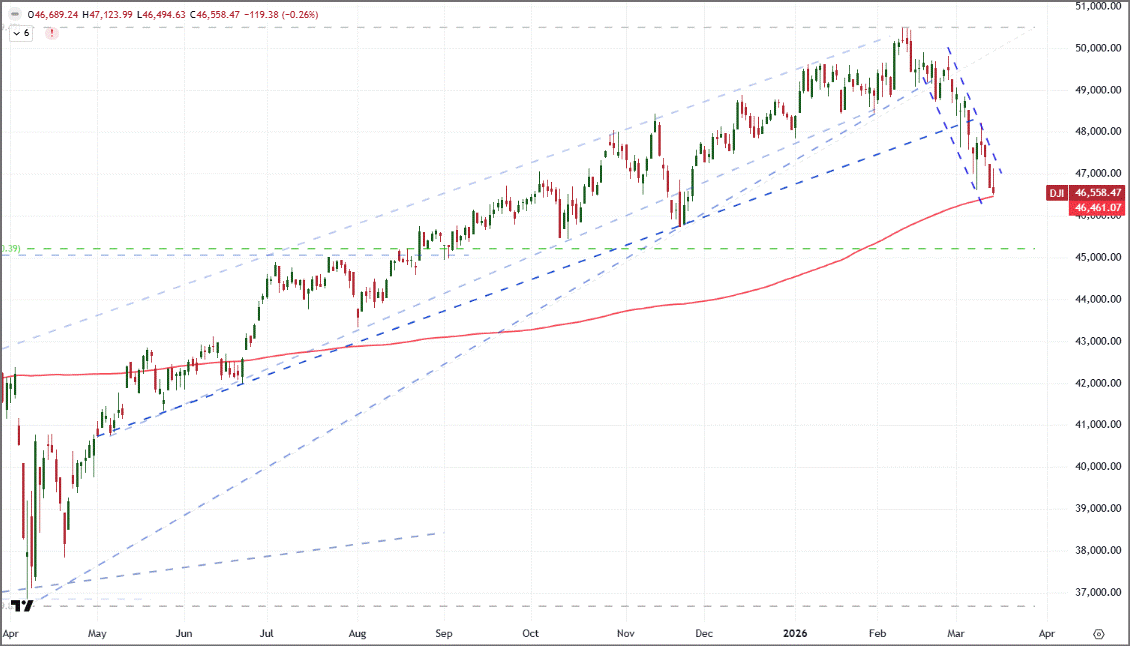
Risk benchmarks are flagging, but the technical accelerant for a more committed unwind may be the proximate 200-day moving average for the Dow, S&P 500 and Nasdaq 100
Monetary policy will be a far-reaching theme ahead, with the FOMC decision a centerpiece between updated forecasts, a proximate Chairman swap and higher energy prices
Watch the Full Video
As US-Iran Conflict Shifts from Headlines to Economic Impact
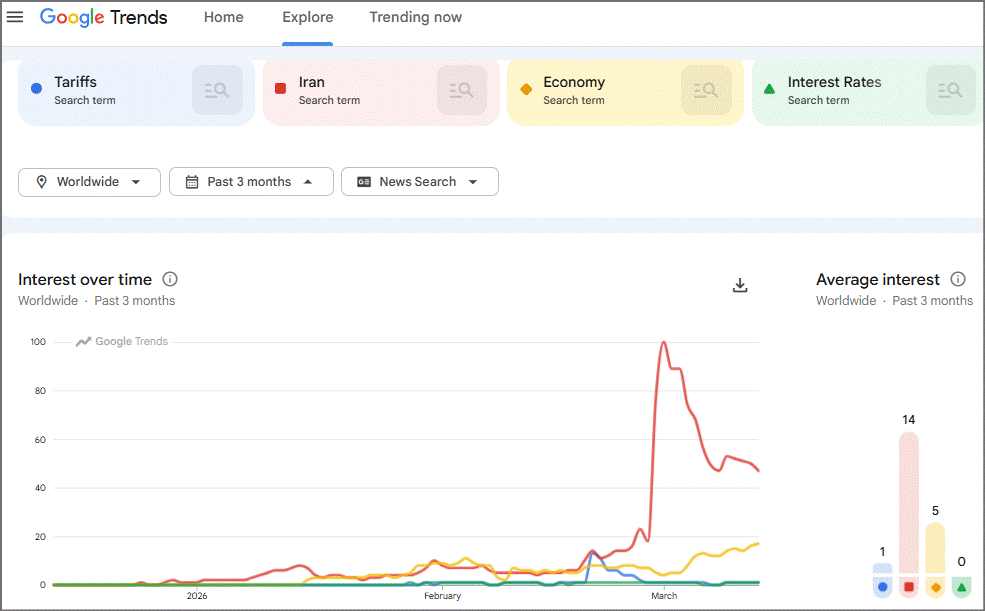
We have entered the third week of the US-Iran conflict, and there seems little sign of a genuine resolution in any of the rhetoric that is being distributed from either side of the battle. The headline shock seems to be receding as the reality of a protracted war seems to be seeping into the collective conscious. And, without a devastating financial or geopolitical calamity, markets are doing what they always do: adapting to the new ‘normal state’. However, in this case, even a contained war will accrue a tangible economic and financial toll that eventually finds its way to unsettle the heart of speculative complacency that has persisted for so many months. We have already seen with the drop in ‘Iran’ search interest that there has bene a commensurate swell in news interest around ‘economy’ according to Google Trends. That focus – and likely ‘concern’ – will very likely be exacerbated with the run of central bank rate decisions over the coming week.
News Search Interest for Key Economic Influences (Daily) Source: Google Trends; John Kicklighter
A Concert of Technical Barriers Can Signal 'Risk On' to 'Risk Off'
While it is a defensible assessment to suggest that capital markets are still holding back from a true risk aversion wave; there are certain markets under serious strain, correlations along the lines of sentiment have seen periods of distinct intensity and there are clear technical boundaries that pose serious concern. Looking across the spectrum of high-intensity ‘risk’ assets and favored ‘haven’ markets, there has been remarkable progress. The VEU ‘rest of world’ equity ETF has dropped over 9 percent from its record highs – after refusing to be dragged down by US counterparts – while the US Dollar has seen its safety appeal override the still-extant ‘sell America’ pressure. Yet, as this de-evolution of confidence unfolds, we seem to observe the markets holding onto the vestiges of conviction. It is hard to highlight a ‘line in the sand’ for market appetite to flip form bullish to bearish; but I believe there is a case to be made in the major US equity indices collective 200-day simple moving averages (SMA).
Technical analysis may be popular with more market participants, but it influences a smaller portion of the capital flowing through the system – as it is usually an analytical technique employed by retail traders. That said, if there is any singular chart highlight that makes it to the headlines of financial trades like the Wall Street Journal, it is this moving average. That said, the Dow Jones Industrial Average, S&P 500 and Nasdaq 100 finished this past week just above their respective 200-day SMA. If we cross the threshold on one, it is likely that all three give way; an this is likely to be splashed across the financial headlines – which adds a mysterious concern to the equation for bulls that have already flagged in their convictions.
Chart of Dow Jones Industrial Average Index and its 200-Day SMA (Daily) Source: TradingView.com; John Kicklighter
Expectations are Fueled for Volatility – Bad Timing for These Unsettled Markets
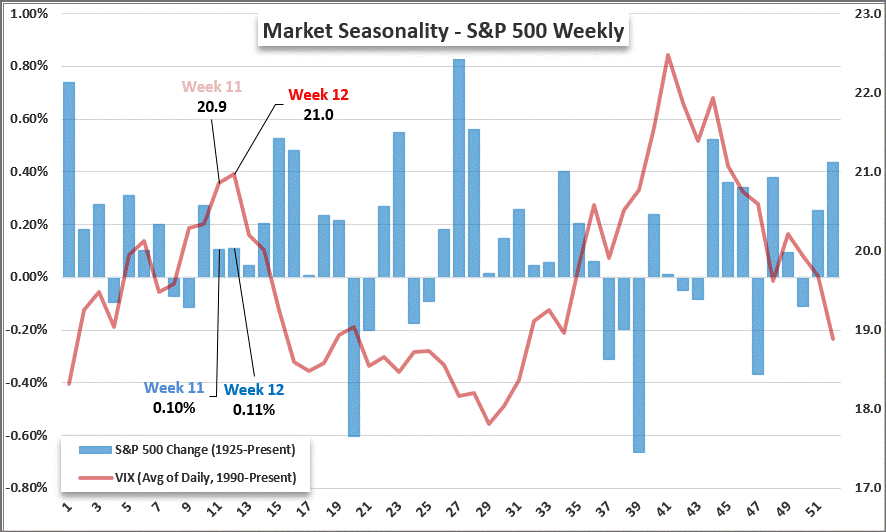
While fundamental and technical analysis should be fully analyzed and incorporated into our navigation of the markets, market conditions remains the principal consideration. What is encompassed in this avenue of study? Participation levels, regulatory development, maturity of market and practical seasonal norms are all factors that qualify. As far as seasonality, the expectations are strong for the coming week. Historically, the 12-week of the year draw the peak of volatility (VIX) for the S&P 500 since the measure’s inception over 35 years ago. Relative price change for that period is a wide spectrum that happens to average a modest gain, but activity is a more consistent metric. There are a few reasons for this: fund diversification and event risk. In the case of the former, the redistribution of capital by funds and other long-only groups following the start of a new calendar year tends to peter out around this period – volume and open interest for proxies tend to reinforce this state. What’s more, this is also the time around which the key event risk is aggregated – specifically a dense wave of major central bank policy decisions.
Chart of S&P 500 and VIX Weekly Seasonality Source: Standard & Poor's; John Kicklighter
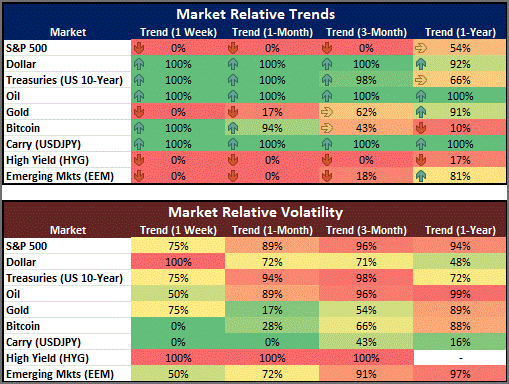
In addition to the seasonal assumptions and scheduled event risk, we also have the statistical making of ‘dry speculative tinder’. Looking at relative positioning of speculative assets and their respective volatility measures (implied or realized), we are witnessing growing pressure that is increasingly difficult to dispel as a mere wobble that complacency can gather opportunists back to the cause of buying into stretched prices and valuations. While we have notable retreats in the likes of the S&P 500, crypto, emerging market and high-yield fixed income alongside a sharp rise in the haven US Dollar; more interesting has been the persistence of implied volatility.
The product of derivative costs generally associated to hedging, it has been the norm for months that market pullbacks have generated very little actual effort by exposed money to pony up the capital to protect against significant reversals (a potentially costly endeavor). Whether crude oil’s OVX, Treasuries’ MOVE rebound, VXEEM’s emerging market substantial premiums or the traditional VIX’s steadfast climb; we are seeing a more rooted concern – versus a respite used to re-enter at brief discount.
Relative Market Position and Volatility Source: John Kicklighter
There is a Particular Theme to this Week’s Calendar
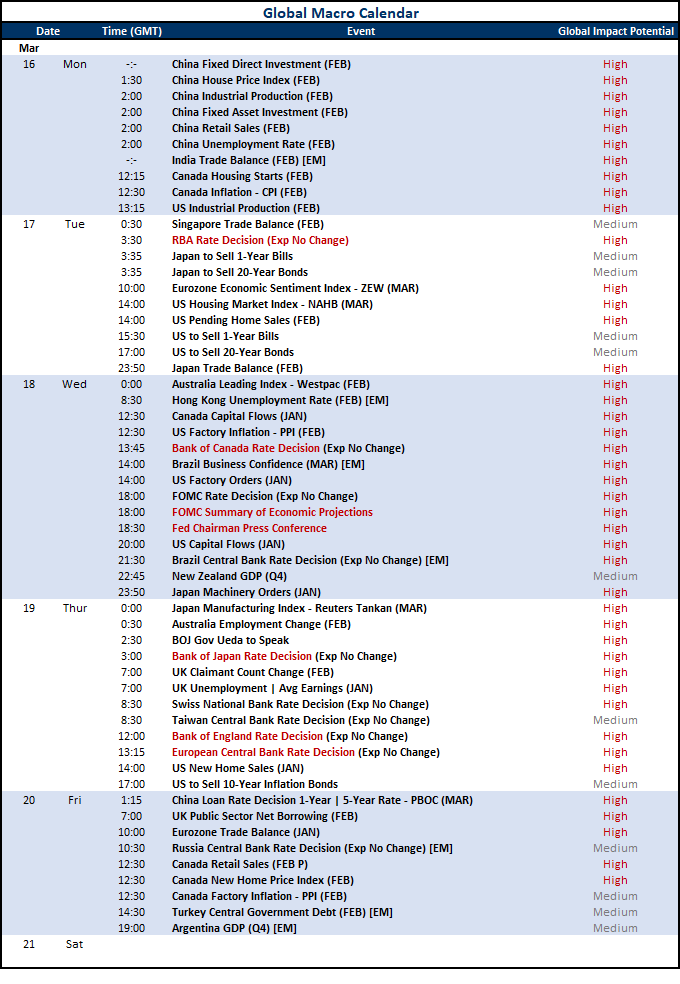
As the markets await either a shocking headline or an economic tipping point related to the ongoing US-Iran conflict, the global macro calendar will offer a healthy run of top level event risk to either distract from or channel the dominant theme. If we are looking for insight into the impact of uncertainty over global security and energy prices, it would have to come in the form of March data, but there is precious little on the docket that both covers the immediate period and is readily absorbs the risks. Forward-looking sentiment measures would be the best bet at this stage; and, as it happens, we are likely to hear critical outlooks from the wide range of monetary policy makers. While we are unlikely to see any change in benchmark rates, the markets should functionally discount this consideration and shift their attention to projections.
Calendar of Top Global Macro Event Risk Source: John Kicklighter
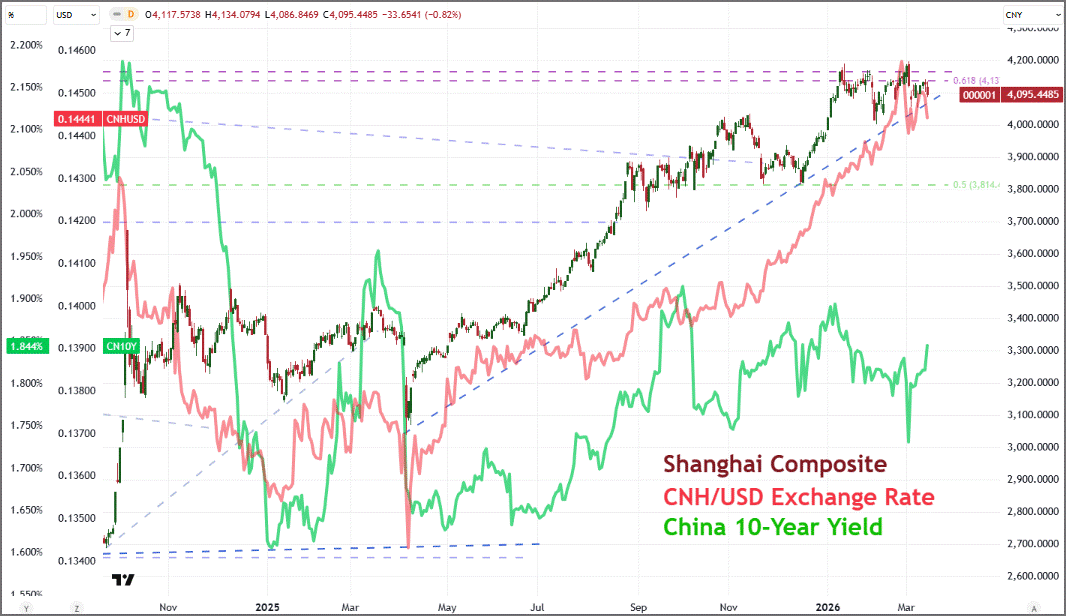
Keeping an Eye on China After Two Sessions, Amid Iran Tensions, and Feb Data
Looking for anything of scheduled importance outside of the thematic influence of monetary policy this week, there is a notable concentration in timely and consequential data due from China. It is also scheduled for release Monday before the central bank activity can fully draw our attention in. The February updates on Chinese housing prices, industrial production, retail sales and fixed investment among other measures will give a convenient overview of the prevailing health of the world’s second largest economy. While international investors take the data with a grain of salt, the trends behind the different series play to the scepticism around the government’s objective of transitioning from trade and credit-fueled growth to more sustainable domestic demand. Another consideration is that this data will take on the context of the NPC downgrading the country’s growth target and the uncertainties implied by a heavy dependency on energy flowing through the Strait of Hormuz.
Chart of Shanghai Composite, USDCNH and China 10-Year Yield (Daily) Source: TradingView; Shanghai Exchange; John Kicklighter
A Special Call Out to the Fed Decision – As the President Will be Watching
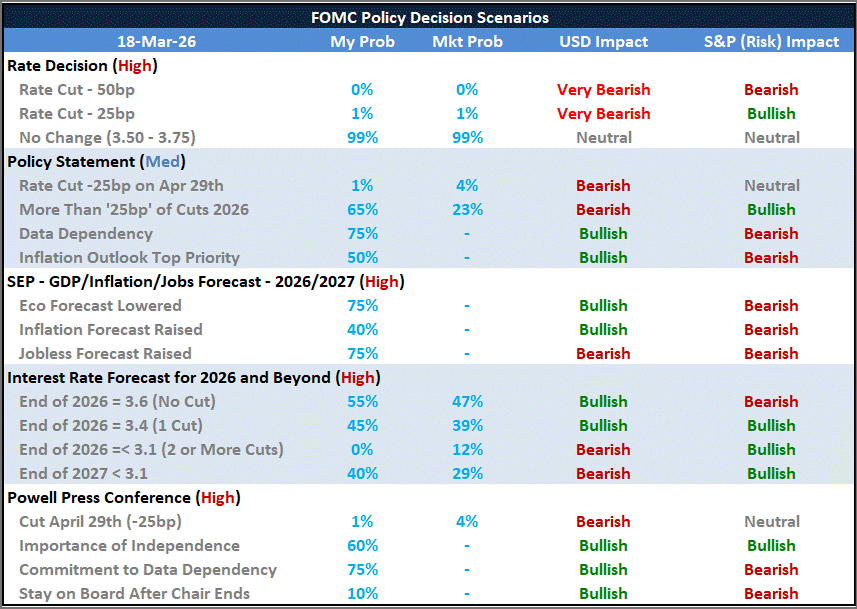
There is quite a run of central bank rate decisions on tap this week, but the Federal Reserve’s update deserves closer observation. As the world’s largest bank directing policy for the largest economy and most heavily used fiat currency, the slight adjustments for rate expectations carry outsized implications for the global markets. What’s more, there are many moving parts to this update where speculation will be either undercut or reinforced. In short, there is a high risk of volatility and meaningful threat of trend determination following this event.
First and foremost, the market expects no change in the benchmark lending rate – which will no doubt still raise the hackles of President Trump. Despite the administration’s conviction that the US economy is on a strong path and there is no risk to employment trends, the President has still voiced his believe that rates should be cut by at least 200 bps. Setting aside the concern around higher inflation pressures around the current state of energy prices, cutting rates that much in short order would usually signal to the market that something is foundationally wrong in the system. There would be a similar extreme concern if the central bank were to ‘cut rates out of the blue’ at this meeting, even if by a standard quarter-percentage point.
As the FOMC maintains its commitment to independence from political pressure, the focus will instead turn to added insights around expectations going forward and addressing the pressure from the White House to adopt policy that the collective views as wholly inappropriate. As this is a quarterly event, we are due the Summary of Economic Projections (SEP). While the interest rate forecast and dispersion will be of interest, this may be the rare instance where expectations for inflation and economic activity carry more immediate weight for speculators. As far as the ongoing debate over whether Trump’s demands will eventually steer the central bank’s hand, Powell’s press conference will draw plenty of questions; but don’t expect the Chairman to take the bait.
FOMC Scenario Table with Market Impact Source: John Kicklighter
There are a Lot of Central Banks in the Same Economic/Inflation Trouble
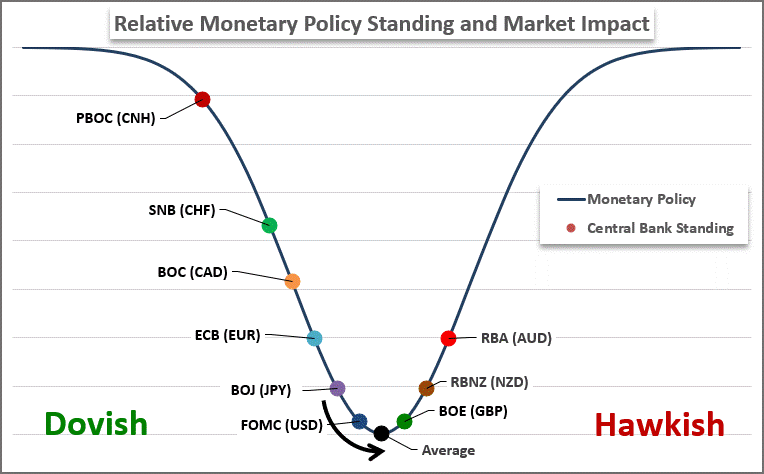
While the Federal Reserve’s rate decision carries unusual weight for the global markets and economy, it isn’t the only central bank due to give a policy steer this week. On tap we have: the RBA on Tuesday; the BOC and Brazil central bank Wednesday; BOJ, SNB, BOE, ECB and Taiwan central bank Thursday; and PBOC and Russian central bank Friday. That is a long list with a remarkable reach across the global economy. Most are expected to hold, but there is some speculation of hawkish potential as inflation pressures pick up – notable for the Australian and Canadian authorities. There is also the capacity for updated insights from many of these groups, which will provide a steer on the course of general monetary policy expectations for the world. Should the perception of broad monetary policy shift hawkish to fight inflation, it would bode poorly for the unconvincing backdrop of growth and increasingly tenuous stature of risk appetite in the capital markets.
Chart of Relative Monetary Policy Standing of Major Central Banks Source: John Kicklighter
Access More Global Macro Insights, Forecasts and Tools
Stay connected to timely global macro analysis designed to help market participants navigate shifting economic conditions and evolving risk. Gain access to regular market commentary, updated quarterly forecasts, a comprehensive two-week forward economic event calendar, and specialized tools built to support informed trading and risk management decisions.
The subsidiaries of StoneX Group Inc. provide financial products and services, including, but not limited to, physical commodities, securities, clearing, global payments, risk management, asset management, foreign exchange, and exchange-traded and over-the-counter derivatives. These financial products and services are offered in accordance with the applicable laws in the jurisdictions in which they are provided and are subject to specific terms, conditions, and restrictions contained in the terms of business applicable to each such offering. Not all products and services are available in all countries. The products and services offered by the StoneX Group of companies involve risk of loss and may not be suitable for all investors. Full Disclaimer. This content is not intended for residents of any particular country, and the information herein is not advice nor a recommendation to trade nor does it constitute an offer or solicitation to buy or sell any financial product or service, by any person or entity in any jurisdiction or country where such distribution or use would be contrary to local law or regulation. Please refer to the Regulatory Disclosure section for entity-specific disclosures. No part of this material may be copied, photocopied or duplicated in any form by any means or redistributed without the prior written consent of StoneX Group Inc. The information herein is provided for informational purposes only. This information is provided on an ‘as-is’ basis and may contain statements and opinions of the StoneX Group of companies as well as excerpts and/or information from public sources and third parties and no warranty, whether express or implied, is given as to its completeness or accuracy. Each company within the StoneX Group of companies (on its own behalf and on behalf of its directors, employees and agents) disclaims any and all liability as well as any third-party claim that may arise from the accuracy and/or completeness of the information detailed herein, as well as the use of or reliance on this information by the recipient, any member of its group or any third party.
Our market expertise, advanced platforms, global reach, culture of full transparency and commitment to our clients’ success all set us apart in the financial marketplace.
Reach
With access to 40+ derivatives exchanges, 180+ foreign exchange markets, nearly every global securities marketplace and numerous bi-lateral liquidity venues, StoneX’s digital network and deep relationships can take clients anywhere they want to go.
Transparency
As a publicly traded company meeting the highest standards of regulatory compliance in the markets we serve; our financials and record of accomplishment are matters of public record. StoneX’s commitment to “doing the right thing over the easy thing” sets us apart in the industry and helps us build respect, client trust and new partnerships.
Expertise
From our proprietary Market Intelligence platform, to “boots on the ground” expertise from award-winning traders and professionals, we connect our clients directly to actionable insights they can use to make more informed decisions and achieve their goals in the global markets.