Global
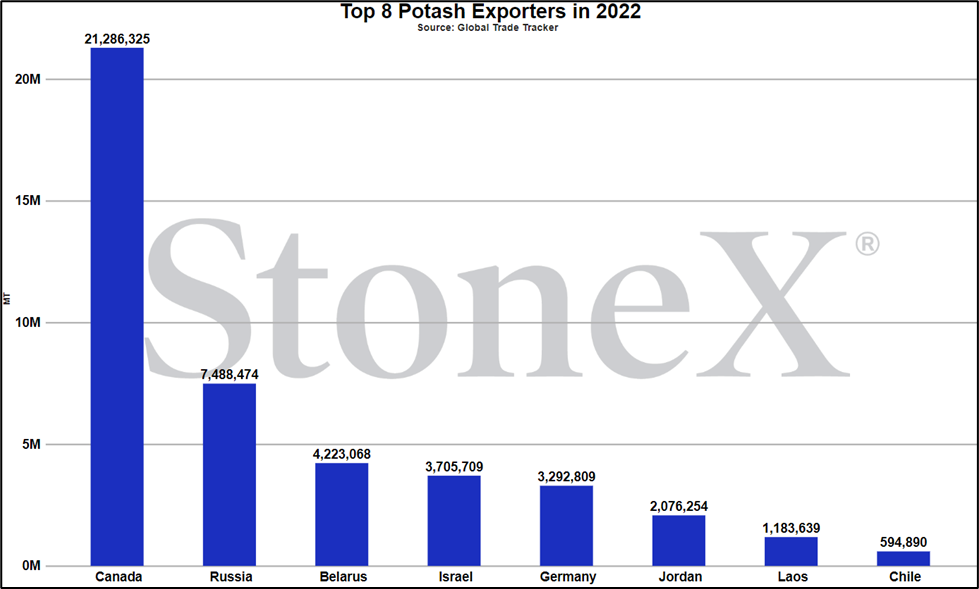
Global potash values have been quiet for a while as the market settles back into normal. Lot of the new production plans and expansion plans were tabled for better days/values. Some new production is still in the works which will see global capacity grow (most notably in Laos where China is investing heavily). However, global demand also continues to grow slightly.
It is hard to see values dropping much further from where they are today with grain values continuing to hold...but it is also hard to paint a bullish picture. Market appears very flat but we continue to have a bias to the higher priced side.
Now, that call DOES NOT include a market that has Israeli potash operations attacked/damaged/destroyed. If that were to happen, we would be firmly in the bullish camp nearby as it would impact the 4th largest exporter in the world. So if you wake up and see "attacks" and "Israel potash" in the same sentence, know that we have moved from neutral to bullish.
North America
This should be pretty simple, right? If I am largely neutral with a bias to bullish for the world, the same holds for North America. Not so fast.
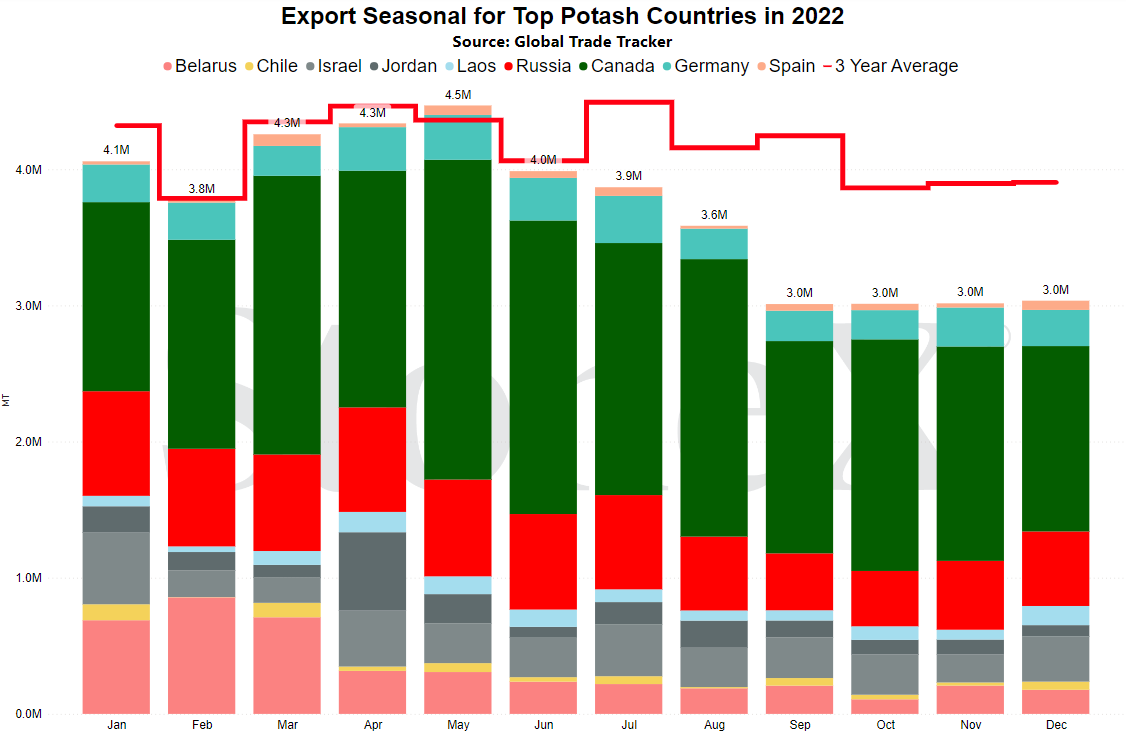
North America just wrapped up a HUGE fall run. That means the system is EMPTY. I'm not talking about a situation where some warehouses need to be refilled. I am hearing the system empty from the farm to the manufacturing side. The fall season wrapped up around mid-December which means there is only a 3-month period to get refilled.
For North America, prices should be on the firm side going into winter/early next spring.
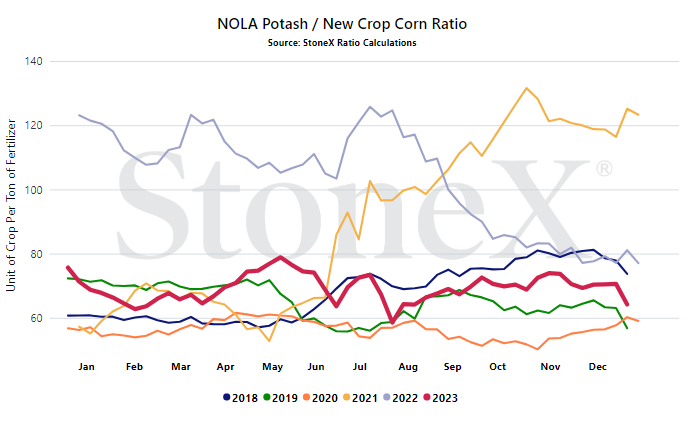
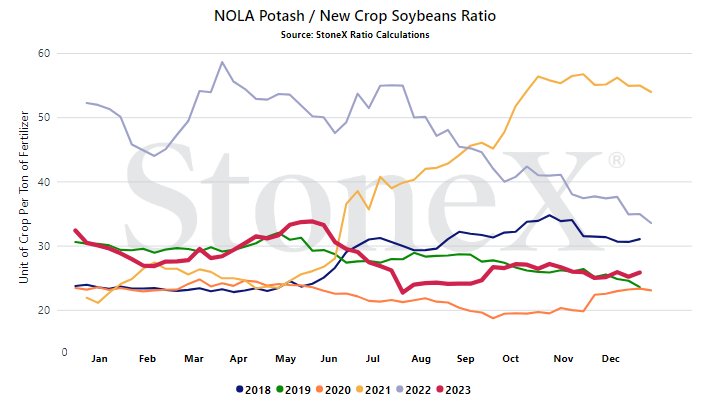
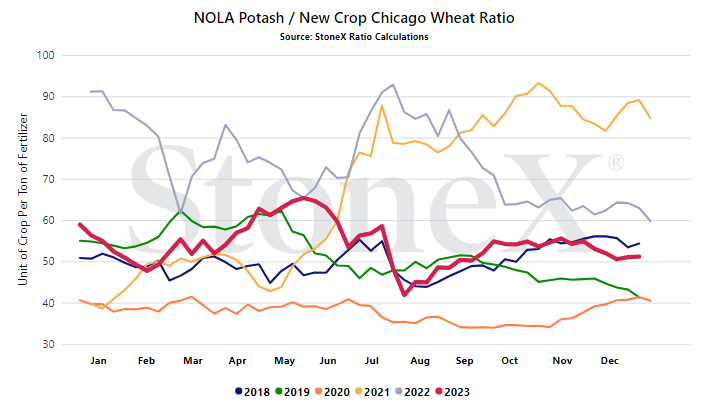
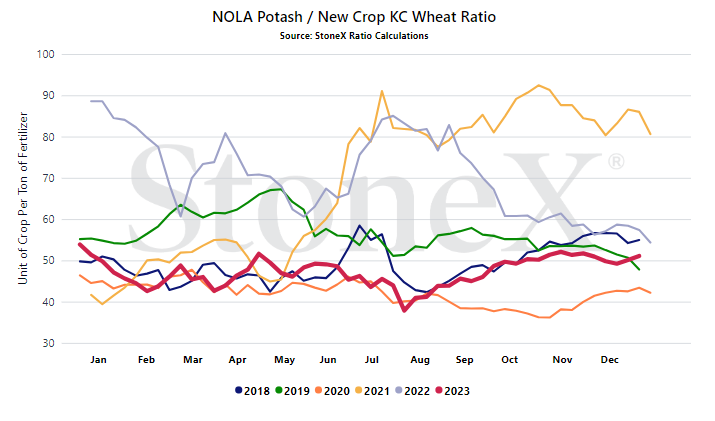
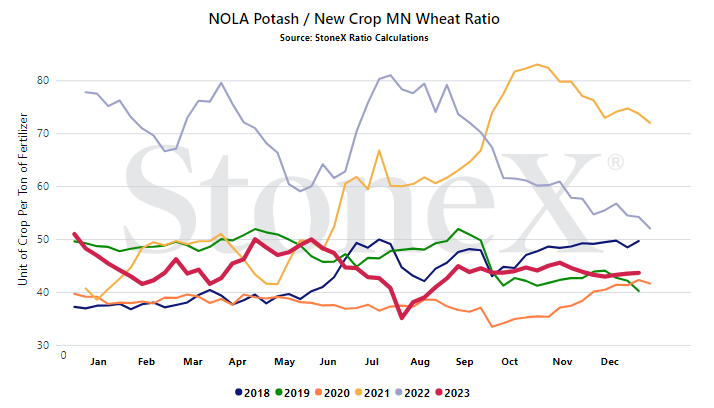
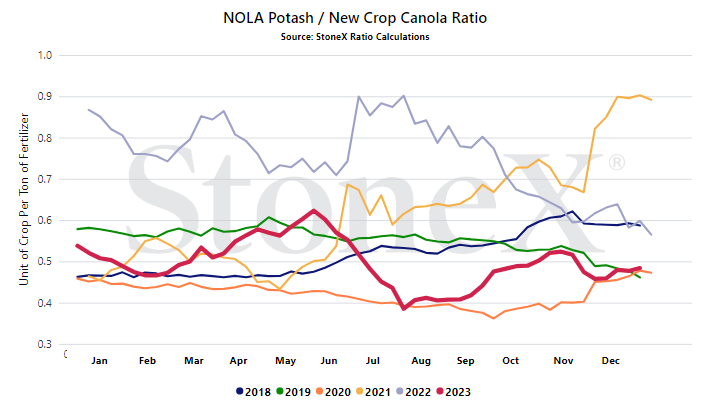
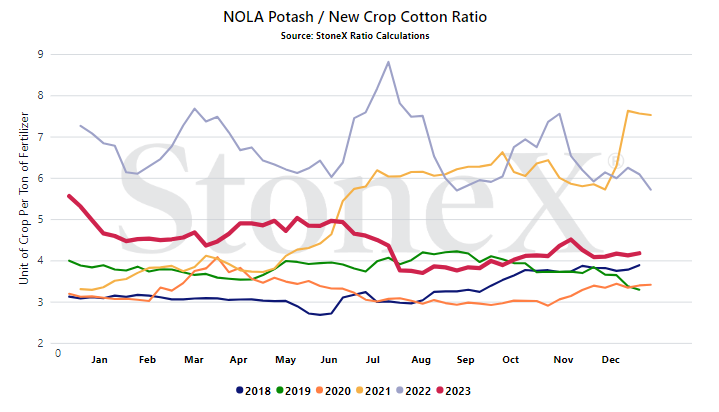
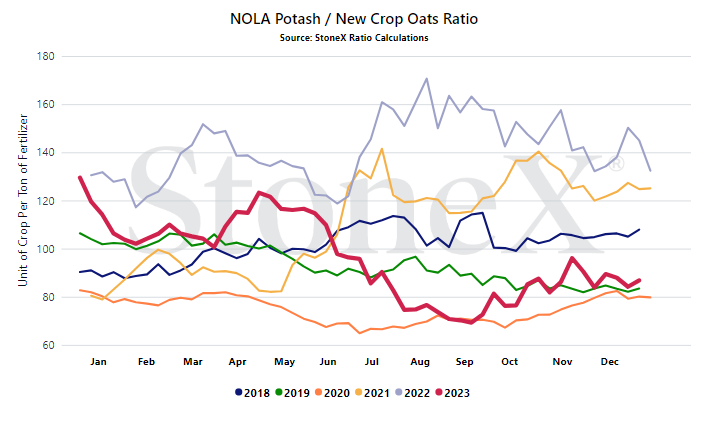
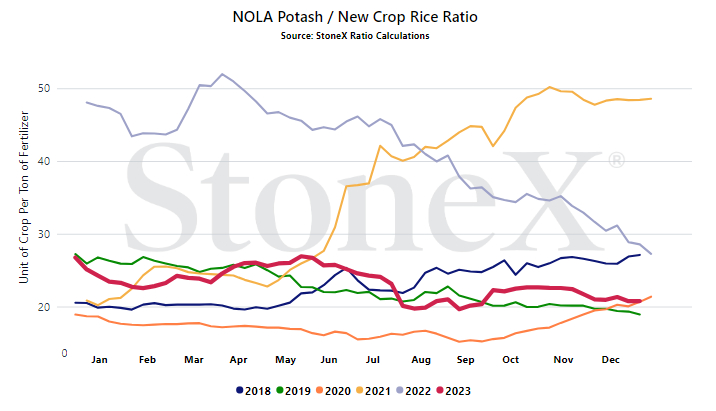
Logistics are going to be strained to get refilled in time for that spring demand to appear. Also, demand should remain VERY good based on current grain values. The price makes sense when looking at the ratios.
So strained logistics and solid demand should equate to higher prices.
New International production capacity still expected
This is a long term story, but a story nonetheless.
At the height of global potash values (March/April 2022), there were numerous plans by various companies to ramp up existing production sites as well as develop new mines. That made sense because "in place" potash manufacturing was making money hand over fist. Everyone wanted in on the margins.
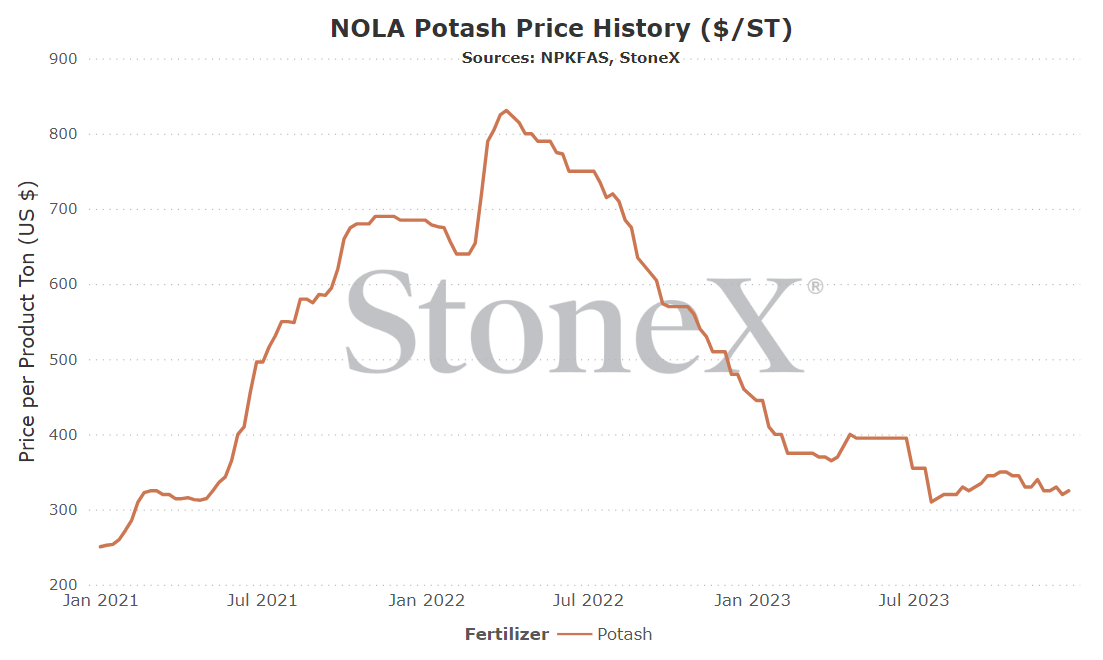
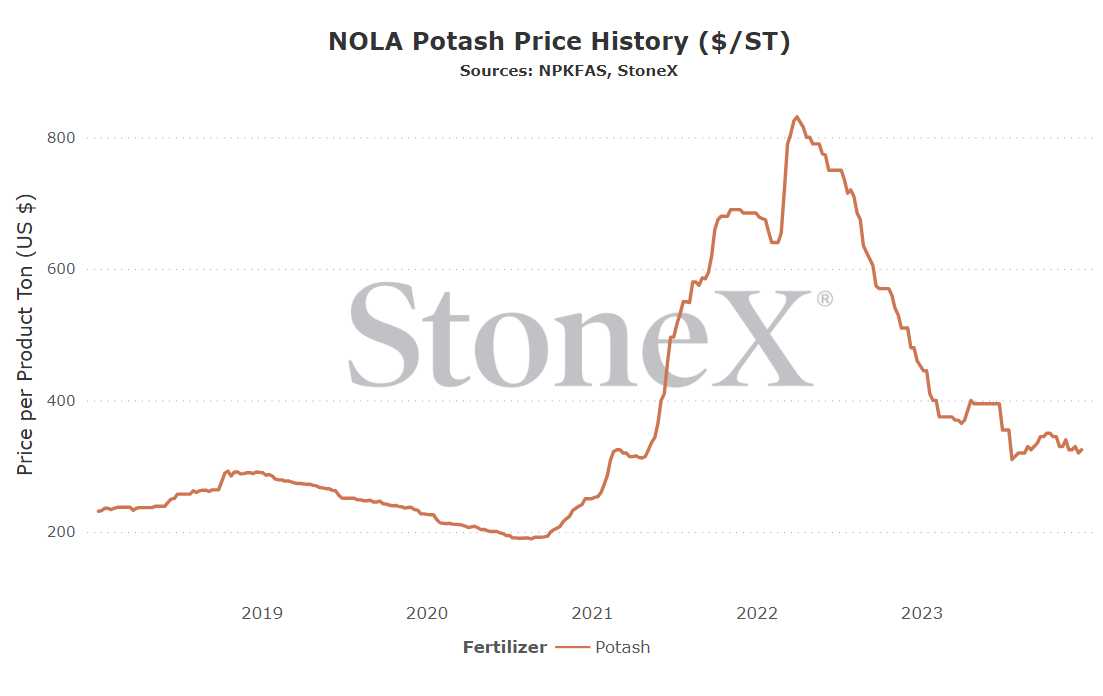
Since then, we have seen NOLA values fall from a high of around $850. Today, NOLA sits around $325. That is a serious correction in the market which has had a HUGE impact on manufacturing margins. Not to say that in place manufacturers are losing money (they are doing just fine), but the margin is small enough that it isn't worth the investment to expand.
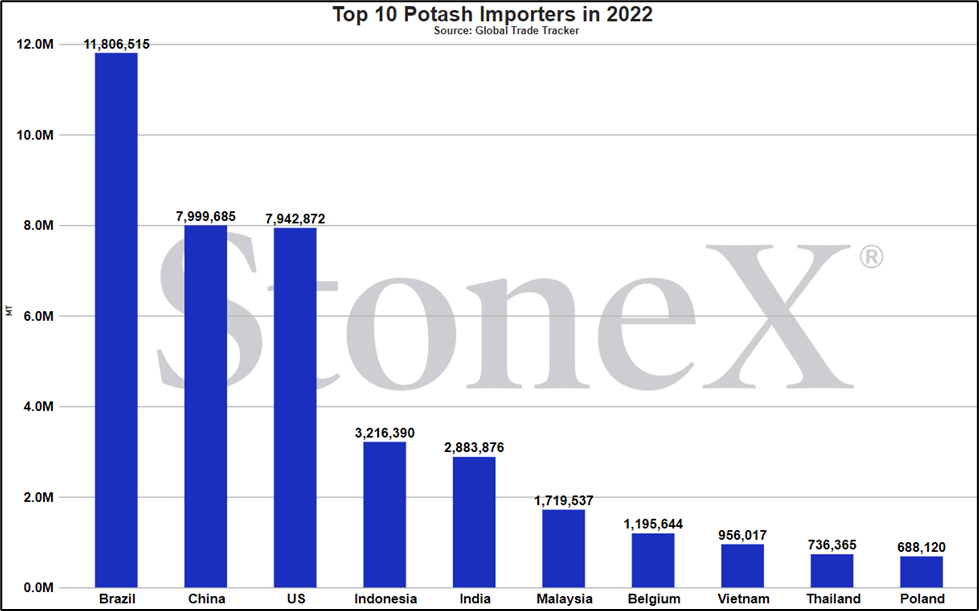
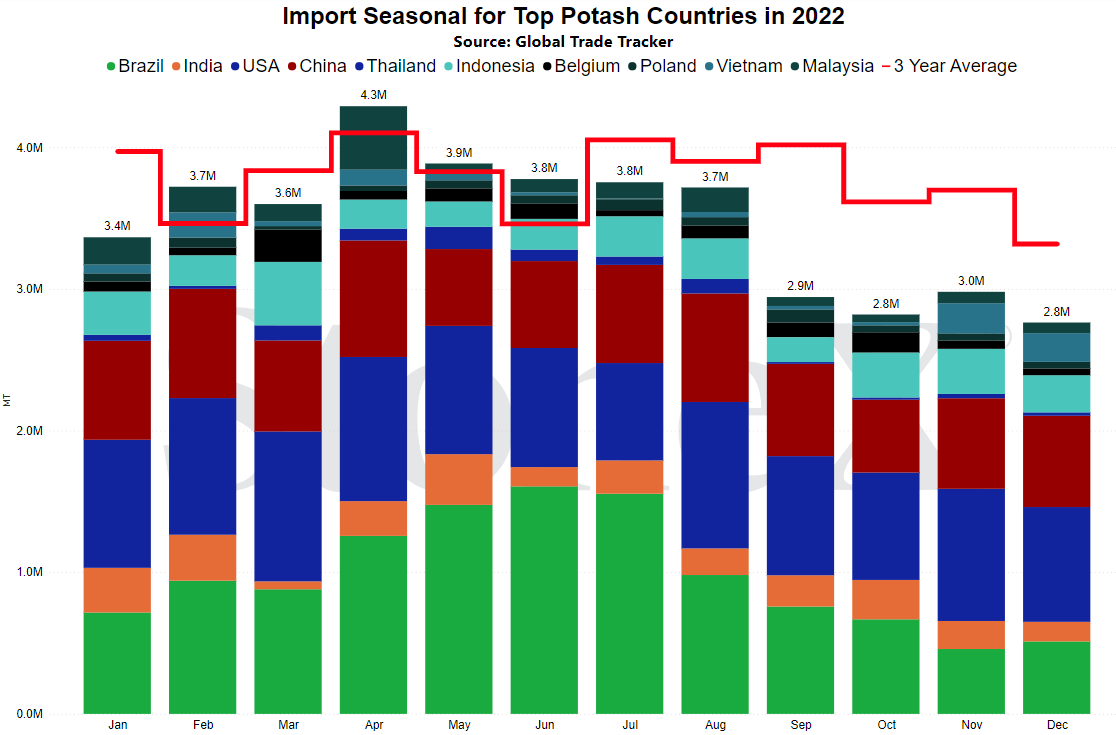
Still, that doesn't mean all plans are off the table. We continue to expect to see Laos production balloon with the help of Chinese investments. China is a major world buyer. Investing in a nearby regional production location not only helps them from a political situation (closer allies) but also makes them less dependent on further away supply points. With some shipping issues in the world today, I can't say that I blame them. We also continue to expect some production expansions in Canada to start eventually. That will help to boost production numbers.
Ultimately, potash is a market that we still see as being better supplied than all other fertilizer in the coming years. Not only will it be well supplied, but plans that were discarded after price corrected still exist. Another run in prices could see those plans dusted off and revisited.
This isn't to say that any of these expansions/productions will happen in the coming weeks/months. Merely to say that better days are coming...eventually.
N.A. had a huge fall application run
North America just wrapped up one of the better fall weather seasons in a very long time. While it wasn't perfect, it was about as close as we can get. Wide open windows for farmers and retailers to get into the fields and fertilize to their hearts content! Likely this fall will be one that we talk about for years to come.
The bright side is that most everyone that wanted to apply potash in the fall got to do so. Mother nature cooperated.
On the not so bright side, the system is empty. I am talking about a top down emptying of the system. With a lot of areas still going until mid-December, it doesn't leave a lot of time to get refilled. A large chunk of the Midwest will plan on applying early to mid-March. That only leaves 90-days for the system to recharge and get ready. That is going to be tough.
If logistics were "normal", it would still be a feat to get done. Unfortunately, that isn't the case. While potash is much less dependent on the river systems when compared to nitrogens and phosphates, there are still tons that move via barge which means the Lower Mississippi River water level situation could impact resupply efforts. Rail continues to do what rail does. You may read into that however you deem necessary. Trucks always seem to be lost to other, easier industries.
A fall like this has a tendency to carry over for a couple seasons. The coming spring story will be tighter than normal inventory levels which could/should keep prices steady at best and bullish at worst. At the end of spring, assuming mother nature plays nice again, the story will shift to being very empty once again at the start of summer. There will be more time to recharge the system, but starting so low on inventories will be a feather in the negotiation hat for manufacturers. That story could carry into fall. Then if another big fall run...
All is not lost and I AM NOT saying you will not be able to get product. Merely trying to point out that the system is now in catch up mode which changes the dynamics.
Israeli potash operations remain untouched
This story is a non-story.
War continues to wage between Israel and Hamas with the battles now being fought within Gaza. This has placed Hamas on the defensive and largely unable to blatantly attack Israel as they originally did.
That should mean that Israeli potash operations should remain unimpacted...but the chance does remain. My guess is that if there is another attack by Hamas, it will once again be against people or against infrastructure. Most people do not go around thinking "you know how we can cripple them? Target their potash production.". Still, the possibility is still there and needs to be watched/considered.
NOLA/New Orleans Louisiana
Vs 30 days ago - unchanged vs last month
Vs 90 days ago - -6% or approximately $20 lower
Vs 6 months ago - -18% or approximately $70 lower
Vs 1 year ago - -29% or approximately $135 lower
U.S. Midwest Average (average of several points across the Midwest)
Vs 30 days ago - -6% or approximately $26 lower
Vs 90 days ago - -3% or approximately $14 lower
Vs 6 months ago - -7% or approximately $29 lower
Vs 1 year ago - -30% or approximately $171 lower
- N.A. system was wiped out this fall – this was a stellar fall run for N.A. I would dare say this was the type of fall that we will look back on and compare against. That means inventories were WIPED OUT thru the whole of the system. Assuming that is the case (I very much think it is), that means there is a lot of resupply work to do and not a lot of time to do it in. That keeps sellers in control.
- Prices remain attractive vs grains - even though the fall was huge and the system is empty, we haven't seen a reaction in terms of pricing...yet. That means that current grain/potash ratios are still very attractive. Buyers should be lining up to lock in their spring needs, causing prices to rally.
- Israeli potash operations could be attacked – fortunately from a fertilizer standpoint, Israeli potash operations (Israel being 4th largest potash exporter in the world) have been spared. Unfortunately, the war rages on and it only takes one rocket to change the entire scope.
- Long term potash market outlook remains very well supplied – while many of the new production/expansion plan announcements were ultimately rolled back, some remain. Assuming that stays the case, the outlook for potash appears very well supplied. That outlook should keep buyers from getting overzealous.
- Ummm... - I sat and stared at this monitor for longer than I would like to admit trying to come up with more than 1 bearish factor. All, I have nothing. That's how much faith I have in potash right now...now watch the market fall because I allowed myself to get confident.
We believe that only looking at the flat price of either grains or fertilizer can be misleading:
-
Only selling grain can hurt you if fertilizer prices rise substantially
-
Only buying fertilizer can hurt you if grain prices fall
We look at the ratio "value" to get a better indication of where we are or how many bushels of X does it take to pay for 1 ton of fertilizer.
Would you rather:
-
Spend 120 bushels to pay for 1 ton of potash
-
Spend 60 bushels to pay for 1 ton of potash
When we compare the current ratio value against recent years, we start to see if we are high or low.
YOUR VALUES WILL LOOK DIFFERENT
This graph looks at the NOLA potash price vs the flat grain price. There are no logistics on either product. Your location will look different due to fertilizer logistical costs, grain basis, etc.
- Logistical capacity in a 90-day period - well done everyone. That was a huge fall run that emptied the system. We continued to hear reports from retailers that folks were running into mid-December. That means we have 3 months to get refilled and prepared for spring season. That is going to take a Herculean effort for logistics which were already struggling with fewer trucks, sometimes questionable rail capacity and a Lower Mississippi River that is still far from healthy.
- Demand over next 3 weeks - based on conversations, a lot of N.A. had a better crop than they expected to harvest. Anticipation is growing that there are a lot of dollars that either need to be spent on inputs or sent to the government. Let's face it, inputs win every time. Over the next few weeks, that demand should step forward and provide a boost to the market..."should".
StoneX Ratio Calculation
The ratio calculation is derived from Bloomberg historical grains values as well as fertilizer values from StoneX, NPKFAS, and Argus.
The calculation is simply dividing the fertilizer price by each grain price.
All data was sourced from StoneX unless otherwise noted.
This material should be construed as market commentary, merely observing economic, political and/or market conditions, and not intended to refer to any particular trading strategy, promotional element or quality of service provided by the FCM Division of StoneX Financial Inc. (“SFI”), StoneX Financial (Canada) Inc. (“SFFC”) or StoneX Markets LLC (“SXM”). SFI, SFFC and SXM are not responsible for any redistribution of this material by third parties, or any trading decisions taken by persons not intended to view this material. Information contained herein was obtained from sources believed to be reliable, but is not guaranteed as to its accuracy. Contact designated personnel from SFI, SFFC or SXM for specific trading advice to meet your trading preferences. These materials represent the opinions and viewpoints of the author, and do not necessarily reflect the viewpoints and trading strategies employed by SFI, SFFC or SXM. The FCM Division of StoneX Financial Inc., a subsidiary of StoneX Group Inc., is a member of the National Futures Association (“NFA”) and registered with the U.S. Commodity Futures Trading Commission (“CFTC”) as a futures commission merchant and commodity trading advisor. StoneX Financial (Canada) Inc. is currently registered as a Futures Commission Merchant or equivalent in all provinces of Canada and is a member of the Investment Industry Regulatory Organization of Canada.