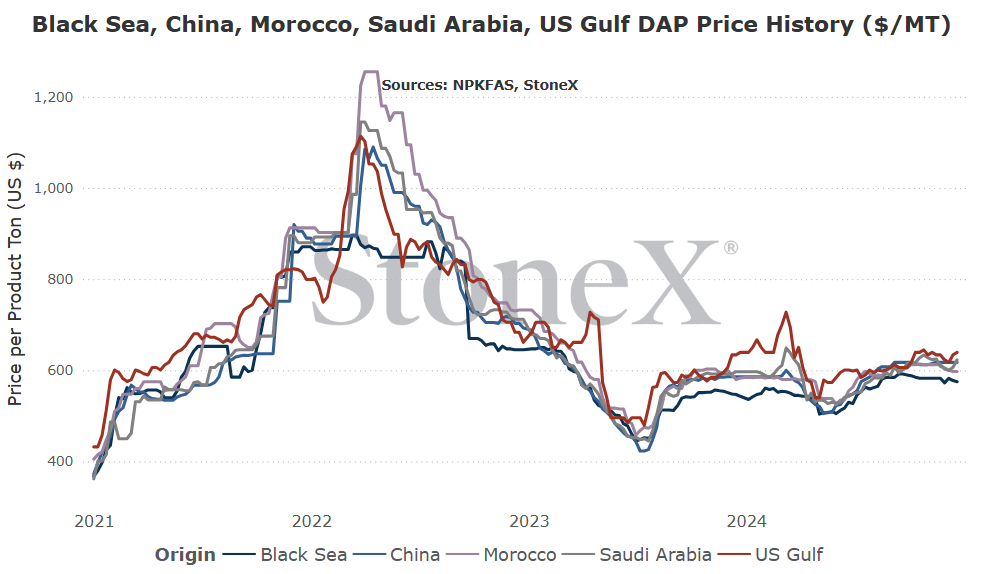
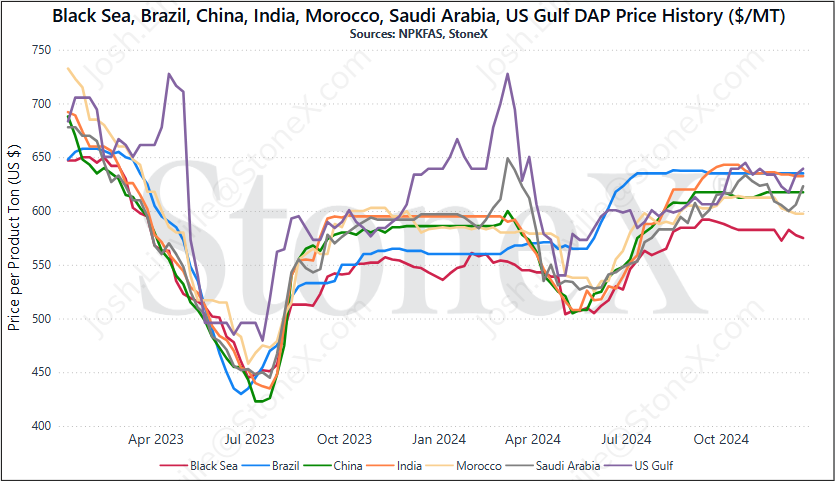
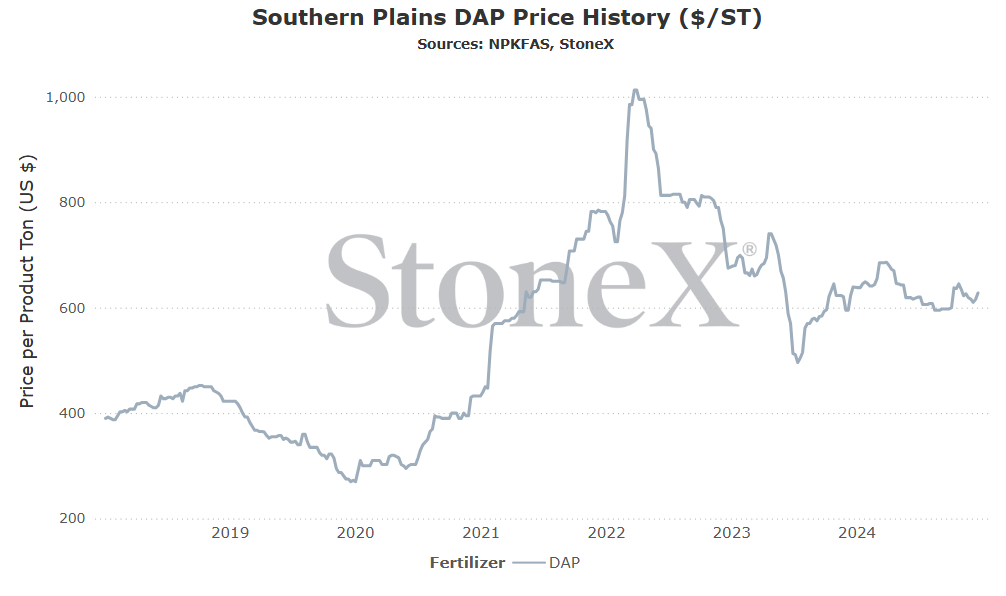
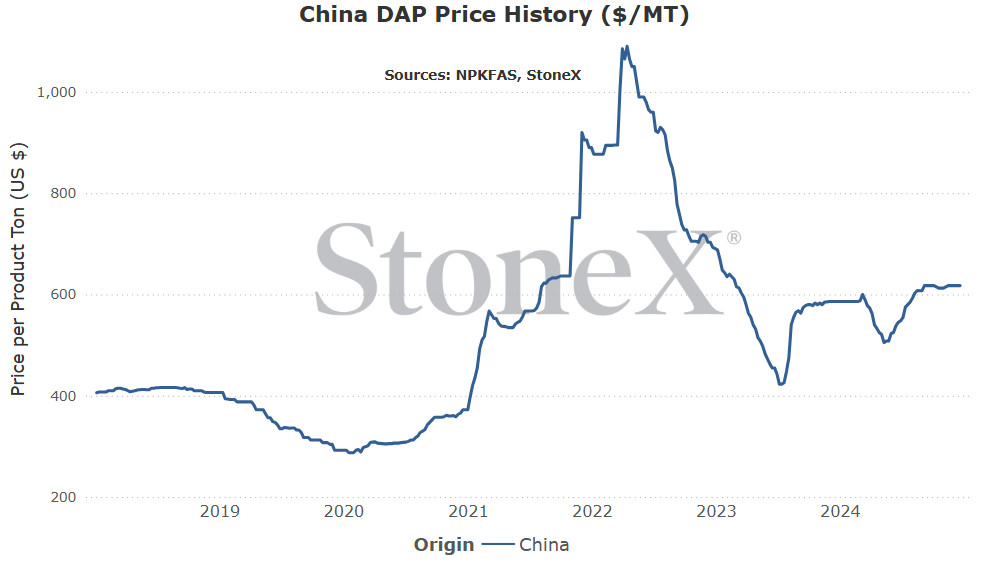
I will say this now and will say it going forward to eternity: these are the flat price graphs for each individual location. Your price where you are is going to be different. There are logistics. There is the cost of storage/interest/insurance/etc. These graphs should not be taken as "it shows the price at $700, why isn't my price $700". These graphs should be used to give an appreciation for price movements.
All values are in metric tons and USD currency.
Global
The phosphate markets continue to be in a "funny" place.
Not funny "ha ha" but the type of funny that makes you want to cry a little.
There is no doubt that prices are extremely high. It doesn't matter how you make your measurements, everyone comes to the same high cost ending. That should mean that demand is taking huge hits which would offset tight supplies and help lower values...but that doesn't seem to be reality. China, the world's historic largest exporter, continues to be feared lowering their export flows. India, the world's largest buyer, is still lower on supplies than their comfort level. If the global S&D remains as tight as it is, it is hard to see much downside...
China remains my major pivot point for the global phosphate market. If exports continue to be squeezed/lowered, then global supplies are tight and it is really hard to see much price downside short term. However, the flip side remains just as important. If we suddenly hear a return to normal, global long positions/sellers will likely be selling as quickly as possible to get out of their way.
My POV today is that there are more roads that lead to flat/higher pricing short term (i.e. thru March/April) as I believe Chinese exports will remain restricted. However, once the Northern Hemisphere gets past spring and has to start facing the long summer period, we should see values lower.
North America
It's interesting. Just before starting this, I read an article that talked about North American phosphate demand being low this fall. Based on everything I have seen and heard, I fully disagree with that narrative. Now, I will fully agree that the fall season was unorthodox on its timing. Most of November was lost with wet conditions. However, things dried nicely heading into Thanksgiving and has mostly stayed that way. Heck, I'm still seeing folks putting on fertilizer today! I think demand was better than expected which should mean a lot of space to fill in a relatively short winter window.
Since fall demand was better than previously expected, that means we will enter winter with relatively empty storage thru the system. Empty storage means plenty of sales opportunities for distributors/manufacturers in a relatively short winter period. Because of that, it is hard for me to see much price depreciation between now and April. Once we hit April, that is a new ballgame. That is the shift from preplant to planting. For phosphate, that is the difference between max demand/application and the dead summer period. We "should" see prices down April and beyond.
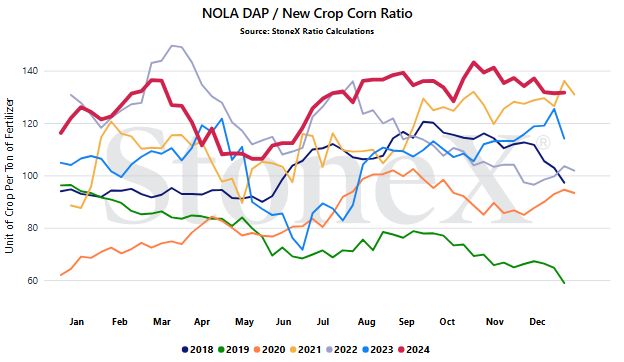
These are some of the highest grain/phosphate ratio values that we have ever seen. In fact, if corn/DAP holds, it will set all-time high's for January and February. Unfortunately, demand still looks solid and supplies still look snug. That should keep values flat to higher for the coming period.
2025 global phosphate market outlook
A new year means a fresh look at the factors that we are watching in the phosphate markets. This is far from a complete list, but I feel like it hits the highest highlights.
- Chinese export flows - China has historically been the world's largest exporter of DAP/MAP. The last few years has seen the government intervening and restricting export flows. For Chinese farmers, this program has been great as it helps to ensure domestic supplies and lower domestic values. Unfortunately, for the rest of the world, this strategy has worked and continues to be used. Never count out China. They could return to full exports and not blink an eye...it just doesn't look likely today.
- India's continued attempt to rebuild stockpiles - Indian phosphate supplies have been a rollercoaster of emotion in 2024. As the world's largest importer, that means we need to watch and take note. You can read more about what happened in 2024 below but for here, focus on starting inventories for 2025. They would normally start with a comfortable stockpile of around 2M tons. This year will start with them closer to 1M. This shouldn't be an "oh crap" amount...but stockpiles need to be built. That means the world's largest buyer will be buying at a faster clip.
- Farmers reaction to high prices - phosphate prices are high regardless of how you look at them. Vs historical values. Vs grain values. Vs production values. All high. So high that the corn/NOLA DAP ratio, if it holds, will set all-time high values for January and February. We thought we would see sizeable demand destruction in fall application programs...but that doesn't seem to be the case. Maybe we will see spring demand lower...but it doesn't look like it.
- Any new global production hopes - we have not seen/heard anything that leads me to believe any new production expansions are coming, but high prices tend to increase production. I have a bit more hope that Mosaic will be allowed to expand their mines in Florida. Florida governor DeSantis recently started to allow phosphate production byproducts phosgyp to be used in road construction. If these piles which have long been an eyesore and a major issue that environmental groups point to start to get used up and disappear, perhaps they will be more willing to expand their mining lands. Not sure it will happen but we need more production.
Phosphate is in a bad place right now. Demand is solid, supplies are low and there is little hope of near term help in the way of increased production rates. Until increased production is found, the world is going to continue snug...and likely remain high priced.
Fears growing of further Chinese export restrictions
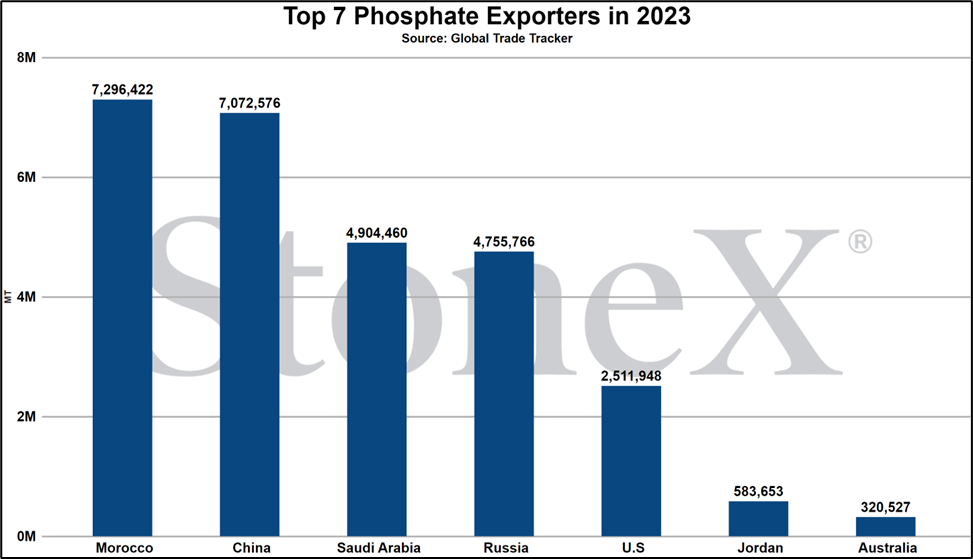
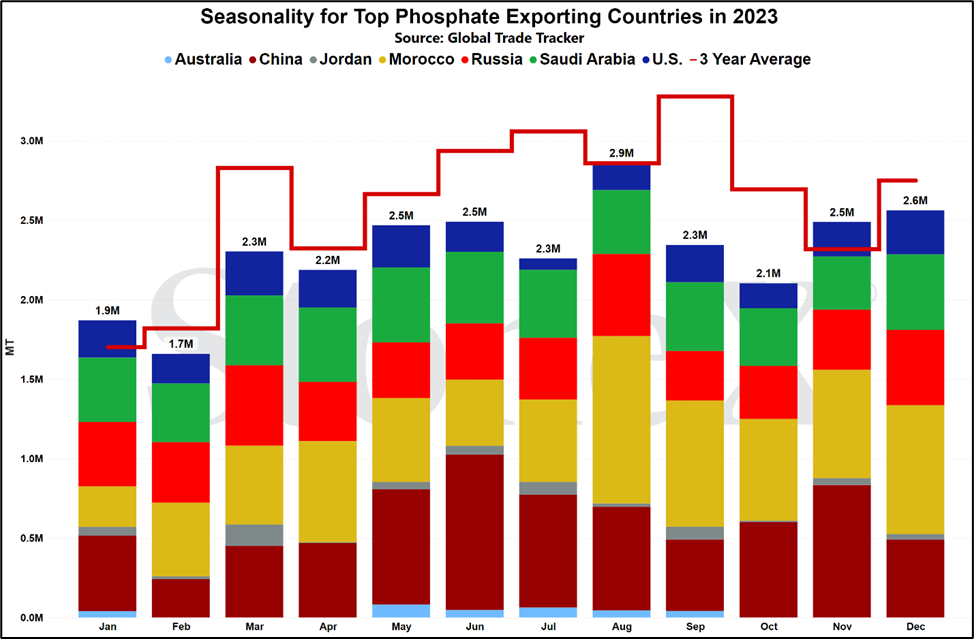
China has historically been the largest exporter/provider of phosphate to the world. However, the last few years have seen their volumes extremely volatile:
2021 - 10M
2022 - 5.5M
2023 - 7M
Earlier this year, there was hope that China was getting ready to reclaim their title of largest exporter. At the very least, there was hope that they would increase their volumes which was met with lower price ideas. Unfortunately, that was a short lived hope.
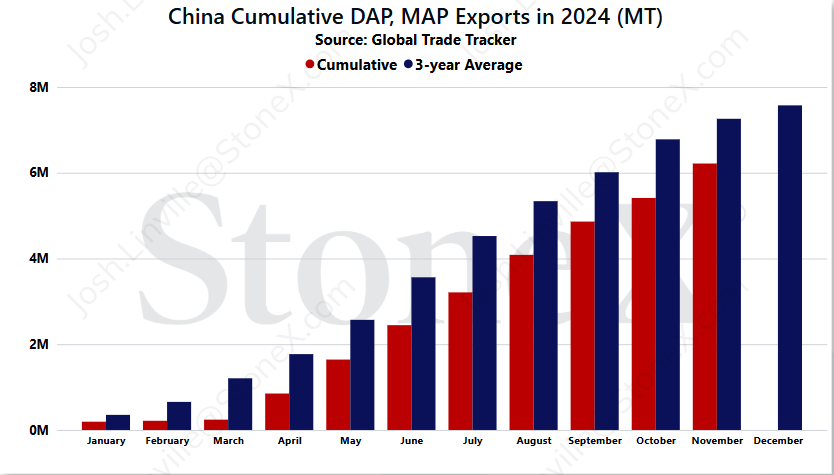
The remainder of 2024 saw exports continuing to trend below their 3-year average which was already 2+ million tons lower than what was normal. Now, as we look ahead to 2025, a great fear is growing. There have been a lot of stories/rumors that the Chinese central government was getting ready to put further restrictions in place. During the global fertilizer price runup, China started to curtail exports to accomplish two goals. One was to guarantee domestic stockpiles. The other to lower domestic values. If their product couldn't be exported, then prices would have to fall.
Fortunately for Chinese farmers, this strategy worked.
Unfortunately for the rest of the world's farmers, this strategy worked.
Global values have remained high and this fear derives from the expectation that the government is going with the same strategy at the cost to the rest of the world. It is impossible to know what they will do but know that if further restrictions are put into place, it will be very difficult for values to fall short term.
What does this mean for farmers?
To be simple, it means higher prices around the world.
Losing the largest supplier in the world means the global S&D remains very tight. A very tight S&D typically means prices are supported. That is exactly what we are seeing today. It doesn't matter where you farm. Unless your government subsidizes your fertilizers, then you are feeling the pain.
India looks set to start 2025 low on stockpiles vs normal
We spend a lot of time talking about the importance of Chinese phosphate exports. With their being the historic global leader, it makes sense that we need to track what we think they will do and what they will ultimately do.
If we spend that much time/energy on the world's largest supplier, shouldn't we spend equal energy on the largest buyer?
That would be India...and they have had problems in 2024. Last summer, the Indian government saw an opportunity. Global values were falling as it appeared that Chinese exports were improving. In an effect to save money on subsidies to the ag industry and to help values lower, they dropped their subsidy rates to low enough levels that importers were not able to function. This worked...for a short time. Unfortunately, as most of the rest of the world came to realize, China was about to pull a 180. Rather than return to anything close to normal export levels, they started to scale back once again. Global markets started to rally and India was slow to respond. By the time they fixed their subsidy programs, domestic stockpiles had fallen to very low levels. Near the levels that were seen in late 2021 that caused farmers to be outraged and riot in the streets.
This was a short term issue. Eventually, the government made the necessary changes and imports started to flow...and support global values. If Chinese exports were slow and India was buying at a rapid pace, it put a lot of power in the hands of manufacturers.
Now, we are starting 2025 and it appears that India is STILL low on stockpiles. They would "normally" start the new year with approximately 2M tons in storage. However, it has been rumored/reported that they will begin this year at only 1.2M tons. This is not low enough for them to panic, but it is certainly attention grabbing. The northern hemisphere is gearing up for its spring season. Even Australia is making preparations for their phosphate applications. If we suddenly see India start locking up large quantities, it could push price ideas higher in a very short time.
What does this mean for farmers?
So the global leading exporter has been scaling back exports and now the largest buyer is behind on inventories...that isn't a good combo for the world of phosphate.
Unfortunately for the rest of the world, India still has stockpile catch up in front of it. That means heavier demand in an already tightly supplied world.
Lower supply + higher demand = should mean higher prices.
N.A. winter fill programs flat to ending fall values
For those hoping for lower phosphate values in the spring, the first winter fill programs didn't help any.
As fall season wrapped up and the holiday season began, it became clear that the N.A. fall run was better than expected. There was a lot of demand trepidation, but ultimately applications got done and inventories were emptied.
At the same time, global values have continued to remain high as global supplies suffer with Chinese exports slow and feared to get worse in 2025. Manufacturers saw this and set their winter programs at largely the same price as where fall values left off.
Now, for the part that I really worry about...N.A. phosphate values could go higher.
Look at the chart below. The last 2 winter/spring seasons have seen NOLA DAP values jump to a significant premium vs the world. This is plausible this winter/spring. We are coming out of fall season low on inventories. We are continuing to see N.A. production rates much lower than what had been normal before 2021. U.S. duties again Morocco/Russia/China continues to limit where resupply product can be sourced. Demand continues to be expected solid and rising corn acreage estimates are only pushing demand expectations higher.
There is nothing about current phosphate values that are cheap or attractive...but if the next few months play like the last couple winters, we could look fondly back on this time.
January/February 2025 look to set all-time high corn/phosphate ratios
When I look across farming inputs, the one that stands out as the highest price is phosphate. There are a couple ways to skin it.
The first is just the price. Nitrogen and potash values both fell to around a third of the high's that were set in early 2022. However, phosphate only fell to about half...and has pushed higher since.
The second and more important in my mind is the price vs grain values. You likely know how large a proponent I am for looking at the input and output prices together. That is what worries me for phosphate. When I look at current NOLA DAP values and current December '25 corn values, that ratio currently sits at just above 130. The graph just below shows all of the weekly ratio values going back to 2005. If DAP and corn values hold, and everything appears as though it will, the market will set the highest ratio values ever for January and February. That means you are paying more bushels for every ton of phosphate that you apply.
One surprising thing is that we did not see demand fall off this fall season as many expected. I certainly went into harvest thinking demand would be down substantially. Yields were expected to be poor on field reports. Grain values were in the tank. 2024 wasn't going to be great and the 2025 outlook wasn't much better. There was going to have to be input cuts and at the front of that line, phosphate.
Then harvest started to roll. Many reported that yields were better than expected. That didn't mean record yields everywhere, but it was bigger than feared. Bigger yields = bigger nutrient removal. Then, we also saw grain prices rally. Again, not to previously high values, but at least not at the horribly low price they were. Suddenly, there was an influx of cash that wasn't expected. If phosphate was the first to be cut, it was going to be the first to be added back in. Especially as farmers know that they can apply every fertilizer/chemical/etc. perfectly, plant the seed pristinely, and have perfect growing conditions but if phosphate soil levels are left low, the yield potential is limited.
While we expect a bit more demand destruction in the spring, that could be offset by incoming U.S. government payments. Again, if phosphate was the first out, this cash could mean the first opted back in.
Ultimately, phosphate is high priced.
One educational note: we had a great opportunity the summer of 2023. If you look at that black line, you see it dipped in June/July/August. That 80 - 90 ratio range represents the bottom 25% of values going back to 2005. If we had it to do over again, we should have built our soil levels at these price points (buy the phosphate AND sell the corn). Then, as we got into the current situation, we could draw back on applied phosphate while relying on the insurance rates in the soil. These opportunities do not happen all the time. When they do, we need to act.
I'll try to do a better job of calling it out next time I see it.
What does this mean for farmers?
This should mean a massive cut in demand. Farmers are having to spend more dollars and more bushels to pay for their phosphate inputs. 2025 is already looking like it is going to be tough in terms of profitability...maybe profitability isn't the correct term there.
However, we have not seen evidence of that.
I think a lot of folks yields were better than expected, and we know what that means. Bigger yields means bigger nutrient removal. We can be upset/angry at the phosphate price, but we cannot get angry to the point where we make irrational decisions. If we do not replace phosphate, we can do everything else perfect and we are still limiting 2025 yield potential.
I am not here to tell anyone what they should/should not do. I merely want folks to be aware that phosphate is very high priced. Your anger/frustration is legit. Just make sure when it comes time for purchase decisions, do it with a clear head.
NOLA/New Orleans, Louisiana DAP price comparison
Number 5 global exporter in 2022
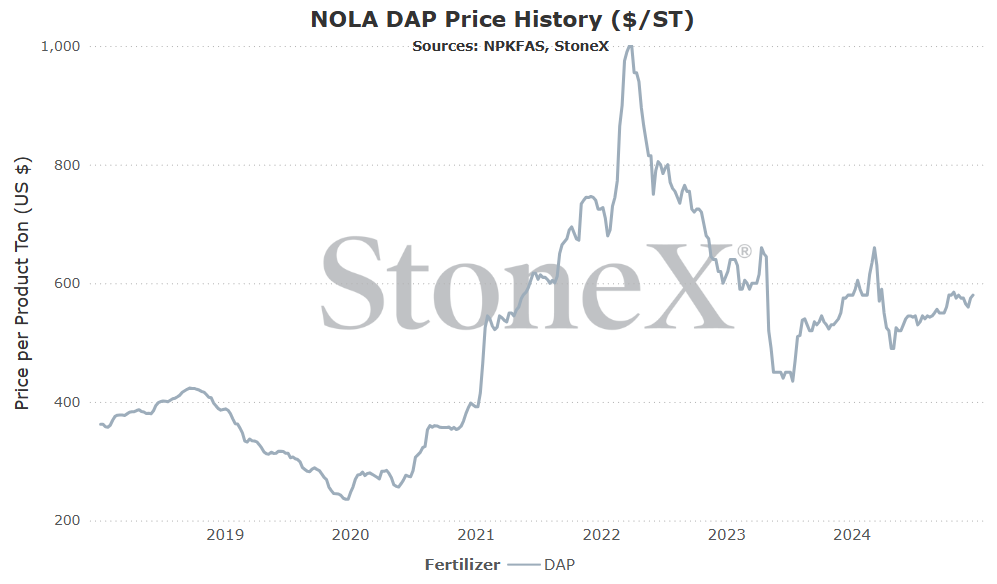
Price comparisons
Vs 30 days ago - 1% or approximately $5 higher
Vs 90 days ago - 5% or approximately $30 higher
Vs 6 months ago - 6% or approximately $35 higher
Vs 1 year ago - unchanged vs last year at this time
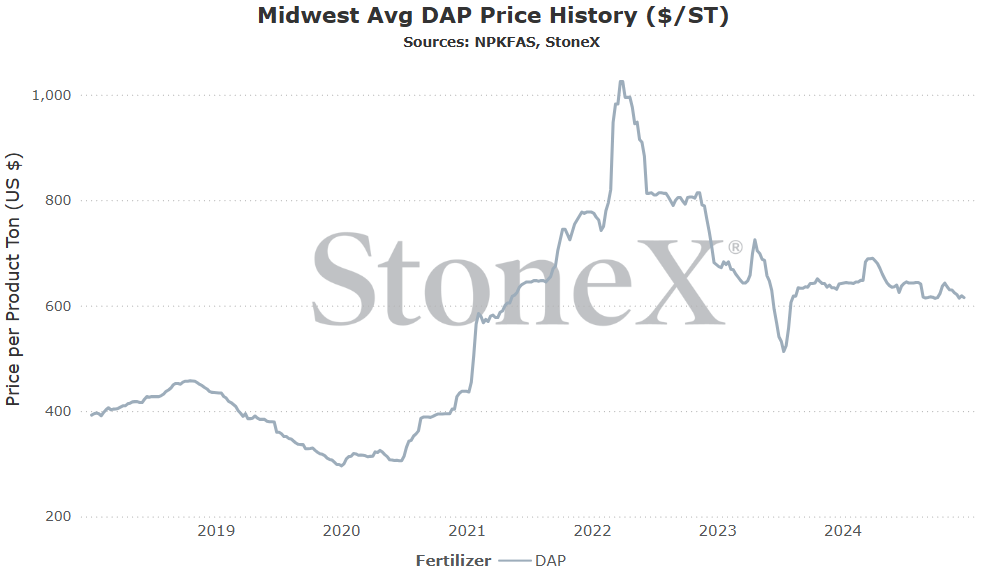
U.S. Midwest Average (using multiple points across Midwest) price comparison
Vs 30 days ago - -1% or approximately $9 lower
Vs 90 days ago - unchanged vs 90-days earlier
Vs 6 months ago - unchanged vs 6-months earlier
Vs 1 year ago - 3% or approximately $17 higher
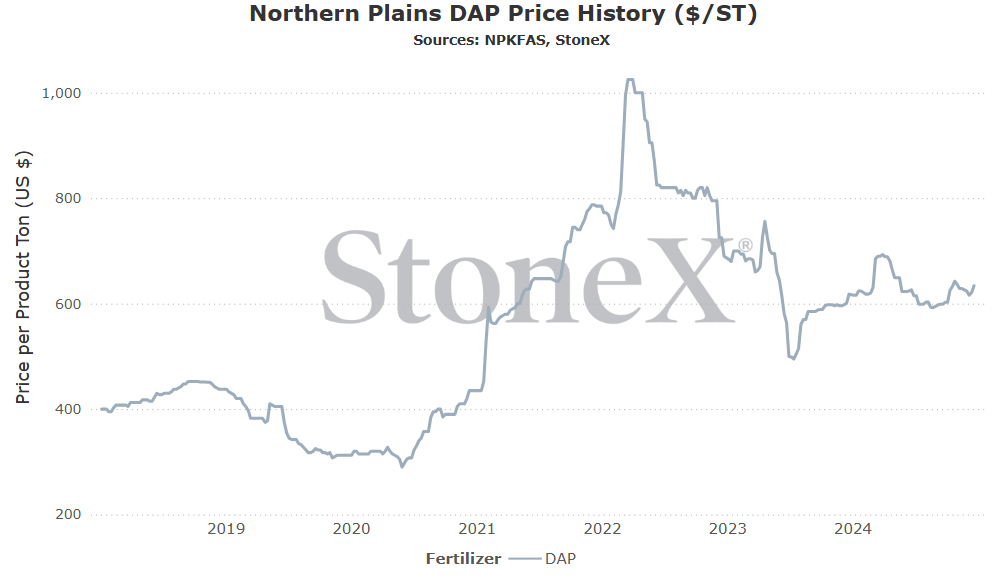
U.S. Northern Plains Average price comparison
Vs 30 days ago - 1% or approximately $8 higher
Vs 90 days ago - 6% or approximately $35 higher
Vs 6 months ago - 3% or approximately $19 higher
Vs 1 year ago - 3% or approximately $17 higher
U.S. Southern Plains Average price comparison
Vs 30 days ago - 1% or approximately $9 higher
Vs 90 days ago - 5% or approximately $30 higher
Vs 6 months ago - 2% or approximately $10 higher
Vs 1 year ago - -2% or approximately $11 lower
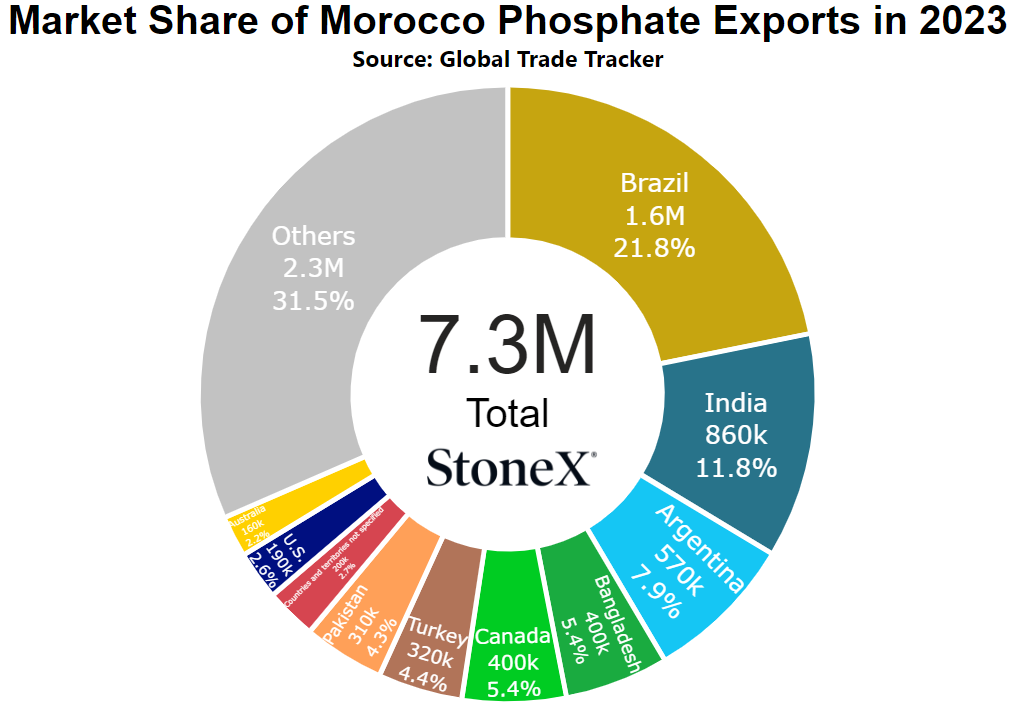
Morocco DAP price comparison
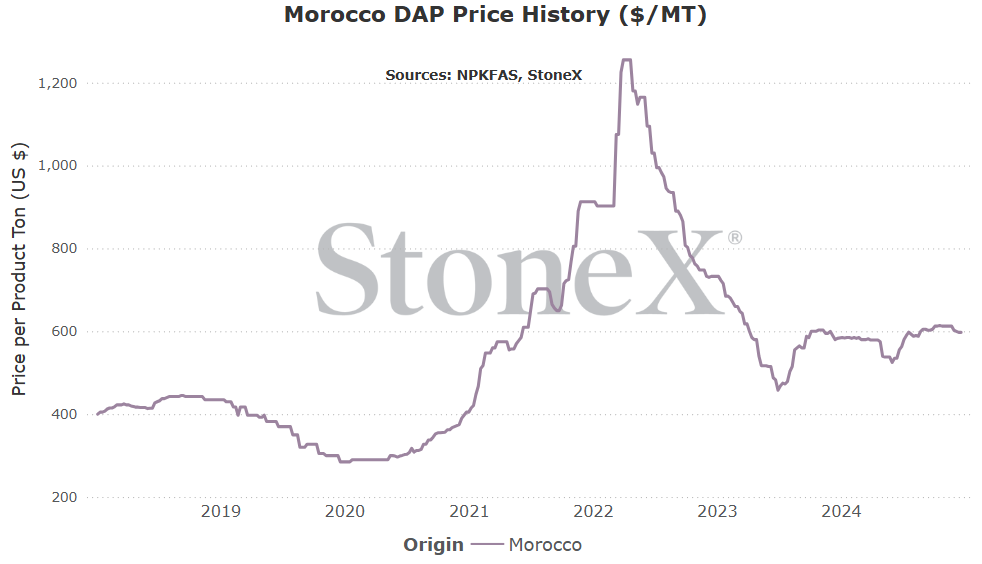
Number 1 global exporter in 2022
Price comparisons:
Vs 30 days ago - -2% or approximately $15 lower
Vs 90 days ago - -1% or approximately $5 lower
Vs 6 months ago - 8% or approximately $43 higher
Vs 1 year ago - 3% or approximately $15 higher
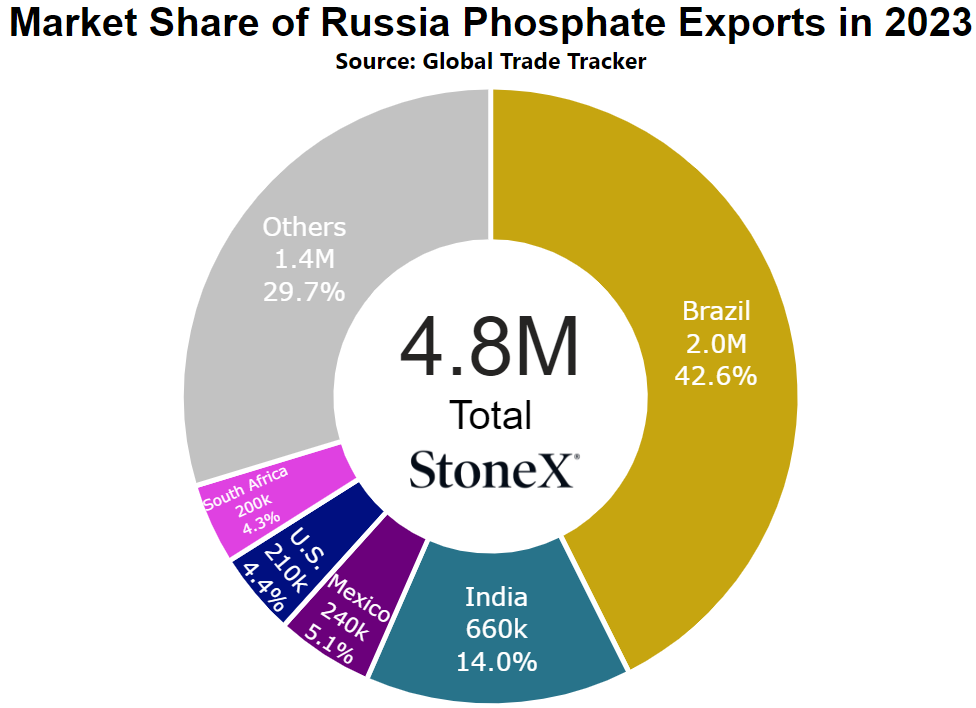
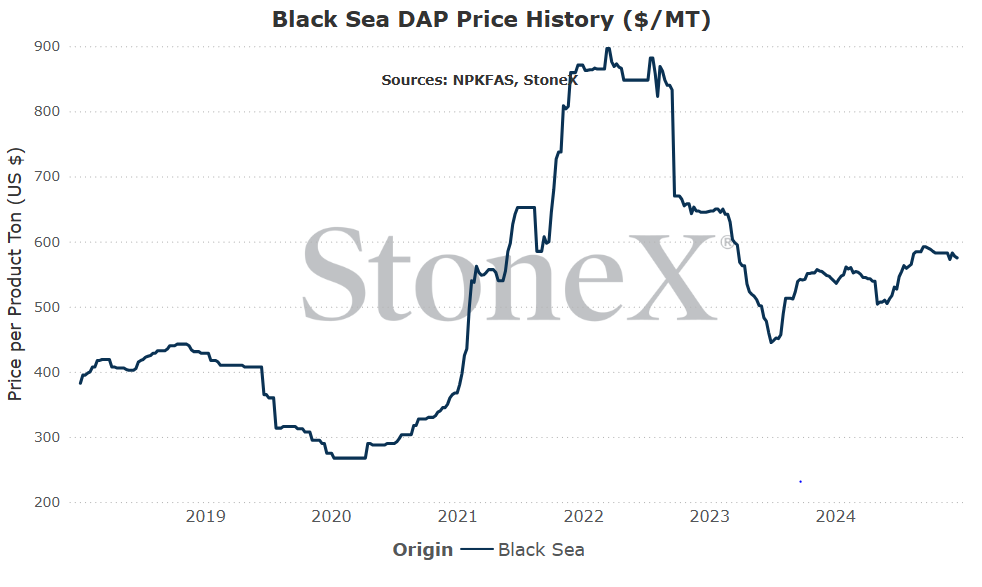
Black Sea DAP price comparison
Number 3 exporter of DAP/MAP in 2022
Price comparisons:
Vs 30 days ago - -1% or approximately $8 lower
Vs 90 days ago - -3% or approximately $17 lower
Vs 6 months ago - 8% or approximately $45 higher
Vs 1 year ago - 6% or approximately $33 higher
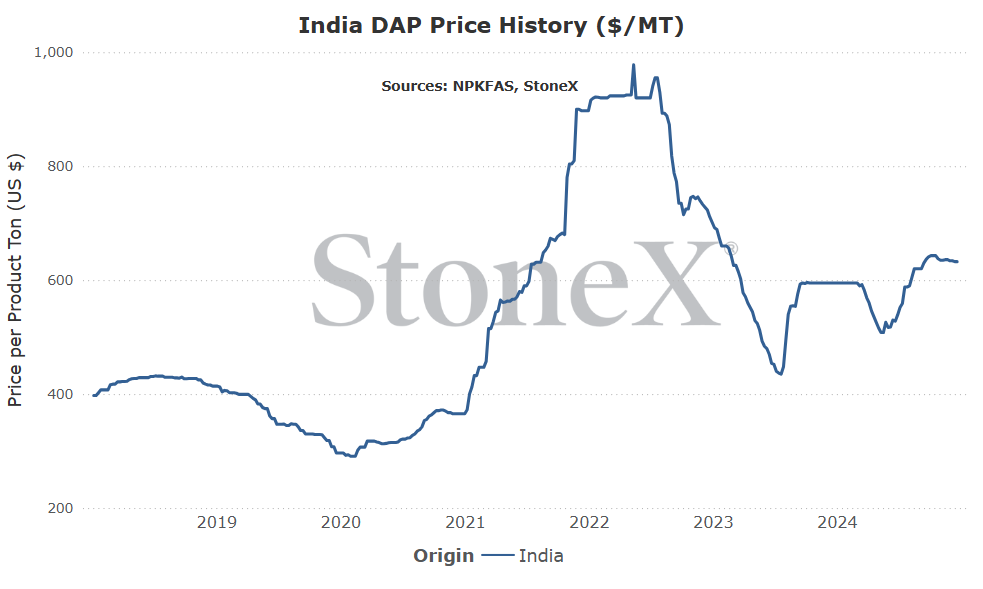
India DAP price comparison
Number 1 global importer in 2022
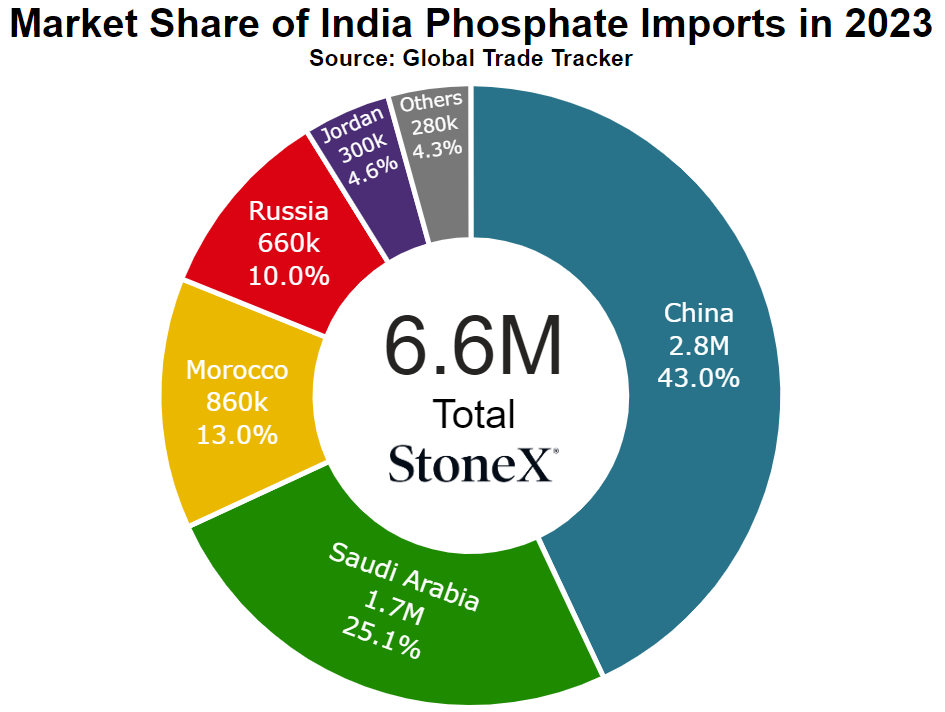
Price comparisons:
Vs 30 days ago - -1% or approximately $4 lower
Vs 90 days ago - -1% or approximately $4 lower
Vs 6 months ago - 20% or approximately $105 higher
Vs 1 year ago - 6% or approximately $38 higher
China DAP price comparison
Number 2 global exporter in 2022
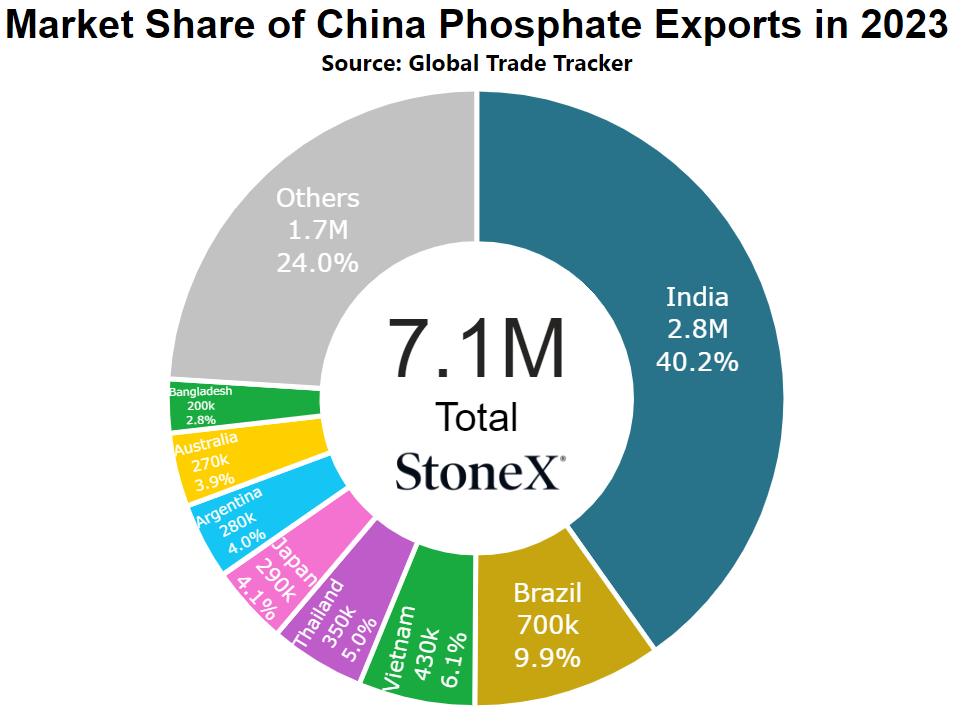
Price comparisons:
Vs 30 days ago - unchanged vs 30-days earlier
Vs 90 days ago - unchanged vs 90-days earlier
Vs 6 months ago - 13% or approximately $73 higher
Vs 1 year ago - 5% or approximately $32 higher
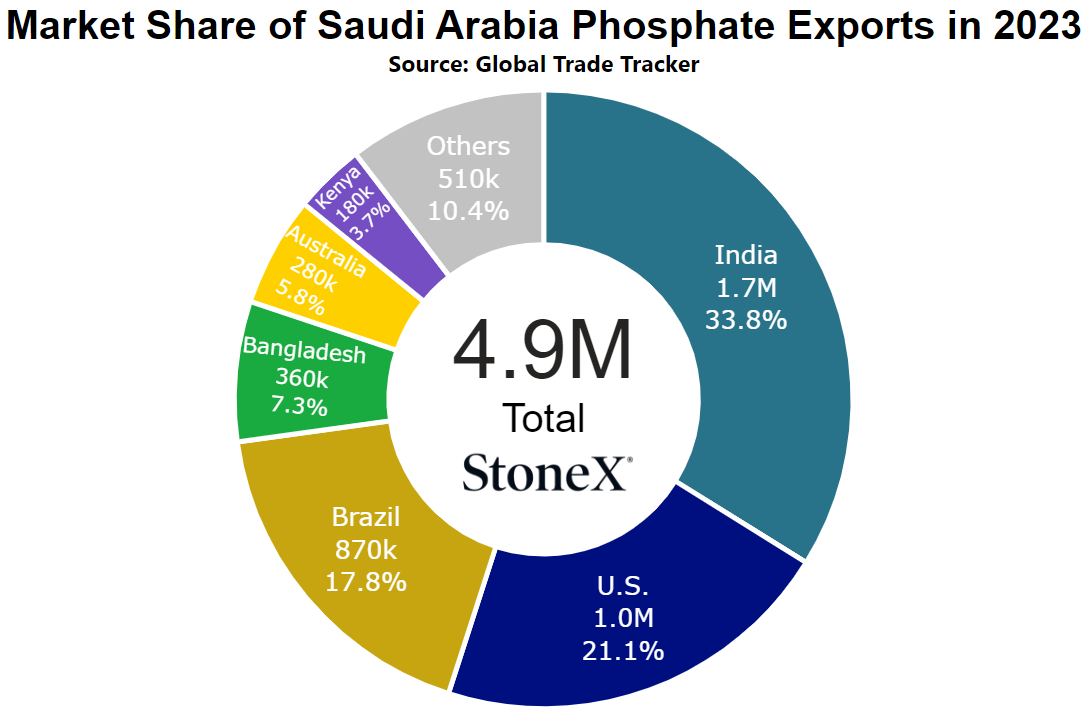
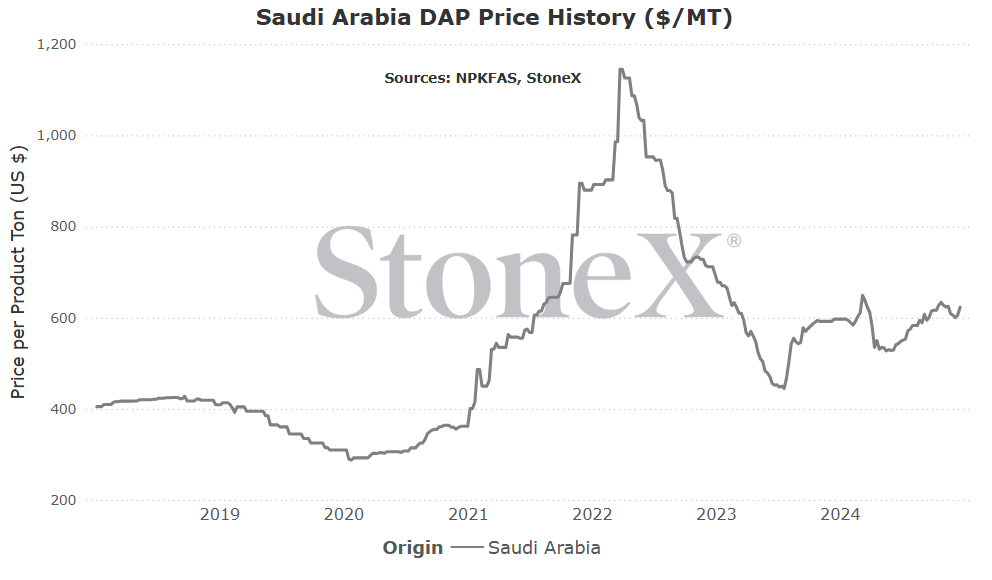
Saudi Arabia DAP price comparison
Number 4 global exporter in 2022
Price comparisons:
Vs 30 days ago - 2% or approximately $14 higher
Vs 90 days ago - 4% or approximately $22 higher
Vs 6 months ago - 15% or approximately $81 higher
Vs 1 year ago - 4% or approximately $26 higher
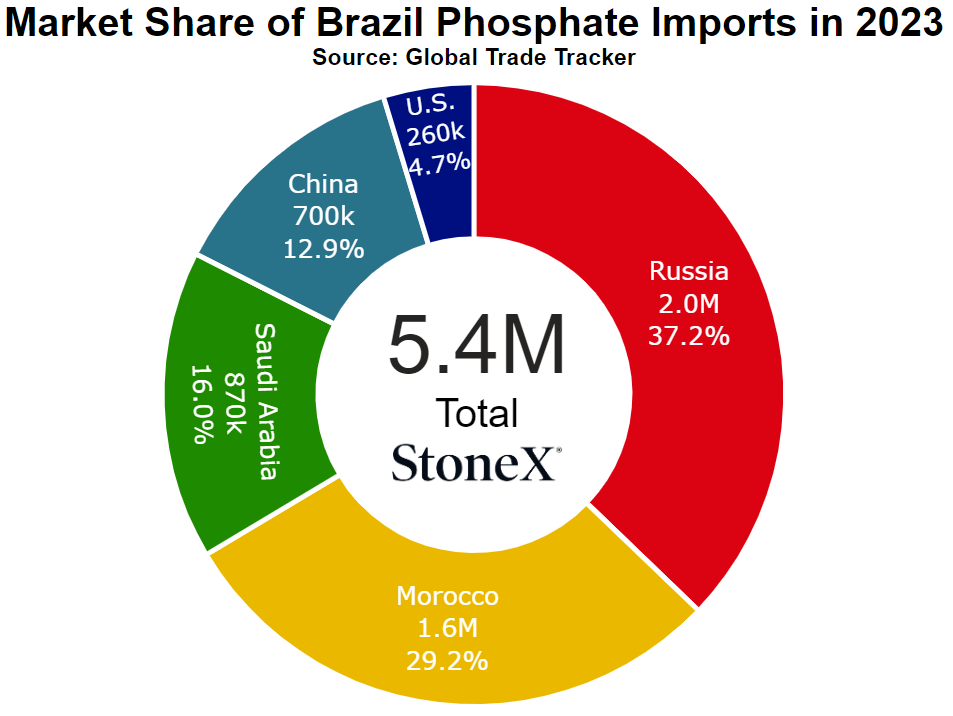
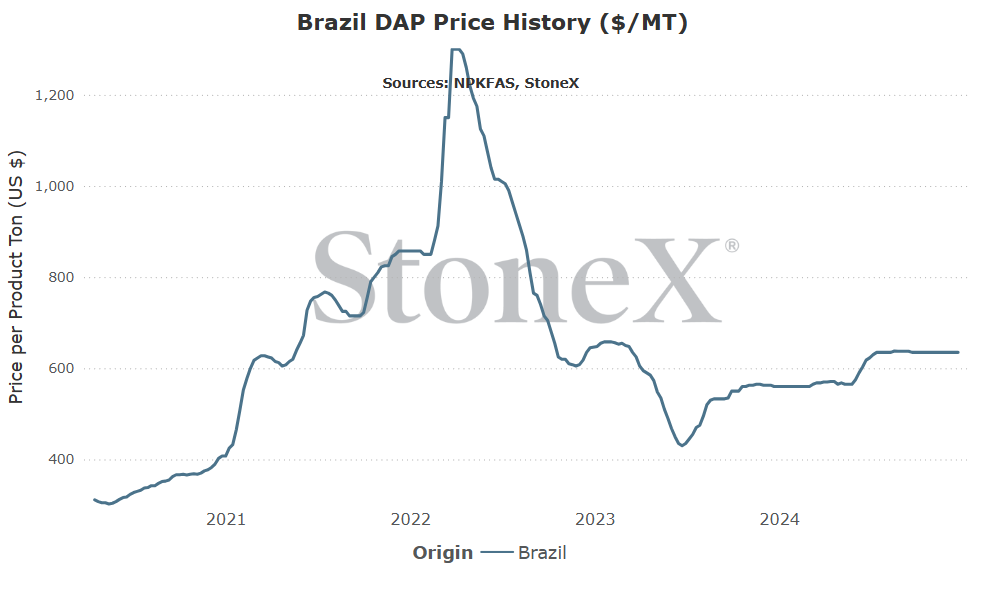
Brazil DAP price comparison
Number 2 global importer in 2022
Price comparisons
Vs 30 days ago - unchanged vs 30-days earlier
Vs 90 days ago - unchanged vs 90-days earlier
Vs 6 months ago - 3% or approximately $18 higher
Vs 1 year ago - 13% or approximately $75 higher
- Chinese exports stay lower / go lower – one of the biggest factors that have kept global phosphate prices high as been Chinese exports being significantly lower than what is considered normal. As the world's historic export leader, when they scale back, everyone feels it. While 2024 exports have been slightly better than expected, there is a growing fear that trend may flip on its head. It is so feared that some are theorizing that earlier committed sales from China will not be honored. Long story short, there is real concern that China will further restrict exports...and that will be felt.
- India continues to play catch up with government money/subsidies – India is the world's largest buyer of DAP/MAP and they have been low on inventories for much of 2024. While they have made significant gains on building stockpiles, they are still short of comfortable. They would normally enter the new year with approximately 2M tons already in place. This year, it looks like they will enter around 1.2 to 1.3M tons. This should keep them hitting global manufacturers to try and rebuild those stockpiles back to normal.
- Demand remains solid – one of the biggest surprises of this fall for North America was phosphate demand. Before harvest, I largely believed we were going to see significant application cuts. Grain prices were horrible. Yields were not expected to be great. Cash flows were in the bin. Then it improved. Yields, while not record everywhere, were mostly better than expected. Grain prices did not improve back to 2021/22 levels, but they bounced off the bottom. Suddenly, farmers realized they had a bit more cash...and a need to rebuild soil phosphate levels. That looks to be the same as we look to spring. Not only is the need to rebuild soil profiles still there, but we are seeing the U.S. government disperse funds to farmers that will likely make pulling that trigger a little easier.
- Horribly high phosphate values finally break demand – the 3rd bullish factor above points to possible big demand continuing as it did this fall...but what if it doesn't? What if spring demand simply cannot afford to apply phosphate at these values? If phosphate/corn values hold, as we expect them to, we will set all-time high/bad ratios for January/February. Worse than the same time in 2021/22. Even worse than where 2008 started. Farmers do not have unlimited funds to grow a crop. This is especially true in what is considered the "fringe" acres (those that were not corn prior to the ethanol boom). If demand starts to slide, we could see long positions start to puke.
- Chinese exports resume – never say never when it comes to China. Today, most of the belief lies in that Chinese phosphate exports will get even lower than they were in 2024. Unfortunately, that is just speculation. When it comes to China, we never know. That means there is still a possibility that their exports could be opened once again which could cause global manufacturers/suppliers to start cutting prices to get ahead of them. While this may not be a high probability situation, it is highly impactful.
- Fears of carrying product past looming spring cause sell offs – it is much easier to carry product over from fall than it is from spring. There is relatively little time between the end of fall and start of spring. That means less carry cost, less market risk, etc. This is why we watch for sell offs as we near the 2nd half of preplant applications. If demand is not meeting expectations, long positions start to worry. Worry typically helps justify lower prices. Lower prices tend to create sell-offs. Today is too early for that to happen, but March is only 60-days away...
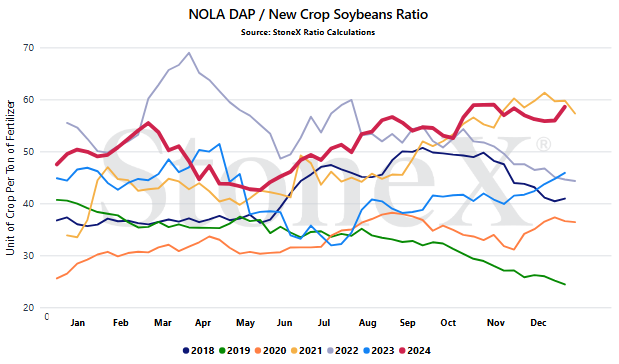
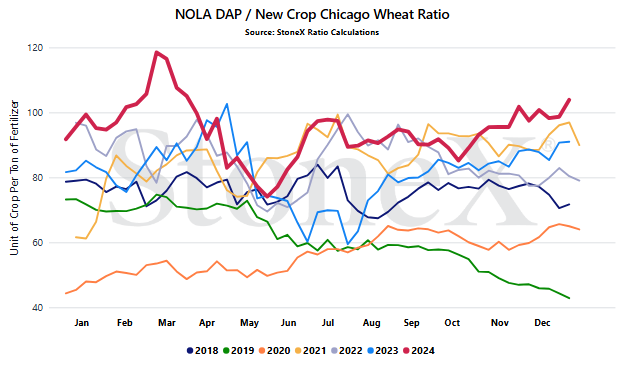
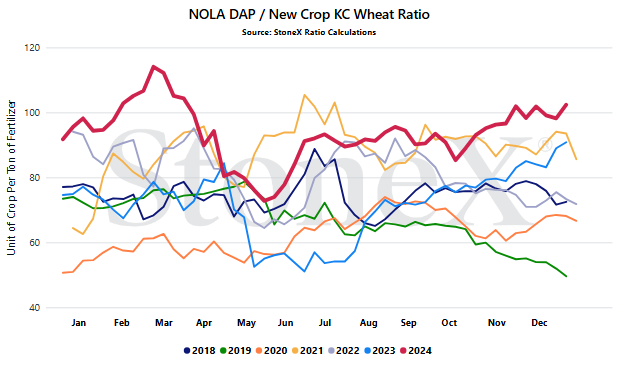
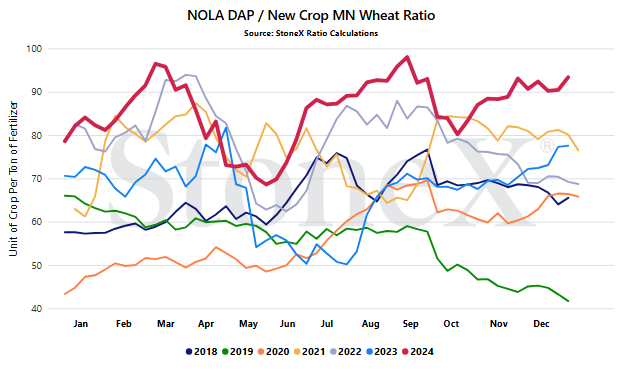
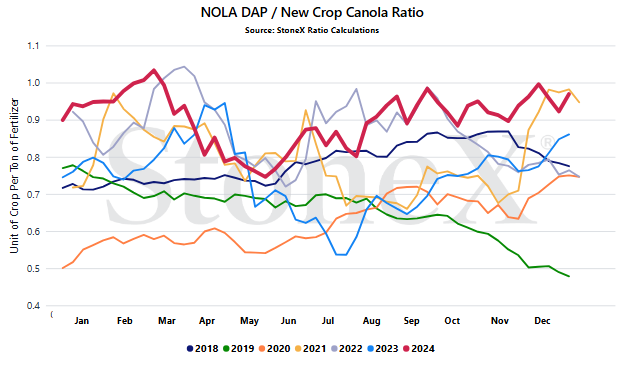
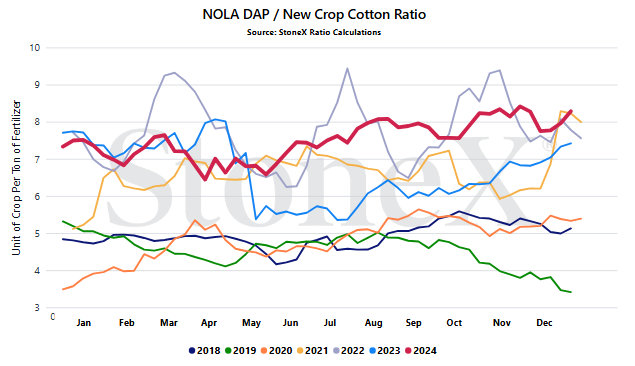
We believe that only looking at the flat price of either grains or fertilizer can be misleading:
-
Only selling grain can hurt you if fertilizer prices rise substantially
-
Only buying fertilizer can hurt you if grain prices fall
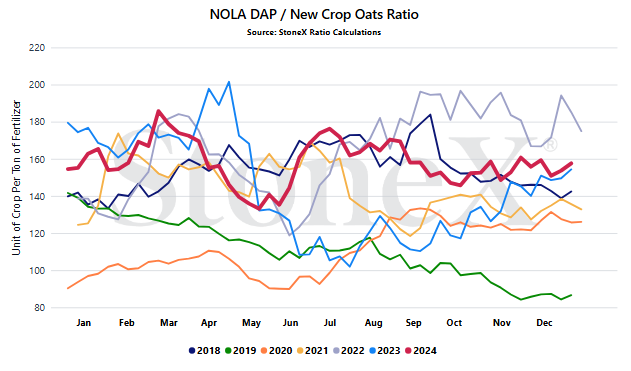
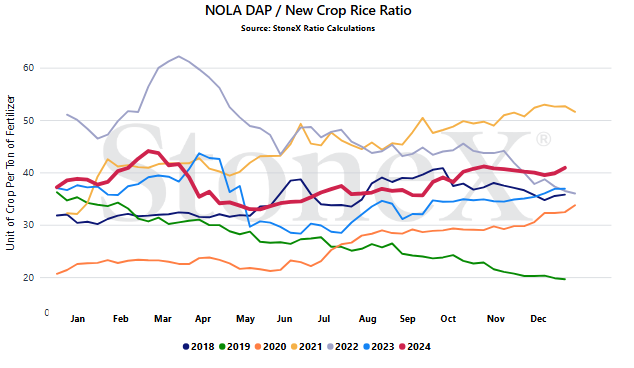
We look at the ratio "value" to get a better indication of where we are or how many bushels of X does it take to pay for 1 ton of fertilizer.
Would you rather:
-
Spend 150 bushels to pay for 1 ton of DAP
-
Spend 80 bushels to pay for 1 ton of DAP
When we compare the current ratio value against recent years, we start to see if we are high or low.
YOUR VALUES MAY LOOK DIFFERENT
This graph looks at the NOLA DAP price vs the flat grain price. There are no logistics on either product. Your location will look different due to fertilizer logistical costs, grain basis, etc.
- Chinese export flows - until Chinese phosphate exports return to normal, do not expect this focal point to change anytime soon. China used to export around 10M tons per year. January thru November of 2024, they only exported 6.2M tons and there is growing fear that the Chinese government will put bigger restrictions in place to start 2025. This is a big loss for the world. This is several million tons of product missing that should be in the S&D. We always have to remember that China can change on a dime, but today it is looking more likely that they will leave the world wanting. Significantly lower Chinese phosphate exports = significantly higher global phosphate prices.
- Does India feel the need to build stockpiles further - India has played a dangerous game with phosphate in 2024. For a time, they allowed their phosphate stockpiles to drop to dangerously low levels. At one point, they came within a few hundred thousand tons of the low levels that caused farmers to riot in late 2021. Fortunately, the government stepped up their programs and imports resumed. Many put the story to bed thinking it was done...but it is not. Estimates put their current stockpiles at 1.2M vs a historical norm/comfortable 2M tons. India still has tons to buy just to catch up to normal quantities as we start 2025.
- Spring demand reactions to high price - how will farmers react to extreme high phosphate values? This last summer (June/July/August), I truly believed that we would see phosphate demand down significantly. The phosphate price was simply too high vs grain values and farmers did not have excess cash on hand. Input cuts were going to need to be made for 2025. Well, the fall season got saved by a larger crop than expected and farmers know that big crops equals big nutrient yields that need replaced or risk lowering yield potential. I guess my question as I look to spring is whether that farmer group can afford it as well. There is still nothing great about grain values. 2025 is going to be a rough year financially speaking. I just have to wonder if there is a layer of farmers who are at a breaking point that need to make some hard decisions. If cuts need made, phosphate is either at the front of near the front of the list of inputs to be cut...
StoneX Ratio Calculation
The ratio calculation is derived from Bloomberg historical grains values as well as fertilizer values from StoneX, NPKFAS, and Argus.
The calculation is simply dividing the fertilizer price by each grain price.
All data was sourced from StoneX unless otherwise noted.