Global
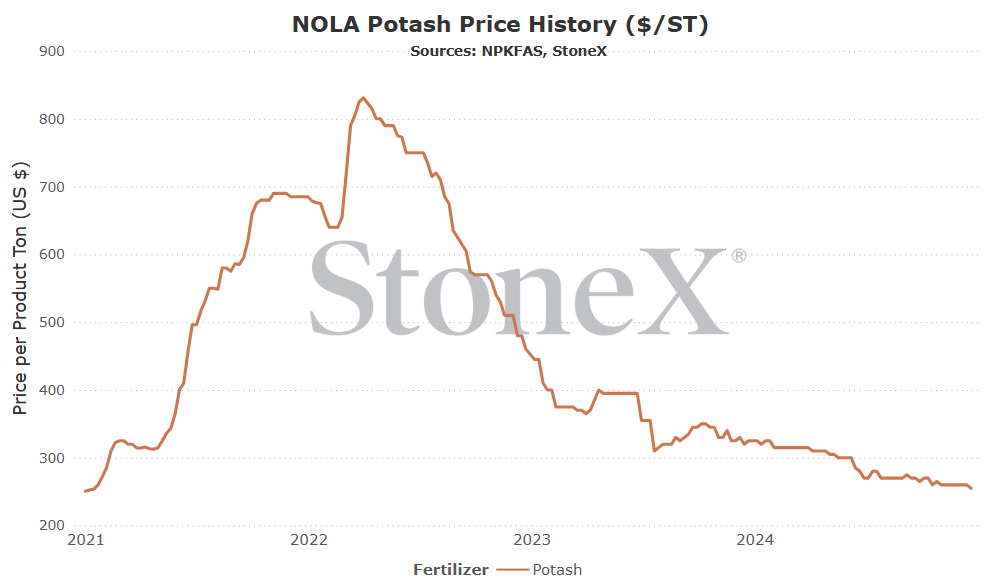
My POV on the global potash marketplace remains unchanged. We have seen solid demand across many of the biggest global buyers in 2024, yet values have stayed relatively flat to lower. I guess my biggest question is whether the fervent demand can continue in 2025 and if it doesn't, how could values rise?
I still have a lingering concern that lower potash values will entice global manufacturers to curtail production rates which will lower supplies and finally stop the bleeding. However, this cannot be a single company/country approach. This would take the participation of multiple/most manufacturers to really move the needle...and that still doesn't solve all of the expected new production coming online in the coming years.
All that to say short term I expect the same pattern, flat to soft...but I am keeping an eye on how manufacturers approach it in 2025.
North America
Like the global POV, it is hard to see a significant turn in price without major steps by manufacturers. We have long thought the potash market as being very well supplied and with new expansions/production coming in the coming months/years, we will be toeing the line to oversupplied which should act as a significant lid on pricing.
However, do not underestimate the power of manufacturers. Outside of a single Canadian mine curtailing production in 2024 and the President of Belarus recently discussing the possibility of cutting production by 10%, potash manufacturers have been churning out product with no slow downs. My question is this: how long can/will they keep this approach? With values continuing to fall, at some point someone needs to cry uncle. Do not forget that manufacturers still fondly remember their margins from late '21/early '22. They would love to see something similar to that again.
If manufacturers continue at normal production rates, I continue to see supplies as ample which should keep a lid on price ideas. Now, values can only fall so far and today's pricing is very attractive vs grain values. That said, outside of some logistical issues that "could" pop up, potash continues to look like the potash of old...flat and boring!
Just remember that it likely wouldn't take much for production rates to start going lower as margins get squeezed...

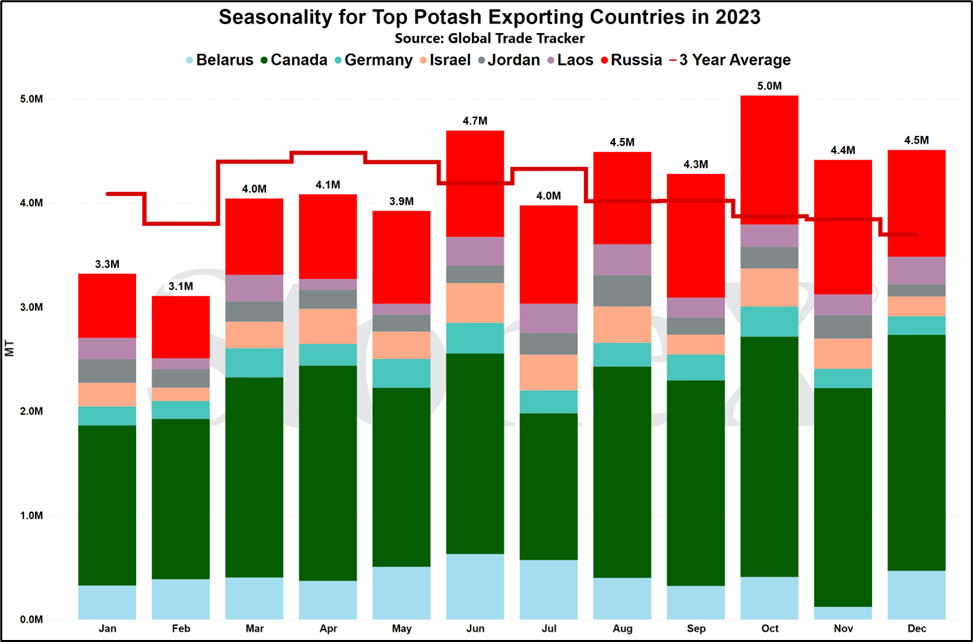
2025 global potash market outlook
The start of the new year means we should take a quick look at some of the biggest things that we are watching. This doesn't mean this is everything in the potash world that matters. Far from it. However, from our perspective, these are the things that have the highest chance of moving global values.
- Russia's relationship with the world - in late 2021/early 2022, global potash values skyrocketed. A large part of that bullishness was the worry that the world would lose Russian potash exports on top of already losing Belarusian exports. Russia has long been the world's 2nd largest exporter, well behind Canada, with exports between 7 - 11M tons the last few years. Fortunately, that stoppage never happened and global values fell...but can that continue? Russia refuses to give up on their invasion of Ukraine, much to the angst and anger of much of the world. If it continues/escalates, we need to consider how the world reacts. It may not do anything...or we may start see much of the world close its borders which will affect supplies.
- How well Belarus continues to return - you cannot discuss the Russia/Ukraine war without talking about Belarus. Just a quick background: Belarus would historically produce potash, ship it thru Lithuania and then out to sea. That all ended when Belarus allowed Russia to use their land to invade Ukraine from the north. Belarusian potash exports quickly sank and left the world more tightly supplied. Since then, they have been making inroads with new routes thru Russia/China but still fall below where they normally were. Their ability to return to full export levels will go a long way in determining the world S&D.
- How quickly new and expanded production comes online - the global potash market is already well supplied...and there is more coming. There is new production coming online in Canada in the coming years that will add more tons to the S&D. Russia looks as though they are going to keep expanding their production. China continues to invest in Laos to build their production capability (let's them buy from a neighbor rather than a western country). If the global potash market is already well supplied, these increases could push it into a near oversupplied market. Oversupplied markets tend to keep a lid on price ideas. This would be a good thing for buyers.
- Whether manufacturers will allow prices to stay low/get lower - potash values have been solid since correcting away from the early 2022 high's. Almost every week has seen price ideas flat or lower. The question today is how long that can last. Prices cannot fall forever. At some point, manufacturers have to start curtailing production as market values dip below production values. I'm not sure if we are to that point of production losses yet, but it feels like we are getting close. We have already seen the Belarusian president discussing lowering production rates due to low values. We haven't seen other countries/companies follow suit, but we have to stay vigilant. If others start to follow, it can impact supplies and rally price ideas.
Again, these are the highlights of what we are watching. North America certainly needs to keep an eye on the incoming Trump administration. President Trump has been threatening tariff's on Canadian imports and given how many tons of potash flow south, this could be massively impactful...I just do not think it will happen. Calmer heads will find common ground and proceed.
This list is more of things that can impact the overall S&D. No doubt other things will pop up, but it is a good start.
Incoming Trump administration threatens tariffs on Canada
From how I see it, President Trump came into office the first time almost surprised that he won. It took him time to figure out the system, set his team, build strategy, etc. That DOES NOT look to be the case during his 2nd term. He is coming in with a full head of steam and he is taking full advantage.
Unfortunately for Canada, he has them on his list.
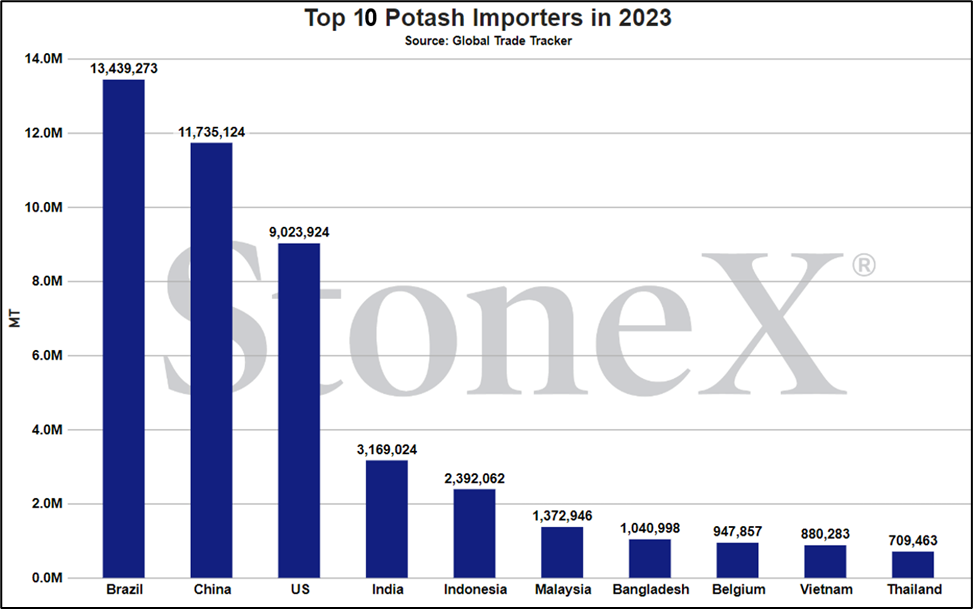
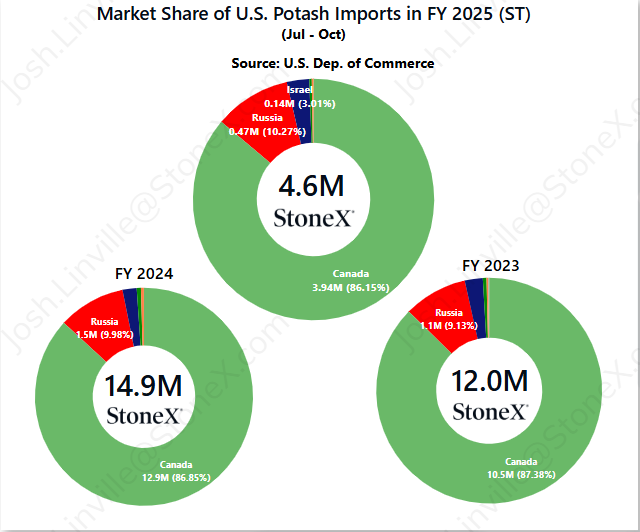
We have been seeing threats that the incoming Trump administration will impose heavy tariff's on Canadian imports if certain demands are not met. If this happens (I'm still hoping it doesn't), this will impact the nitrogen markets but it will have a bigger effect on potash. The last 2 fertilizer years have seen between 12 and 15M tons of potash flow from Canada into the U.S. Now, not all of this is for U.S. consumption. There is a good amount of product that flows to the world via U.S. ports and there could be an argument that those tons are immune from Trump tariffs. However, there is still plenty that flows south for U.S. farmers that would be squarely in the crosshairs.
Again, I am really hoping that this is a story that we worry about and nothing ends up happening.
What does this mean for farmers?
When it comes to commodities, I haven't seen many examples where the tariff impact didn't eventually find the end user. In this case, that would be the farmers on both sides of the border.
Potash manufacturers have already seen the price of their goods drop substantially and then stay low. While I do not think we are at break even levels today, I think we are much closer than some anticipate. The fact that we have already heard the Belarusian president discuss production curtailments and saw a single Canadian mine already take a curtailment earlier in 2024 lends support to that idea.
If tariff's are put into place, my fear is that the cost will be passed along onto the sales side. The higher price will be sent to the distributor. They will pass it to the retailer who will have no choice but to pass it to the farmer.
Hopefully this never sees the light of day, but if it does, be weary of pricing...
Global demand remains high...and prices continue lower
When looking at all major fertilizer inputs, potash is the one that stands out as the most "normal".
Historically speaking, potash values are relatively low.
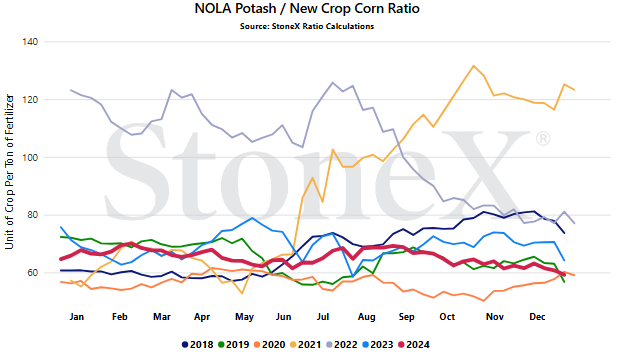
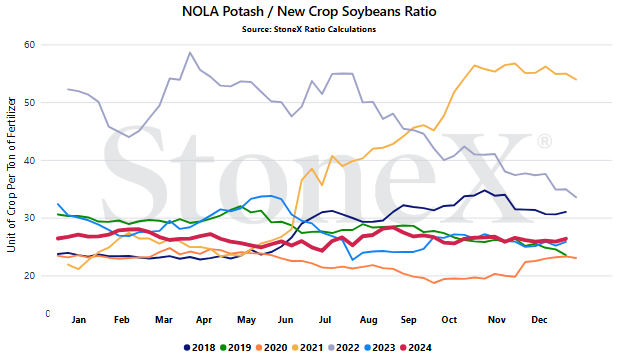
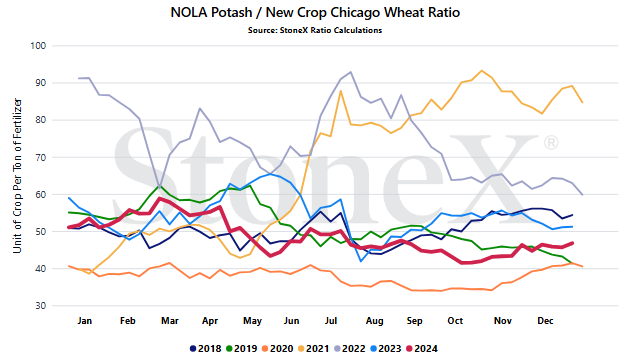
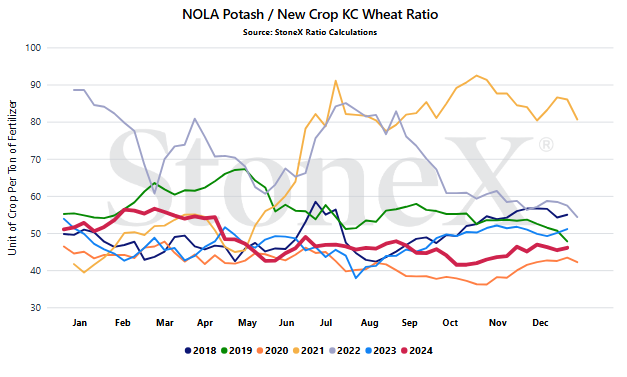
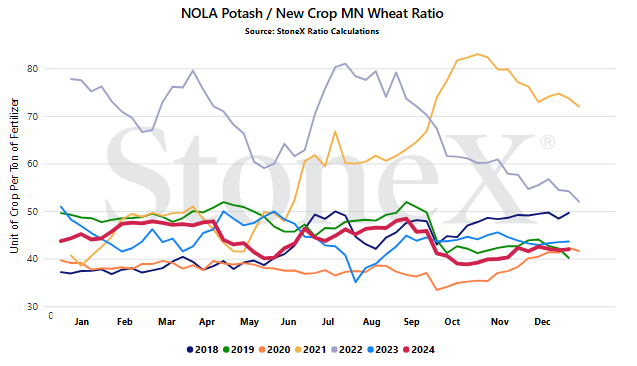
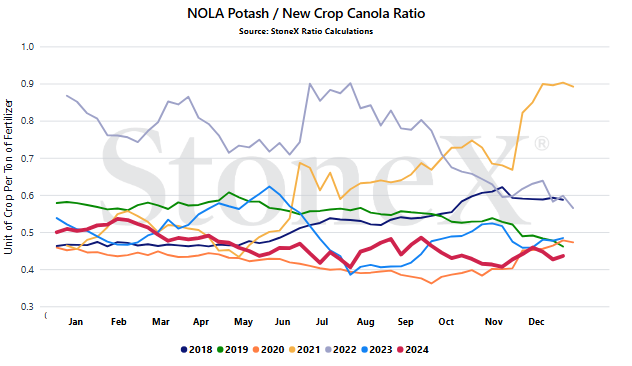
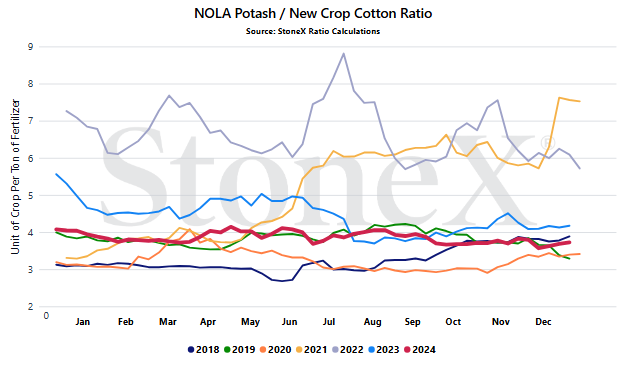
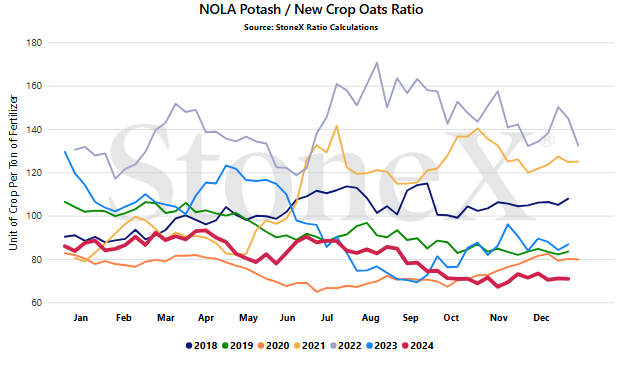
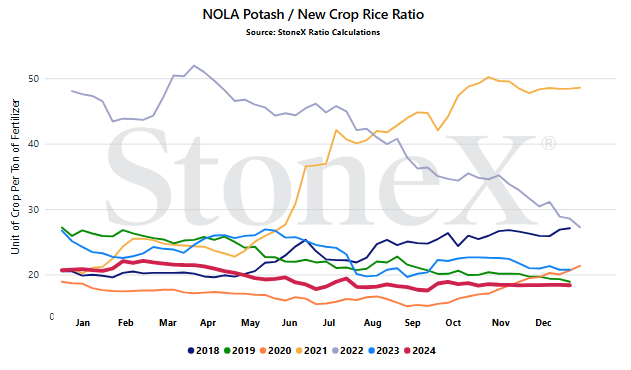
When compared again grain values (check the charts near the bottom of this newsletter), the ratio values are on the lower end of normal.
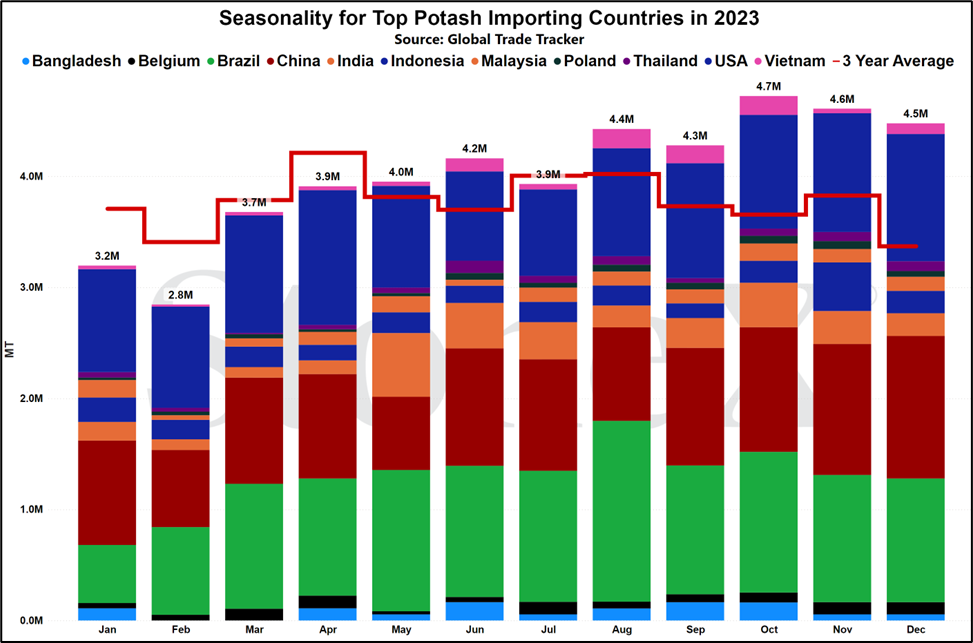
Potash has done more work than any other major fertilizer input to get its price right...and demand has rewarded it. We have been seeing major import countries trade data showing rates exceeding their 3-year average.
So the world is seeing higher demand...yet prices continue to fall.
For me, this is another strong indication of how well supplied the global potash market is. Even with big demand, prices have been unable to move higher. This isn't to say that prices cannot move higher. As soon as I ever make comments like that, the market proves me wrong. This is to say that it will take a lot to break potash out of its current trend...and that is a good thing for farmers.
What does this mean for farmers?
This is a good thing for once.
A very well supplied/over supplied marketplace typically sees values low as the market is desperate for demand. Sellers know there are plenty of options for buyers which mean they need to be aggressive in their price to make sure they get the sale.
The fact that global potash demand has been so good yet values haven't really budged continues to back the well supplied narrative. With more production on the horizon, I hope this will mean continued aggressive pricing for potash.
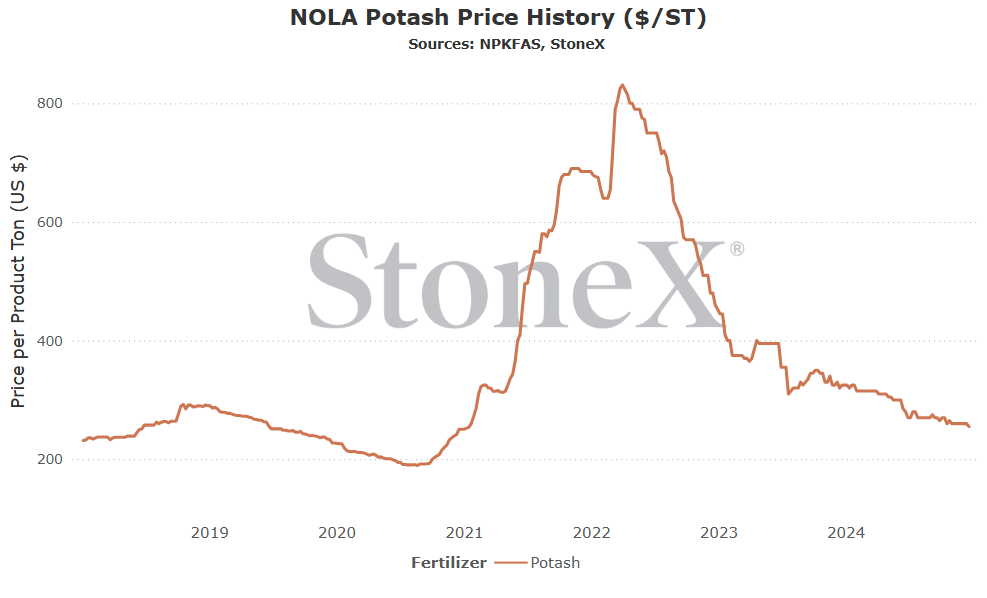
NOLA/New Orleans Louisiana
Vs 30 days ago - -2% or approximately $5 lower
Vs 90 days ago - -6% or approximately $16 lower
Vs 6 months ago - -9% or approximately $25 lower
Vs 1 year ago - -22% or approximately $70 lower
U.S. Midwest Average (average of several points across the Midwest)
Vs 30 days ago - -4% or approximately $13 lower
Vs 90 days ago - -8% or approximately $26 lower
Vs 6 months ago - -17% or approximately $61 lower
Vs 1 year ago - -23% or approximately $91 lower
- Global manufacturers start to curtail production – other than some commentary from the President of Belarus, we haven't really seen potash manufacturers reacting to prices that continue to fall. While this has been great for buyers, I have to wonder how long this will be allowed to play out. Eventually, prices will go low enough that at least someone in the production world has to scale back because they are at best breaking even or at worst losing money with every ton produced. If we see enough manufacturers pinched, we could see widespread production curtailment that could send prices higher.
- Solid potash price vs grains keeps demand high - when one looks at nitrogen, it is hard to get excited as values are on the higher side of normal vs grains. Phosphate values are extremely high regardless of how you look at it. Potash is the one major fertilizer that is extremely well priced. Look at the ratio charts below. It isn't often that the values get lower than where they are. If buyers see this and start to ramp up their applications to build soil levels, we could see prices pop to keep up.
- Short winter turnaround for N.A. pressures logistics – the N.A. fall season might have been unorthodox, but it was still successful. We should be heading into 2025 with relatively low inventories. That means less time to refill. There is only 75 days before we are mid-March and in the middle of spring preplant application for wide swaths of land. There are only so many trucks/railcars/barges to move product. It is possible that we see freight rates higher to rush the refill...and those costs would eventually get handed down to the farmer.
- Production remains normal/demand falls – until we see production rates starting to get impacted, it is very hard to see values higher. In fact, as we look forward to new/expanded production in the coming months/years, supplies will be even more adequate. I still believe we will be toeing the line to an oversupplied market. That means aggressive pricing for the farmer. As Martha Stewart says, it's a good thing!
- Global manufacturers battle to break high cost producers - today, prices continue to slip because production continues at normal rates. To stop the bleeding, someone needs to get shut out. There is a possibility that manufacturers realize this and take steps to speed the process. This is especially true if they think it will slow/stop new or expanded production coming online. If manufacturers decided that lower prices ultimately heal the market faster, that could mean good things for buyers short term.
- I'm struggling with a 3rd!!! – I am in a weird spot. While I'm not sure if potash is low enough to start shutting off production, I'm getting to the point where I wonder how much lower it can go. If prices dip much further, I think we hit the pain point and manufacturers start to react. I'm sure there is something I am missing, but I'll be danged if I can think of what it is today!
Where are the current potash/grain ratio values today
We believe that only looking at the flat price of either grains or fertilizer can be misleading:
-
Only selling grain can hurt you if fertilizer prices rise substantially
-
Only buying fertilizer can hurt you if grain prices fall
We look at the ratio "value" to get a better indication of where we are or how many bushels of X does it take to pay for 1 ton of fertilizer.
Would you rather:
-
Spend 120 bushels to pay for 1 ton of potash
-
Spend 60 bushels to pay for 1 ton of potash
When we compare the current ratio value against recent years, we start to see if we are high or low.
YOUR VALUES MAY LOOK DIFFERENT
This graph looks at the NOLA potash price vs the flat grain price. There are no logistics on either product. Your location will look different due to fertilizer logistical costs, grain basis, etc.
- Manufacturers reaction to low pricing - prices cannot fall forever. There is a definitive floor to potash pricing. One of the surprises of 2024 is that we have not seen more manufacturers reacting to low values. Except for one mine, I cannot point to any other production point that curtailed production purposely. That means one of the bigger questions for 2025 is if that will change. If we suddenly start to see multiple mines across multiple countries start to curtail production to limit supply, we could see values start to normalize and even push higher. While these types of markets never seem to last long (if prices rise, it incentivizes them to restart production), they can have a short term effect. All this to say that we need to watch production rates. If rates remain high, prices likely stay under pressure. If we start to see production curtailment announcements, the bear train ride might be coming to an end.
- N.A. trade routes if Trump follows thru with tariffs - just before writing this, I read an article that talked about Canadian officials traveling to Mar A Lago to meet with the Trump team. I am VERY hopeful that these talks/discussions will end with agreement on both sides that ends with no tariffs being implemented. If that is the case, then potash flows between Canada/U.S. will continue as normal and we can all put this period behind us. However, if they fail and we do see tariffs put into place, it is going to be a burden. Canadian potash manufacturers will struggle as they rely on U.S. ports to export around the world. U.S. farmers will struggle as Canadian manufacturers will want to keep their margin and so will try to pass the higher cost along or threaten to not send it at all. There are a lot of theories on how markets will react if these get put into place. Let's hope that is a lesson we do not need to learn...
- Timing of expanded/new production - this has been a watch point of mine for a while and it remains on the list. 2024 has seen potash values lower thru most of the year, and we haven't even seen all the new production online around the world. There is still more coming in Canada. I expect to see expansions in Russia. Laos is supposed to ramp up even more. The current global potash market already feels well supplied so what will that mean when even more starts getting produced? Prices cannot go down forever...but we might challenge how low they can go.
StoneX Ratio Calculation
The ratio calculation is derived from Bloomberg historical grains values as well as fertilizer values from StoneX, NPKFAS, and Argus.
The calculation is simply dividing the fertilizer price by each grain price.
All data was sourced from StoneX unless otherwise noted.