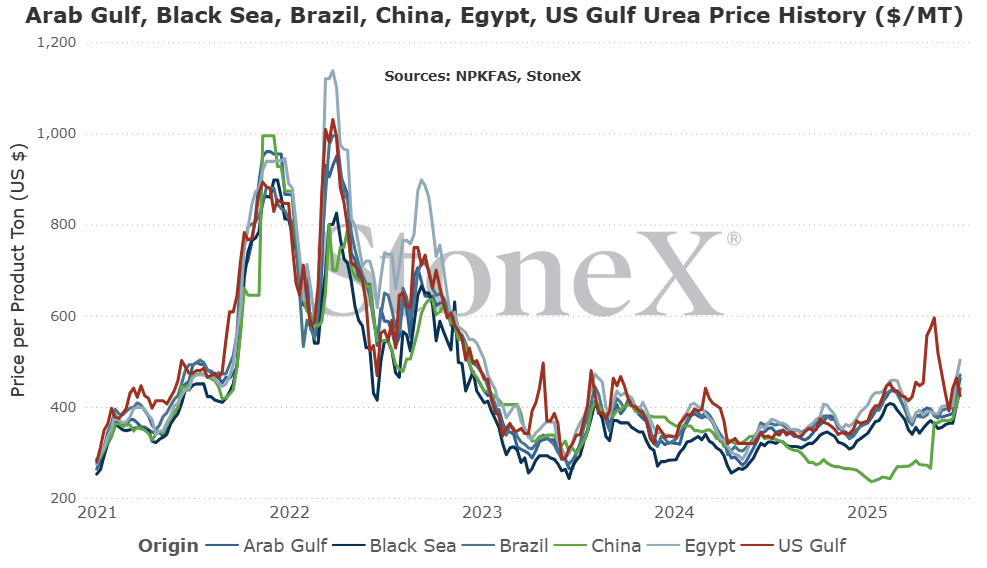
As I write this, the ceasefire agreement between Israel and Iran is relatively fresh and appears to be holding. Gas production in both countries is about to resume and nitrogen manufacturers in Iran and Egypt have stated intentions of resuming production in the coming days. Global values have fallen hard off their high's at the peak of the conflict.
So rather than take the easy way out and say "I'm bearish" while acting like I'm making that call at the height of everything, I am making this call from June 25th. Brazil urea futures have fallen nearly $100 from their Monday settlement high's. N.A. values have tumbled to the high $300's.
From here...I still think there is a chance of lower prices sometime in the next few months.
India announcing a huge 2M ton urea purchase tender isn't going to help as it provides excitement in what should otherwise be a quiet demand period.
The best news is that the Middle East is quieting down and rather than the market focusing on what could be, it is now focusing on only losing a few weeks of production from the 3rd and 4th largest exporters.
There is also hope that President Trump can now find peace between Russia and Ukraine. That could help improve relations and reopen normal global urea trade flows.
Ultimately, today's prices are high vs grains which means little end demand interest. There is a long time until next spring so very likely buyers will wait which will hopefully put bearish pressure on the market...hopefully.
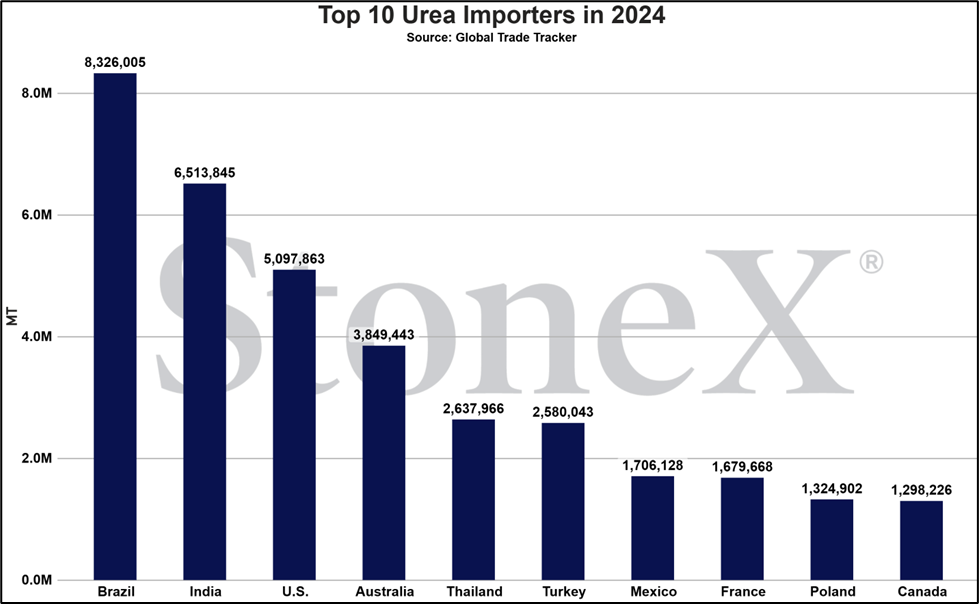
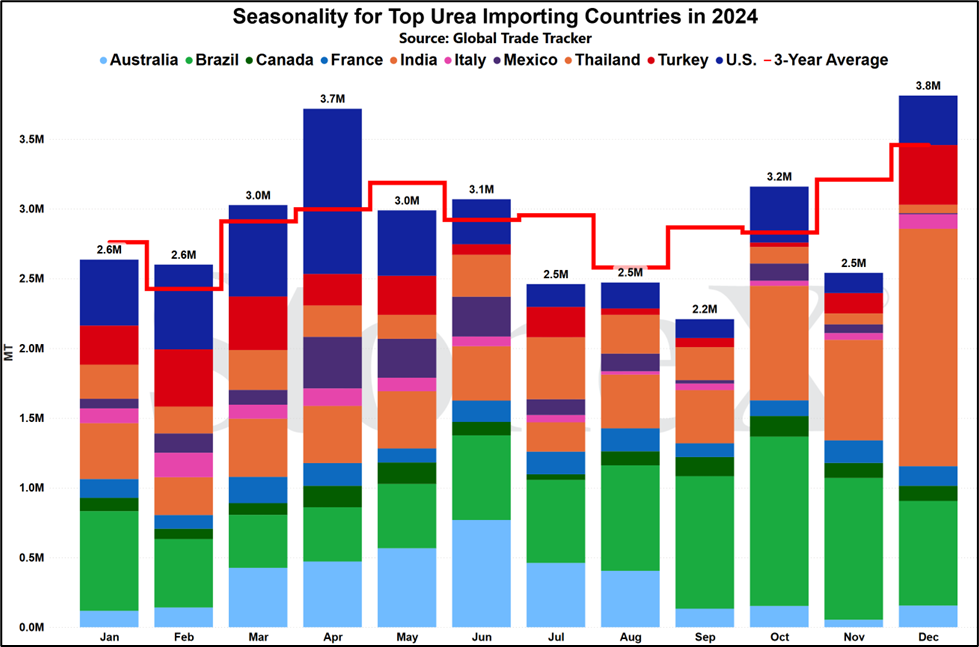
WAR...and peace
What a month it has been...
Almost every global headline over the last several weeks has been focused on the Israel/Iran war. As you are probably already aware, Israel completed preemptive strikes on Iranian targets due to their continued nuclear program work. After years of threats, attacks, and funding of other organizations for their own attacks, Israel's red line that couldn't be crossed was Iran possessing a nuclear weapon. They felt that enough progress had been made by Iran that they had to act.
However, a preemptive attack like that was not going to be ignored. Iran responded with attacks of their own.
Then things started to spiral.
One the one side, Isreal is REALLY good at this whole war thing. When they pick a target, they do not level a city block. They know the building. They know the floor. They know the corner of the building and decide to send a missile through this window. While they are at it, they probably pick if it is better to target the upper or lower pane of that window. What that meant is that there was little chance of collateral damage. Little chance that missiles would accidently hit surrounding areas. However, even with this surgical approach, Iran made the decision to shut down their gas production facilities. Better to shut them down in case Israel changes their minds on attacking infrastructure rather than be surprised. That meant that Iran's nitrogen production facilities had to shut down as well. No feedstock, no production.
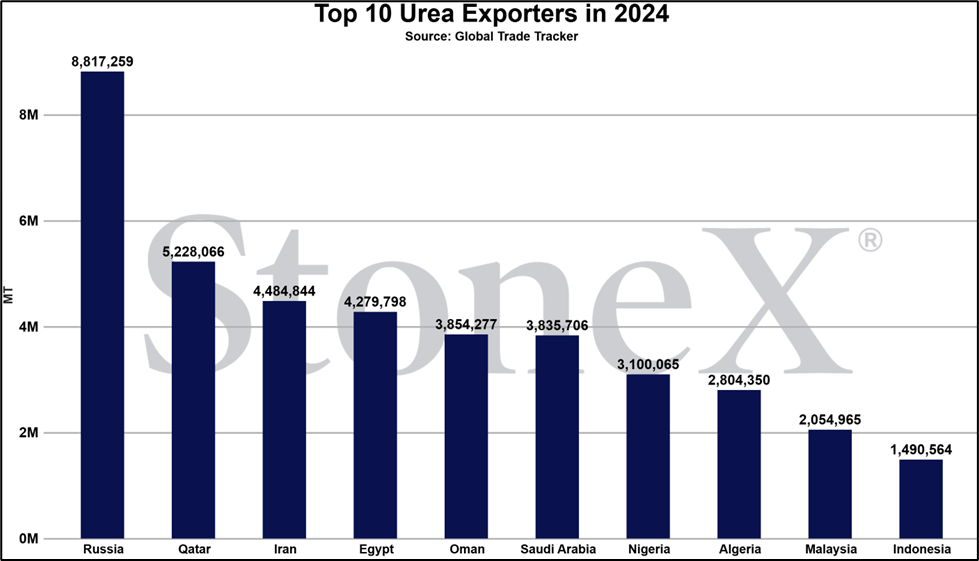
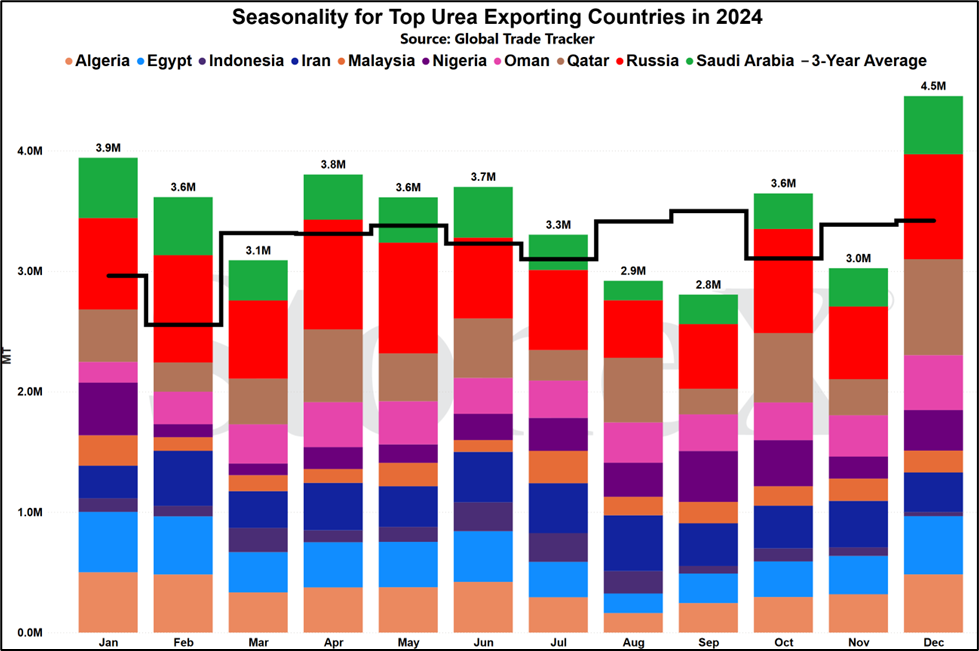
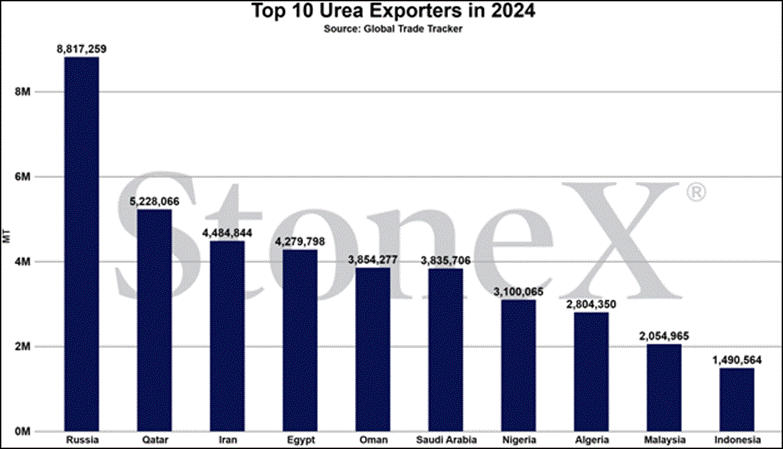
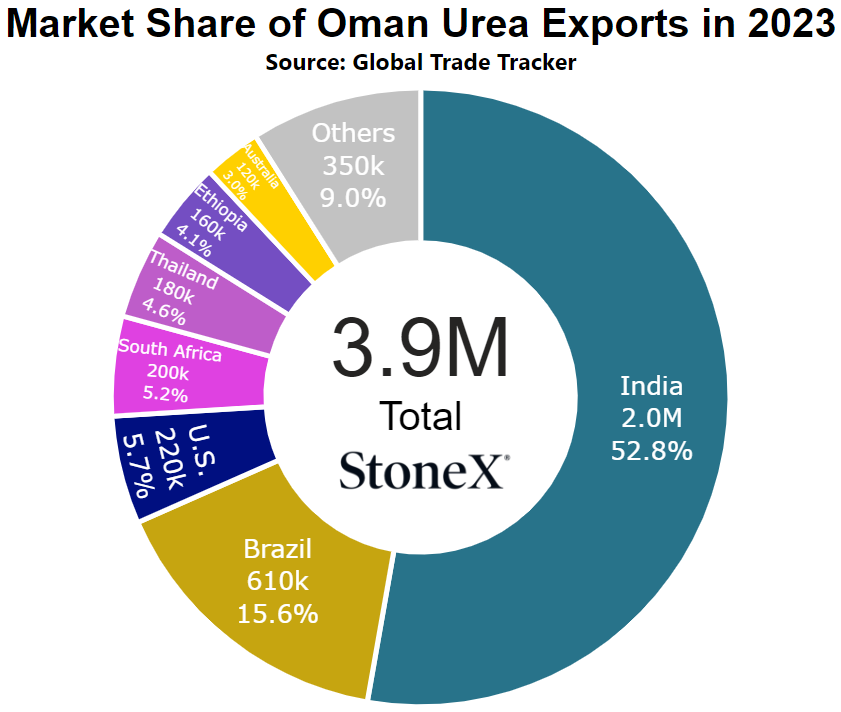
As you can see on the chart below, this meant the world had once again lost the world's 3rd largest urea exporter of 2024.
On the other side, Iran takes a bit different approach to attacking. Rather than surgical strikes, they take a bit more of an old school approach of spray and pray. They launch dozens/hundreds of rockets in the direction of their target and hope they hit. This, unfortunately, represents a much larger chance of collateral damage. An overwhelming rocket barrage can see some slip through defenses and strike infrastructure. Like Iran, Israel took the precautionary measure of stopping their gas production until everything calmed down.
...but Israel isn't on the chart below so why do we care?
Egypt cares. Egyptian nitrogen production can be highly dependent on Israeli gas flows. When Israel shuts off their gas production, Egypt had to shut down their nitrogen production until Israel restarted.
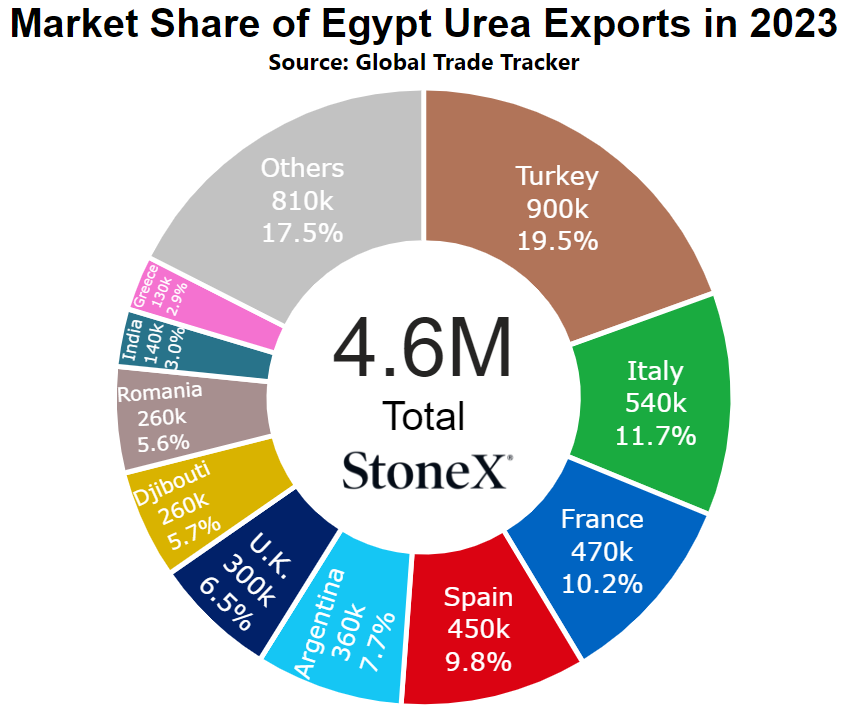
Again, as you can see below, this meant that the world had once again seen the 4th largest urea exporter of 2024 go offline.
In the lead up to these attacks, the global urea market was already struggling with Chinese exports expected to be less than half their normal amounts and European production remaining at 75% of normal. This event caused values to skyrocket around the world.
Then, the unthinkable happened. President Trump authorized direct strikes on Iranian nuclear sites. That meant B-2 bombers (which are stationed relatively close to where I live which is exciting and terrifying at the same time!!!!) loaded with the infamous bunker buster bombs flew undetected halfway around the world, hit the nuclear sites, and then flew home. All in, those jets were in the air for 36 hours and by all accounts were extremely successful.
Again, Iran was angry (as they probably should be). Suddenly, the Iranian government voted to do the one thing that keeps me up at night. They voted to "close the Strait of Hormuz".
Now, if you have heard me present or have been on this newsletter for a while, you know why this scared the crap out of me.
Take a look at the map below. The Strait of Hormuz is a very narrow waterway that is incredibly important for global shipments. The amount of materials that flow through that channel is insane. Oil is typically the most discussed, but a lot of urea flows through there.
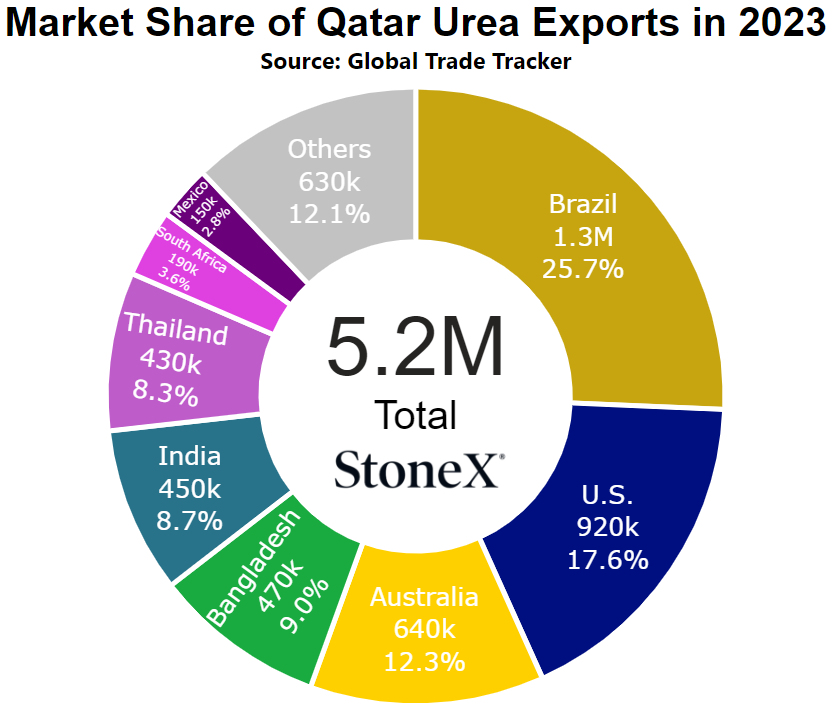
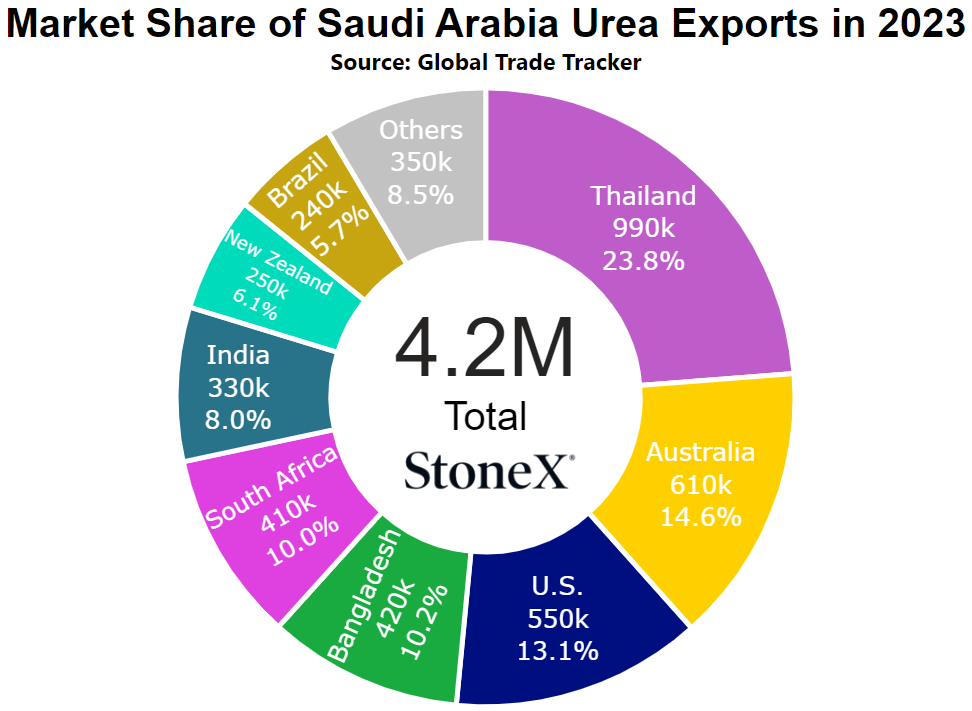
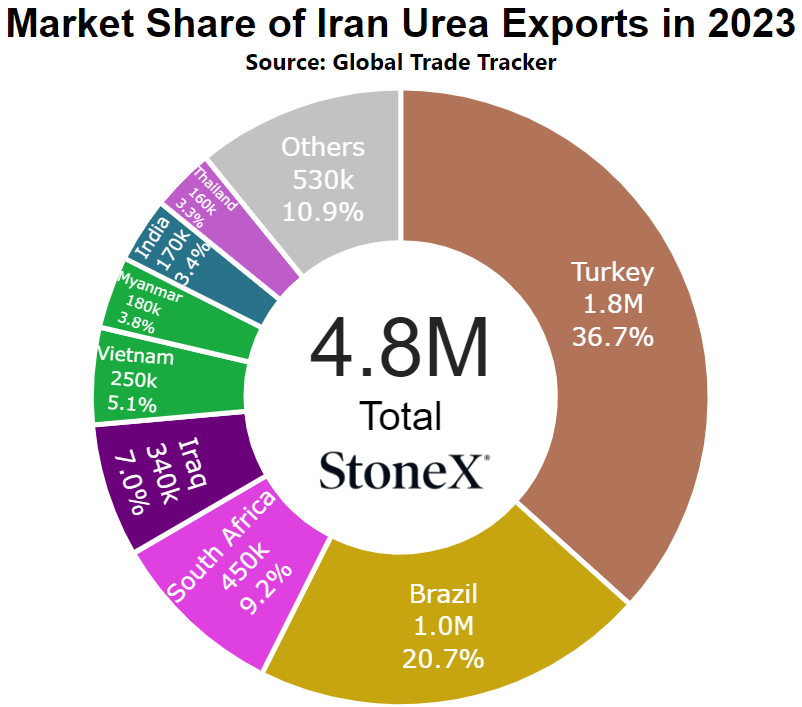
The map below shows the number of tons that each nation on the North African/Middle Eastern region exported in 2023...that is a lot of tons surrounding the Persian Gulf. Now, look at Iran in relation to the Persian Gulf. They dominate the entire northern coast. To say that they could influence traffic would be an understatement. Suddenly, global urea values shot even higher as this was our "worst case scenario".
Then the calm began. Iran retaliated with rocket attacks on U.S. bases in Qatar. However, these attacks were "hollow". In the past, when in a similar situation, Iran will reach out and basically say "we are done but we have to do a show of force for our people. We are going to attack at this time and from these locations. These attacks will not hit anything.". That is exactly what this looked like.
Suddenly, by Monday night/Tuesday evening, a ceasefire agreement was reached..and global urea prices were sent tumbling. Brazil urea futures led the charge with prices falling on trade $100 vs Monday settlement prices. By Wednesday, other markets began to show their own corrections. However, values are still not as low as they were at the start of the fighting and that is due to the fact that the global S&D is very tight and we lost production from 2 very important players. Production that is going to be very difficult to make up short term.
The best example I can give is the NOLA urea market. Please keep in mind that these are barges sitting in New Orleans, Louisiana. Your values/price changes very likely look different:
- Prior to the war starting - $345
- Height of tensions (Monday, June 23) - $455
- June 25 - $385
Values have come off $75 in a matter of a couple days. However, the price is still $40 higher than where we began.
All in all, it looks like the fighting is done as Iran has shown very little willingness to continue. We are hearing that production in Iran and Egypt is already in the process of restarting which is great news for the world. In fact, one positive that could come from this is that part of the peace agreement could mean Iran being able to do more business with the world. If so, Iranian produced urea could suddenly starting finding much more efficient destinations rather than targeting countries that are will to ignore global sanctions. It is still too early to tell if that will happen, but it is on our radar.
Another positive could be that President Trump sets his sights on finding peace between Russia and Ukraine...but we will talk about that later.

India "fails" another purchase tender, another announced immediately
At some point, you almost have to start feeling bad for India because they cannot catch any breaks.
In late May, India announced yet another urea purchase tender with ambitions of securing 1.5M tons for west coast ports. Honestly, it looked like they were going to do well. 1.5M tons didn't seem feasible but hitting 7-figures appeared to be in the cards.
Unfortunately, the timing of the offers being due hurt them...bad.
For a bit of history on how India works, their farmers are not subject to global price volatility. The government imposes a strict flat price to the farmer. They are the world's largest democracy and the largest part of their people are attached to ag. With the government imposing a low, flat price, they make a lot of their voters happy so they can keep their positions. However, since that price is far too low to justify imports, the government creates subsidies that bridges the gap between world prices and domestic prices. This allows importers to do their job. It comes at a great cost but it keeps them in power.
Then, when it comes time to need imports for urea, they will use a tender approach. The government taps an import company to handle it. That company puts out the call to the world and sets guidelines (offer due date, shipment due date, etc). Once offers are submitted, all the information is released to the world so that shady deals cannot be done. The importing country then establishes an "L1" which is the lowest price offered. Every other offer, if they want to sell/participate, must lower their price in line with the L1. This also keeps backroom deals getting done since everyone must match the same price.
It has become a very effective tool to get a clean look at the world's current market.
Back to this last one.
Everything in the lead up looked promising. Global demand had started to slow. Values were starting to see softness. Offers were due by June 19th. Offers were submitted...and then Israel attacked. The companies that established the L1 ($399mt CFR) were required to sell, but everyone else saw what had happened and realized what it meant for global urea markets (bullish). Suddenly, what looked to be a solid tender for India turned into a disaster. As expected, all other offers refused to participate and the tender only garned 229K vs their stated goal of 1.5M tons.
This was just another "failure" in a series of struggles:
- December 19 tender - 1.5M ton goal / 187K tons secured
- January 23 tender - 1.5M ton goal / 558,900 tons secured
- March 26 tender - 1.5M ton goal / 884,650 tons secured
- May 28 tender - 1.5M ton goal / 229K tons secured
Unsurprisingly, India announced yet another purchase tender immediately after the last tender completed. This will be known as the June 24th tender.
- Offers are due by July 7th.
- Vessels are to ship by August 22nd.
The biggest stand out of the announcement was the tonnage. Normally, the tenders look for 1 - 1.5M tons. This tender is looking for a staggering 2M tons total split between the coasts. I cannot remember a tender where they have stated this high a goal.
It is still far too early to tell how this will play out. They are looking for a lot of tons during a part of the year where demand is typically the lowest which "should" mean that offers are big. On the other hand, there are a lot of supply issues with Chinese exports likely to be less than half of normal, Europe continuing at a 75% production rate, Iran and Egypt continuing to have problems, etc.
We will continue to watch and get updates as we get them. This piece is more to show that the world matters. If this tender sees prices lower, teh rest of the world is likely to follow. If this tender ends higher, everyone else will follow to a certain level.
Basically, world events matter.
Will Russia/Ukraine peace be next? What would it mean?
President Trump has been taking a victory lap in the last several days as the ceasefire agreement between Israel and Iran has taken hold. Even some of Trump's biggest "enemies" have had to admit that they are surprised by his ability to bring a swift end to the conflict.
He does not move fast. It is not likely that he rest on his laurel's. From my perspective, I would not be surprised if the Russia/Ukraine conflict is next on his radar.
Now, I could probably fill a book on the reasons why/why not that these efforts will be successful and I'm not going to try and act like I am smart enough to know how it plays out. But I CAN give some insight on what would I think would happen if that peace was found.
#1. Global relations with Russia would improve - right now, Russia has been shut off by a lot of countries. From a fertilizer perspective, Canada and Australia are most notable. In recent weeks, we even saw the EU adopt measures that further penalizes Russian fertilizer imports. Long story short, Russia has lost a lot of natural urea destinations because of its actions in Ukraine. If Russia agrees to a peace deal, it may demand that these blockades be removed. If that happens, farmers in the EU/Canada/Australia could see their prices lower as they get access to those Russian flows once again.
#2. Peace could restart flows of Russian gas to European countries - now, this is a multi layered situation. First, European countries have to be willing to take Russian gas. By that, I mean that many countries have a very green agenda and they still view gas as dirty. However, gas costs are significantly higher than where they were pre Russian invasion of Ukraine. Second, if everyone agrees, Russia then needs to start repairs on the Nordstream pipeline. Remember that someone blew it up deep underwater. The inside of those pipes have been subjected to salt water. The inside of those pipes are not likely coated to withstand that corrosion like the exterior is so a solid section will need replaced. However, if those things happen, we could see the last 25% of European production restart which would be a huge boost to global supplies and it would slash global demand with EU farmers no longer needing the world to meet their needs. This would be bearish the world but very bearish EU farmers.
#3. Return of Russian relations coupled with European restarts could settle global values/inventories which COULD allow Chinese government to expand exports - this is a stretch. I know it is a stretch. I think it is possible. The reason the Chinese government restricted exports was to keep domestic inventories high (feared that exports would drain the system) and keep domestic values low (as the world prices shot higher). If suddenly the rest of the urea world looked well supplied, that would help prices to fall. Both of those could be reasons the Chinese government loosens restrictions which would be yet another win for global buyers.
I realize a lot of the above seems like hopes and prayers. It would take a lot for all of this to come together and would likely take a while to play out but it is something that I think we need to start keeping in the back of our minds. Wars do not last forever. Relationships come and go, just like whatever normal is anymore...
Global supply issue list grows
I really went back and forth of whether I should include this piece but I think it is important to show how tight global urea supplies.
For starters, the last several years have seen a situation where global production growth has not kept up with global demand growth. Global production capacity is still bigger than global demand, but that differential has gotten smaller and smaller. That is a big part of why the markets react so violently to news today vs several years ago...ok decades but I didn't want to admit how old I am!
Years ago, when production far outweighed demand, you could have a situation where production goes down and it was "fine". There was plenty of backup capacity that could make up the difference. Today, when production is lost, it is very hard to make up the difference. This is very similar to grains stock to use ratios. If you were to take a grain trader from the 90's, stick him/her in a time machine, and then sit them at a computer to look at today's market, they would freak out. We are so close to failure that the price has to rally. These markets have seen those gaps close over the course of years so that it was much more normalized.
I suppose a frog and pot of boiling water might also be a good description!!!
So what is the current list of urea production issues?
- European region - with Russian gas no longer flowing, European natural gas values jumped and nitrogen production slowed. Today, we estimate EU production of nitrogen at about 75% of normal.
- China - the government continues to restrict exports to the tune of 2M tons for 2025 (we hope) vs their "normal" flows of 5 to 5.5M tons.
- Iran - before their fight with Israel, Iran had production issues due to unreliable gas flows. The fight with Israel only added a few weeks of production downtime.
- Egypt - like Iran, they had issues before they lost gas flows from Israel. The fight only compounded the loss.
- Russia - Ukraine has been attacking targets deep within Russia and one of those recent attacks centered on a nitrogen production facility. I still believe they were trying to shut down that plants nitrate production capabilities, but urea production was also impacted.
There are other hiccups which include expected North American production downtime as several plants need to make repairs this summer.
Does this mean there will be shortages? No. I am NOT saying that.
What this does mean that the global urea market is poised to react even more violently if there are other problems. The global S&D is already extremely snug. Any further issues just make it worse.
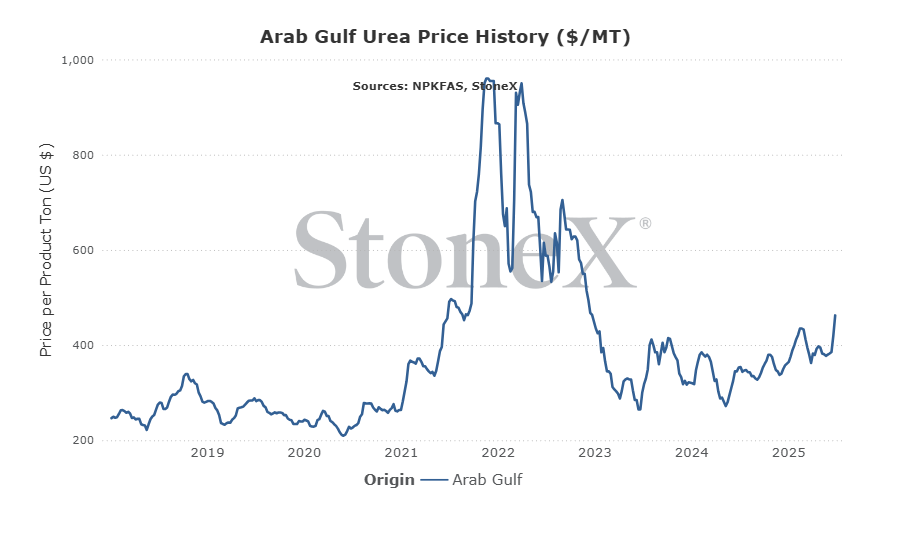
Number 1 exporter (as a region, not as individual nations)
Vs 30 days ago - 22% or approximately $83 higher
Vs 90 days ago - 21% or approximately $80 higher
Vs 6 months ago - 27% or approximately $98 higher
Vs 1 year ago - 31% or approximately $110 higher
Egypt
Number 4 global exporter in 2022
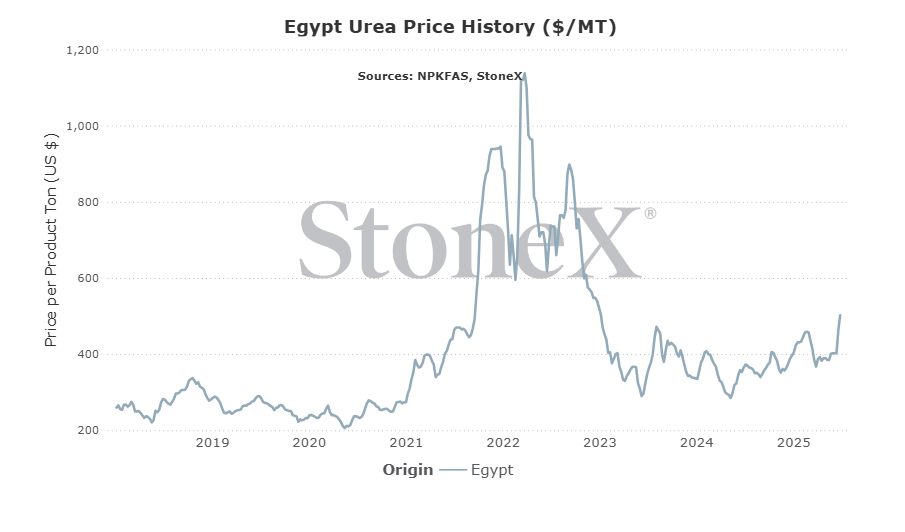
Price comparisons
Vs 30 days ago - 25% or approximately $100 higher
Vs 90 days ago - 30% or approximately $116 higher
Vs 6 months ago - 24% or approximately $98 higher
Vs 1 year ago - 38% or approximately $138 higher
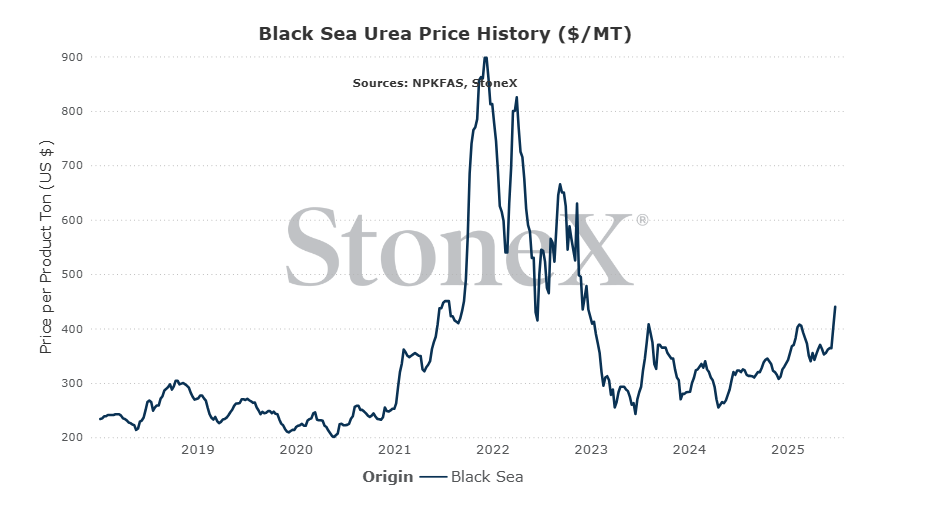
Black Sea
Number 1 global exporter in 2022
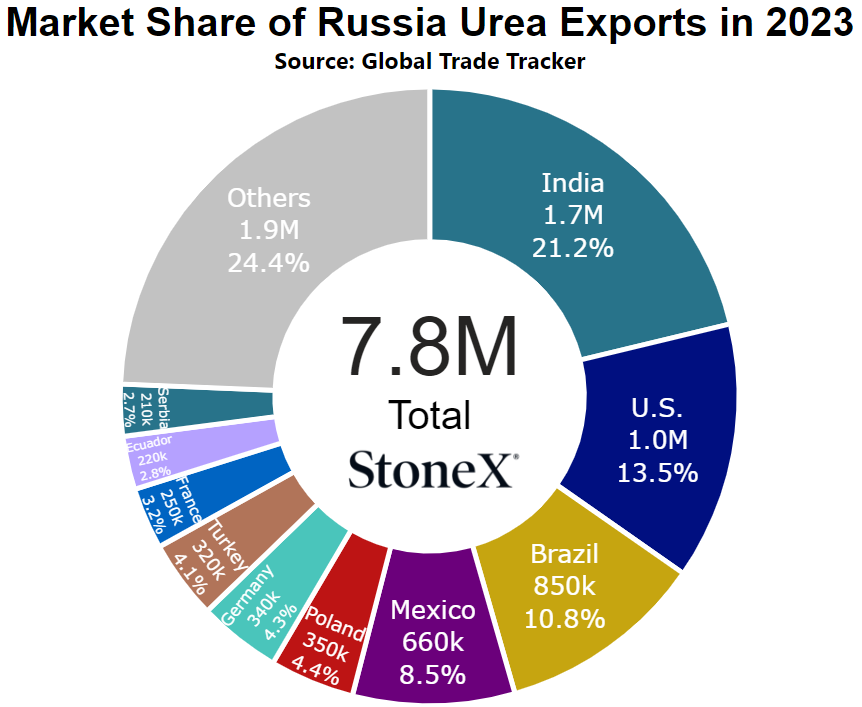
Price comparisons
Vs 30 days ago - 22% or approximately $79 higher
Vs 90 days ago - 24% or approximately $85 higher
Vs 6 months ago - 28% or approximately $98 higher
Vs 1 year ago - 36% or approximately $118 higher
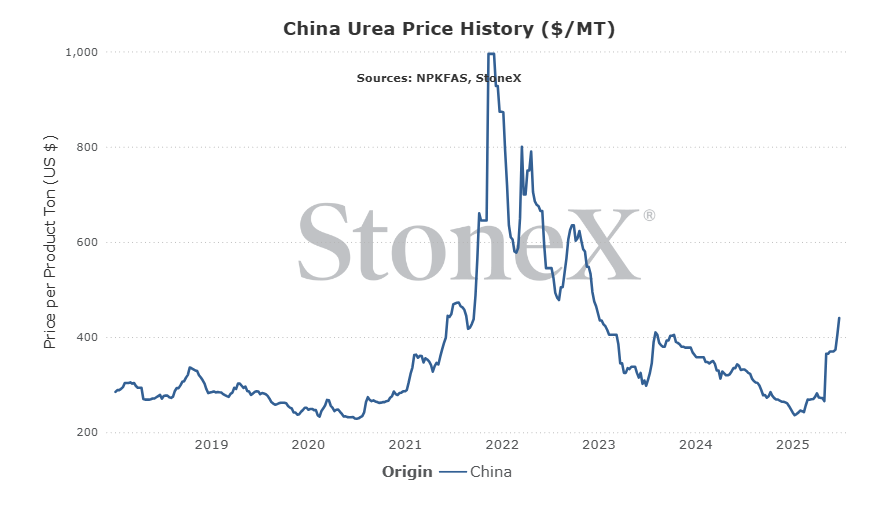
China
Number 9 global exporter in 2022
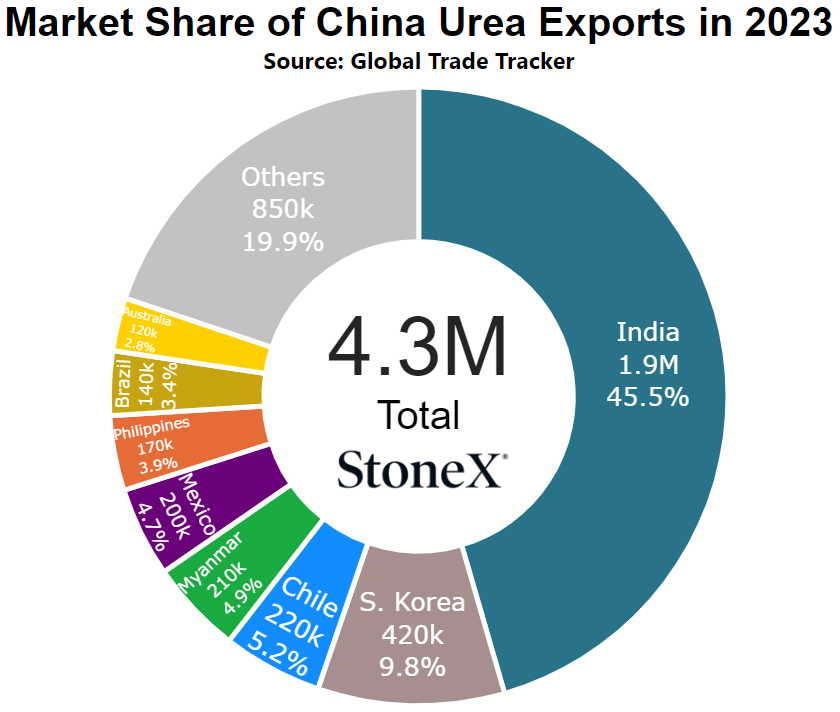
Price comparisons
Vs 30 days ago - 19% or approximately $70 higher
Vs 90 days ago - 56% or approximately $158 higher
Vs 6 months ago - 82% or approximately $199 higher
Vs 1 year ago - 33% or approximately $108 higher
- Tensions in the Middle East are reignited- right now as I write this, the ceasefire between Israel and Iran is holding. That is raising hope that this conflict is done which means that nitrogen production in the region can resume full capacity. However, we know how quickly things can fall apart. We know that in the last days of the conflict, Iran was threatening the Strait of Hormuz. If fighting begins anew, no doubt global nitrogen/urea markets will respond higher.
- India needing 2M tons on this tender creates enough demand to boost the markets - typically as we enter into the 3rd quarter of the calendar year, demand falls as no one wants ownership. Manufacturers around the world see unsold inventories start to build which puts pressure on prices. However, this year is different. India has just announced a fresh purchase tender after the last 4 "failed" to reach their tonnage goal. This tender is requesting 2M tons to be secured. Doesn't matter how you look at it. That is a lot and provides a life jacket to a market that might have been eying lower prices due to lack of buyers.
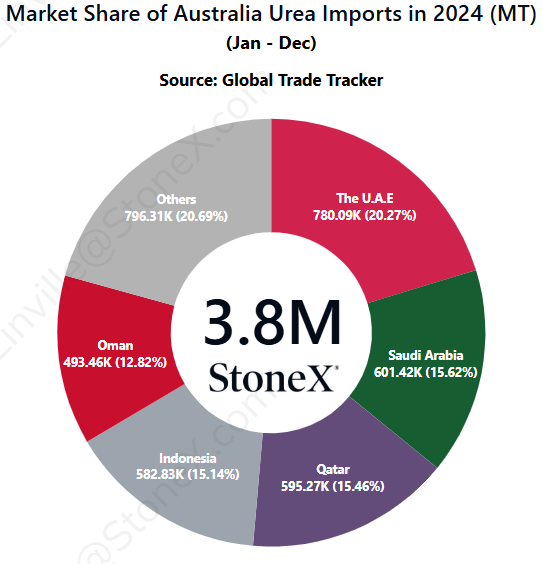
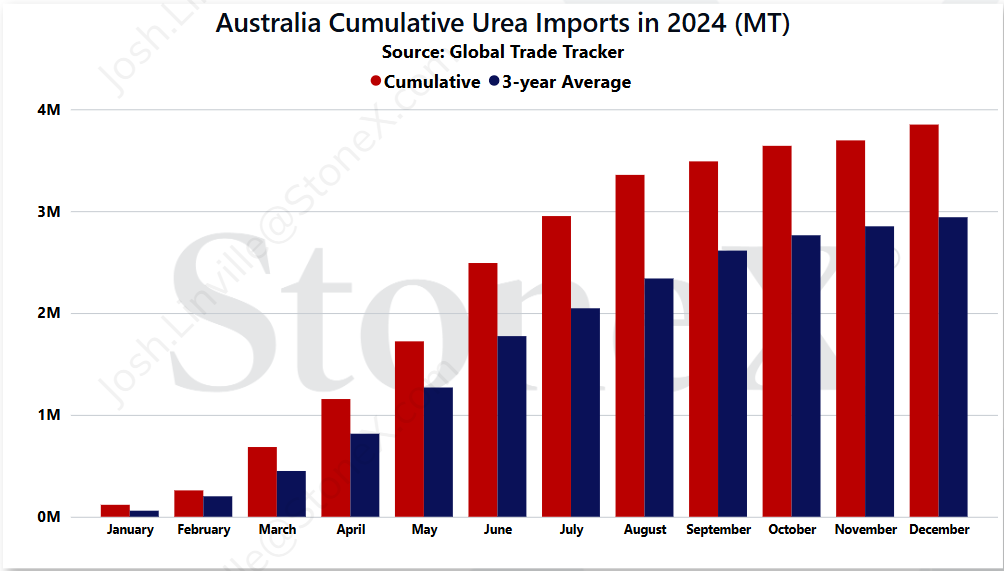
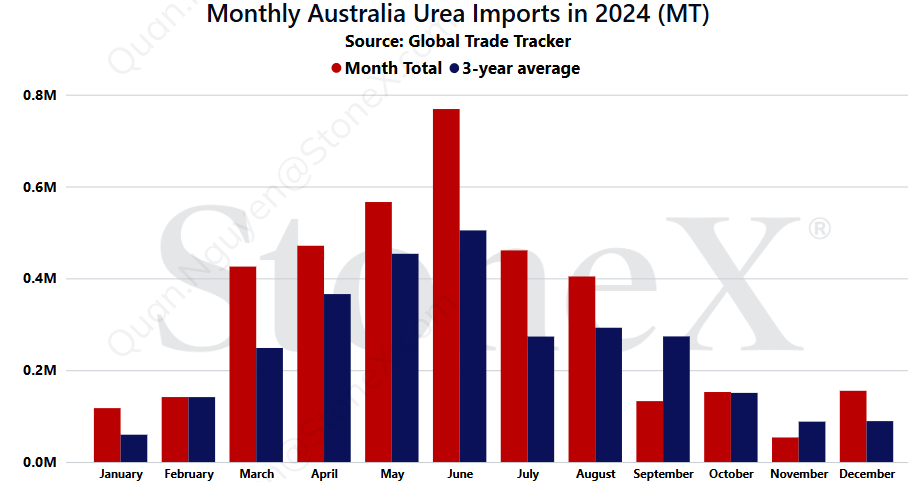
- Aussie importers continue to struggle with supply after rains returned - the start of the urea application cycle was marred by widespread dryness that had farmers not wanting/needing to secure their urea. This lasted long enough that importers were forced to turn ships to other destinations (why come to Australia when there is nowhere to dump it). The rains have returned as has demand...and suddenly supplies are tight. The longer this plays out, the higher the price will be.
- Middle East peace allows the market to cool - now that it looks like peace is going to hold in the Middle East, buyers will not be pressed to step forward to buy. That push is no longer in place so folks can wait. The longer buyers wait, the more unsold inventories build. The more unsold inventories build, the more pressure manufacturers feel. If that pressure gets big enough, they lower prices to find buyers.
- Peace between Ukraine/Russia allows European production to resume - this is a long shot and likely not a short term factor, but worth considering. Now that Israel/Iran have stopped fighting, President Trump can turn his attention to the Ukraine/Russia conflict. If he can broker peace there, that will be a major step toward normal relations once again. If those relations can normalize, Russia can begin repairs on the Nordstream pipeline which would finally cause European gas values to fall. If all of that happens, we could see the final 25% of European nitrogen production that is still offline come back.
- Importers finally catch back up - no doubt once the rains returned, importers started making plans to secure new vessels to arrive with urea. That takes time, but those vessels may finally be arriving. The more than arrive, the better the supply situation. The better the supply situation, the higher the chance that values could dip.
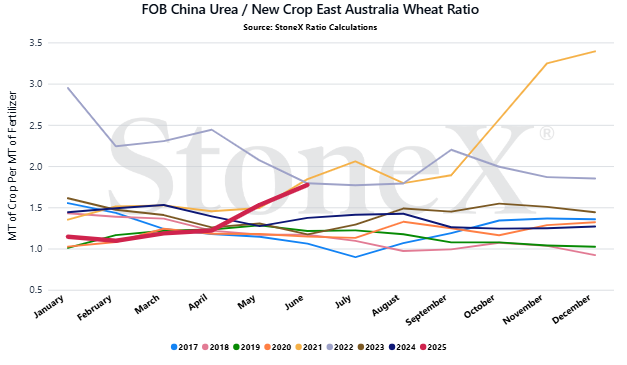
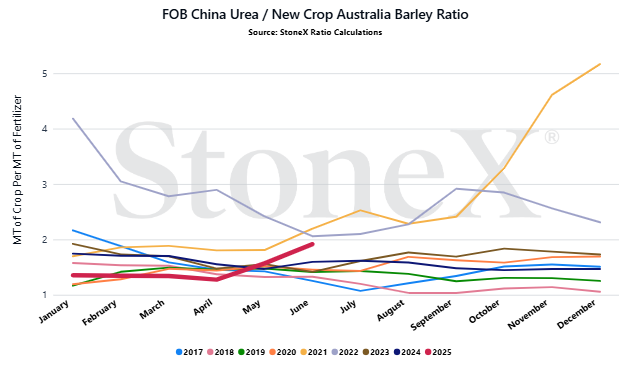
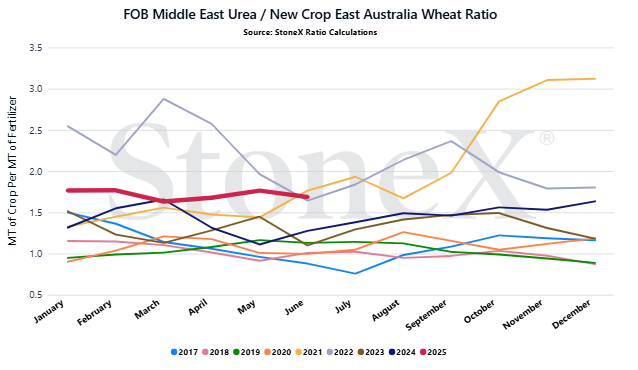
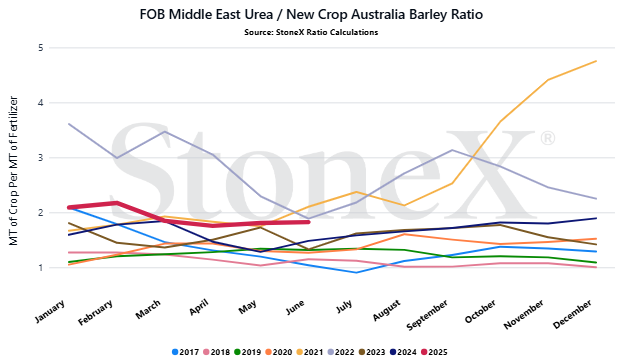
We believe that only looking at the flat price of either grains or fertilizer can be misleading:
-
Only selling grain can hurt you if fertilizer prices rise substantially
-
Only buying fertilizer can hurt you if grain prices fall
We look at the ratio "value" to get a better indication of where we are or how many bushels of X does it take to pay for 1 ton of fertilizer.
Would you rather:
-
Spend 135 bushels to pay for 1 ton of urea
-
Spend 55 bushels to pay for 1 ton of urea
When we compare the current ratio value against recent years, we start to see if we are high or low.
YOUR VALUES MAY LOOK DIFFERENT
This is a work in progress section! We plan on looking at the relationship between Aussie grains and global price points (and hopefully Aussie specific locations, though that data is hard to secure, very protected). Big reason why we are still in the "trial" stage of this newsletter!!!!
- U.S. vs Iran - all the talk of if the U.S. would strike Iranian nuclear sites is now a thing of the past. That attack has taken place and now the more important story has begun: will Iran retaliate and if they do, how? Unfortunately for global urea markets, Iran's government has voted to close the Strait of Hormuz which is incredibly important. Now, there is a big difference between voting to close it and actually being able to close it. The western world will not sit idly by and allow this to happen. It has prepared for years for exactly this outcome. Still, even the threat of attacks will likely have vessel owners considering other routes or moving their freight rates higher as a response. Also needing to be considered is how long this stalemate continues. The longer it plays out, the longer production in Iran and Egypt remains offline. With world supplies not much above world demand, every week lost will be extremely difficult to make up.
- Russia vs Ukraine - it is hard to believe that Russia continuing to invade Ukraine has become a page 2 or 3 story given world events. Still, this fight continues. The escalation in the last month was Ukraine's successful attack on a Russian nitrogen production facility. Now, we presume the reason for this attack was to shut down its nitrate production (this single plant accounted for nearly 40% of Russia's production). We all know what nitrate can do so this was strategic. While urea production wasn't likely targeted, it was still affected with the NH3 plant still down. The longer this plant takes to bring back to operations, the more production that is lost. Worse, if Ukraine starts to target other nitrogen production facilities...
- Chinese exports - how has the world become so tense that Chinese exports have drifted to the 3rd slot this month? Russian nitrogen produciton was targeted and attacked. Iran is threatening the most important body of water for urea in the world. The Chinese government was already keeping a close eye on export flows. With these situations playing out, it heightens the risk that the government will decide to stop the flows to maintain solid domestic stockpiles and values. Expecting Chinese exports at 2M tons this year (vs a normal flow of 5 to 5.5M) was already helping to buoy price ideas around the world. If China makes the decision to stop exports once again...
- Time of year - listen, there is never a "good" time to have a war. None of this is good. However, for the nitrogen markets, this couldn't be happening at a better time. This is the time of year when demand typically falls away and values hit their seasonal lows. That should help lessen the price impact to a point. Imagine if all of this was happening in January/February right before the start of Northern Hemisphere spring demand.
- India purchase tender approaches - the most shocking thing on this list is that I have dropped India to the very bottom. That is how haywire these markets are. Still, we need to watch them as they will be setting the price tone. They have just "failed" their 4th purchase tender in a row (falling far short of their purchase tonnage goal). It is incredibly likely that they will be forced to announce yet another purchase tender that feasibly could see them targeting 2+M tons. If global events continue to set the market higher, the India purchase tender could prove it true.
StoneX Ratio Calculation
The ratio calculation is derived from Bloomberg historical grains values as well as fertilizer values from StoneX, NPKFAS, and Argus.
The calculation is simply dividing the fertilizer price by each grain price.
All data was sourced from StoneX unless otherwise noted.