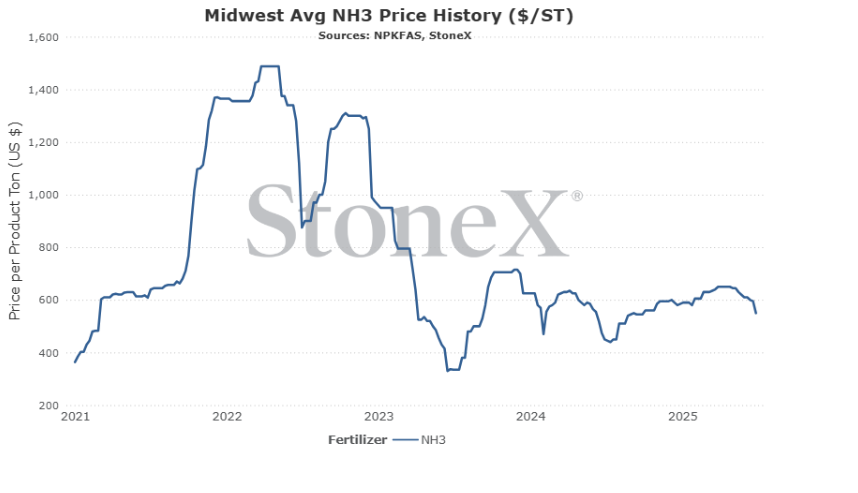
The first graph is the AVERAGE of the entire Midwest U.S. region. That means your local value WILL be different than what the graph reflects. Please do not take this into your retailer and say "why isn't my price the same as here". That is comparing apples to oranges. You might be on the cheaper or more expensive side of this graph. This doesn't take into account logistics/storage/interest/insurance/shrink/etc.
This graph looks at the price from a short ton and USD currency POV.
This second graph looks at the price set for Tampa NH3. This value does not have a high correlation to Midwest values. It is a talking point used when prices are rallying...yet somehow gets skipped on the way down. This price is more an indication of the global price. This price is set by two parties (purchaser - phosphate producer in Florida / seller - international producer providing NH3 to FL phosphate production).
This graph CAN be used as an indication of global market price direction/trends. This graph SHOULD NOT be used to determine a Midwest value. Tonnage is listed in short ton and currency in USD.

The list of supply problems around the world for NH3 has grown:
- Russia - exports are still not happening
- Europe - production still 75% of normal
- Trinidad - sounds like production hiccups still in place
- Egypt - shut down for Israel/Iran war
- Iran - shut down for Israel/Iran war
That is a hefty list.
Now, let's be clear. I am writing this AFTER the July Tampa NH3 price was set $25 higher than June. It would be pretty easy to say prices are going higher and then take credit for something that happened already!! That said, I did have a bullish outlook before it was announced.
Now, the world looks a little different. The Israel/Iran ceasefire appears to be holding. My guess is that President Trump's next target will be the Ukraine/Russia war. If, and this is an enormous if, he can be successful, that could be hugely bearish for global NH3. Peace could involve normalizing relationships around the world. It might also include the Russian government allowing the Taman facility to become operational which would have Russian tons flowing once again. That doesn't even touch on the beginning stages of bringing European production back.
Assuming the Israel/Iran ceasefire holds, it should limit NH3 price upside. If that breaks down, there is no more limit.
If peace can be fond with Ukraine/Russia, we could see Russia flows return to the world which could be very bearish.
I am leaning to slightly bullish...but I sure hope I am wrong.
North America
As I write this, summer fill and fall prepay programs have been announced. Unfortunately, they were almost exactly where I expected them to be...I really wanted to be wrong and values come in lower.
These values look like they are going to work for the most part. Retailers appear to be locking up some layers which should make manufacturers comfortably sold for several weeks to a couple months. As long as they are comfortable, why would values fall?
On the flip side, grain prices cannot seem to help falling. Eventually there will be a breaking point where enough is enough and it hurts enough demand that NH3 has to react. That doesn't seem nearby right now, but it is something to watch.
Still, I think we have likely set the price floor.
Global supply issues finally turn NH3 bullish
For month's the Tampa NH3 price, typically the easiest global NH3 price indicator, has been falling. However, July finally saw that tide change to the bullish side as the price was set $25 higher than June.
What changed?
Well, it seems like the Israel/Iran battle was the final straw that broke the trend.
- Russian exports still do not exist - typically the world's leading global exporter of NH3, their flows are still not being seen. It sounds like their Taman facility is ready to go, but with Ukraine continuing to show an ability to strike well within Russian territory, the government has not given the green light to go. Better to wait than to fill the facility and then have an attack cause a catastrophic leak that destroys the people and environment around it.
- Russian production falls after Ukraine attack - Ukraine surprised the nitrogen industry by attacking a large nitrogen production facility in Russia. While I still believe their intended goal was to stop production of nitrate (plant accounted for just under 40% of Russia's capacity), it still destroyed the NH3 production.
- European production still 75% normal - as long as the Russia/Ukraine war continues, Europe has little desire to improve relations with Russia or to receiving products. That means Russian gas is still blocked from coming to Europe which is causing their natural gas prices to be high which is causing 25% of Europes nitrogen production to remain offline.
- Trinidad continuing to have production issues - while there is hope on the horizon as exploration and development continues to expand their natural gas production capabilities, that will take time. Until then, nitrogen manufacturers continue to see iffy flows which is making for iffy production rates.
- Egypt production has had issues, made worse by fighting - Egypt has already been struggling this year with production rates as extreme temperatures have forced the government to make gas available for its people rather than its industry. It didn't help that the Israel/Iran war forced Israel to stop their gas production as a precautionary measure. That cause Egyptian nitrogen production to stop...again.
- Iran production has had issues, made worse by fighting - years of sanctions and then winter weather has caused Iran to have to prioritize public demand of gas over nitrogen production. Then, once the war with Israel started, they had to shut down gas production as a precautionary measure. Without gas feedstocks, nitrogen manufacturing had to stop as well. More production lost.
If these events all remain in place, it would not be surprising to see continued strength in the coming months but as we have become accustomed to, change is the only constant.
How did the Israel/Iran battle impact NH3? How could it have been worse?
The last 30-days has been hard on global nitrogen markets, with NH3 very much being a part of that.
In a move that shocked the world, Israel grew tired of Iran continuing to build a nuclear program. They made the decisions to preemptively strike Iran in order to slow their progress. As expected, Iran responded with attacks of hundreds of rockets. This back and forth continued until the U.S. entered the fray. He authorized direct strikes on Iran's nuclear sites by using B-2 bombers equiped with the massive bunker busting bombs to reach these underground facilities. After an "announced" retaliation by Iran on U.S. military bases in Qatar, a ceasefire agreeement was put into place and the fighting has stopped...for now.
So what was the actual impact to NH3?
On Iran's side, they had to shut down their nitrogen production facilities. Now, Israel is very good at this whole war thing. When they have a target, they do not try to level a city block. They target the building, they target which floor of the building, they target which corner of the building and probably go so far as to decide if the upper or lower pane of the window they will shoot the missile through will be best. That means very low chance of collateral damage. However, Iran had to be cautious and as a result, they shut down their gas production. Without gas feedstocks, the nitrogen production facilities had nothing to produce with so were forced to shut down.
On Israel's side, they had to shut down their gas production because Iran takes a different approach. While Israel is surgical on their strikes, Iran still uses the spray and pray method where they launch hundreds of rockets and hope that one finds its targets. Iran still does not appear to hold the technology to be more precise and Israeli air defenses are so good that the only chance of beating them is in sheer numbers. This caused Egyptian nitrogen production to stop.
Wait a minute, why did you just jump countries?
The result of the attacks on Israel is that they had to stop their own gas production. Egyptian nitrogen manufacturers are highly reliant on Israeli gas so when those field stopped production, Egypt had to stop their production. This once again shows that we need to know the direct effects of these events, but also factor in side effects.
In the end, peace was found and it sounds like both Iranian and Egyptian nitrogen facilities are in the process of restarting. This means that the market has shifted from "worst case scenario" to "well, we only lost a couple weeks". There was damage to the global S&D but it was nowhere near what it could have been.
Which brings us to the "educational moment in case this happens again".
Following the U.S. attacks, the Iranian govenment voted to close the Strait of Hormuz. No doubt their intention was to devastate the U.S. economy by blocking energy/oil flows. I think they quickly figured out that while the Persian Gulf flows are important, it was much more important to their ally China! It isn't as though Iran would be allowed to stick ships in the middle of the waterway and allow some ships to pass and others to go back. Frankly, I always thought Iran had little chance of success. Western nations have a very large precense in that area and have trained for YEARS for exactly that event. This step would not have been taken lightly.
Still, what would have happened if this war had continued and the Strait was shut down?
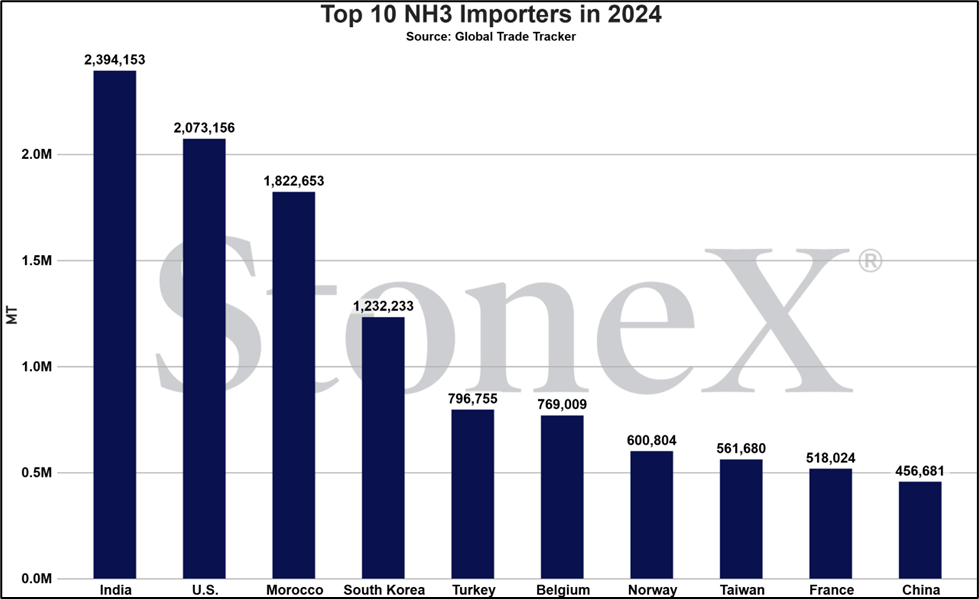
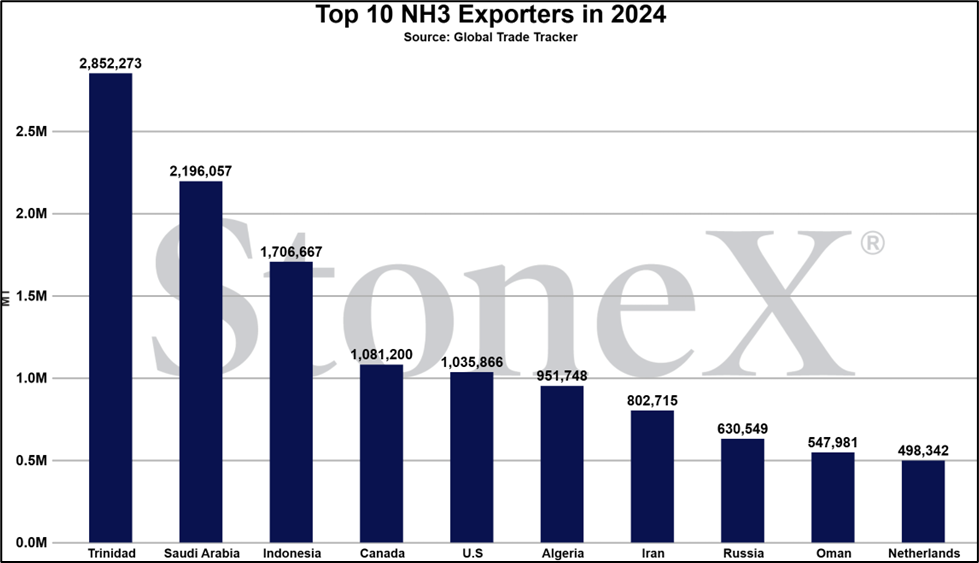
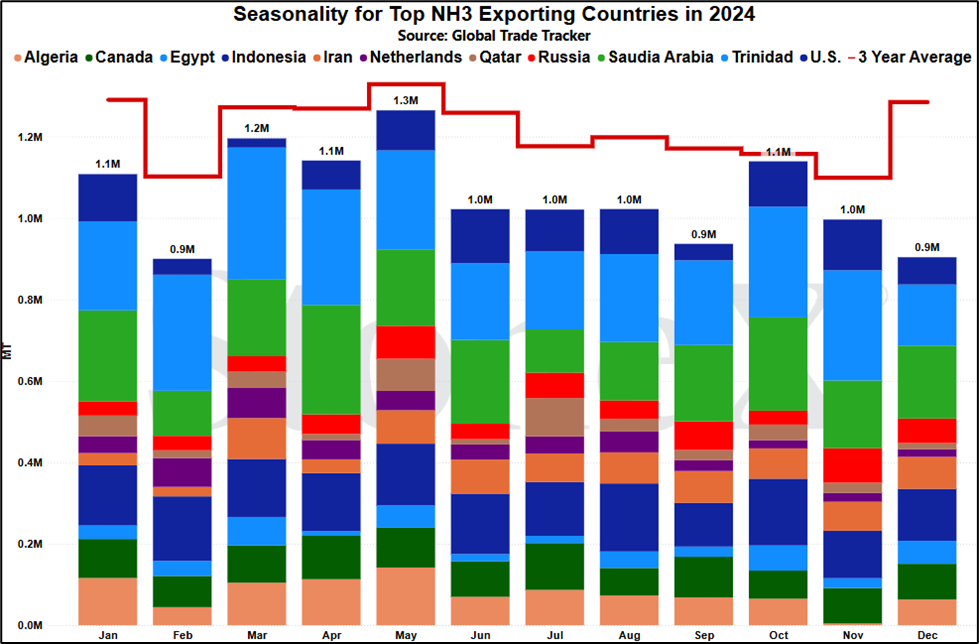
Take a look at the map below. Immediately, we have to assume that Egypt and Iran both keep their NH3 production offline as long as they are exchanging attacks. Then we need to notice how large a player Saudi Arabia is. If the Strait has been shut down, Saudi Arabian NH3 flows would also stop and they were the 2nd largest exporter last year. With so many other production/supply problems for global NH3, this likely would have hurt bad.
Fortunately, we do not have to worry about that scenario today. It appears peace has been found and hopefully it continues. Hopefully we will see that trend flow to Russia and Ukraine (more below). For now, this has been a great way to realize how important global events are to the markets.

Could peace between Russia and Ukraine change NH3?
I know this is a stretch, but I think we would have said it was a stretch to think that the Israel/Iran fight would have been brought to an end after only 12 days. Now, with President Trump coming off a major victory there, I have a feeling he is going to put his full effort into finding peace between Russia and Ukraine. I do believe that will be a much harder ceasefire to complete, but this has been one of his big priorities and now he can focus fully on it.
Whether it will or will not happen, we do need to be aware of what could happen if peace was made.
- Russian NH3 exports could resume - this is easily the biggest thing that could happen. Since Russia first invaded Ukraine, Russia fell from the top of the global export list to barely making the top 10. That is what happens when your export flows were dependent on a pipeline and terminal facility that sat in the country you were invading. Still, a lot of work has been done in Russia to create new logistical routes to move the product with the "crown jewel" being a new export facility in Taman. The facility sounds ready to work, but the government has been slowing that start. With Ukraine attacking targets deep in Russia, it has created a pause. Better to wait until peace is found rather than filling the facility, having an attack happen, and then having to deal with a catastrophic release that would kill people and destroy the environment around it. If peace is found, there is no reason for them to keep the facility offline. The world could get their biggest supplier back quickly.
- Global relations with Russia could improve, allowing free flows once again - right now, a large chunk of the world refuses to do business with Russia because of their invasion. Australia and Canada have long refused to allow business. The EU just put into place bigger blockades that will increase over the next several years. If peace is found, part of the agreement could be that economic blockades are removed, allowing freeflowing trade routes that help lower global values.
- Gas values in Europe could fall, allowing production to resume - this is a longer term one but still worthy of consideration. When Russia shut down the Nordstream pipeline, gas values in Europe skyrocketed to the point. While they have corrected lower, 25% of European nitrogen production is still offline, forcing them to import far more than they normally would. If peace is found and it includes improved relations, we could see an agreement to resume gas shipments to Europe. That would take a bit as the Nordstream was blown up under a lot of water. Those repairs are never quick. However, once all of this happened, you would think that European gas values would fall back to historically normal levels that may allow those offline plants to restart.
On that last point, one other thing to note. Those plants are not young. They have a lot of years on them. We also have to consider the fact that Europe still is not a fan of what it considers "dirty" production. They are very in line with the green initiative. This means that Europe nitrogen may never look the same.
Still, while peace between Russia and Ukraine may seem far off, we need to keep it in mind as it should have a huge impact on global nitrogen and NH3 markets.
N.A. summer fill/fall prepay programs announced
As expected, the North American summer fill/fall prepay NH3 programs were released before the 4th of July.
How did they shape up? Unfortunately, they are higher priced than last years numbers. When faced with lower grain values, it doesn't feel very good...but it might be the best that we get.
For NH3, I do a lot of comparisons. I compare it against recent year programs. I compare it against grains. I compare it against other nitrogen markets. I take all that information and use it to back into a price idea.
I can tell you that my recent forecast for summer fill was spot on. Fall prepay I was just under the official programs by around $15 (urea market rallied messed me up!!). This is all to say that using all the information that was available, there was nothing surprising. I was really wanting to be wrong with programs significantly cheaper than my expectations.
With this said, have a conversation with your supplier. The numbers I am seeing might be different at the ground level. Those relationships may make these programs look better/worse.
Also, please note that the fall prepay programs set the fall. Summer fill focuses on open storage. That is a very FINITE asset. Storing NH3 is no easy task and with some communities having a small population that likes to help themselves to the product as well as the danger of a rupture/leak, that storage capacity always seems to get smaller. Those values/ratios are better because there isn't that much storage. If you have some, that is worth a conversation.
Again, have that conversation. Only there can you truly know how good/bad it is.
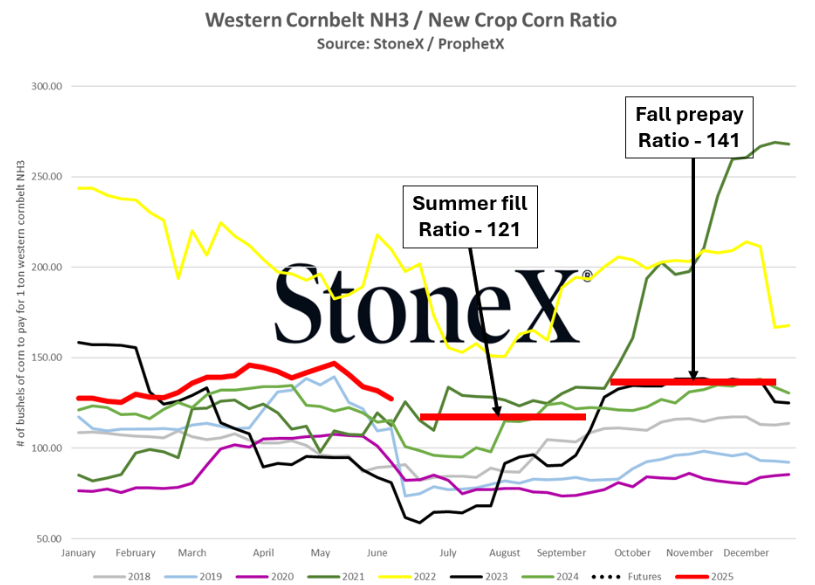
U.S. Midwest Wholesale price average
Vs 30 days ago - -10% or approximately $60 lower
Vs 90 days ago - -15% or approximately $100 lower
Vs 6 months ago - -7% or approximately $40 lower
Vs 1 year ago - 22% or approximately $100 higher
U.S. Southern Plains price average
Vs 30 days ago - -4% or approximately $23 lower
Vs 90 days ago - -10% or approximately $56 lower
Vs 6 months ago - -1% or approximately $8 lower
Vs 1 year ago -37% or approximately $137 higher
- The list of production outages globally finally tilts the market higher - global NH3 supplies continue to take hits. It was already without Russia, the largest exporter. It was already missing 25% of European production. Trinidad as already having issues. Then the Israel/Iran fight cause local production to suffer. The list of issues may have finally gotten long enough that values start to appreciate once again.
- Israel/Iran ceasefire fails to hold - there is a lot of hope in the nitrogen markets that the fight between Israel and Iran will hold which will allow regional production to resume. However, we know how quickly these agreements can be broken and the region decends into chaos once again. If that happens, we have already seen Iran threatening the Strait of Hormuz which is hard to understate its importance in the energy markets. NH3 is not immune in this scenario. Even if the peace is broke, there is no guarantee that Iran can shut the waterway, but the fear/risk of it would still be very price supportive for NH3.
- N.A. buy-in to summer fill/fall prepay is overwhelmingly positive - we are expecting to see summer fill NH3 programs and possibly fall prepay programs released by the time this is published. A lot of what happens with values depends on how manufacturers approach these programs. If they start at a decent price that convinces the market to buy in, it is very likely the next layers will be at higher prices.
- Israel/Iran ceasefire holds and production/shipments return - the Israel/Iran fight had the nitrogen markets factoring in a lot of wartime premiums for fear of what would happen. Fortunately, the fighting did not last a full two weeks and for the most part, both nations production facilities were left untouched. In theory, gas fields can resume production which would allow nitrogen production facilities to restart as well. The return of production is a return of supply which is great for the S&D.
- Russia/Ukraine peace is found next - now that President Trump can claim victory for finding peace with Iran/Israel, his next target is likely the Ukraine/Russia war. Let's say he is successful in finding common ground between these enemies, what then? Russia's new export facility in Taman is reportedly complete and operational. Exports have not happened for fear of filling it with dangerous NH3 gases that would escape during an attack, causing massive environmental and people destruction. If peace is found, there is no longer a fear of attack. No reason to keep it offline. The world could get its biggest supplier back.
- Manufacturers get cute/high with their summer fill/fall prepay numbers - there is a balancing act for manufacturers when they roll out price programs. Start to low and limit tons and you will end up with furious customers who are angry they couldn't buy more (it happens). On the other side, start too high and buyers run away which leaves you with unsold inventory. If they try for the high side approach, we could see the market shun their offers. That would create a very nervous manufacturer who wants to clear excess tons very quickly.
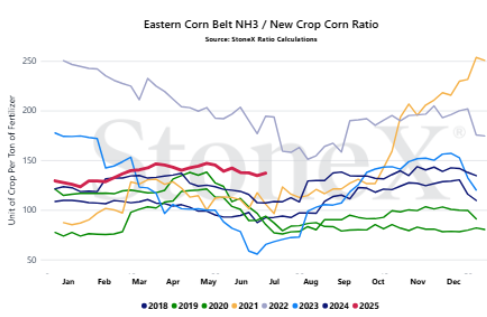
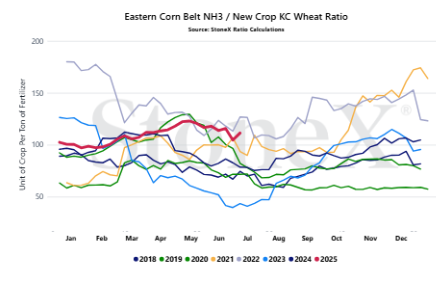
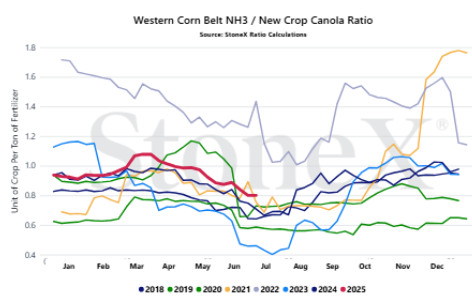
Where are the current NH3/grain ratio values today
We believe that only looking at the flat price of either grains or fertilizer can be misleading:
-
Only selling grain can hurt you if fertilizer prices rise substantially
-
Only buying fertilizer can hurt you if grain prices fall
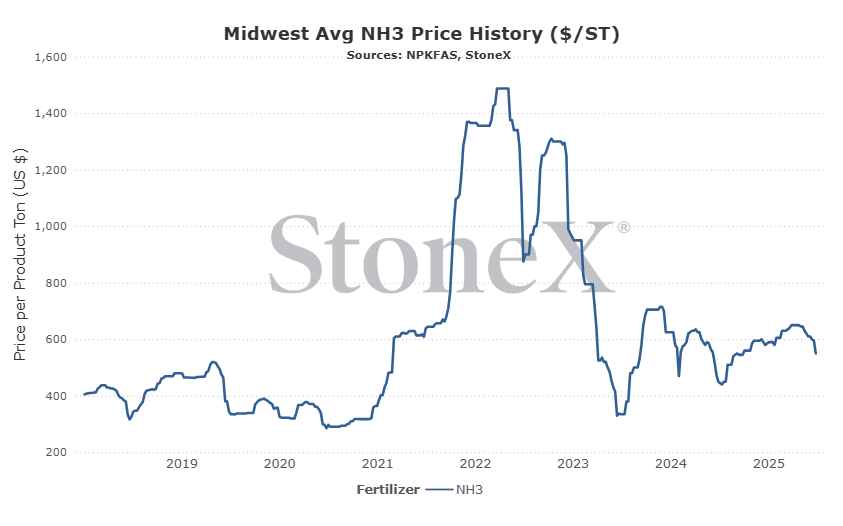
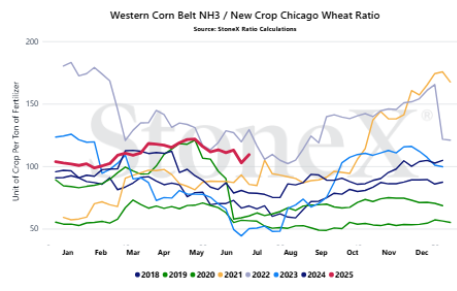
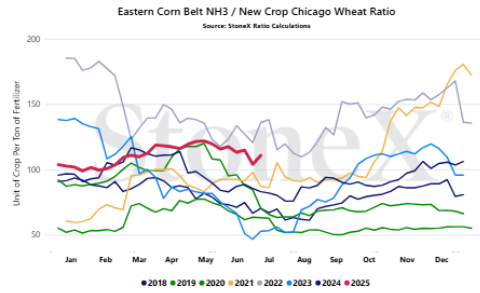
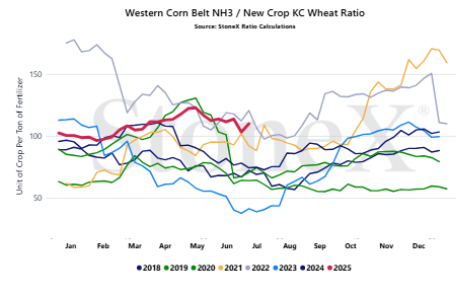
We look at the ratio "value" to get a better indication of where we are or how many bushels of X does it take to pay for 1 ton of fertilizer.
Would you rather:
-
Spend 150 bushels to pay for 1 ton of potash
-
Spend 100 bushels to pay for 1 ton of NH3
When we compare the current ratio value against recent years, we start to see if we are high or low.
YOUR VALUES MAY LOOK DIFFERENT
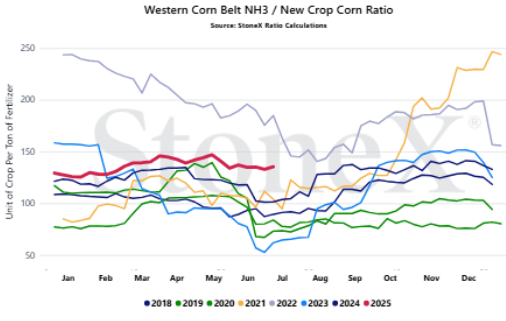
This graph looks at the NOLA NH3 price vs the flat grain price. There are no logistics on either product. Your location will look different due to fertilizer logistical costs, grain basis, etc.
- Middle East tensions/Strait of Hormuz - as I write this, reports are coming out that a cease fire agreement has been reached between the U.S. / Israel / Iran. If this is false or if it falls apart, one of the threats made by Iran was that they would move to close the Strait of Hormuz. While it is extremely doubtful they could accomplish this, the mere threat should send shockwaves through the market. That region is incredibly important for global NH3 markets. Hopefully by the time I send this, a long lasting peace will be found and we can drop this factor for August.
- Global production rates - there are a lot of production issues around the world right now (no Russian exports, European production at 75% of normal, Trinidad production issues, Iran offline, Egypt offline, etc.). NH3 values have been sliding for several months in a row but eventually that pattern will be broken. Given the build up of supply issues, that may happen sooner than later.
- How will N.A. manufacturers approach summer fill/fall prepay - UAN values have remained high since the peak of spring demand. Urea fell for a time, but rebounded on Middle East fighting (hopefully it lowers on cease fire agreements). N.A. manufacturers have plenty of reasons to be proud of their NH3, but they also have to be a little more cautious. NH3 storage is a very finite asset. Miss out on summer fill and you may miss out on most opportunities and get caught full yourself (bad for plants). Price yourself too high for fall prepay and you might see the market revolt and refuse to buy anything, leaving you with the bill. If there was ever a time for manufacturers to get bold on prices, now is that time...but will they try it?
StoneX Ratio Calculation
The ratio calculation is derived from Bloomberg historical grains values as well as fertilizer values from StoneX, NPKFAS, and Argus.
The calculation is simply dividing the fertilizer price by each grain price.
All data was sourced from StoneX unless otherwise noted.