

Global
If we were currently in a space where we had not seen countries like India and China step in for big tonnage contracts, I would still be holding onto my belief that solid supplies should keep values steady, if not lower.
Unfortunately, that is not the case. We have seen both step in for very big volumes. Then we started to see the Canadian export company Canpotex announce that they were "committed" through all of Q3.
That is simply too many supportive price factors lined up to ignore.
Longer term, I still will not be surprised to see values lower but for now, the manufacturing side has won. Their ability to point to their big sales is a big win that will carry over to other sales opportunities. Prices should stay steady to slightly supportive for the next few months.
One word of caution. President Trump has found peace between Israel and Iran. His next target will likely be Ukraine and Russia. If he can broker that, relations with Russia can start to improve. That "could" result in Lithuania lifting their border blockage with Belerus. If that were lifted, Belarus could resume their best export flow which could see exports grow from there. That and the elation of improved Russian relations (another major exporter) could weigh on price ideas.
North America
Like the global outlook, North American values appear set. I do not love current potash values. They are on the higher side of "normal" when compared against recent year corn ratios. However, I have to hand it to manufacturers. They did a phenominal job of framing the market and getting buyers to agree. I think with all of the sales/commitments that have been made, they are in a spot where they can sit back for a while without any new demand.
Ultimately, I still think appreciation is a bit limited, but it is harder to see values going lower in the next few months. Manufacturers should be comfortably sold so little reason to drop prices.
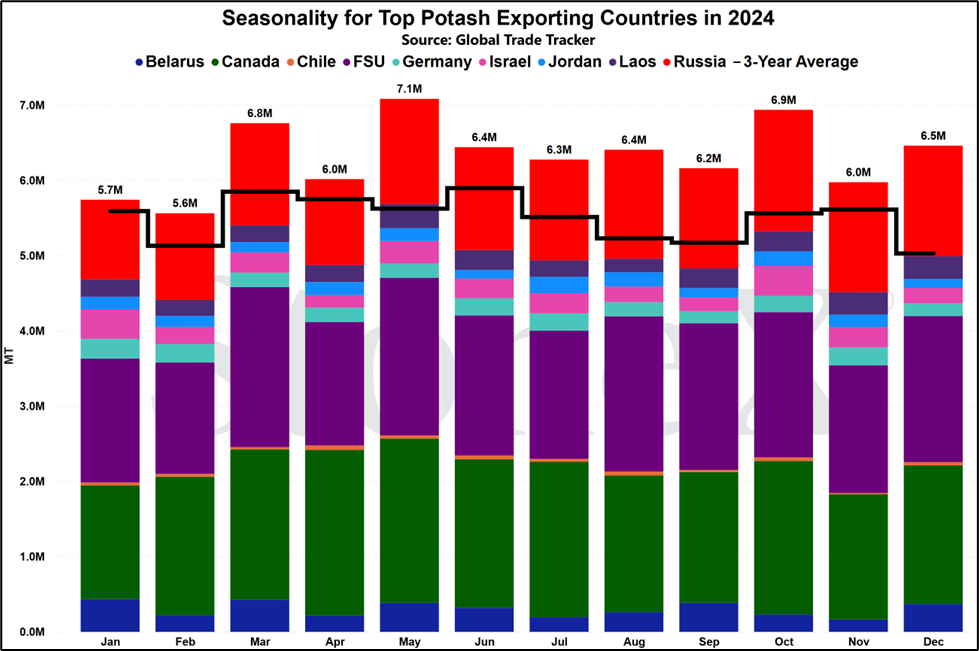
India/China set world tone with major annual purchases
I like to admit when I am wrong and I was wrong on potash.
My POV has been that potash supplies were fine globally and that grain prices continuing to go lower would help potash prices fall. There is a long time between the end of spring and the start of fall which is plenty of time to refill. Plenty of time to put pressure on manufacturers to put a price out that makes sense.
I did not see India and China folding so quickly on purchase agreements at these values.
Can't get them all right.
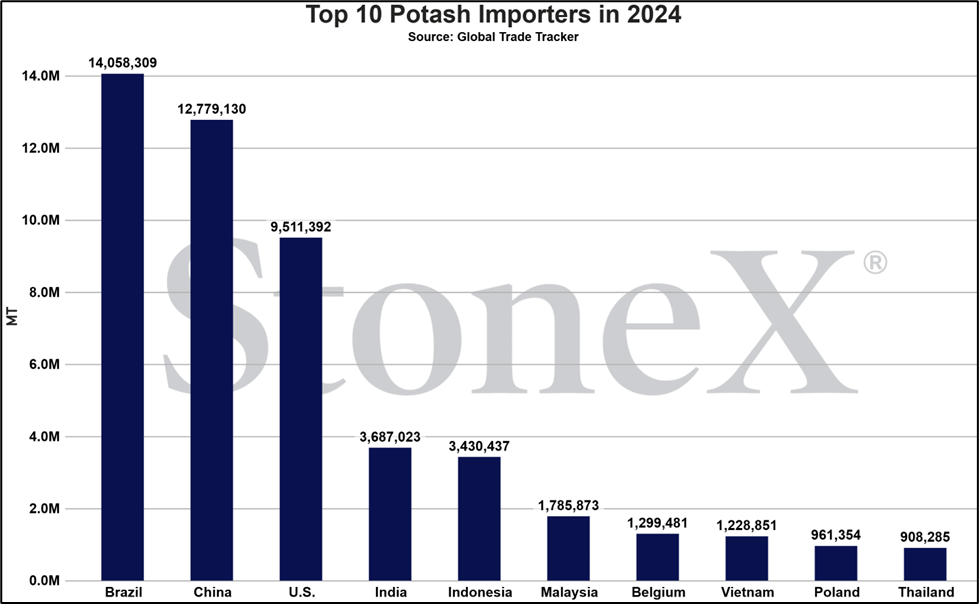
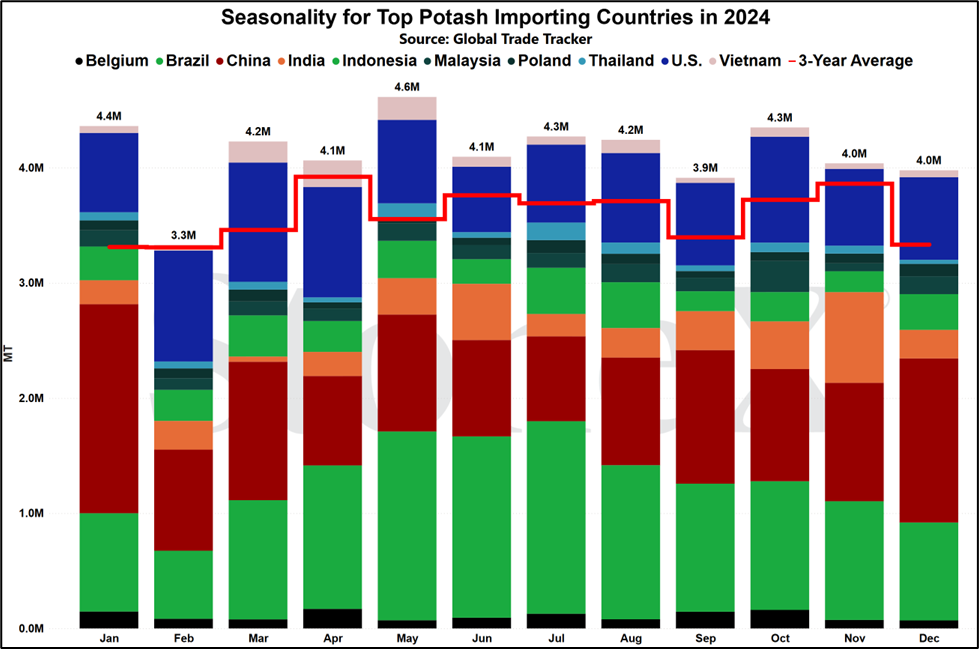
India was announced first. It was reported that they had secured a 650K ton contract with Belarus at a price of $349. This was a surprise but I brushed it off as a one time thing. That one time thing was quickly followed with a similarly priced contract with Russian supplies.
...ok, but then we watched China. China typically waits until Indian negotiations are complete and then works to get a lower price. Shortly after we were right!! They did get a cheaper price!!!
...by $3.
So now, global manufacturers were able to point to 2 major importing countries having decided to pull the trigger on huge volumes. If China and India saw it in their best interest to secure these values, why wouldn't everyone else?
Adding fuel to the fire was the reports that Canadian potash exporter Canpotex was "fully committed" through the 3rd quarter of 2025. Now, whether those values were already secured or they just knew that product would ship through that period remains to be seen. Ultimately, it didn't matter as the story was set.
This situation has created an extremely firm price floor for potash around the world. This does not mean that lower prices are not possible. Stranger things have happened but this now means that it would be an intense battle to have that happen.
With grain values continuing to fall, maybe more of that fight is already happening...
N.A. summer fill programs announced, how do they shape up?
North American potash manufacturers wasted no time on jumping on the global price activity/strength.
By mid-June, the first summer fill program was announced. Normally, these programs are announced at somewhat of a discount. The typical thought process is that summer is long and potash typically does not get into a rush. In order to get buyers to step forward early, a cheaper price is offered and then once a certain number of tons are sold, they move the price higher.
That certainly was not the case this year.
With reports of major global sales at flat values and the knowledge that the system was relatively empty at the end of spring, there was very little need to drop the price and that is what they did.
How did these programs shape up?
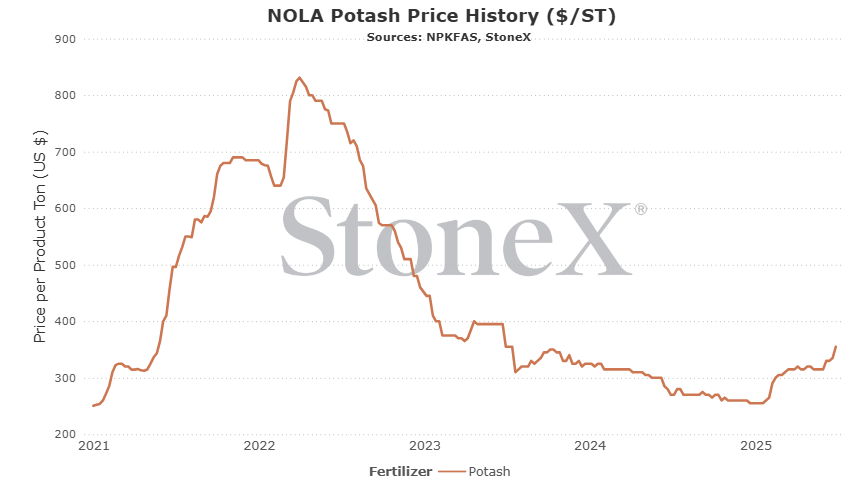
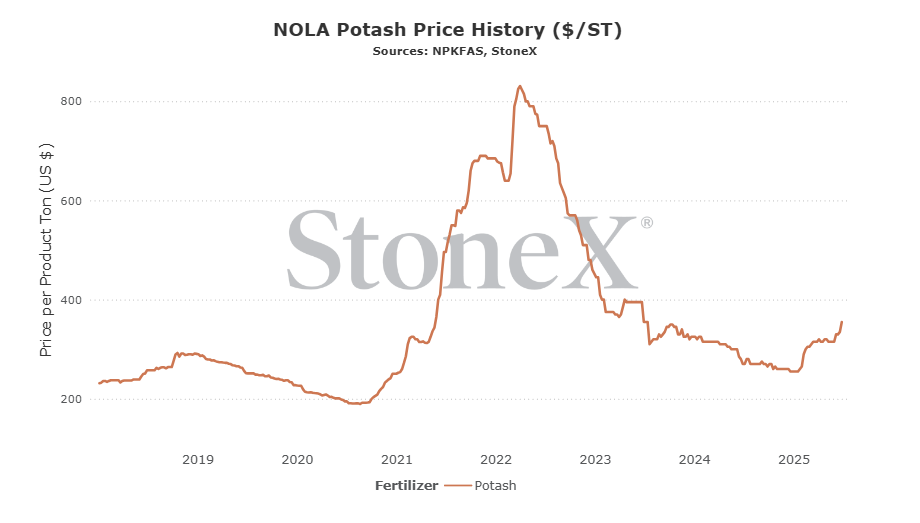
- Vs last summers values - while NOLA is not the best fob location to use for potash (it is more an inland priced product), NOLA is the best place we have for historical data so it is what we primarily use. When looking at NOLA, current potash values are around $65 higher than where they settled to their low's last year. Unfortunately, grain value are no better.
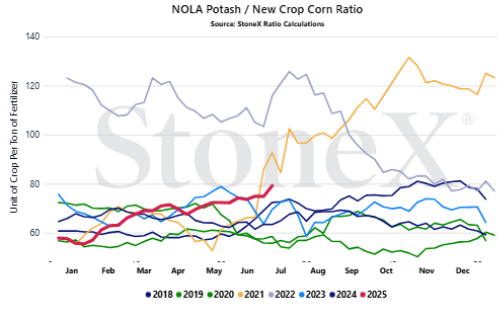
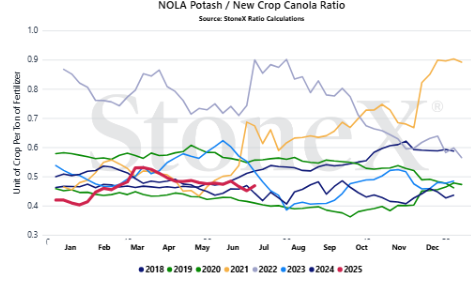
- Vs grain/corn values - by now you know I am a big fan of comparing N.A. fertilizers to corn. For much of the region, corn is king and corn is what most of the demand models are based on. When looking at the NOLA potash price vs December 2026 corn values, the ratio sits at 74. If you look at the graph below, you will notice that 74 is on the high side of most of the recent years. It isn't as bad as 2022 and 2023, but it is on the high side of everything else. Again, not overly attractive, but not as bad as it could be.
I was really hoping that when fill programs came out, I would have better news. I know you get plenty of negative news. This is what it is, unfortunately.
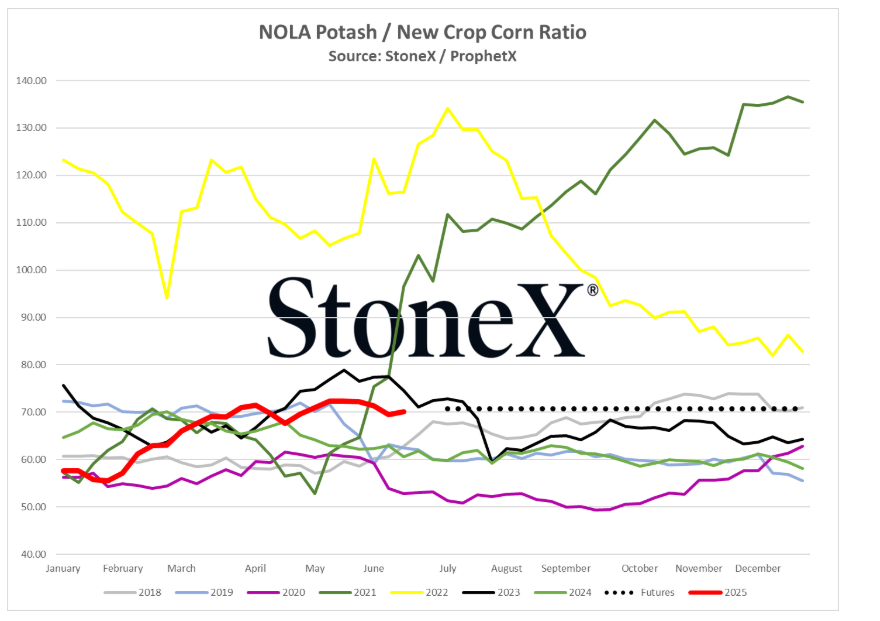
Prices are high. Has the supply outlook changed?
Long answer short, no.
Just because a market is well supplied does not mean that values cannot go up. Just because a market is tightly supplied does not mean that values cannot go down.
Our longer range outlook continues to be that supplies will increase:
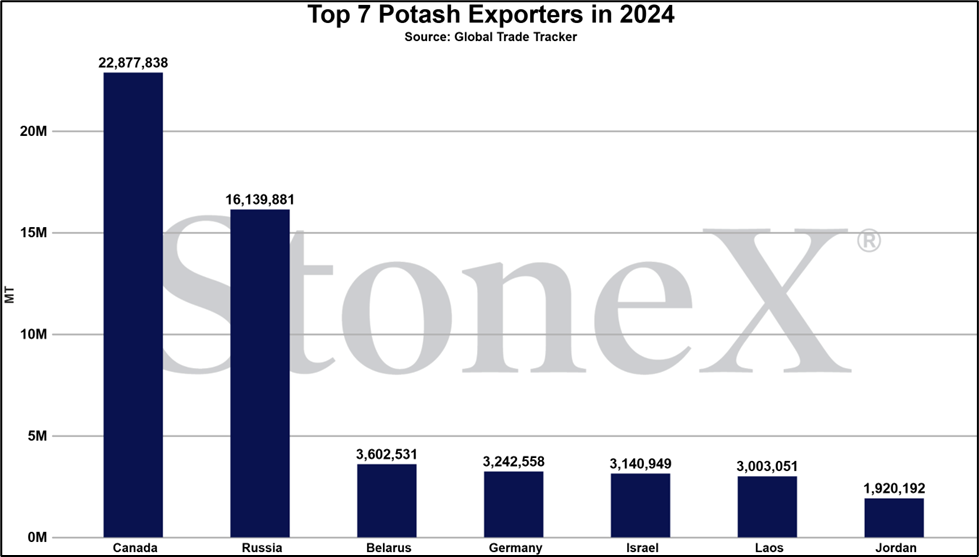
- Canada - BHP continues to work on their mine that will bring a huge amount of production to the world.
- U.S. - Michigan Potash Company has received funding from the government to develop their production. Expectations for several hundred thousand tons per year.
- Laos - China is heard to continue to invest in Laos potash production. China is a major buyer and would much rather buy from a local country than from western countries like Canada.
- Russia - I believe there are still more production increases in the works
While there may be others out there, these are the majors. We do have to factor in that some of the largest potash importers in the world have seen their demand up substantially. This is helping to keep the S&D much tighter than it would have been otherwise.
Ultimately, our outlook is still that global supplies will outweigh global demand and that should continue to keep bearish pressure on price ideas. Again, that does not mean prices cannot go higher. It just makes it a lot harder.
Could peace between Ukraine/Russia be next? Would that help Belarusian exports?
Now that peace between Israel and Iran has been found, my guess is that President Trump will be turning his focus to Russia and Ukraine. There are no guarantees that happens, but I think it is something we need to watch for now.
What would that mean for global potash?
Russian potash has never slowed down as many expected back in late 2021/early 2022. However, Belarusian exports did. If you remember, at the start of Russia's invasion of Ukraine, Russia approached Belarus and asked if they could move troops thru south Belarus in order to attack Kiev from the north. Belarus allowed it, and the west was not happy. Shortly after, Lithuania made the decision to shut the border of Belarus. For their potash exports, this was hugely detrimental. Belarus had long shipped their product through Lithuanaia, to deep sea ports, and out to the world. With the border closed, that avenue was shut with few alternatives. If peace was found between Russia and Ukraine, it is feasible that we could see relations between Belarus and Lithuania improve. That could include reopening the border and reestablishing that important trade route that could provide more product to the world.
For Russia, improved relations could see more traditional trade routes reopen to places like Europe. This would help farmers in those effected areas access cheaper product.
The potash scenarios are not nearly as ground braking as other fertilizers, but there are still things that could improve.
NOLA/New Orleans Louisiana
Vs 30 days ago - 6% or approximately $20 higher
Vs 90 days ago - 5% or approximately $15 higher
Vs 6 months ago - 31% or approximately $80 higher
Vs 1 year ago -20% or approximately $55 higher
U.S. Midwest Average (average of several points across the Midwest)
Vs 30 days ago - 3% or approximately $10 higher
Vs 90 days ago - 8% or approximately $27 higher
Vs 6 months ago - 26% or approximately $80 higher
Vs 1 year ago - 5% or approximately $20 higher
- Continued reports of big sales – sort of like the phosphate market has been for weeks/months, continual and constant reports of sales help to support price ideas. It is a "constant" story that folks are buying so you should too. As long as these sales reports continue and values hold flat to higher, it helps support the tone for the globe.
- Price appreciation in the grain markets - right now, part of the reason many of the fertilizer prices are not higher than they are is due to poor grain prices. Low grain prices causes a lot of demand to hold back in hopes of a better day ahead. However, if suddenly we start to see grain prices jump substantially higher, all of that demand that had been waiting will rush ahead to take advantage. That demand rush would likely cause values to jump on potash as well as everything else.
- Further global turmoil/tensions blocks further exports – there is a lot of tension around the world. Russia and Ukraine are still fighting. The Israel and Iran exchanged attacks. Everytime that we think things are going to calm down, something new pops up. We can hope that doesn't happen, but we still need to be prepared if it doesn't. If we see an escalation in these events or see new events occur which impacts potash production/export capabilities...higher prices. The manufacturers have already done a good job of setting the price floor. Any further supply hiccups only build that case.
- Demand turns off and there is plenty of potash available – now, I say this from a farmer input macro level. Potash itself is not as insanely high as phosphate and nitrogen has been. However, many times farmers will make a purchase across the products rather than split them out. If farmers (and retailers) continue to see a tough road ahead, they may stop any further purchases in hopes of better conditions in the future. If enough demand dies off for a little while, it can put that pressure back on the manufacturer to lower prices to incentivize demand. It doesn't look likely today, but it is possible.
- Peace between Russia/Ukraine leads to more Russia/Belarus exports - President Trump has just done what the world thought was unthinkable. He ordered the direct attack of Iranian nuclear sites. Some call it bold. Some call it threatening. To some countries, it might be both. President Trump has been fighting to find peace between Russia and Ukraine with Russia not being interested. Now that Trump has shown a willingness to do something like this, it could have Putin rethinking his approach. If we suddenly see peace agreements put into place, that can calm and improve relations. If this extends to Belarus/Lithuania (remember that Lithuania shut off Belarus potash export flows due to their helping Russia), we could see Belarus resume normal export flows. That would be a boost to global supplies which would lean on price ideas.
- Grain values remain low/go lower, causing farmers to wait – farmers are struggling. That is a common theme in this months edition. If grain prices continue to fall, there is absolutely a breaking point where farmers say no thank you. If that level is reached and demand falls off, it will start pushing that pressure back to the manufacturer. If that lasts long enough, it could cause manufacturers to need to lower prices to find sales.
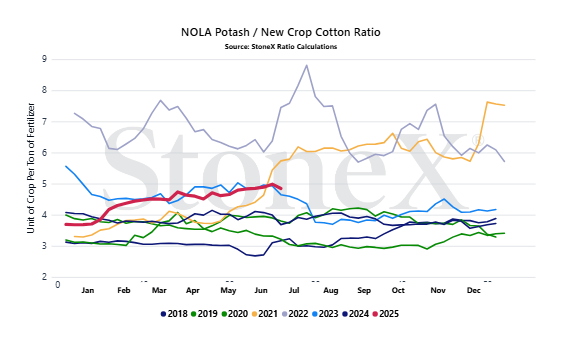
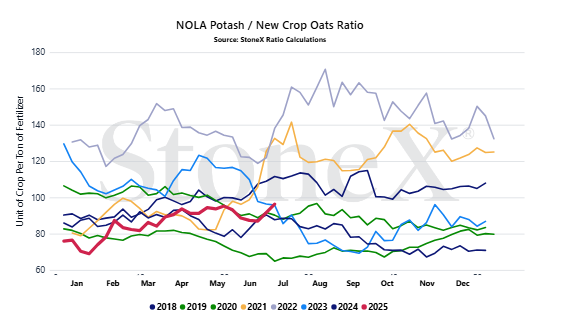
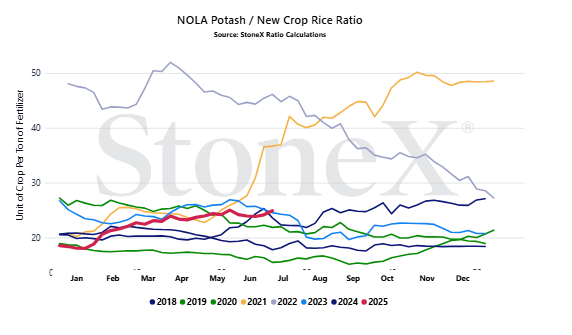
Where are the current potash/grain ratio values today
We believe that only looking at the flat price of either grains or fertilizer can be misleading:
-
Only selling grain can hurt you if fertilizer prices rise substantially
-
Only buying fertilizer can hurt you if grain prices fall
We look at the ratio "value" to get a better indication of where we are or how many bushels of X does it take to pay for 1 ton of fertilizer.
Would you rather:
-
Spend 120 bushels to pay for 1 ton of potash
-
Spend 60 bushels to pay for 1 ton of potash
When we compare the current ratio value against recent years, we start to see if we are high or low.
YOUR VALUES MAY LOOK DIFFERENT
This graph looks at the NOLA potash price vs the flat grain price. There are no logistics on either product. Your location will look different due to fertilizer logistical costs, grain basis, etc.
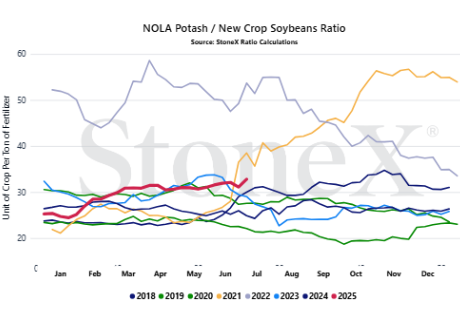
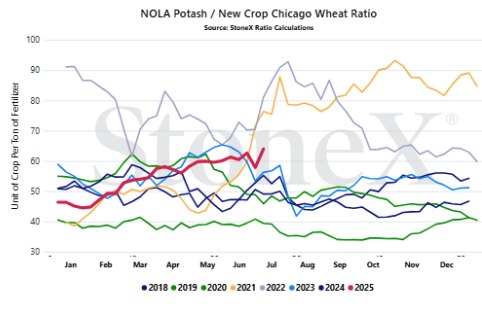
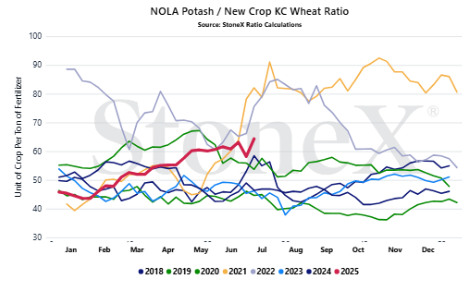
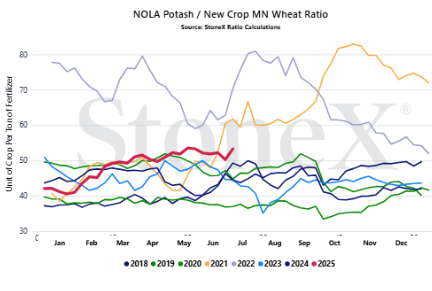
- Have global manufacturers sold enough to convince the market that lower prices are not coming? - global potash markets notched a few major wins in the last couple weeks after signing higher than expected contracts with China and India. That set the tone for summer fill values to remain unchanged and saw a lot of sales put on the books. Now, the question is can this hold through summer. If demand starts to fall off and the markets get quiet, can that cause prices to fall or has enough already been done to keep that from happening?
- Will the combination of high priced potash and phosphate along with low priced grains hurt demand in the fall? - for a while now, potash has been low priced enough to help offset the high price of phosphate. While very unhappy about it, farmers looked at the two together and decided to proceed with largely normal application rates. That is not the case this summer. Potash is high priced vs grains. Phosphate is excessively high priced vs grains. Could that combo finally cause farmer demand to break?
StoneX Ratio Calculation
The ratio calculation is derived from Bloomberg historical grains values as well as fertilizer values from StoneX, NPKFAS, and Argus.
The calculation is simply dividing the fertilizer price by each grain price.
All data was sourced from StoneX unless otherwise noted.