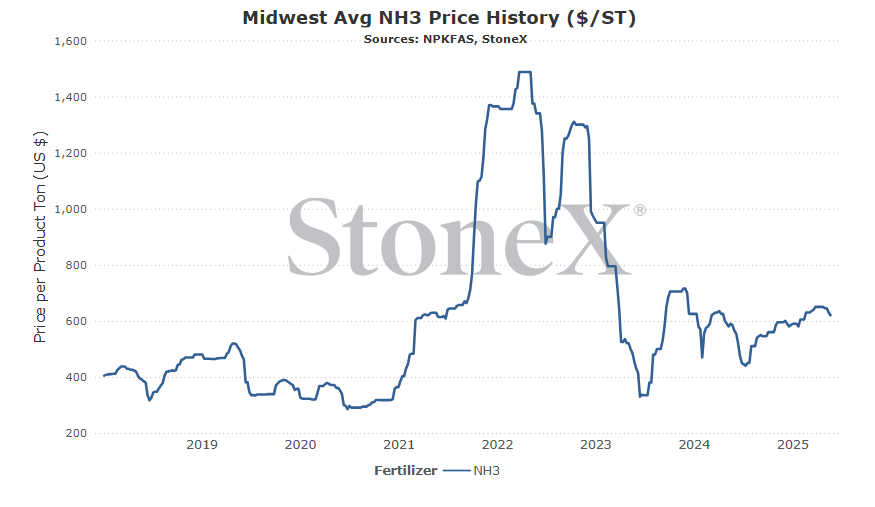
The first graph is the AVERAGE of the entire Midwest U.S. region. That means your local value WILL be different than what the graph reflects. Please do not take this into your retailer and say "why isn't my price the same as here". That is comparing apples to oranges. You might be on the cheaper or more expensive side of this graph. This doesn't take into account logistics/storage/interest/insurance/shrink/etc.
This graph looks at the price from a short ton and USD currency POV.
This second graph looks at the price set for Tampa NH3. This value does not have a high correlation to Midwest values. It is a talking point used when prices are rallying...yet somehow gets skipped on the way down. This price is more an indication of the global price. This price is set by two parties (purchaser - phosphate producer in Florida / seller - international producer providing NH3 to FL phosphate production).
This graph CAN be used as an indication of global market price direction/trends. This graph SHOULD NOT be used to determine a Midwest value. Tonnage is listed in short ton and currency in USD.
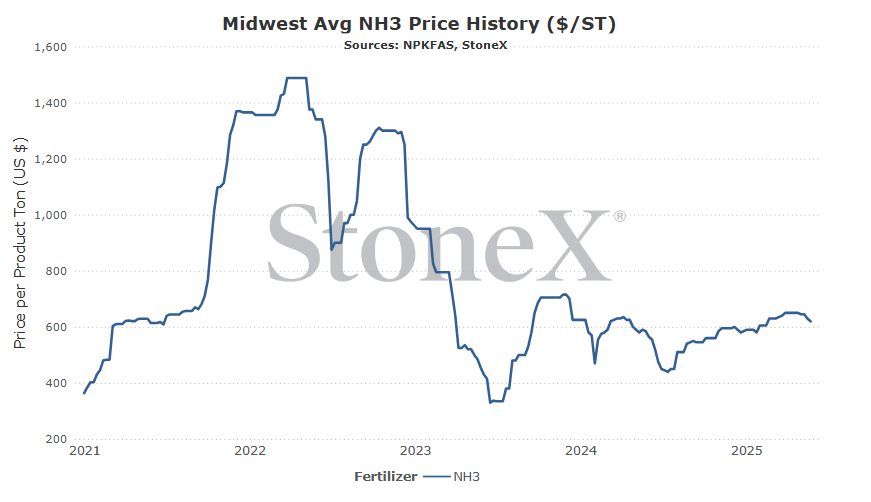

Spring agricultural demand is mostly behind us at this point. Sure, there is sidedress demand that could be bigger than normal given the lack of UAN and high priced urea, but only so many areas can apply sidedress.
This should mean a march to lower prices as the market tries to contemplate summer resets for fill and then fall prepay values.
We should see spot values continue lower through the month of June as long positions and manufacturers continue to fight for a smaller and smaller demand pie. What will be interesting is whether the market will start summer fill programs before July 4th. I think we will see it and then fall prepay programs will wait until later in July. Neither feels like they will be overly aggressive in terms of lower prices.
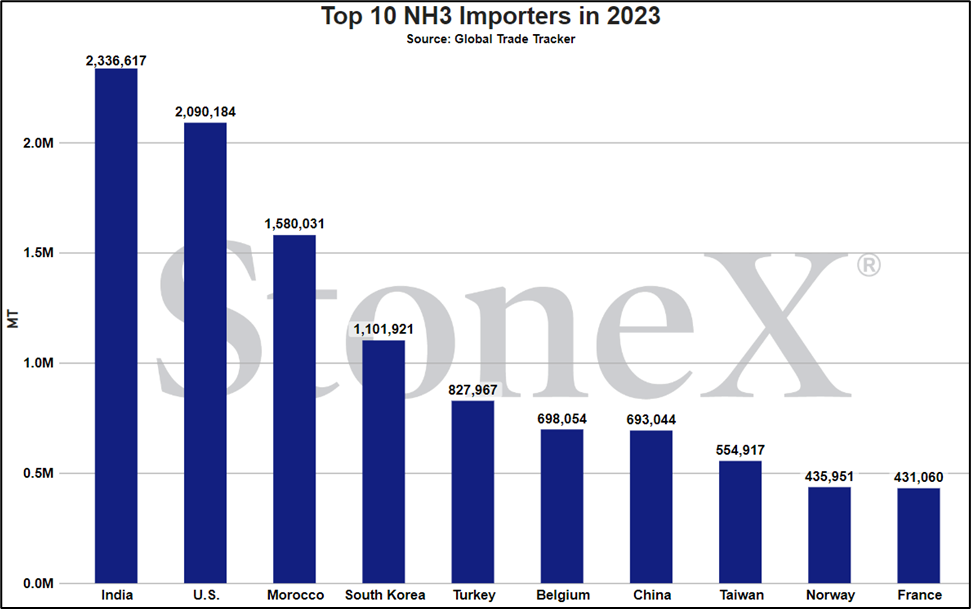
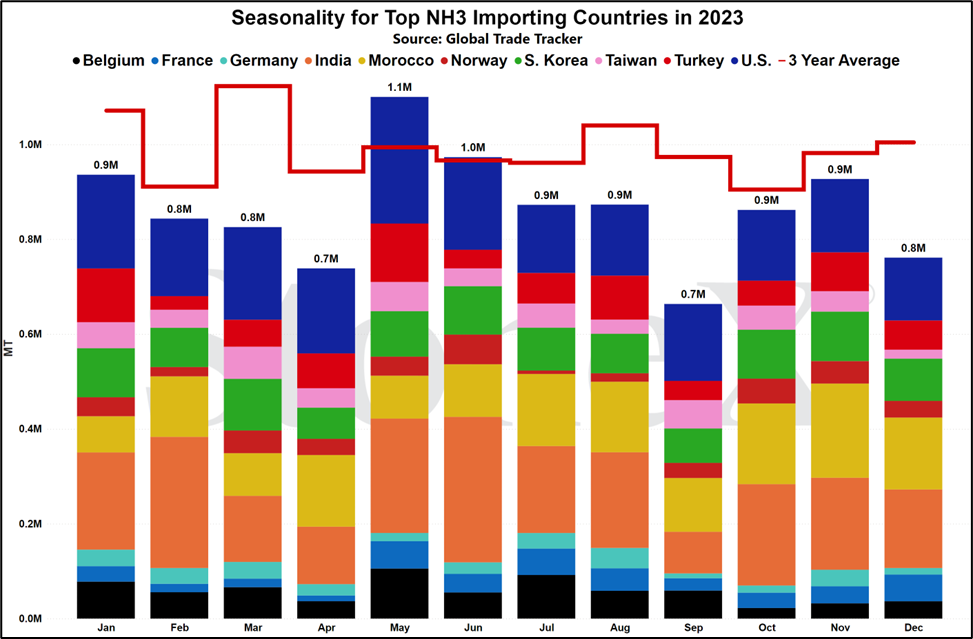
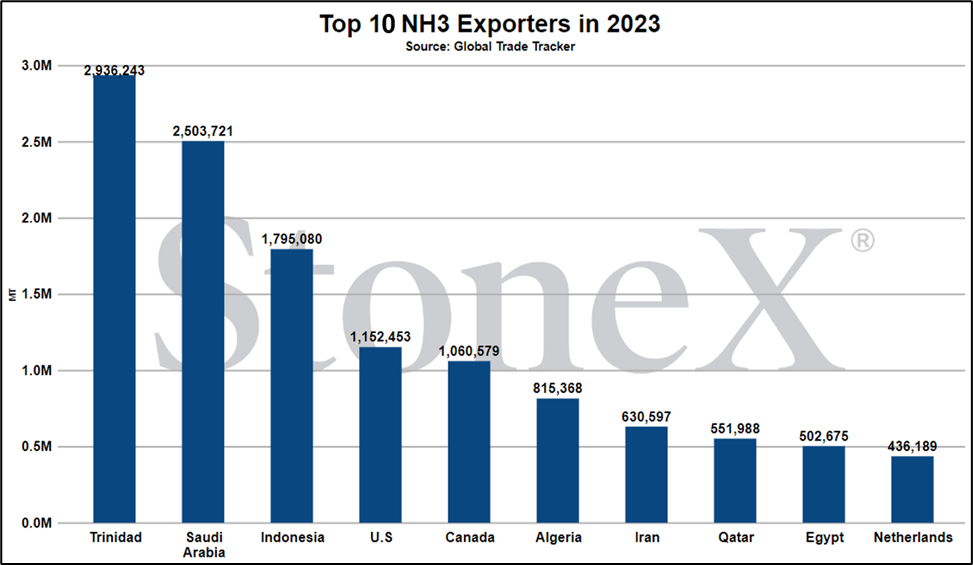
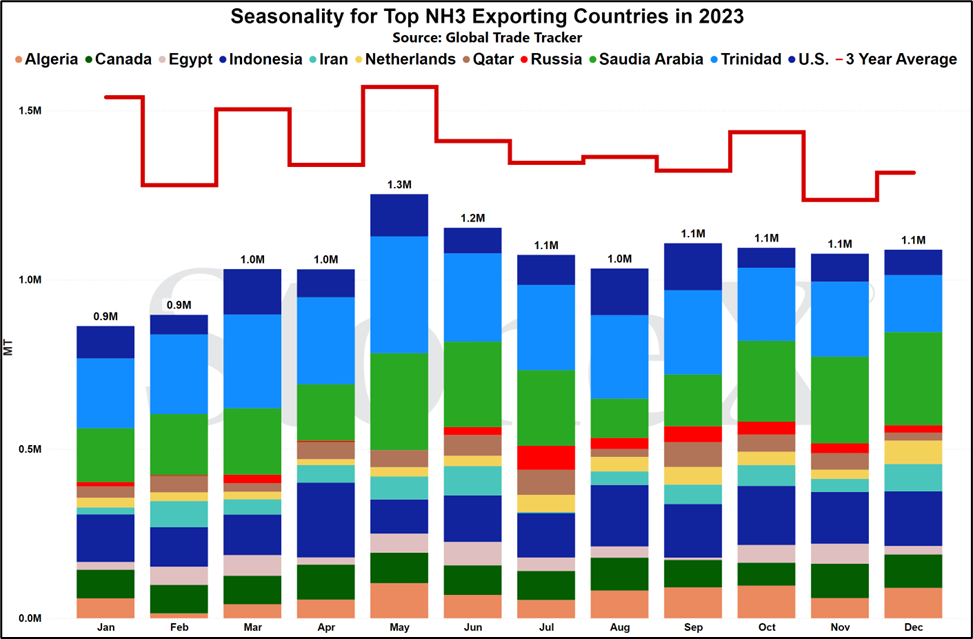
Global markets relatively quiet with some watch points
In terms of the global NH3 market, the last month has been relatively quiet with few changes:
- European production remains mostly unchanged - after getting into a tiff with Russia, European nations quickly learned how reliant they were on Russian natural gas flows. Once the Nordstream pipelines were shut down and then eventually attacked/damaged, European gas values skyrocketed. The result for NH3: massive plant shutdowns due to massive input costs. Fortunately, the market eventually corrected much closer to normal, but it is still historically high and that means European nitrogen production is running at approximately 75% of normal. That lowers global supplies and raises global demand for NH3. Even though it is unchanged, it is still supportive.
- Still no sign of Russian export returns in a big way - Russia used to be the world's leading NH3 exporter. The issue they faced when they invaded Ukraine is that they were heavily reliant on Ukraine to make those tons disappear! Their pipeline ran through the east/south, ended around Odessa, and was loaded onto vessels around there. Shockingly, Ukraine decided to no longer allow this to happen when Russia invaded! Today, it sounds like Russia's new export facility based in Taman is ready to go...but the government has not given permission. That makes perfect sense. Taman sits just east of Crimea which is WELL within striking distance for Ukraine. NH3 is an extremely toxic gas. If Russia started that facility and it was attacked while full, the surrounding population/ground/water would be devastated. Better to hold off on the start until closer to peace. So Russia is still largely gone, but they are close to returning...we hope for buyers.
- Trinidad production hiccups due to unreliable natural gas supplies continue - with Russian exports still being held at bay, Trinidad has taken the top spot in the world. That means when they have issues, the world needs to take notice. Unfortunately, that has continued to be the case. While there are efforts in place to expand natural gas supplies, this will take time. Until that day comes, current natural gas supplies can ebb and flow. Right now, they are fighting lower supplies. When those supplies dip, nitrogen manufacturers have to slow their production rates to match their input flows. That means less NH3 produced and less NH3 available for the world.
On the demand side, it has been relatively quiet. The biggest news of the last few weeks was hearing that an NH3 trader had sold a vessel of NH3 to U.S. based phosphate producer Mosaic at a surprisingly low price of $375. The price itself isn't hugely out of line but it was a stark discount to recent done/recently believed doable price. That, in my opinion, is why we still have not heard the Tampa June NH3 price. My guess is that Mosaic is wanting Yara (those are the 2 parties that set the Tampa price) to match their low price purchase from Trammo. Yara, on the other hand, is likely pushing back and wanting higher.
Otherwise, there isn't a whole lot that has changed the global complex for NH3.
What does this mean for farmers?
Midwest values do not have nearly as much correlation to global values as some might think. Global/Tampa prices are talked about at length by the sell side when those prices are rising and to a certain extent, it makes sense. If Midwest values do not keep up with international, then the eastern NH3 pipeline will start to lose the import flow from places like Trinidad. That cannot be allowed to happen. However, when global/Tampa prices start to fall, that story starts to disappear!
We need to watch global values for a sense of price direction, but do not fall into the trap that just because global does X, Midwest will do Y.
N.A. spring season nearly complete, now watching summer resets
While there is going to continue to be side dress applications in parts, the bulk of spring NH3 is now behind us.
So now we look forward.
As of right now, when I go through my demand models, my urea and UAN price reset expectations, demand outlooks, etc., my summer fill price looks to be about $50/ton higher than last summer. I'm hopeful that the fall prepay price, at least in the beginning, will be closer to last years first edition of fall prepay.
Now, that outlook does expect to see urea and UAN resetting much lower than what a lot of folks in the space are thinking. My NOLA urea summer reset price has elicited a couple chuckles and some have wondered if UAN suppliers need to get as low as I think to bring buyers forward after what happened this spring. I would say I am on a bit of an island for my nitrogen reset views. Those are the values I believe we will see based on the fundamentals in hand.
Enough of that. What I am trying to say is that my NH3 expectation is linked largely to my urea and UAN price reset expectation. If the rest of the market is right in their view, it is VERY likely that NH3 values will be set higher.
Ultimately, if you are holding out hope that prices will be lower than last year...well, I'm here with the bad news. Anything can happen. The market can be completely wrong and it does fall hard. Unfortunately, I do not have that foresight. At this point, I would suggest expecting prices to be a bit higher.
U.S. Midwest Wholesale price average
Vs 30 days ago - -5% or approximately $30 lower
Vs 90 days ago - -2% or approximately $10 lower
Vs 6 months ago - 4% or approximately $25 higher
Vs 1 year ago - -6% or approximately $35 higher
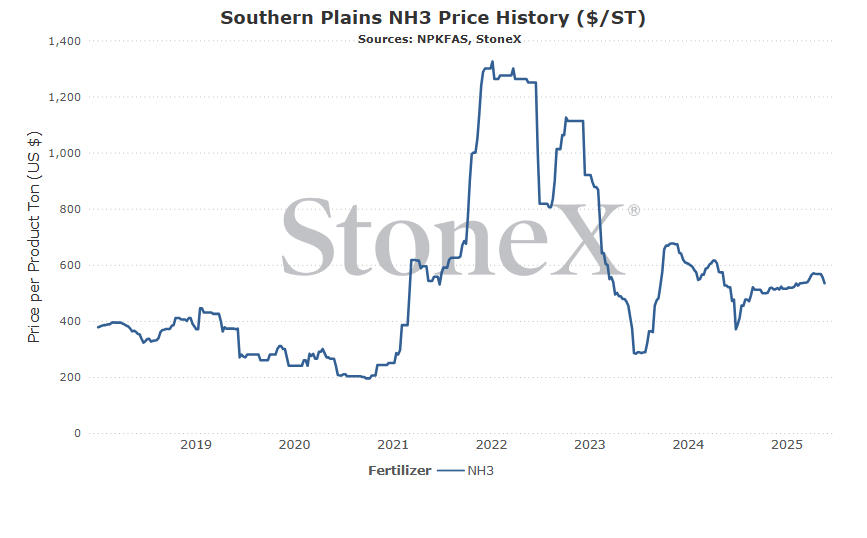
U.S. Southern Plains price average
Vs 30 days ago - -6% or approximately $33 lower
Vs 90 days ago - 0% or approximately $0
Vs 6 months ago - 4% or approximately $22 higher
Vs 1 year ago - 2% or approximately $8 higher
- Continued Trinidad production issues limit U.S. import opportunities - this is a bit of a long shot as I do not expect that Trinidad production issues will be that bad or that long, but it is something we are watching. Trinidad production has suffered due to natural gas flows that have been less than reliant. If this doesn't improve or gets worse, then that could impact the number of U.S. imported tons that flow through the pipeline. Enough of that happens, inland supplies are impacted and suddenly, summer/fall values might see price support.
- U.S. tariffs, if continued, could cause a barrier to import flows - talk about an on again/off again situation. I'm writing this on May 29th and just today we have seen a judge rule that President Trump's tariffs are illegal and are to be cancelled and then by the afternoon an appeals court ruled they were to continue. Let's assume they continue. This will act as a barrier to entry for NH3 (and all other fertilizer) imports. I doubt that they actually block the imports, but values will likely rise and those higher values make their way to the farmgate.
- Unnatural boost in spring side dress demand due to tight UAN/high priced urea lowers supplies - nitrogen has acted in a way that I've never seen for North America. UAN became nearly impossible to find for much of April and May. Urea saw prices skyrocket between the wide open application weather and the increased demand from UAN. Another layer of this was the amount of folks that talked about trying side dress NH3 for the first time ever. While it is a much slower process, at the price differential to urea and the fact that it was available, I think some folks gave it a shot. If that is true, that means more supplies were chewed through and our starting inventory situation for fertilizer year 2026 will be lower than we previously thought. Lower inventories usually allow prices to be higher.
- Once past spring, farmers/retailers are going to be reluctant for summer/fall - regardless of any fertilizer S&D situation, farmers are struggling. Their inputs are stupidly high. Their output/grain values are stupidly low. Cash reserves have been dwindled and it appears that it is finally hitting the checkbooks which means no one will be excited to spend money. On the other side, retailers know this and have struggles of their own. Rather than secure big positions that may not get sold until application, they may pass and decide to wait until closer to application to make purchases. If the demand side of the equation says no, that will place pressure on the sales side.
- Any sudden return of Russian exports - while we have not seen nor heard that Russia has begun exporting NH3 from their new Taman facility (government not allowing it to start, likely due to attack fears), it sounds ready to go. If the government gives the go ahead and exports start to flow, that will signal the return of the world's typical largest exporter. Would be hard to see prices do anything but fall in that scenario.
- Further decline of grain values - farmers are already struggling with low grain values in face of tall input prices. That should mean that any further degradation against the farmer will add more stress and pressure. That would be especially true if grain values dropped further. It is far too early in the calendar to make a call on how good or bad the crop is going to be. If we get several weeks ahead and yields are looking great, that could start to weigh on crop pricing. That starts to happen, it will just send farmers and retailers running even faster away from securing inputs.
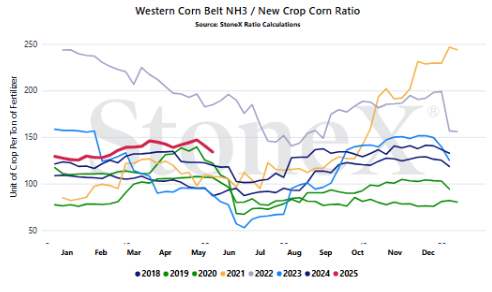
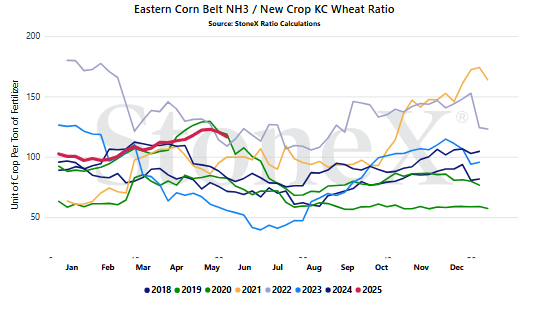
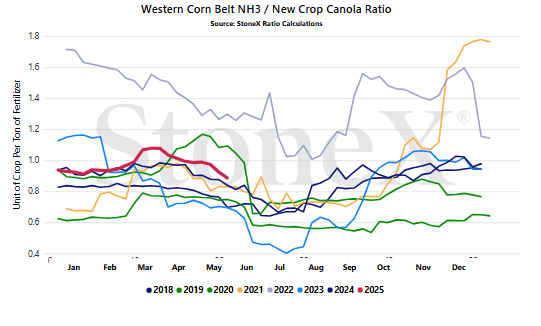
Where are the current NH3/grain ratio values today
We believe that only looking at the flat price of either grains or fertilizer can be misleading:
-
Only selling grain can hurt you if fertilizer prices rise substantially
-
Only buying fertilizer can hurt you if grain prices fall
We look at the ratio "value" to get a better indication of where we are or how many bushels of X does it take to pay for 1 ton of fertilizer.
Would you rather:
-
Spend 150 bushels to pay for 1 ton of potash
-
Spend 100 bushels to pay for 1 ton of NH3
When we compare the current ratio value against recent years, we start to see if we are high or low.
YOUR VALUES MAY LOOK DIFFERENT
This graph looks at the NOLA NH3 price vs the flat grain price. There are no logistics on either product. Your location will look different due to fertilizer logistical costs, grain basis, etc.
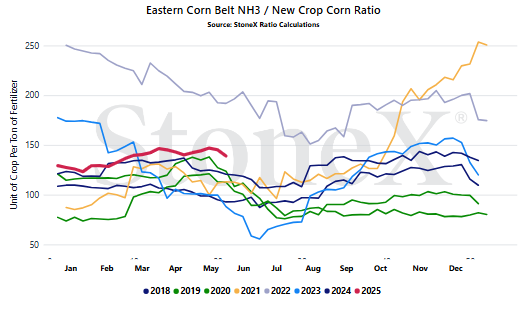
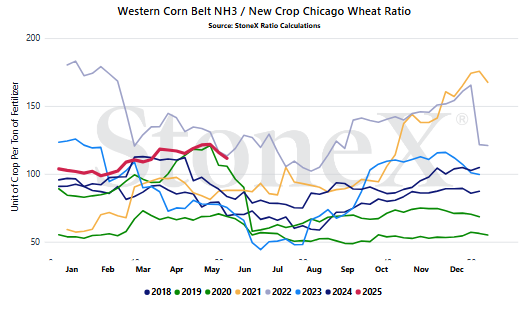
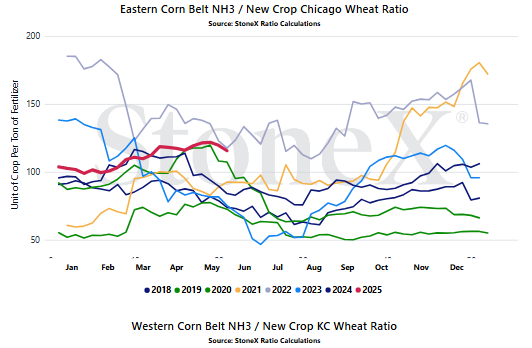
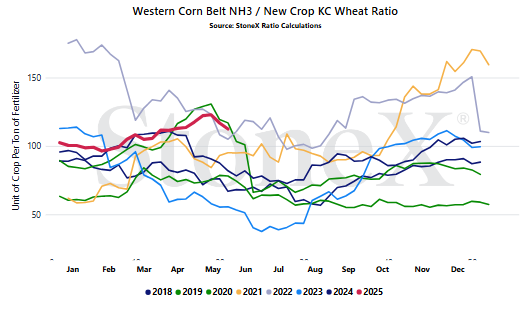
- Biggest watch point remains Russian exports - Russia is typically the world's largest NH3 exporter but they have been absent since they started their invasion of Ukraine. While we have seen price volatility, the overall market has been higher priced since their absence started...which would mean that if/when they return, the market should drop once again. However, peace doesn't look viable as Putin has been rejecting talks with Zelenskyy. If you were Russia, would you want to make a facility operational that handles millions of tons of very toxic NH3 that is placed that close to the country you are invading? Not likely they return near term, but it remains the biggest watch point.
- Continued global production hiccups - European production remains at 75% of normal and so some facilities remain reliant on imported NH3. Egyptian nitrogen manufacturers have had to slow/stop production due to unreliable natural gas flows. Trinidad continues to see nitrogen production speed up/slow down because of unreliable natural gas flows. All in all, there are a few NH3 production issues which is starting to tighten global supplies. As long as these happen, it helps create a price floor...but if they were to get back to normal, prices could slip further.
- How N.A. manufacturers approach summer fill/fall prepay programs - the market knows that farmers are struggling this year and do not have much hope when they look to 2026. Demand isn't going to be excited about throwing money at what they see as high priced product early. Will they take that que and decide to mirror their approach from a couple summers ago where they released an extremely aggressive/low priced program or will they tempt fate by keeping prices higher and hope that buyers will naturally come forward. Ultimately, the markets reaction to their programs will set the tone.
StoneX Ratio Calculation
The ratio calculation is derived from Bloomberg historical grains values as well as fertilizer values from StoneX, NPKFAS, and Argus.
The calculation is simply dividing the fertilizer price by each grain price.
All data was sourced from StoneX unless otherwise noted.