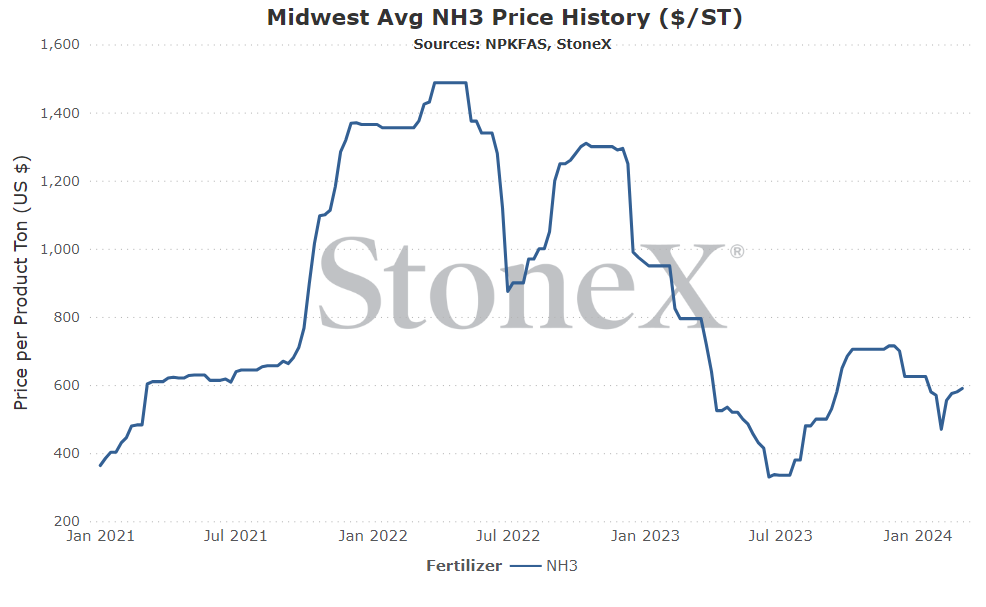
The first graph is the AVERAGE of the entire Midwest U.S. region. That means your local value WILL be different than what the graph reflects. Please do not take this into your retailer and say "why isn't my price the same as here". That is comparing apples to oranges. You might be on the cheaper or more expensive side of this graph. This doesn't take into account logistics/storage/interest/insurance/shrink/etc.
This graph looks at the price from a short ton and USD currency POV.
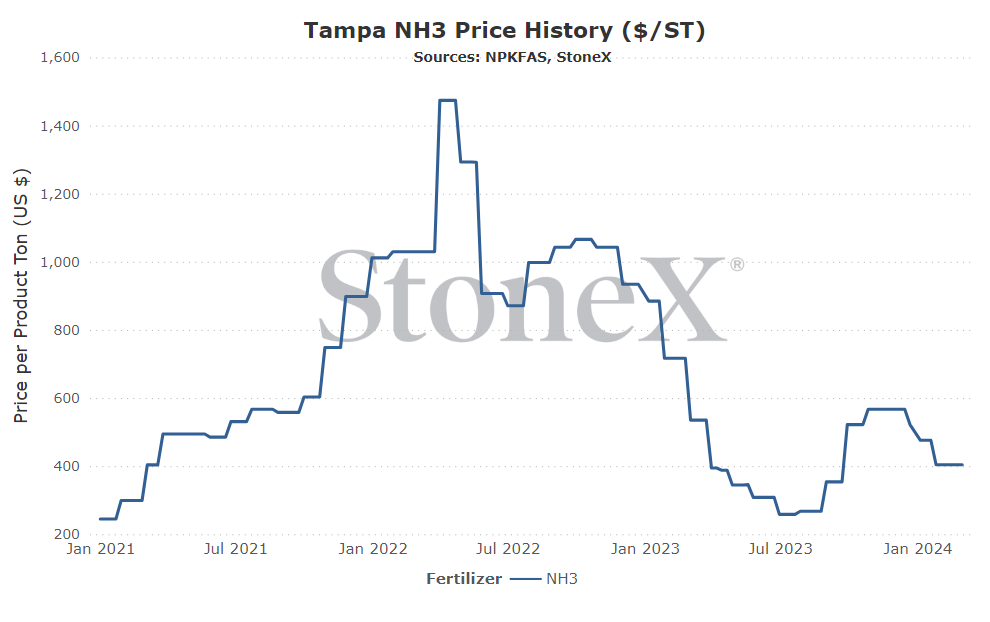
This second graph looks at the price set for Tampa NH3. This value does not have a high correlation to Midwest values. It is a talking point used when prices are rallying...yet somehow gets skipped on the way down. This price is more an indication of the global price. This price is set by two parties (purchaser - phosphate producer in Florida / seller - international producer providing NH3 to FL phosphate production).
This graph CAN be used as an indication of global market price direction/trends. This graph SHOULD NOT be used to determine a Midwest value. Tonnage is listed in short ton and currency in USD.
I'm not going to lie, I was surprised when the March Tampa price was announced at even money to February. While I didn't expect the near triple digit resets we had recently seen, I thought another dip was in order.
Regardless, I'm still holding onto my bearish sentiment.
With Russia continued to be expected to return to exporting and the slower late spring/summer demand period looming, it is hard to be anything but bearish right now.
I'm sure the Russia return date will continue to move but eventually they will find their way back. When that happens, it should be good for buyers around the world.
North America
Mother nature, you are a fickle beast. Sometimes, you make it a struggle to get anything done in the spring (go back a couple years). Then, following one of the largest fall applications runs in recent history, you give us one of the earliest starting windows for the spring. That is a tough situation.
Nearby, values should remain bullish. Inventories are simply too tight with a too early start to application for it to be anything other. However, once demand starts to dry out, watch out. The summer reset will be looming.
As is typical, the biggest question is about "when" it will all happen. If I knew that for certain, I would have a lot more zero's in my bank account! Still, I would guess that values start coming off mid to late April. Too late for the spring run.
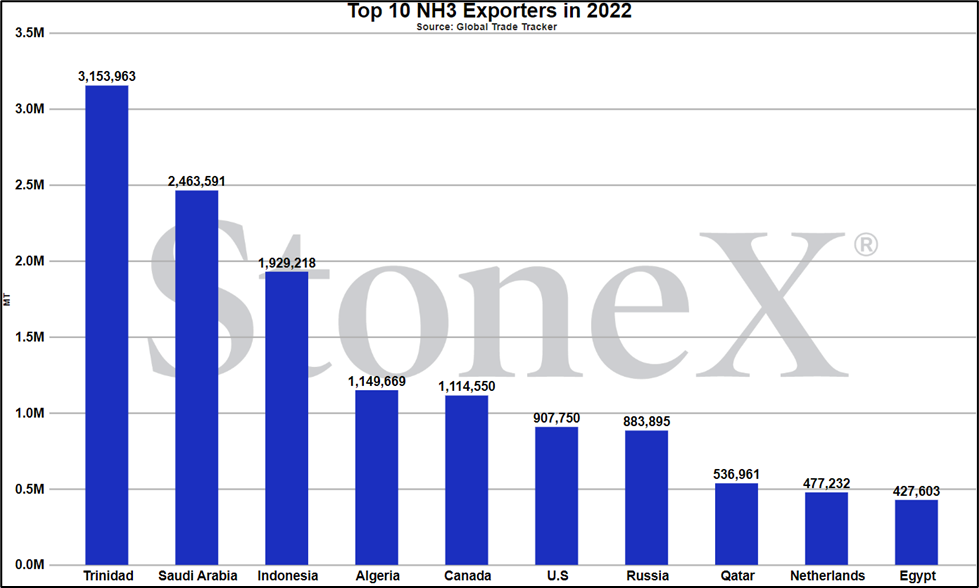
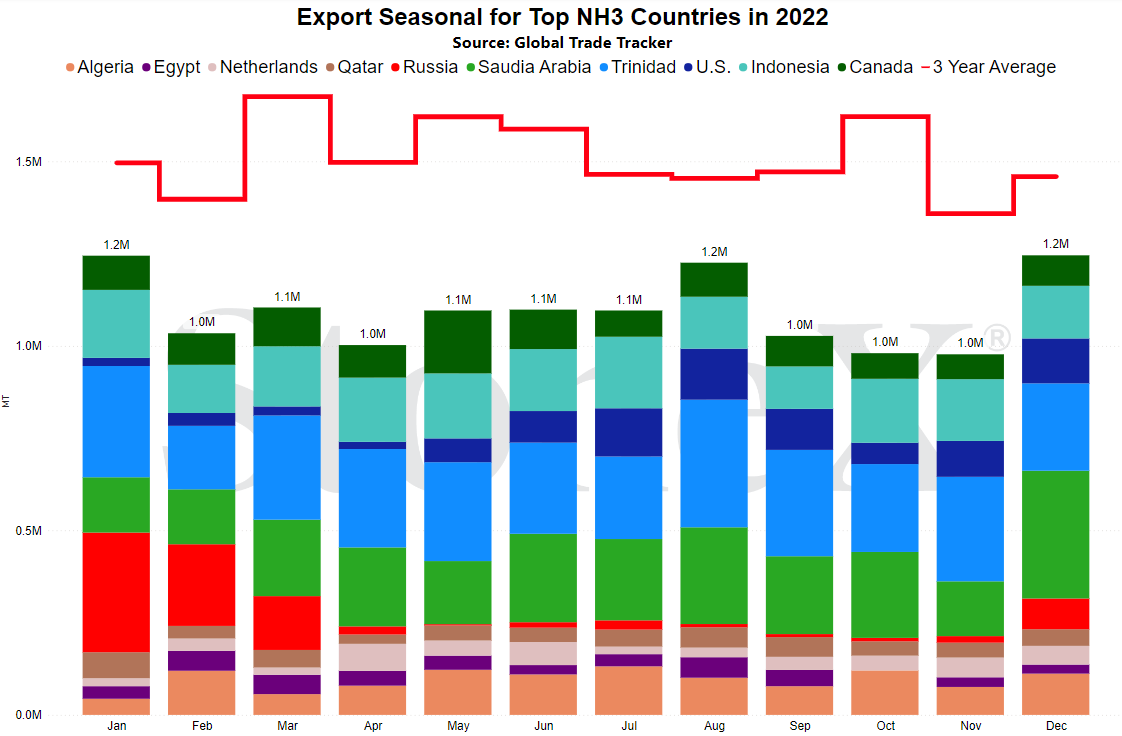
Russian progress continues
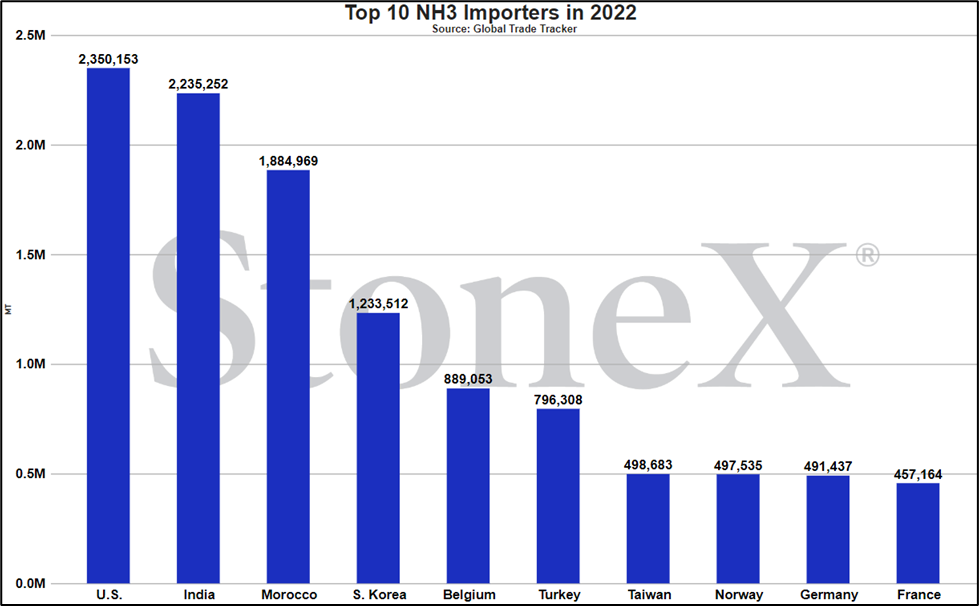
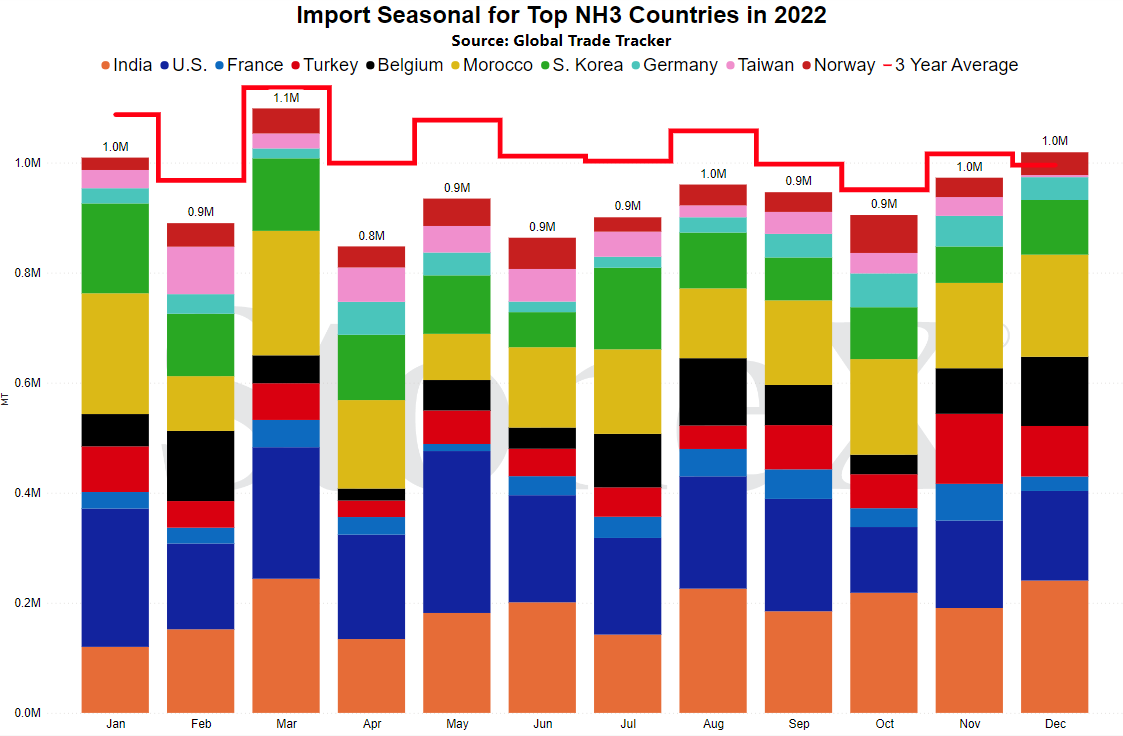
While firm timelines on when Russian NH3 exports will resume have been hard to find, the general consensus is that they are coming sooner than later.
This will be a big deal for global NH3 values. Russia, prior to invading Ukraine, was the world's largest exporter but quickly found out that they can be all but shut out of the market. Seems from a strict NH3 POV, they were a little short sighted. Hard to use an NH3 pipeline that runs thru the country you are invading...
Once they return, the market will have to seperate the fundamental from the emotional.
From the emotional standpoint:
- The world's largest exporter is back which means the world NH3 market is much longer than it was.
- Global NH3 values were elevated with Russia gone but should now crater as soon as they resume.
That will absolutely run thru the minds of many. Those with long positions will likely look for ways to sell off. Those that are buying will likely drag their feet in hopes of lower values coming.
However, on the fundamental side:
- Their typical annual volumes will not be available day one.
- There will most likely be hiccups as there always is with new builds.
Regardless, their return should be seen as an incredibly large bear event.
European outlook improves with falling Dutch TTF values
Dutch TTF (European natural gas values) is the little engine that could!!
After skyrocketing to a high of $103MMbtu back in August 2022, few thought it would come down. In fact, I had a few online experts who all but laughed when I theorized that values could fall.
Today, we continue to see Dutch TTF trading in the $7 - $8MMbtu. Fortunately, this has allowed a large part of European nitrogen production to resume. Unfortunately, it is still not 100% and there is a growing chorus that ponders if 100% will ever be reached again due to the political climate and old age of several plants.
Still, the hope remains that remaining offline plants will restart. That would cause regions that have become reliant on exporting to Europe to become competitive in other areas. For buyers, competition is a good thing!
North America struggling with early spring start
I know I am a broken record here but it is worth repeating.
Last fall, North America had one heck of an NH3 application run. According to our numbers, it was the 3rd largest run going back to 2000. What makes that even more impressive is the fact of how many retailers/farmers have strayed from NH3 due to dangers. It was impressive and did not relent until Mid-December. Basically, the system was empty.
Then, there have been some production issues this winter due to the cold snap. I was take by surprise by announcements but one company stated that 150K tons of production was lost. That was a big deal after ending the fall so empty.
Now, mother nature has allowed a very early start to spring. Typically, most of the Midwest does not start until mid-March. This year, mid-February. That means only 2 months to put product in place and that just isn't possible. We continue to lose trucks all the time. Rail can only do so much. The western NH3 pipeline has been lost for a few years. The early start means that the market is playing catch up.
Now, if we suddenly get a widespread moisture event across the entirety of the Midwest, it would help to put a few more tons in place since wet soil doesn't dry very well this time of year. That would only be a short term band-aid and we would likely be in the same situation shortly after returning to the fields.
Basically, the supply side of the market has the demand side backed into a corner...and we know what typically happens then.
U.S. Midwest Wholesale price average
Vs 30 days ago - +4% or approximately $20 higher
Vs 90 days ago - -17% or approximately $125 lower
Vs 6 months ago - +18% or approximately $90 higher
Vs 1 year ago - -26% or approximately $205 lower
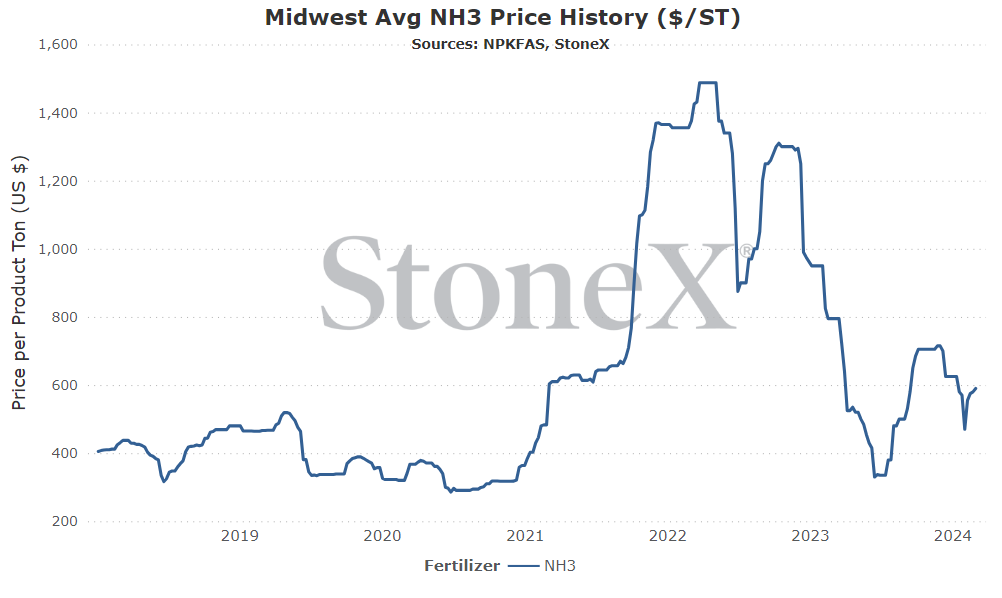
U.S. Southern Plains price average
Vs 30 days ago - -1% or approximately $8 lower
Vs 90 days ago - -16% or approximately $108 lower
Vs 6 months ago - +57% or approximately $205
Vs 1 year ago - -6% or approximately $38 lower
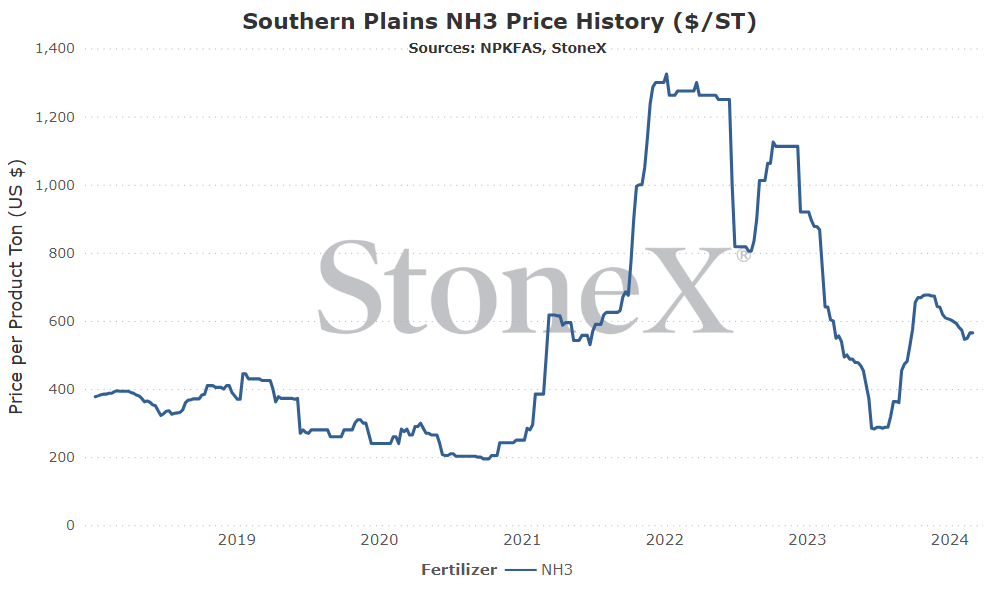
- Early start to N.A. spring season - we are unfortunately living the worst case scenario right now. Large fall run emptied the system. The fall run ran late into mid-December. Now, much of the Midwest has seen a very early start which is running headlong into tight supplies. It doesn't take a rocket scientist to know how suppliers will react...or have been reacting.
- Continued absence of some Europe/Russia - even with European natural gas values single digits, we have not heard many plants restarting. Also, the return of Russia remains a question mark that gets pushed back a bit at a time. This is the loss of fairly major supply that should support global price ideas more than typical.
- More production outages this winter announced than previously expected for N.A. - this was a surprise. During earnings calls, manufacturers discussed having significant production downtime due to the artic blast this winter. I'll be straight with you, I missed it completely. Never thought it had gotten that bad. Still, it did and removed much needed production from our market.
- Russia's return coming - eventually! When they do return, it is going to add a substantial amount of supply to the global market that is very likely to suppress price ideas. Just a matter of when.
- Grain values continue to fall - the lower grain prices go, the harder it will be for buyers to get excited to step in for their next needs. There has been a lot of money removed from the marketplace and a lot of farmers are struggling with their 2024 profits. The onus should be on manufacturers to get the price to a level that the market will buy into. Try for too high and watch the market push them away.
- Summer reset fear could drive markets lower emotionally - the summer reset fear is very real in the face of a strong nearby market. That leaves distributors in a tough position. Do not sell too soon for fear of leaving profits on the table. However, do not sell too late since you might miss demand and ride the price lower. If distributors get more scared of the reset than excited of the top side, you could see the sell off happen earlier.
We believe that only looking at the flat price of either grains or fertilizer can be misleading:
-
Only selling grain can hurt you if fertilizer prices rise substantially
-
Only buying fertilizer can hurt you if grain prices fall
We look at the ratio "value" to get a better indication of where we are or how many bushels of X does it take to pay for 1 ton of fertilizer.
Would you rather:
-
Spend 150 bushels to pay for 1 ton of potash
-
Spend 100 bushels to pay for 1 ton of NH3
When we compare the current ratio value against recent years, we start to see if we are high or low.
YOUR VALUES MAY LOOK DIFFERENT
This graph looks at the NOLA NH3 price vs the flat grain price. There are no logistics on either product. Your location will look different due to fertilizer logistical costs, grain basis, etc.
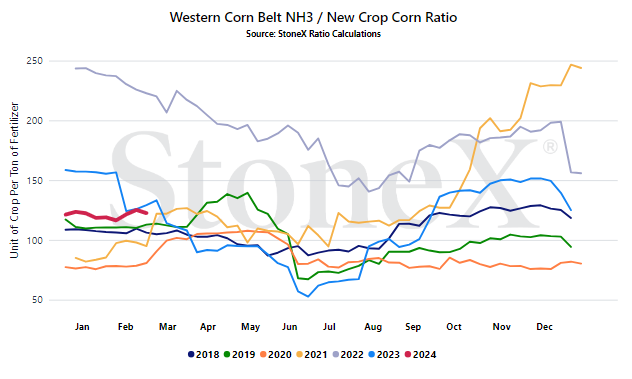
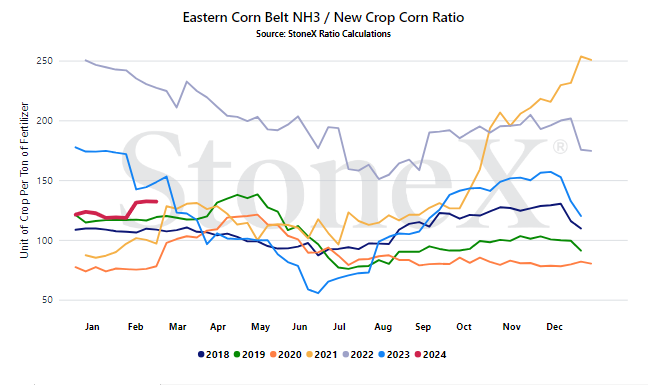
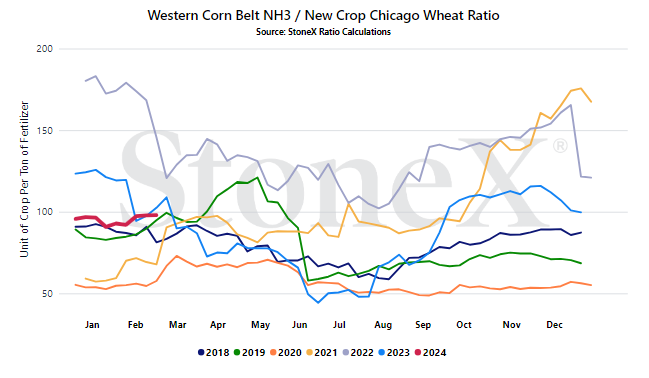
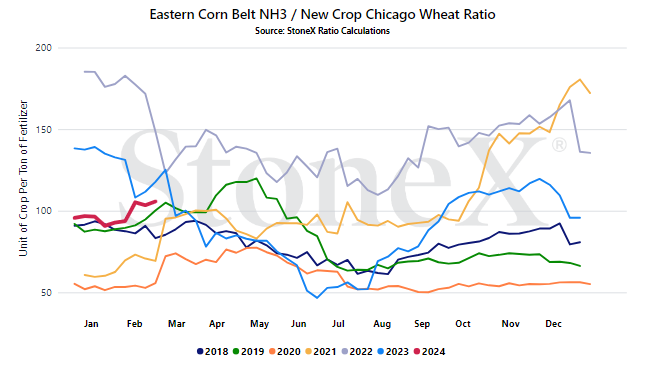
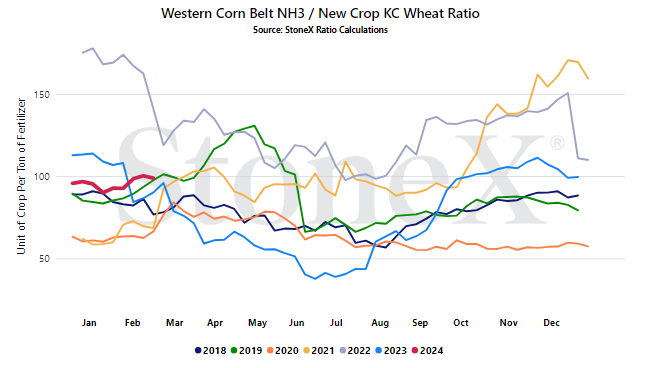
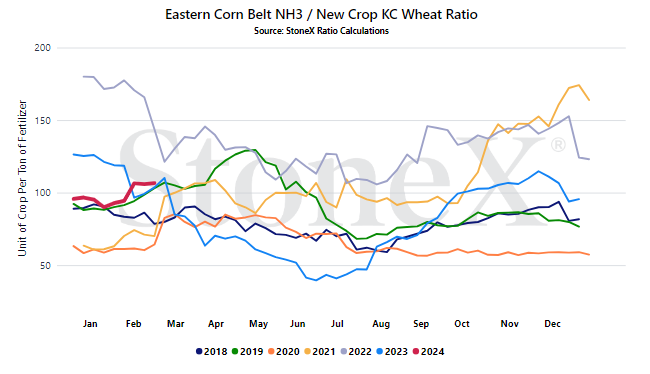
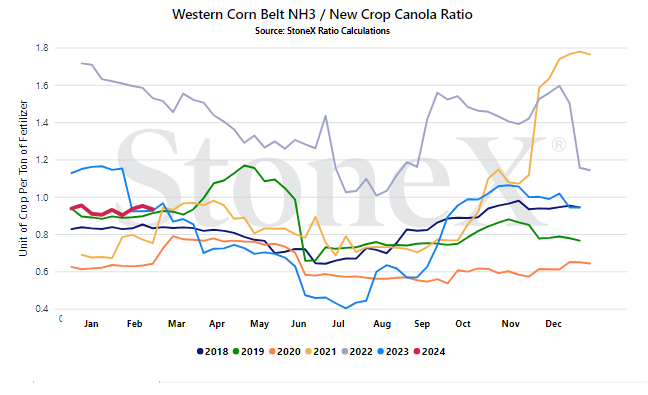
- Large fall run/early spring start for North America - last fall was a huge demand season (3rd biggest since 2000 according to our records) that lasted until mid-December. An on time start to spring (mid-March) was going to be tough to get refilled in time. Mid-February is nearly impossible. North American NH3 market is now going to be in a near constant state of playing catch up with demand unless Mother Nature shuts it down. According to the last forecasts I have seen, that doesn't look likely.
- Grain prices falling - for the nearby, this doesn't matter. Current inventories are simply too tight vs current demand. If manufacturers/distributors cannot fix the S&D on the supply side, they will impact the demand side...and you know how they like to do that. However, looking ahead to summer, the further grain prices fall, the lower the price expectation of the marketplace. Hopefully the corn slippage will stop and turn around, but if it doesn't (and there are plenty of forecasts pointing that way), it should impact price ideas.
- Eventual return of Russian exports - on the global scale, Russia is still to be watched. As the world's typical leading exporter, their being shut from the world hurt supplies. It sounds as though progress continues on their new logistical chains. When they return...well, if they return...it should inject a tremendous amount of product into the world market which should see values lower.
- European production restarts? - I was really hopeful that single digit Dutch TTF values would see the remainder of European production facilities come back online. So far, a couple plants in Romania is all that has been heard. Looking ahead, if we see the rest of the plants online, it should help lower global price ideas as their demand dries up and adds supply to the world. Doubt it would have the same level of impact as Russia returning, but every little bit helps.
StoneX Ratio Calculation
The ratio calculation is derived from Bloomberg historical grains values as well as fertilizer values from StoneX, NPKFAS, and Argus.
The calculation is simply dividing the fertilizer price by each grain price.
All data was sourced from StoneX unless otherwise noted.