Global
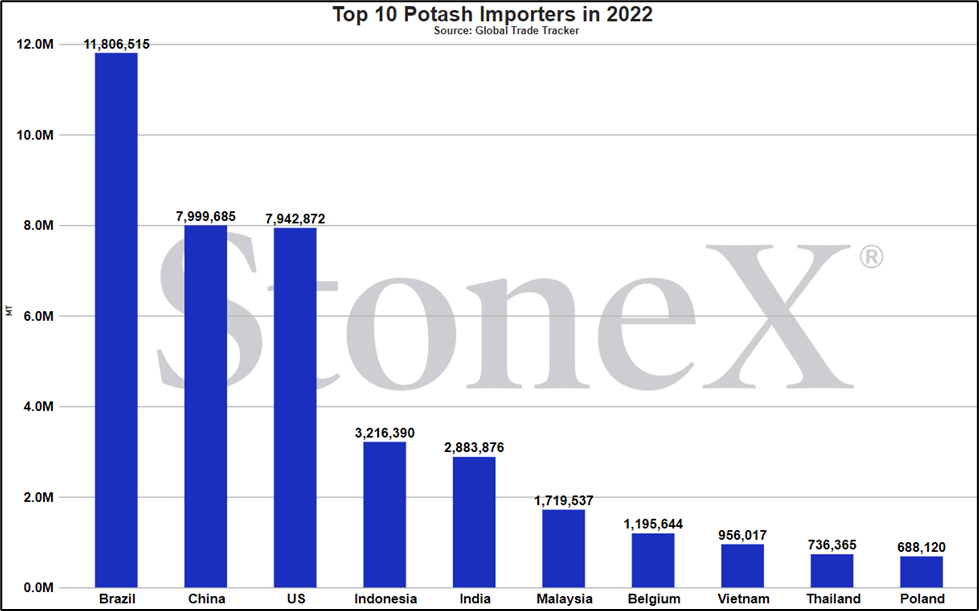
Globally, the market has been quiet in terms of new stories for a while. What I take from that is that there are adequate number of homes for tons being produced to keep tons from sliding but also not so much demand that it is driving values higher. It is in that sweet spot. However, that is exactly what worries me in the next couple months. If demand is in place today and prices are holding steady, what awaits the market if/when demand falls off.
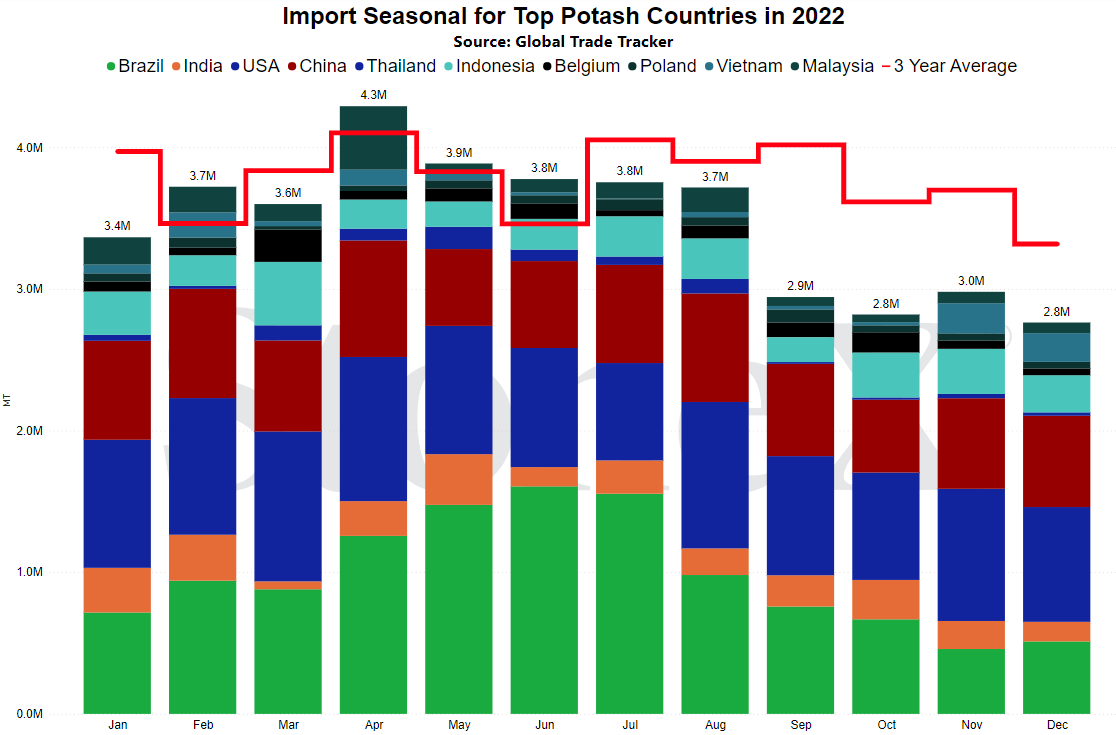
I'm not expecting to see much price movement in the next month but I start leaning bearish going April and beyond as the world market focuses on the annual quiet period.
While a bit away, no doubt large global buyers like India and China are licking their chops on negotiating their annual purchase lower on the back of lower grain values and adequate supplies.
North America
This early spring has thrown the market into a bit of disarray.
We had a great fall run that finally came to an end mid-December. It emptied the system. Typically, spring starts mid-March for much of the N.A. marketplace...but not this year. This year it seems starting to roll in mid-February is the flavor of the season.
Assuming the early start to spring continues, I expect to see replacement values rally. This will have to do with just in time logistics more than the overall market.
What I mean by that is that if the market is playing catch up on replacement tons, those holding tons/trucks/railcars/etc. are more in control of negotiations because they know they hold the power. That typically means higher pricing.
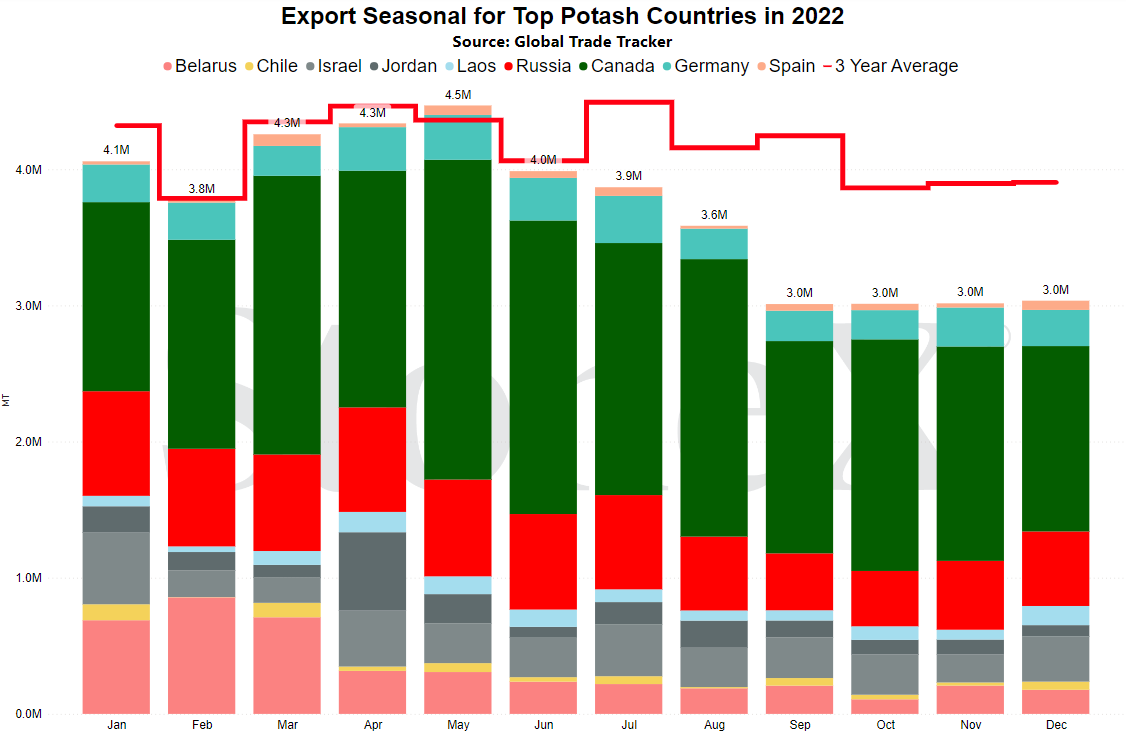
North American spring starts early
At the conclusion of last fall around mid-December, we started talking about how successful the fall run was. The conclusion was that there was only 3 months between the end of fall and the start of spring...if spring didn't start earlier.
Well, it did.
Much of the Midwest has seen applications start VERY early this year...and inventories are starting to show signs of struggling to keep up. While we haven't heard of outright outages, we are already hearing reports of replacement loads taking longer than normal to arrive. Honestly, that is to be expected. 60 days simply is not enough time to refill the entire system.
I have had some push back while saying "if the fall run was so big, there shouldn't be that much demand left for spring". Yes...and no.
On the yes side, for those that got their fields done in the fall, they couldn't care less what is going on today. Unfortunately, there are still many who do not put product on until the spring. This might be a local government regulation situation. This might be that renters didn't know they had the ground until the end of year/New Year period. It might be that the economics were relatively poor so some opted to wait to see if it improved. Regardless the reason, there is plenty of demand remaining in the spring season.
One thing to keep in mind is that if a widespread moisture event rolls thru the Midwest, it will shut the farmers out for a while. It is still late February/early March. Even with warmer temperatures than normal, it still takes a while to dry the soil. The sun simply is not intense enough to make short work of it.
This early spring should be an education on fertilizer logistics. This is certainly not something we can expect every single year, but it does show just how precarious it can be.
Fall corn values impact potash affordability
Unfortunately, corn and other grains have seen values declining rather rapidly. While some are hopeful that this is being caused more by record shorts by funds rather than actual fundamentals, the price fall is hard to ignore in either event.
This has absolutely impacted the affordability for potash.
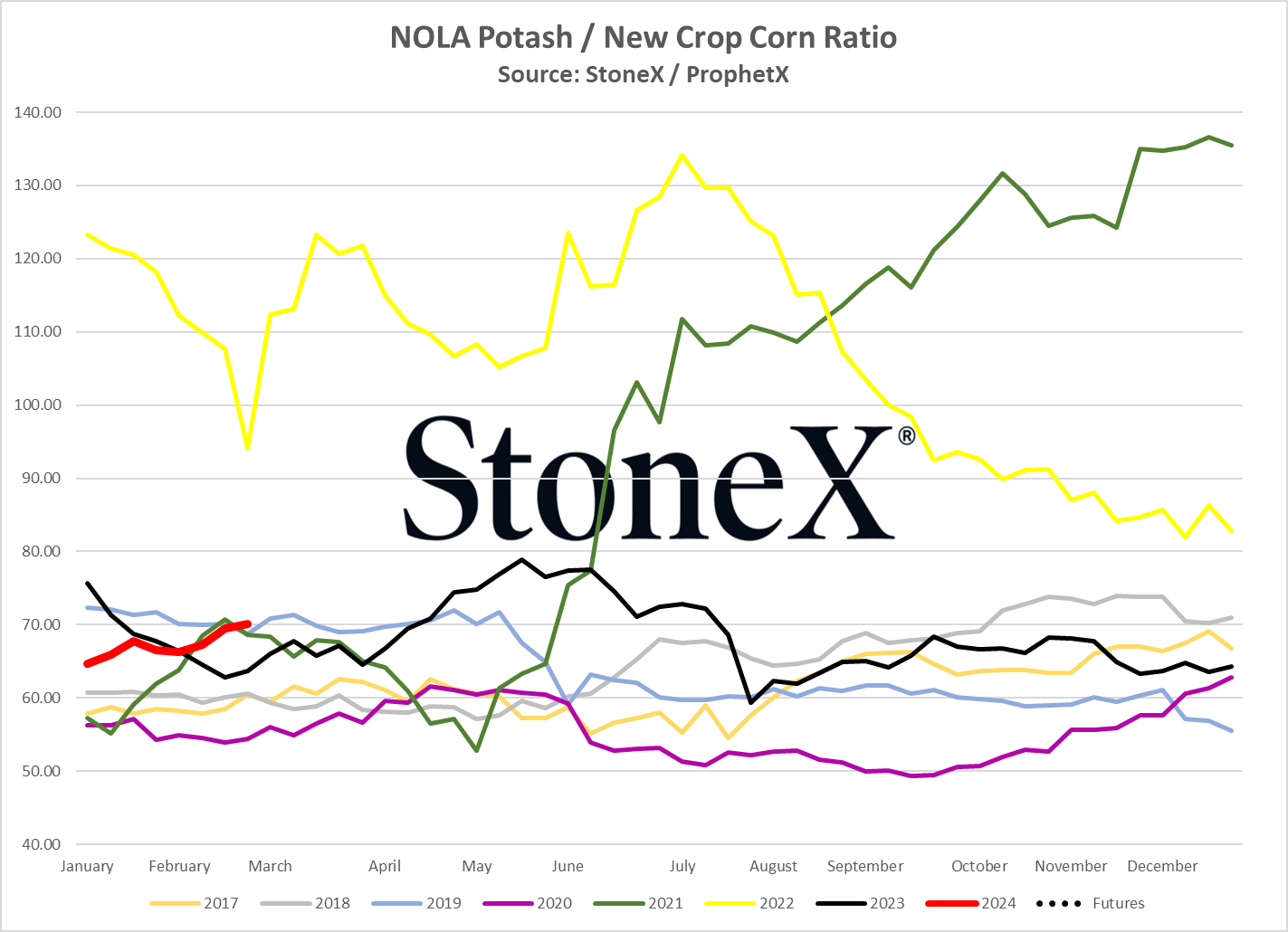
The potash/corn ratio started the year relatively well priced. When compared against recent years, the ratio between the two was in line with the last 7 years (excluding 2022). Since that time, the potash value has been relatively unchanged...but corn hasn't been. After December 2024 corn spent so much time in the $5.10 - $5.25 range, we saw it collapse to a low of $4.45. That pushed the ratio to 71 bushels of corn per ton of potash.
Since that low, we have seen a couple days of improvement in corn values which has helped to lower the ratio, but a lot of the damage is still there.
This is a great point of why we discuss fertilizer value in terms of the grain price. Potash affordability went from decent to high without moving a single dollar. This is why we think looking at the input and output at the same time is a very powerful tool to bring value to the farm.
That said, I really hope in the next couple months the corn price skyrockets and potash values remain low. However, with a lot of models I have seen, I'm not holding my breath that happens.
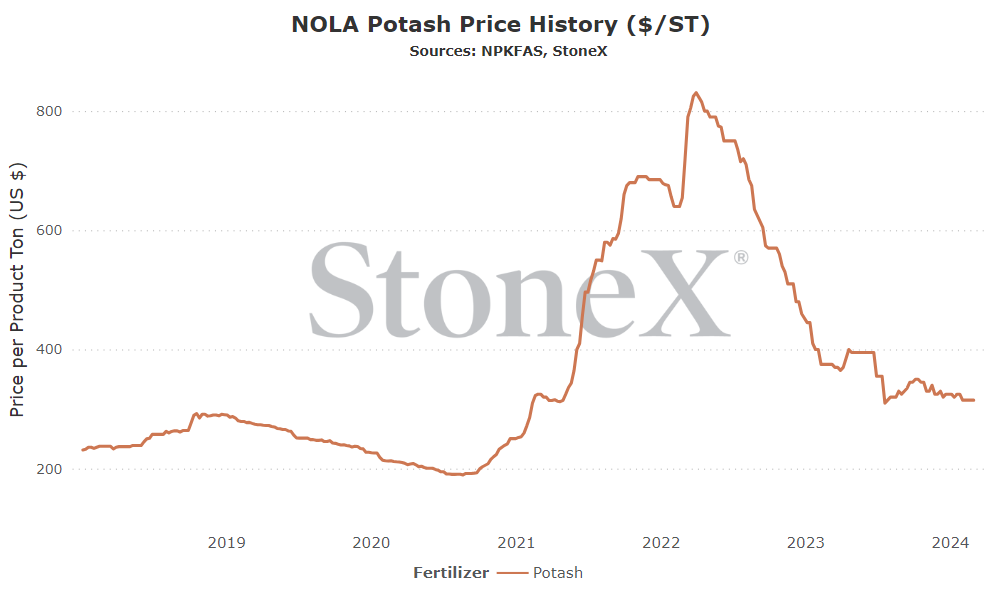
NOLA/New Orleans Louisiana
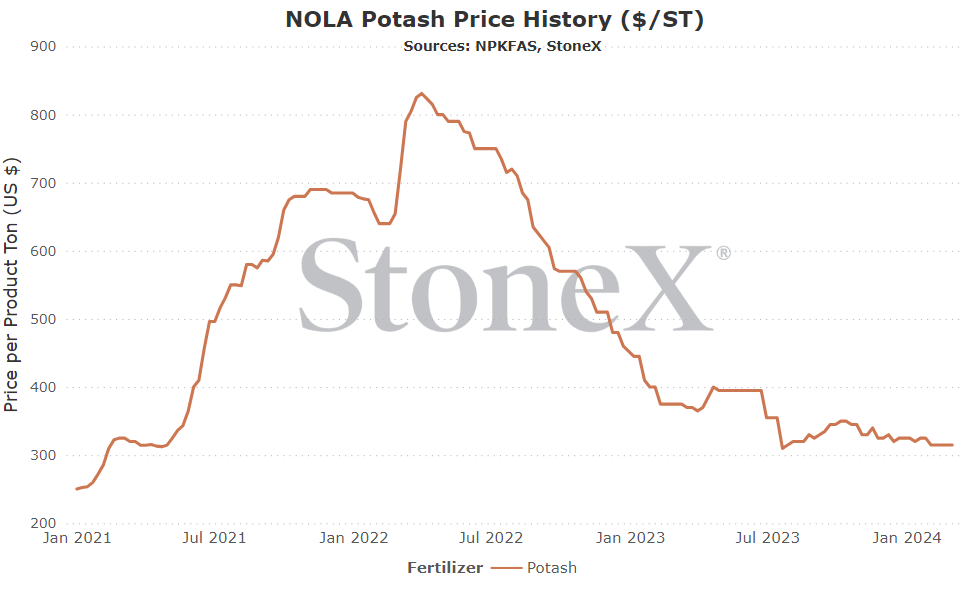
Vs 30 days ago - unchanged vs last month
Vs 90 days ago - -3% or approximately $10 lower
Vs 6 months ago - -5% or approximately $15 lower
Vs 1 year ago - -16% or approximately $60 lower
U.S. Midwest Average (average of several points across the Midwest)
Vs 30 days ago - unchanged vs last month
Vs 90 days ago - -8% or approximately $35 lower
Vs 6 months ago - -3% or approximately $11 lower
Vs 1 year ago - -14% or approximately $63 lower
- Early start to N.A. spring season – this early start to spring was the worst case scenario for those hoping potash values would hold or fall. 2 months between fall and spring simply is not enough time to prepare and now the market is playing catch up. If this continues, it will turn into an auction for every load.
- Just in time demand will start meeting just in time supply - much of the market has struggled with what to do. Farm incomes are hurting after a few decent years. That isn't anyone's fault, but it does mean that remaining spring demand is taking a just in time approach. This just tags onto the above bullish point.
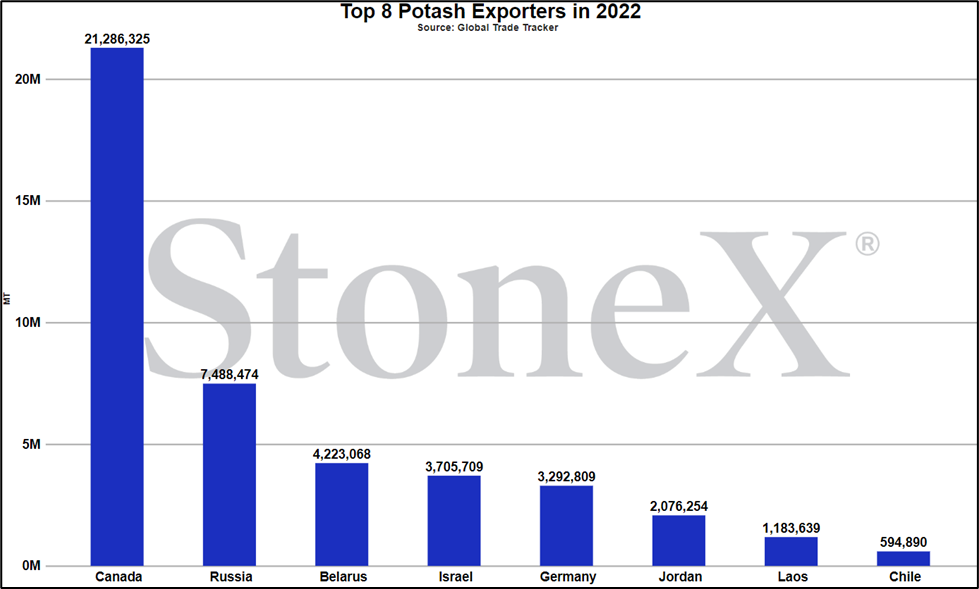
- Increased sanctions on Russia – I'm going to start with saying I do not think this happens. We have seen some get excited that the recent political assassination in Russia will mean Western sanctions against Russian fertilizer. Fertilizer was not included when they invaded Ukraine which resulted in hundreds of thousands of lives lost. Why would a single assassination tip the scales? Still, if I am wrong and sanctions are put into place, it would remove one of the world's largest exporters.
- Falling grain prices causes buyers to back off – corn values have fallen a tremendous amount right before the start of spring/planting. We could easily see some farmers decide to either cut their application rates or switch to a less intensive crop. If this mentality sets in, no doubt it will hurt demand expectations.
- Poor weather sets in, shutting down applications - just because we have started early does not mean we are going to have a great spring. We could easily see cold/wet conditions set in, keeping folks from getting into the fields. It wasn't long ago that much of the north and east dealt with this thur April and then watched as farmers opted to plant rather than apply.
- Fear of summer resets beats excitement of spring bounces – right now, we seem to be far enough away from mid-April that few are talking about selling off positions. However, this thought will likely start to creep into the minds of some distributors. If someone starts to feel they will be too long, they could start to drop price to clear positions. If others start to follow, it starts the trend. Likely more a late March/early April situation but one to watch for regardless.
We believe that only looking at the flat price of either grains or fertilizer can be misleading:
-
Only selling grain can hurt you if fertilizer prices rise substantially
-
Only buying fertilizer can hurt you if grain prices fall
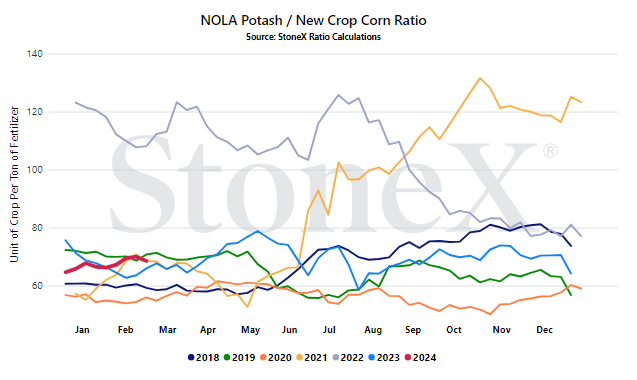
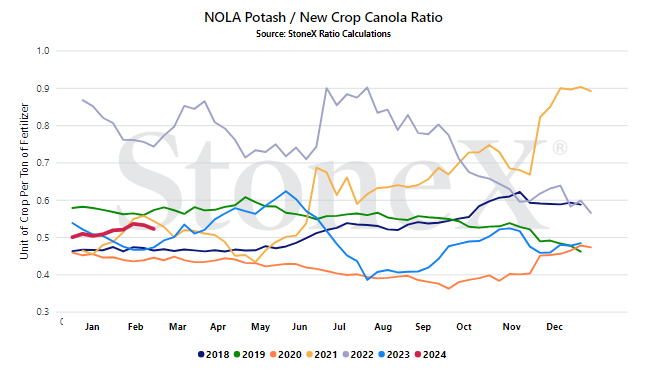
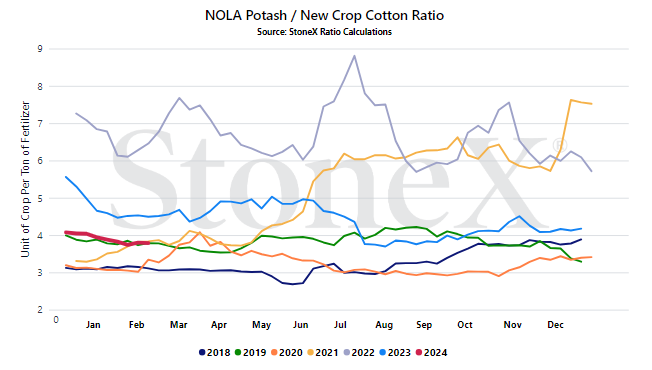
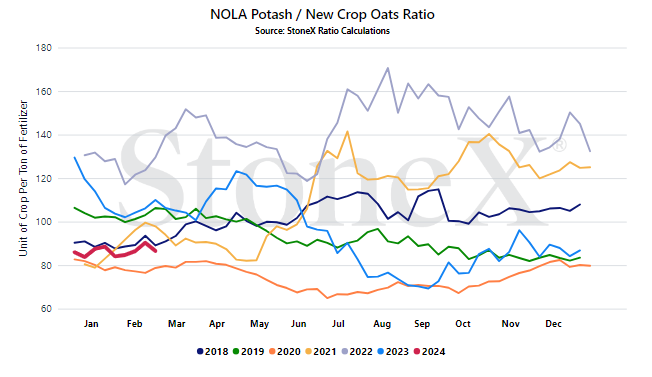
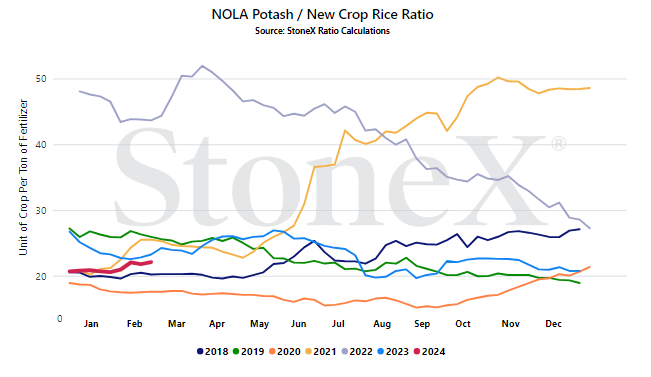
We look at the ratio "value" to get a better indication of where we are or how many bushels of X does it take to pay for 1 ton of fertilizer.
Would you rather:
-
Spend 120 bushels to pay for 1 ton of potash
-
Spend 60 bushels to pay for 1 ton of potash
When we compare the current ratio value against recent years, we start to see if we are high or low.
YOUR VALUES MAY LOOK DIFFERENT
This graph looks at the NOLA potash price vs the flat grain price. There are no logistics on either product. Your location will look different due to fertilizer logistical costs, grain basis, etc.
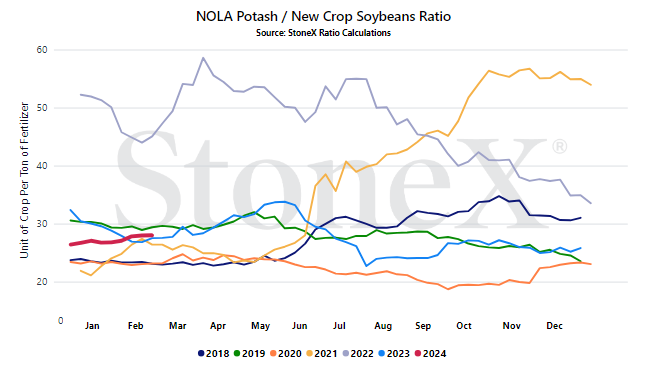
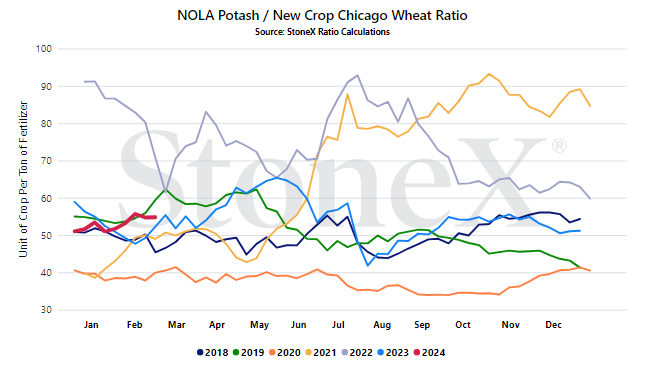
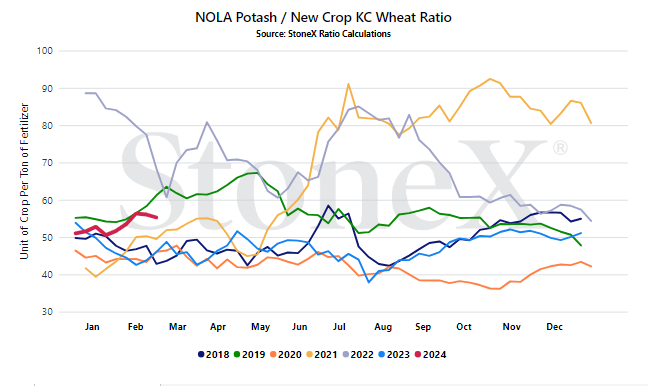
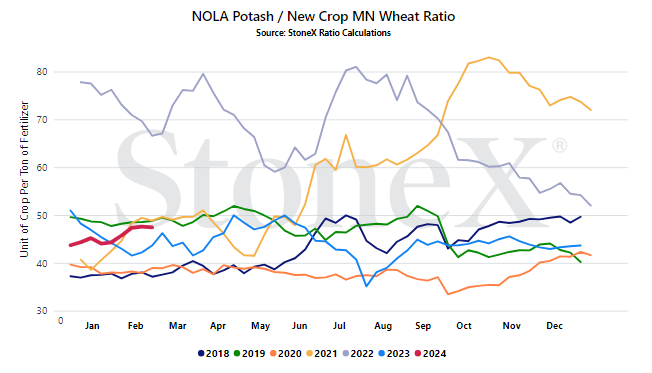
- Grain values - a lot of grains have been struggling of late and a lot of models are not showing it getting better in the near term. If grain values stay lower, or go lower, we could start to see demand destruction either in the form of acres switching to something less potash (and other fertilizer) intensive or reducing application rates. This is especially prevalent in "fringe" acres (those that were not corn prior to the ethanol boom).
- Russia - while it doesn't seem likely that the west will sanction Russian fertilizer (it knows that it needs it), it isn't completely out of the picture. Consider it another low probability/high impact situation. Russia is simply too large an exporter of potash for it not to matter.
- Early spring start / logistics - North America has been taken by surprise on this early start. The longer it goes, the more bullish pressure it will have on delivered prices. However, it can quickly turn cold/wet and shove everyone out again. Mother nature can be fickle.
StoneX Ratio Calculation
The ratio calculation is derived from Bloomberg historical grains values as well as fertilizer values from StoneX, NPKFAS, and Argus.
The calculation is simply dividing the fertilizer price by each grain price.
All data was sourced from StoneX unless otherwise noted.