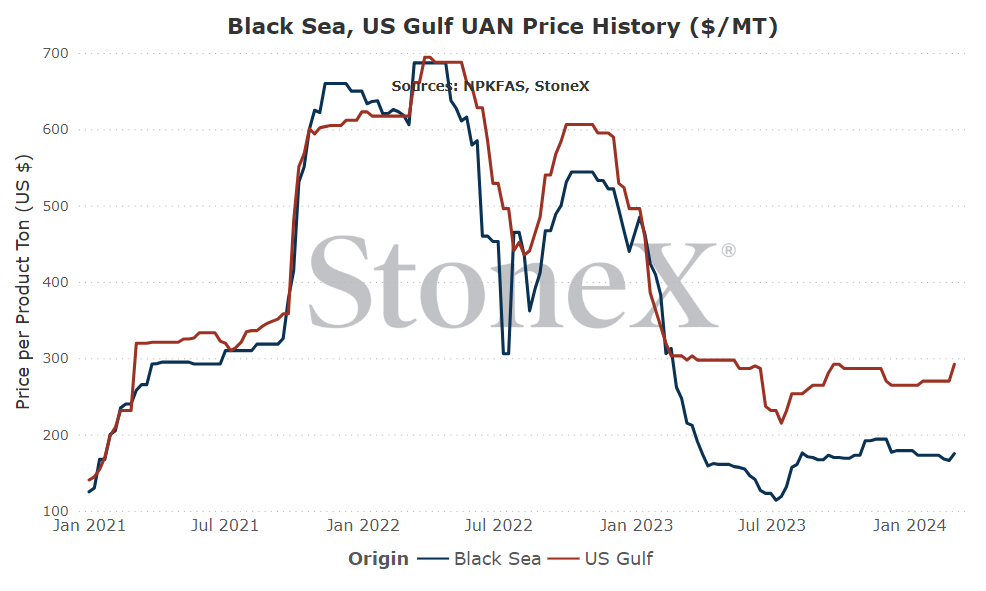
The intention of the below graphs are not to use to say "my price should be X based on this graph". These prices are derived from an FOB price point average. The intent is to show major global price movement trends. Your values will likely have significant basis difference (similar to your local grain price being different than the traded market price).
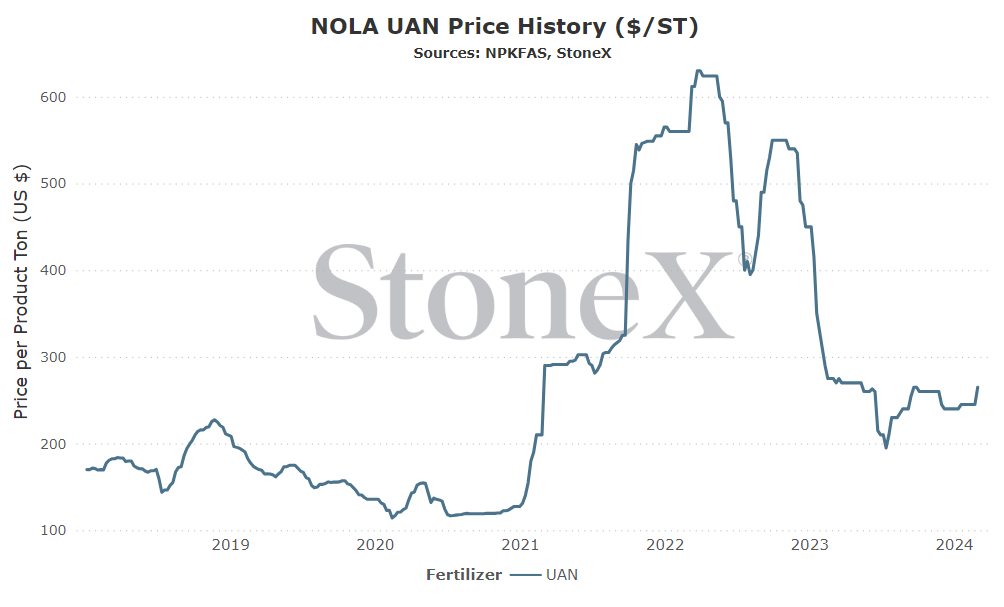
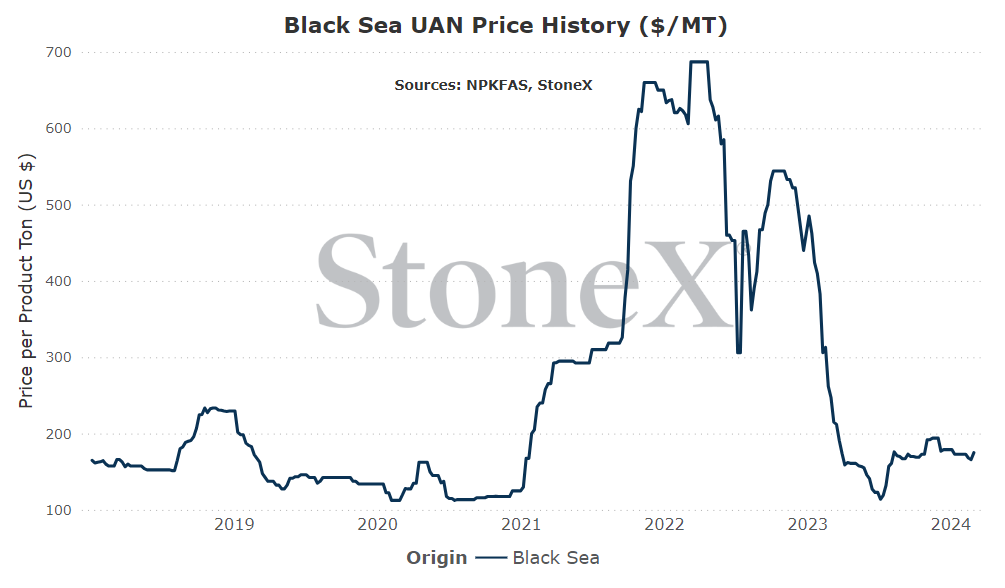
This graph is labeled as MT in USD currency.
|
European outlook improving...but will it matter?
As we have discussed so...sooo many times over the last several months, the European outlook continues to improve. This month, I'm thrilled to say that Dutch TTF values have fallen into single digits with nearby months trading in the $7 - $8MMbtu range! That is fantastic for cost of production and should mean that more nitrogen production is coming online, right?
Not so fast.
Unfortunately, there are still a couple sticking points.
First, the political tension in Europe continues to rise as governments try to tell farmers what they can/cannot do. In response, farmers are protesting in a very big way. None of this builds the confidence of an offline nitrogen production facility to trust what is coming.
Second, the remaining offline plants are likely very old. This does not mean that they cannot come back online. It merely means that it is much tougher to do and if you are going to proceed, then you better have strong conviction that the plant isn't going to be taken offline again in the near future.
Sadly for buyers, we are still forced to sit and wait for news which may or may not come. In fact, even if a plant restarts, it would be in the best interest of the owner to be quiet about it. If you are vocal and tell the world, you are basically saying "I'm creating a lot more supply for the world". Doesn't exactly sound bullish, does it?
Hopefully one of these months in the near term we can report that the remaining plants are online. Today just isn't that day.
Early start to North American spring testing UAN
Whoever had "spring for most of the Midwest will start mid-February" on their bingo card, please step forward!!!
The much earlier than normal start to spring has caught the industry off guard and has caused values to jump as a result. Nitrogen has been interesting from my POV. I understand why phosphate and potash would rally. Those are early application products that have no problem sitting there until they are needed. Even NH3 I can understand if stabilizers are applied to hold it in place until spring. However, UAN doesn't seem as though it will be any earlier.
That said, it doesn't mean the demand isn't there. We continue to see/hear that moisture conditions are exceptional compared to recent years in the south so many believe that demand will be solid. Then, we are seeing NOLA urea values rising in an attempt to move to parity/higher than world replacement to get imports flowing. If urea is moving higher, why wouldn't UAN follow?
In the end, UAN is moving higher. We are not only seeing that but also hearing that price programs are being pulled from time to time to "recalculate". That is a fancy way of saying "we have sold a lot of product and need to make sure we cover the sales and then push higher". Inventories are tighter than expected by many in the industry so do not be surprised if this story continues to be discussed next month.
NOLA/New Orleans, Louisiana
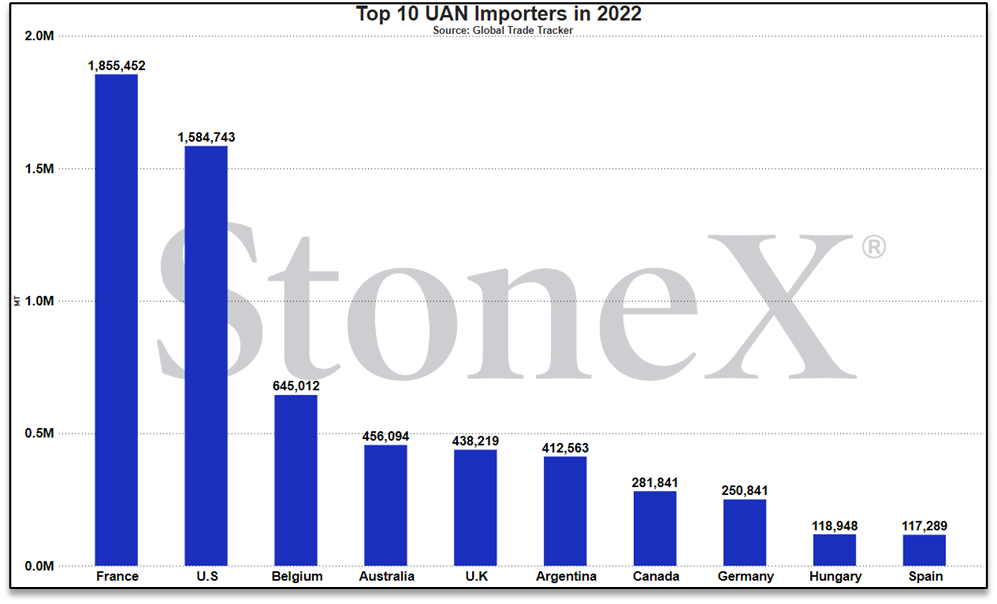
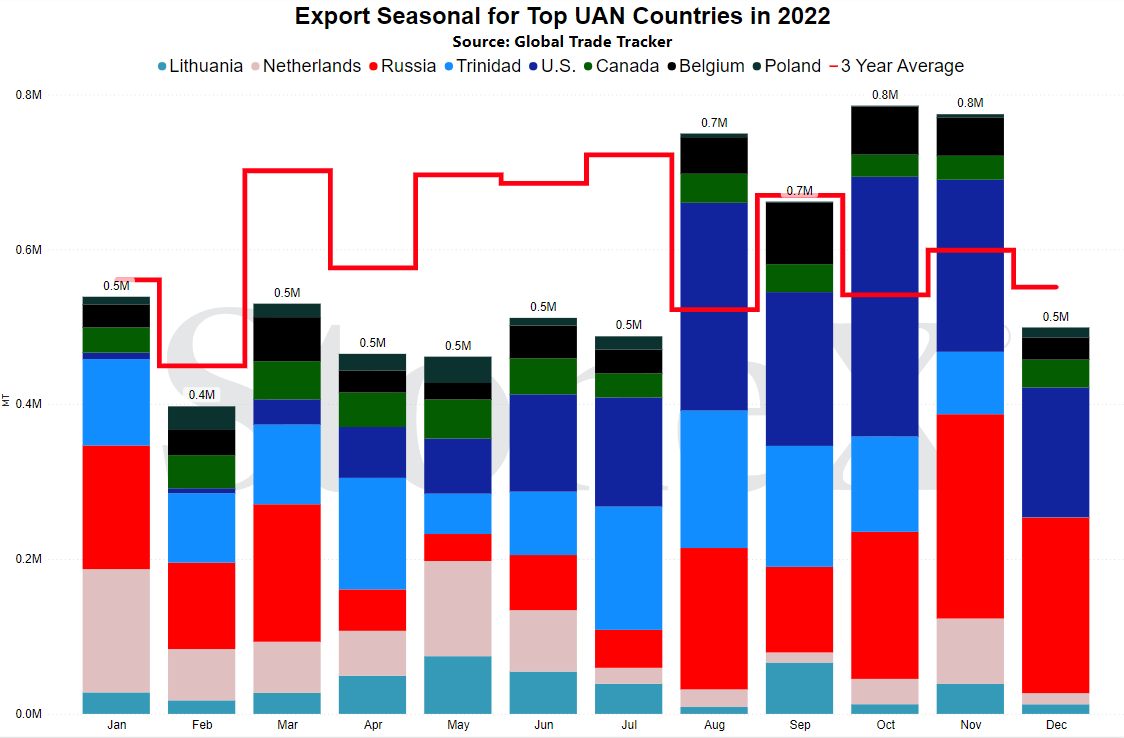
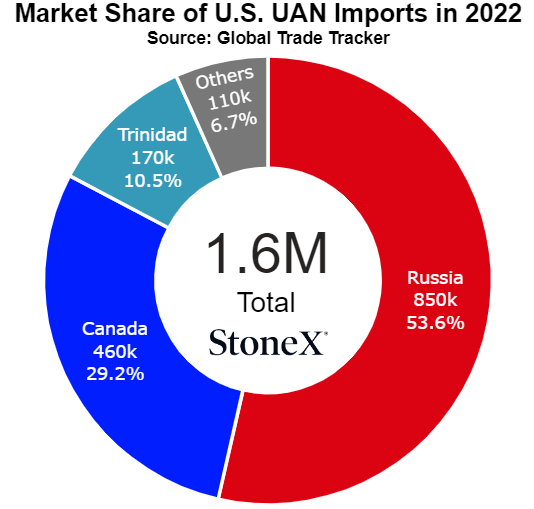
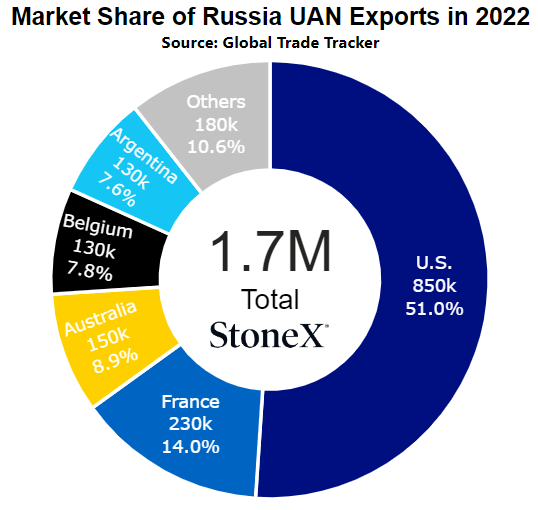
Number 2 global importer in 2022
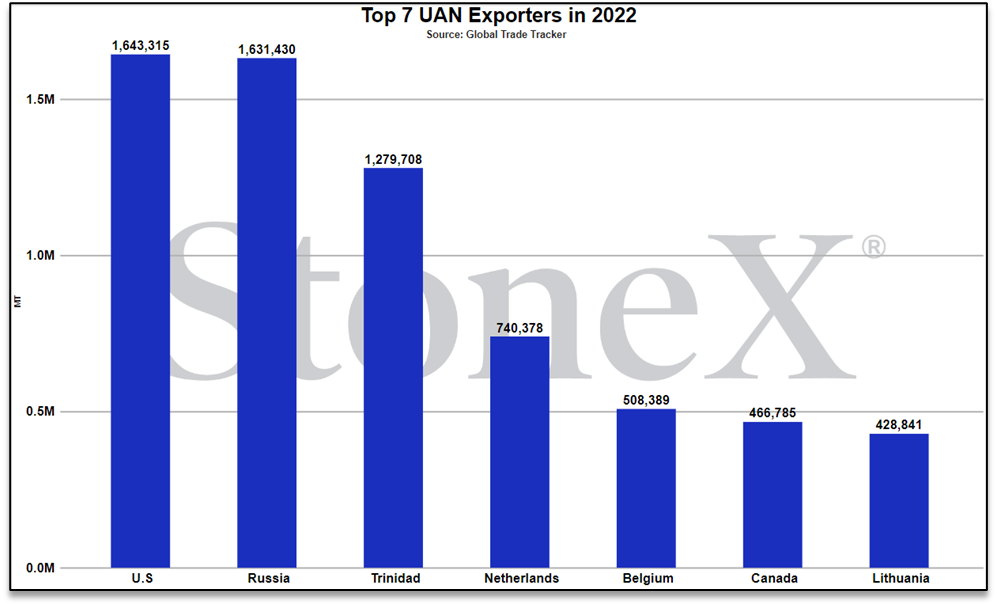
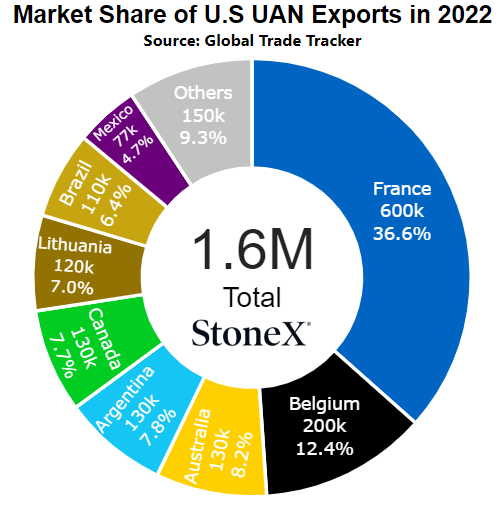
Number 1 global exporter in 2022
Price Comparisons
Vs 30 days ago - +8% or approximately $20 higher
Vs 90 days ago - +2% or approximately $5 higher
Vs 6 months ago - +10% or approximately $25 higher
Vs 1 year ago - -4% or approximately $10 lower
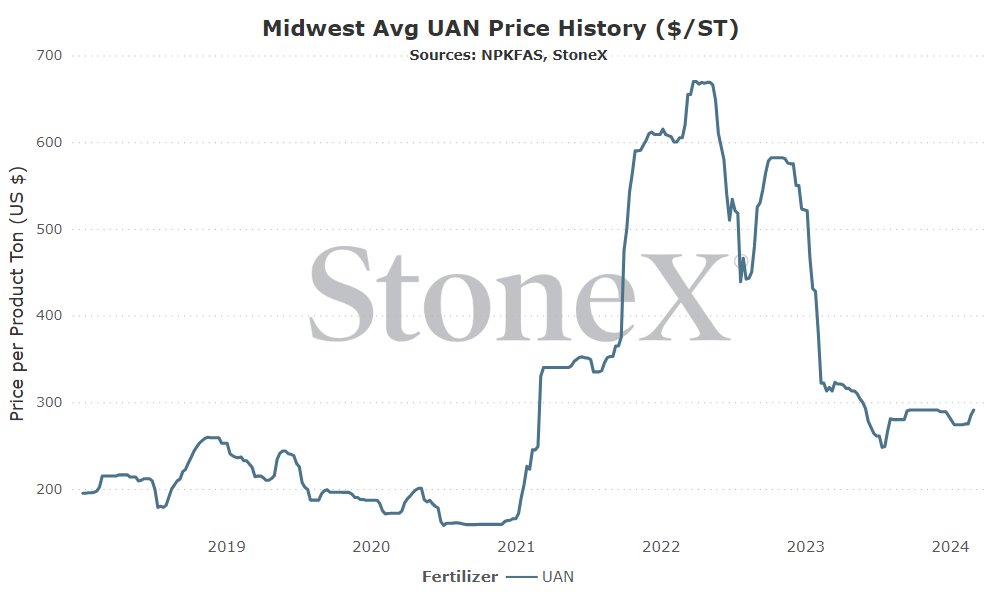
U.S. Midwest Average
Vs 30 days ago - +7% or approximately $18 higher
Vs 90 days ago - unchanged vs 3 months earlier
Vs 6 months ago - +4% or approximately $12 higher
Vs 1 year ago - -8% or approximately $26 lower
Black Sea (Russia)
Number 2 global exporter in 2022
Price comparisons
Vs 30 days ago - +1% or approximately $2 higher
Vs 90 days ago - -10% or approximately $19 lower
Vs 6 months ago - +3% or approximately $5 higher
Vs 1 year ago - -29% or approximately $72 lower
- Urea being bullish – for the time being, UAN is playing catch up to urea strength. While manufacturers want to stay engaged in the UAN marketplace, they will also look for opportunities to follow other products higher. Urea is currently on a tear higher so makes sense that UAN follows.
- North America tight starting inventories/production issues – we knew at the start of the fertilizer year that inventories were low. We also figured that exports would remain strong and some production issues would occur. However, we didn't anticipate imports being slightly lower and production issues bigger than forecasted. Inventories are tight and that is generally reflected in values.
- NH3 struggling to keep up with demand – because last fall lasted so long and ended so late, inventories were low. Then, spring season is starting earlier which is making NH3 struggle to keep up. If we suddenly see planting early, it largely means NH3 is done. If NH3 finishes short of forecast, it could cause a last minute demand bump for UAN...so last minute that it is too late to do anything about it.
- Fear of the summer reset could have sellers stepping forward – this is going to be a tough balancing act. On one side, the UAN market is bullish and manufacturers/distributors want to take advantage. However, at some point, a sale needs to be made to make sure they do not carry product too long. The higher the price goes, the bigger the reset coming. That fear of carrying product too long could cause folks to sell earlier and lower than expected.
- Falling grain prices could shift acres/demand – last spring, we went into it expecting 92M acres of corn and ultimately ended north of 94M. That was a BIG boost to nitrogen demand. This year, we continue to estimate 92M...but there are a lot talking about switching due to poor corn values. The market is preparing for 92M but if it drops a couple million, those tons will be sitting around with nowhere to go.
- Europe restarting – while it still doesn't seem largely likely, there is still a chance. If we see the remainder of Europe restart, that means it no longer needs imports. North America has been a big provider of product. If that avenue gets shut off, those tons get shoved back into the market. That is a great recipe for lower values.
We believe that only looking at the flat price of either grains or fertilizer can be misleading:
-
Only selling grain can hurt you if fertilizer prices rise substantially
-
Only buying fertilizer can hurt you if grain prices fall
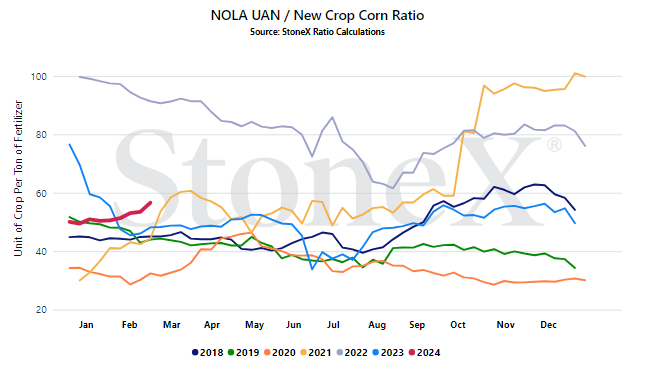
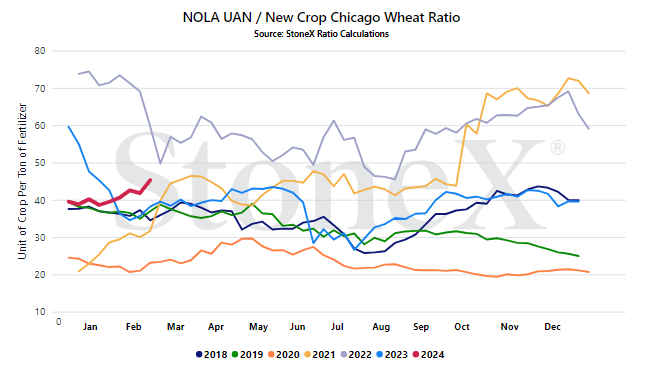
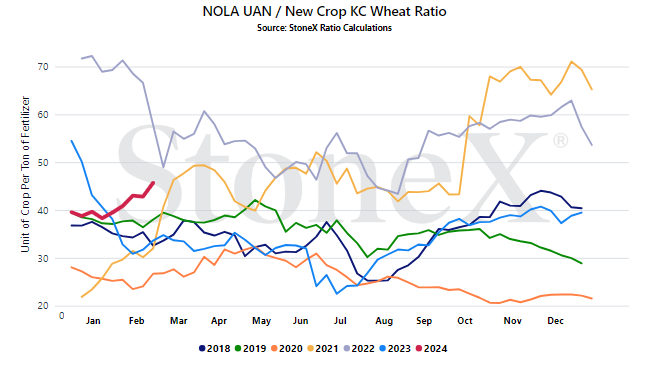
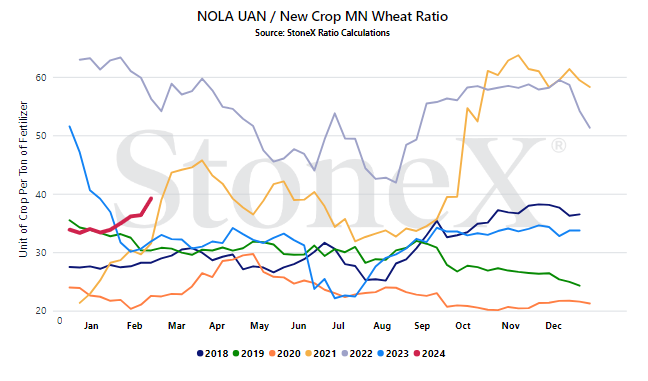
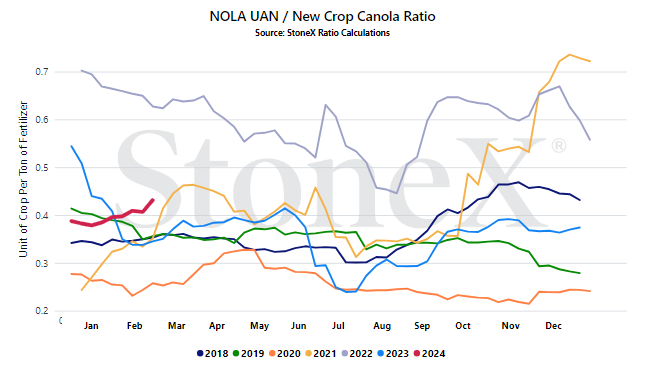
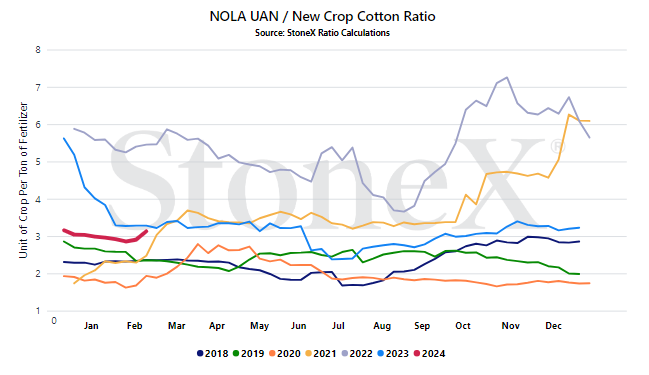
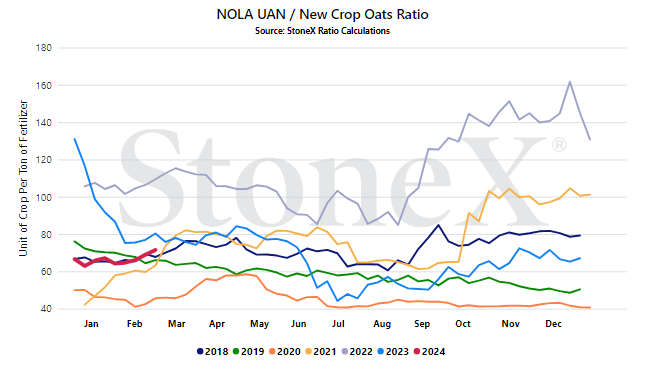
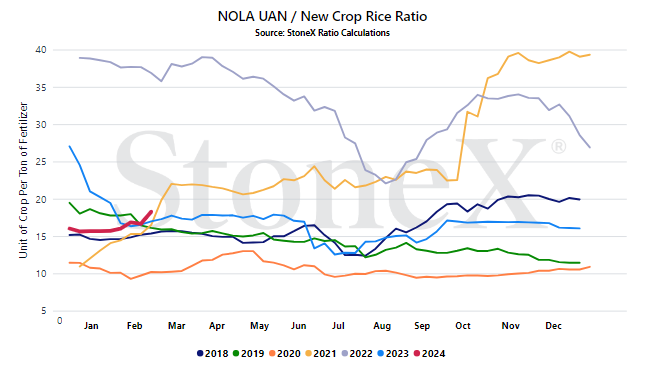
We look at the ratio "value" to get a better indication of where we are or how many bushels of X does it take to pay for 1 ton of fertilizer.
Would you rather:
-
Spend 100 bushels to pay for 1 ton of UAN
-
Spend 60 bushels to pay for 1 ton of UAN
When we compare the current ratio value against recent years, we start to see if we are high or low.
YOUR VALUES MAY LOOK DIFFERENT
This graph looks at the NOLA UAN price vs the flat grain price. There are no logistics on either product. Your location will look different due to fertilizer logistical costs, grain basis, etc.
- Urea values - if urea continues to push higher, it makes sense that UAN would follow. If it doesn't, then a huge amount of demand will switch from urea to UAN and cause inventories to shrink. Unfortunately, that is how free markets work. With urea being the more and widely produced nitrogen, it largely sets the pace for all nitrogen products.
- European production - if Europe were to restart their offline plants, it would mean they no longer need imports from North America. What happens if North America suddenly gets a lot of UAN pushed back into its lap? That's right, they have to compete to make it disappear. That is good for the buyer.
- Grain values/fear of summer - as grain prices continue to fall, it makes UAN look higher and higher priced. Hopefully the worst of the price falling is behind us, but some forecasts are not reflecting that. Distributors/manufacturers need to be weary that demand can dry up and to stay ahead of moves or risk carrying it into the dreaded summer reset period.
StoneX Ratio Calculation
The ratio calculation is derived from Bloomberg historical grains values as well as fertilizer values from StoneX, NPKFAS, and Argus.
The calculation is simply dividing the fertilizer price by each grain price.
All data was sourced from StoneX unless otherwise noted.