Global
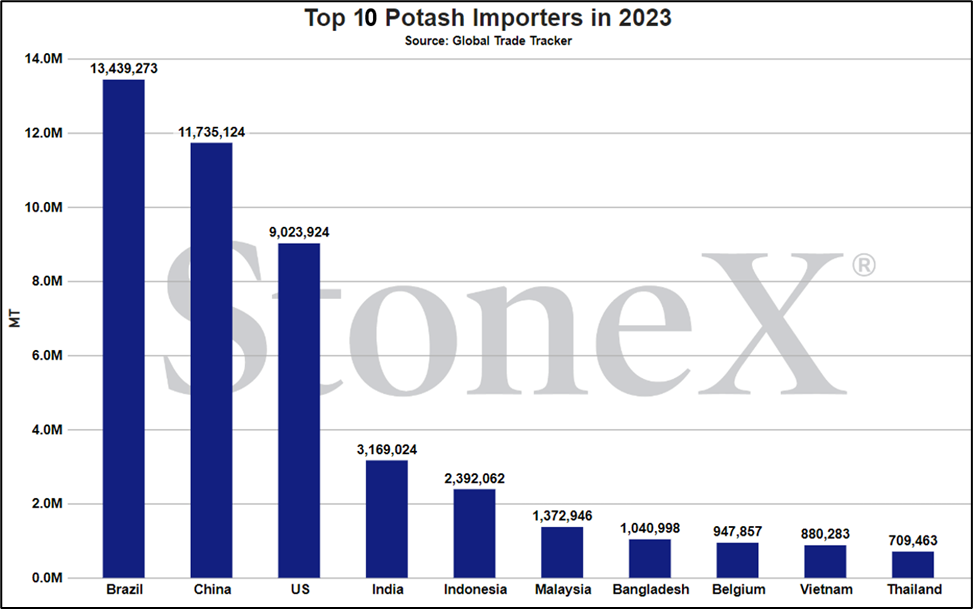
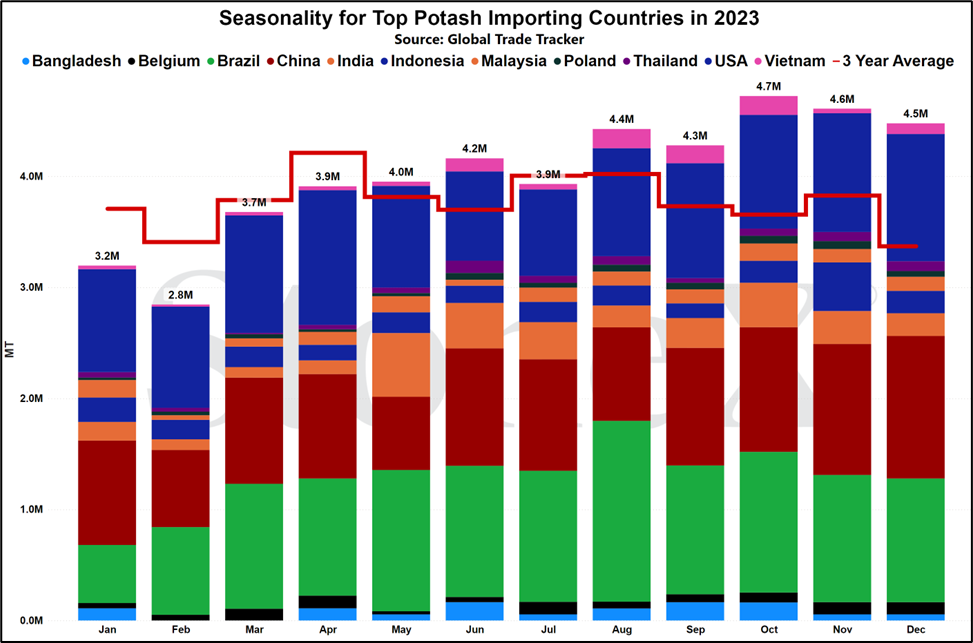
Globally, not much has changed. Supplies continue to look sufficient in the face of solid demand. The further we look out into the future, the better that S&D looks for the buyers. Russia and Ukraine appear to be taking reluctant steps toward peace which could end with Belarus returning to former export glory. Expanded production continues to be expected in Canada/Russia/Laos. Global demand is certainly expected to grow at a somewhat constant pace, but supply growth appears to be outpacing it.
My outlook for global potash remains relatively stable to bearish on ample supplies. We could certainly see manufacturers decide to scale back production to limit supplies and support prices, but if the market is allowed to grow naturally, the S&D gets looser. That is a win for buyers.
North America
Well, I cannot get them all right. Last month, I thought we would see potash continue to be stable to lower on ample supplies. However, I missed several things:
- The fall run was later which means less time between its end and beginning of spring. Effectively, more pressure on logistics to get inventories filled.
- The fall run was solid which means lower ending inventory levels. More empty space means more opportunities for manufacturers/suppliers to sell.
- Potash was well priced vs historical values.
- Potash was well priced vs grain values.
- Spring demand has been growing with increasing corn acres in forecasts.
However, here is where I’m a bit upset that I was wrong. If the market rallied because of all those factors, I would have happily taken the L (as my youngest likes to say). However, it wasn’t that. The reason for the bullishness…confusion and fear regarding U.S. / Canada threats. That was the reason. Manufacturers raised pricing on the back of that uncertainty.
Regardless of the reason, values rose.
For the short term which encompasses spring application (most should be done by planting), prices should be stable to higher on solid demand and buyers waiting for the last minute (just in time logistics cost more). However, once we get past spring application, I think the market will struggle to hold gains. There is a long period between the end of spring applications and fall demand. That is a long time for the market to sit and ponder. With farm profitability forecasts not looking great, I doubt farmers will be jumping up and down to start purchasing inputs for the 2026 crop…

N.A. tariff fears drive prices higher, fundamentals better reason
Potash has been a very interesting market to watch since the start of 2025. Rightfully so, it has been one of the major discussion points surrounding President Trump's tariff threats against Canada. With a huge portion of U.S. potash demand met by Canadian supplies, it made perfect sense to be highlighted and made for an extremely easy talk point in the market.
There was a ton of confusion and fear surrounding these tariff's. Simply put, no one in the industry knew what to make of it. There was, of course, the question of whether Trump would proceed with putting the tariff's in place. POV's painted a whole range of thoughts. Then there was the question of "who pays it".
U.S. officials were right in saying that Canadian exporters would be the one paying. Whichever company handled moving the product across the border, they would be liable for cutting a check to the U.S. From that perspective, Washington D.C. officials were not lying.
However, those checks would be paid using U.S. farmer money.
Very quickly after the story became a discussion point, we started to hear a subtle change in sales contracts. The price was agreed upon but there were new lines basically stating that the buyer would be charged for any and all tariff penalty.
During this period, confusion and fear were the primary drivers...and sellers took advantage. Suddenly, price increase announcements were made and with so much energy being spent on trying to figure out the tariff thing that the increases were largely accepted. This was disappointing but not surprising.
I am not a fan of trying to take advantage of a situation like that, but I do agree with the move higher. My reasons had a much more "fundamental" reason behind them.
First, the fall season was good. While most areas did not start "on-time", most farmers got an opportunity to spread potash. The result was a lot of inventory being drawn down and a lot of storage being empty and in need of resupply.
Second, the fall season was late. The first several weeks of November were too wet for farmers to get into the fields. It wasn't until the week of Thanksgiving that many got their first chance. Fortunately, weather cooperated and gave a great period to apply until nearly Christmas. The issue with that is running until nearly Christmas reduces the time to resupply before spring. The market was only left with January/February/early March to resupply.
Third and last, demand is rising just before spring. Corn acres have been rising across most estimates, ourselves included. We started the year at 92M and quickly jumped to 92.5M just before my family and I went on vacation. I wasn't gone a week and we were higher at 93.5M with a lean higher. Some estimates place the acres in the 94 - 96M range. That feels a bit high today, but when you look at the factors, it makes some sense.
Long story short, every one of these additional acres increases the demand for potash with little time to prepare. Fortunately, flows across the U.S. / Canada border jumped significantly on the tariff fears. Shippers tried to slam product across the border before any tariff rates were approved. We believe most of the product that is needed for spring has crossed the border and even if tariff's are put into place, it becomes more of a summer situation. However, if corn acres continue to rise, demand will rise and may require even more product to arrive that could be subject to these rates.
This is a story that we will not know much about until after it has happened.
What does this mean for farmers?
Unfortunately, it means that potash values are likely rising or set to rise at the retail level. As demand grows and the calendar window closes, it increases the chance that prices will rise.
It doesn't guarantee it, but it does set the stage.
Long term outlook remains well supplied
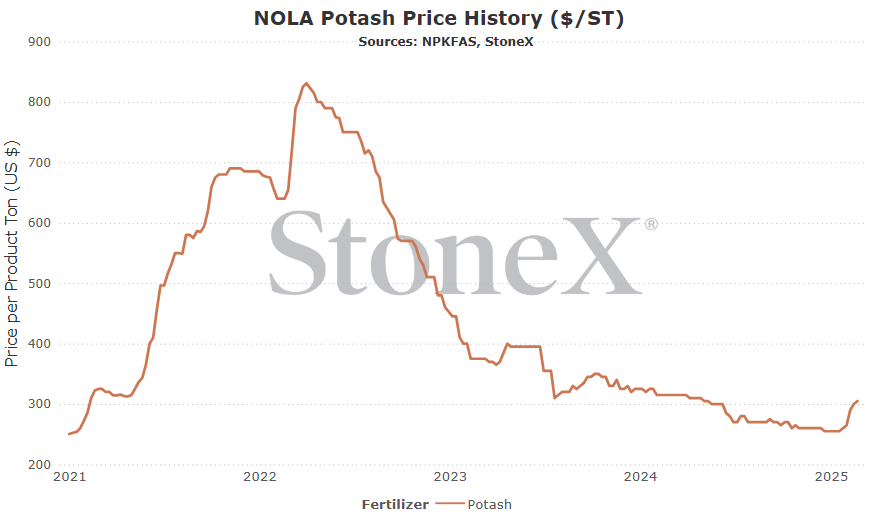
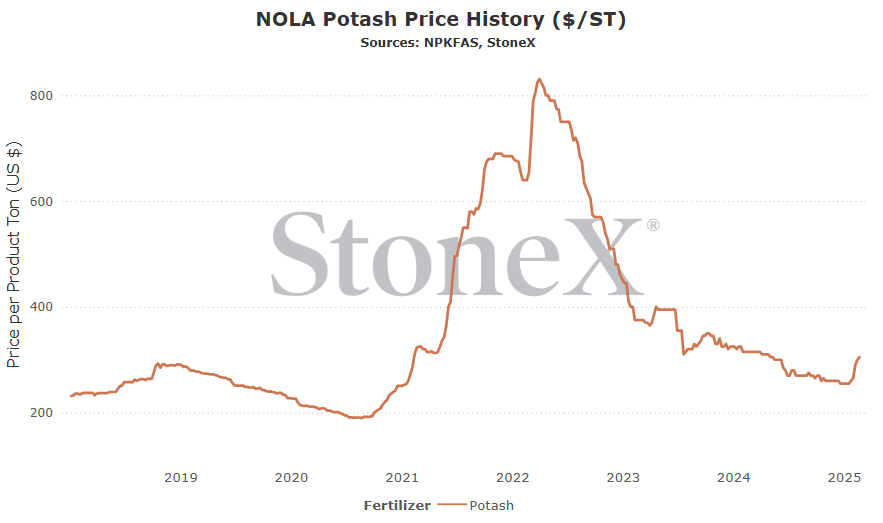
After month's of bearish/flat/boring potash markets, the last month has finally seen activity with prices moving higher. A lot of this is linked to tariff fears. More of it should be linked to the fundamental reasons that quickly lined up to start 2025. Regardless, prices have appreciated for the first time since early 2022.
However, that does not change the longer term outlook.
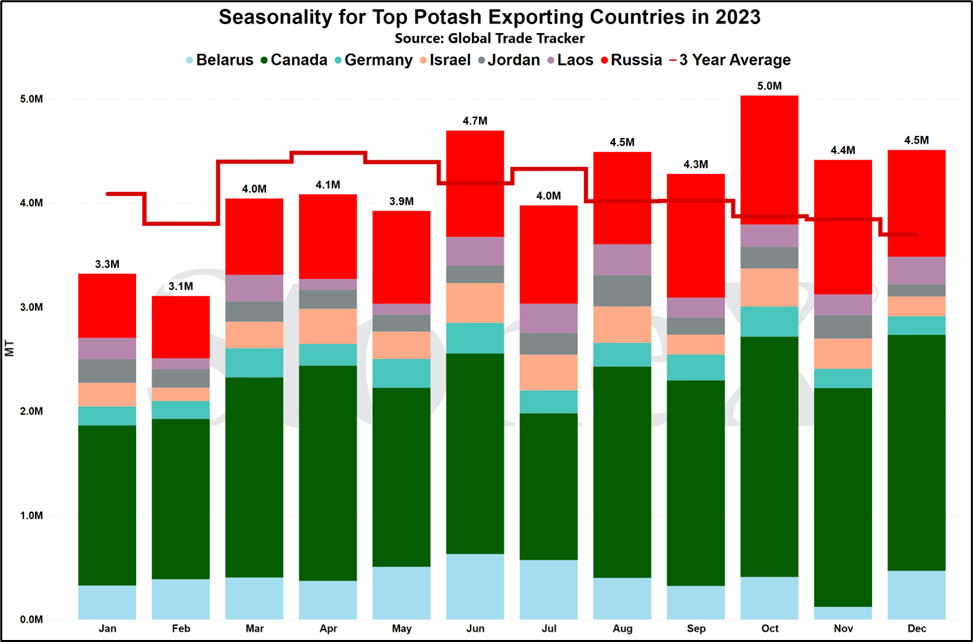
New production by BHP is still expected in Canada in the coming years. This new mine will add millions of tons of production to Canada's already robust amount of potash production. This will be a boost to global supplies.
China continues to invest in Laos to increase their production capabilities. Not only does it help Chinese farmers by creating more product nearby and lessening their reliance on western nations for supply, it also helps the Chinese government increase their sphere of influence in case they decided to take Taiwan.
Steps seem to be happening for peace between Ukraine and Russia. If peace is found, the next logical step should be that government relationships start to heal. It will not happen overnight, but peace would be a good first step. If relations were to improve back to normal, it is possible that Lithuania opens her borders to Belarus once again. That would allow more product to reach the world at a lower logistical cost.
We continue to hear that there are increases coming to Russian manufacturing. The details are a little more scarce but any increase is a boost to global supplies.
Over the next few years, we do continue to expect global demand to rise as well. The difference is that we forecast that supplies will grow faster than demand, building an even more bearish case for the future. Over these next several months/years, there will be periods where prices can pop higher as we are witnessing today. It will just be important to remember the longer term outlook to make sure we do not get lost in the forest.
What does this mean for farmers?
If supplies outpace demand, that should mean lower prices.
Yes, there are going to be periods like we are experiencing today where prices can rise. Those periods should be somewhat short in nature with the market always "looking for the shoe to drop". That creates a situation where suppliers just are not as confident as they might otherwise be.
Basically, potash should remain well valued for a while.
NOLA/New Orleans Louisiana
Vs 30 days ago - 17% or approximately $45 higher
Vs 90 days ago - 17% or approximately $45 higher
Vs 6 months ago - 13% or approximately $35 higher
Vs 1 year ago - -3% or approximately $10 lower
U.S. Midwest Average (average of several points across the Midwest)
Vs 30 days ago - 14% or approximately $43 higher
Vs 90 days ago - 7% or approximately $21 higher
Vs 6 months ago - -1% or approximately $4 lower
Vs 1 year ago - -10% or approximately $40 lower
- N.A. spring looks solid – demand signs are improving. We moved our corn acre forecast from 92M to 93.5M. Others are ranging between 95M to 96M and it is hard to argue their points today. Grain values have improved somewhat, giving farmers more confidence to spend money on inputs. Spring potash demand could be even better than expected.
- Potash's "low" price means higher chance of manufacturer push back - markets cannot fall forever. Eventually, manufacturers have to slow or stop production because they are breaking even at best and losing money at worst. There seems to be a little more mummering about how low the price is. Eventually, action will be taken. When and where, I'm not sure.
- Late, solid fall season means less time to refill – while the fall season was anything but normal, demand was heard to be really good. That means that inventories were emptied and since a lot of area applied until near Christmas, it means even less time to resupply the market before spring. That time is almost up...
- U.S. potash values rose on tariff fears, lack of tariff fears "should" mean they drop again – I'm hoping that by the time I start on the April newsletters, all this tariff nonsense will be behind us. Potash manufacturers took full advantage of the confusion and fear surround the tariff's. While I disagreed with it, it was reality. So if fear of tariff's caused prices to rally, shouldn't the removal of all tariff fears cause prices to fall?
- Global outlook remains very well supplied - while nearby values have been creeping higher, it does not change the overall global outlook. There remains plenty of supply globally, and there is more coming. A well supplied market usually keeps a cap on prices.
- Russia/Ukraine peace could mean the full return of Belarus – this takes a few assumptions. The first is that Russia and Ukraine will find peace. I'm still skeptical but given recent events, it looks like Trump is going to force it. The second is that global governments will return to normal relations. There are a lot of hurt feelings and a lot of mistrust toward Russia so we cannot assume we ever find normal again. Last, it assumes Lithuania would ever consider opening its borders to Belarus again. However, if all those happened, it would likely result in the full return of the world's 3rd largest exporter.
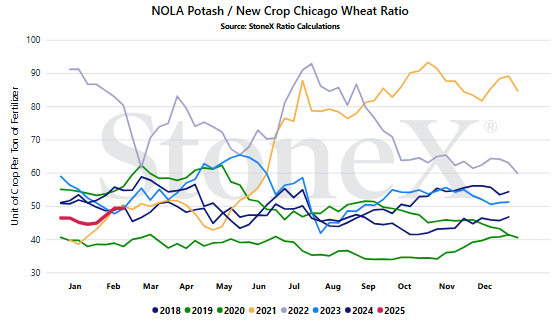
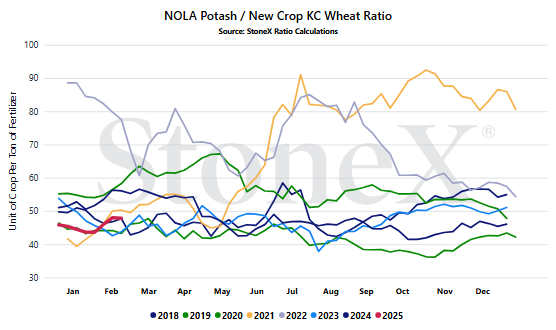
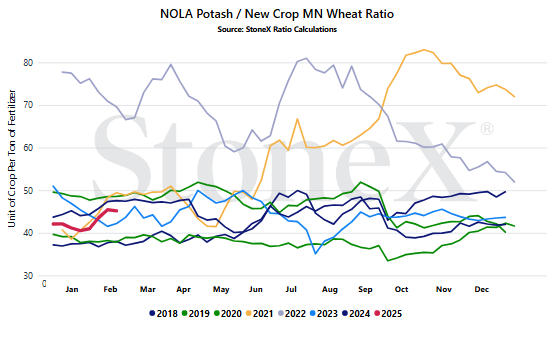
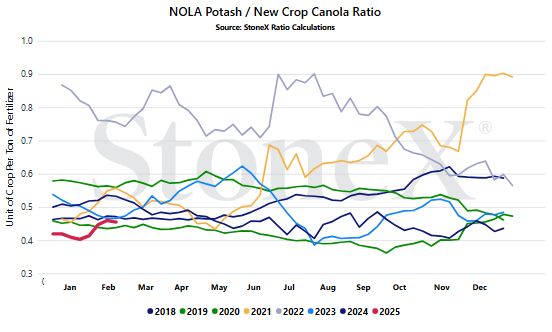
Where are the current potash/grain ratio values today
We believe that only looking at the flat price of either grains or fertilizer can be misleading:
-
Only selling grain can hurt you if fertilizer prices rise substantially
-
Only buying fertilizer can hurt you if grain prices fall
We look at the ratio "value" to get a better indication of where we are or how many bushels of X does it take to pay for 1 ton of fertilizer.
Would you rather:
-
Spend 120 bushels to pay for 1 ton of potash
-
Spend 60 bushels to pay for 1 ton of potash
When we compare the current ratio value against recent years, we start to see if we are high or low.
YOUR VALUES MAY LOOK DIFFERENT
This graph looks at the NOLA potash price vs the flat grain price. There are no logistics on either product. Your location will look different due to fertilizer logistical costs, grain basis, etc.
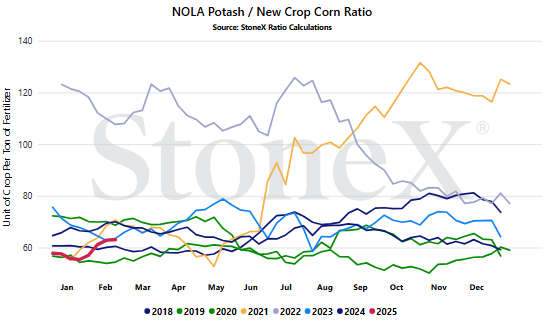
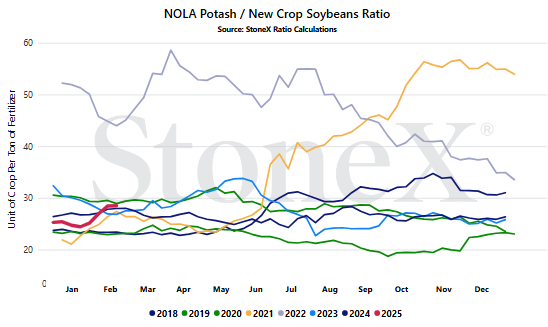
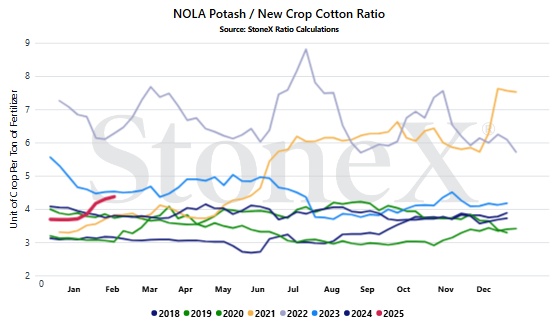
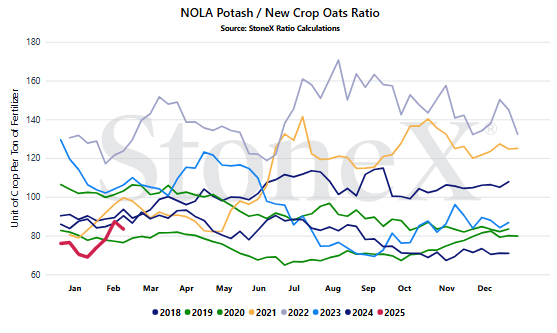
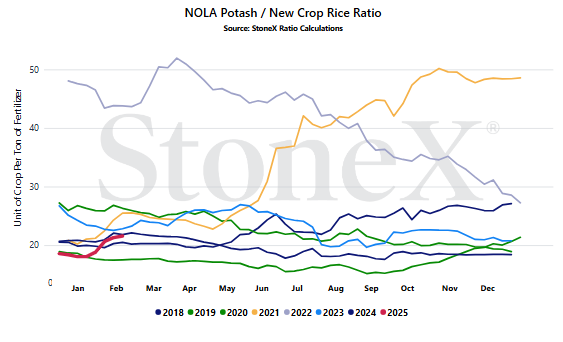
- N.A. markets reaction to tariff fears - in the last month, U.S. potash values have risen. There were plenty of fundamental reasons why the price could have risen. Growing corn acres. Solid fall run lowering inventories. Short period between end of fall/start of spring to refill. Potash low price vs grain values. Even with all of those reasons, the most commonly discussed reason for why prices went up: "we were not sure what would happen with tariff's". If tariff's end up going into effect shortly, it could continue to buoy potash price ideas. If common ground is found and tariff talks go away, that "should" mean prices lower once again.
- Possible peace between Russia/Ukraine - with Trump in office, it appears that Russia and Ukraine are closer to peace than at any point since the invasion began. Now, all parties may not be thrilled about it, but it seems to be working that way. Now, there shouldn't be any potash difference for Russia or Ukraine if peace is found. Ukraine does not export any. Russian exports have actually been higher than normal. The change could be Belarus. If the invasion ends and all parties go back to "normal", that could mean that Belarus is allowed to ship product thru Lithuania once again and back to the world. That would return once of the top 3 exporters back to full strength, providing even more tons to the market.
- Late fall run/growing spring demand for N.A. - this is the story I should have seen coming last month when I wrote this. All the signs were there for prices to perk a little. The fall run was solid, meaning inventories were drawn down. The fall run was late, meaning a short period between the end of fall and the start of spring. Potash values were really good vs historical values. Potash values were really good vs grain values. Corn acres continued to rise, creating more demand. All of these should mean a really good spring run that should create extremely low inventory levels heading into late spring.
StoneX Ratio Calculation
The ratio calculation is derived from Bloomberg historical grains values as well as fertilizer values from StoneX, NPKFAS, and Argus.
The calculation is simply dividing the fertilizer price by each grain price.
All data was sourced from StoneX unless otherwise noted.