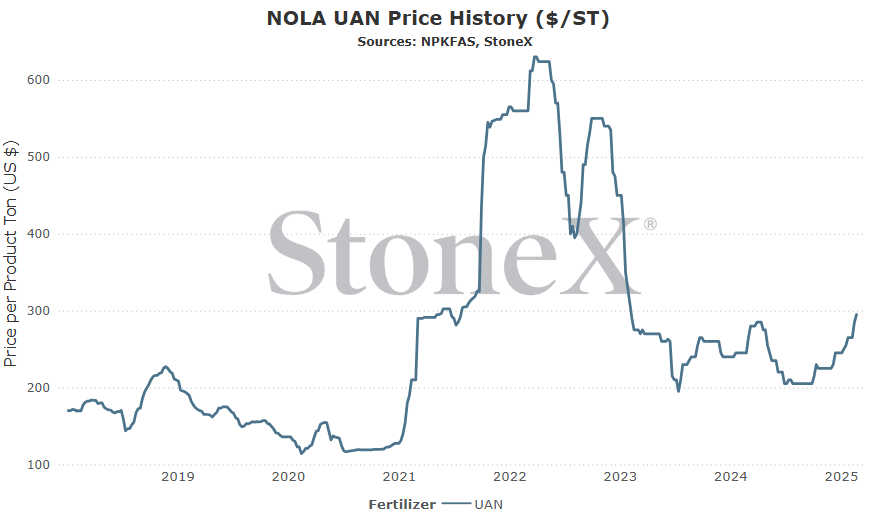
The intention of the below graphs are not to use to say "my price should be X based on this graph". These prices are derived from an FOB price point average. The intent is to show major global price movement trends. Your values will likely have significant basis difference (similar to your local grain price being different than the traded market price).
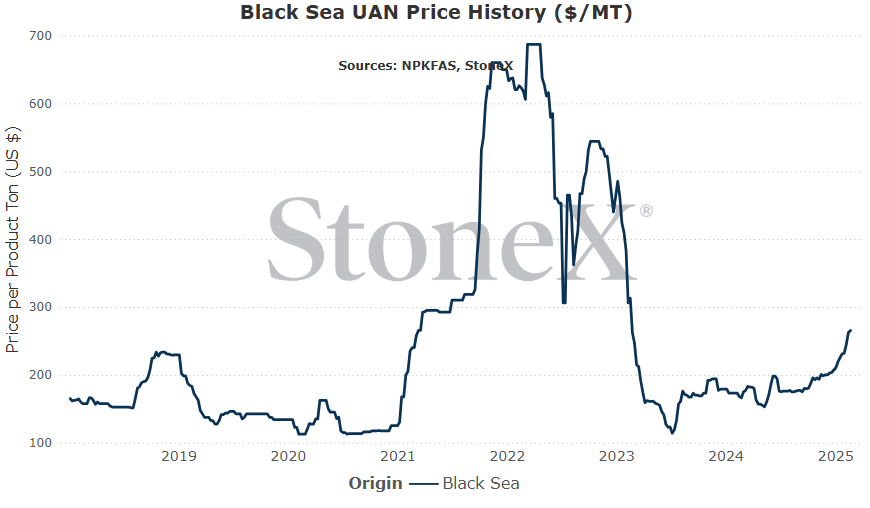
This graph is labeled as MT in USD currency.
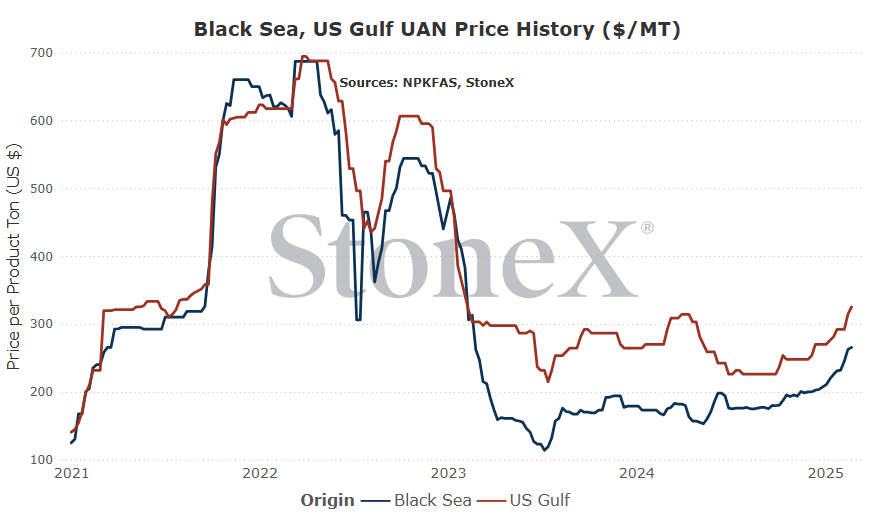
Fortunately, the worst-case scenario from a bullish POV did not play out in the last month. That would have been European production dipping even lower. The global S&D of UAN is already snug. Losing even more Europe based production would not have helped.
Still, there are a couple things that are leaning bullish.
First, it appears that Trump is making headway toward peace between Russia and Ukraine. If peace can be found, that will be a major step toward government relations improving between Russia and Australia/Canada (both which tariffed Russian fertilizers as a response to Russian aggression). If Russia can return to exporting to both nations, that opens their sales book and should allow their values to increase.
Second, urea values continue to look firm. If urea is firm, UAN is very likely to follow.
Last, there is still plenty of demand. Europe is still producing 75% of normal. That leaves them 2M tons short of normal. Spring is just ahead. Sellers are currently in the driver’s seat.
Given all the above, I am still sticking with the bullish POV. This will not last forever. Eventually, the focus will turn from spring demand and to late Q2/Q3 price reset expectations. For now, there should be enough support to keep UAN price ideas moving higher.
There is a problem with North American UAN supplies. We haven’t even gotten to start applying across most of the territory, and there are already reports of tight supplies. Several across the Southern Plains region are reporting an inability to find product that can ship before April.
Why is this? Well, it a few things coming together.
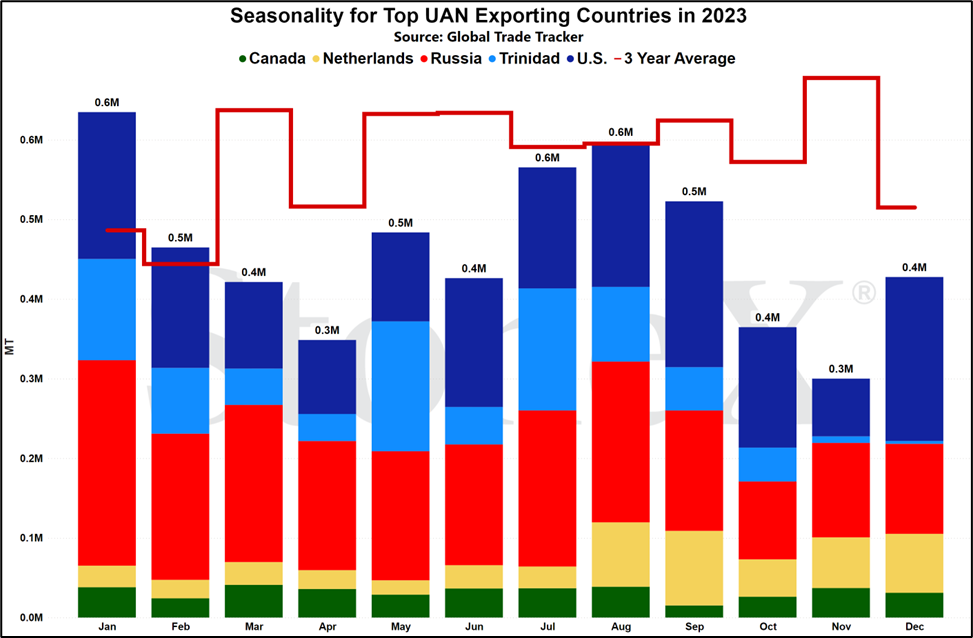
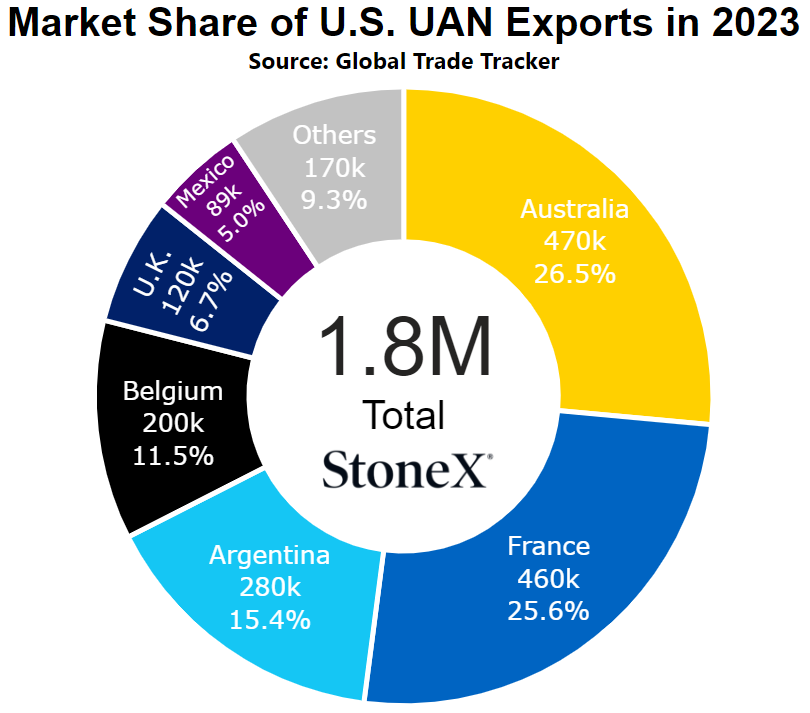
Number 1 – exports from the U.S. are huge. The U.S. has been a larger than normal exporter with plenty of sales options in Europe to backfill their offline plants. This was made worse by Trinidad production issues due to low gas supplies. U.S. manufacturers stepped up to fill the void in the form of higher exports.
Number 2 – several small production outages have combined for a very real number of tons lost. Production facilities go offline. There is nothing malicious about it. Just part of the system. It happens. Fortunately, there hasn’t been a major outage but there has been enough small ones to equal a few hundred thousand ton of production lost.
Number 3 – frigid temps appear to have hurt production worst than previously believed. There have been two periods of extremely low temps that reached far south. While these were nowhere near the events of a few years ago, it appears it was bad enough that plants had to slow/stop for a period. Again, more production lost.
All of those are supply issues. Those do not even begin to tough demand rising in the face of bigger corn acre forecasts.
Long story short, I am still bullish UAN. In fact, I think UAN will hold longer than normal. Typically, we see values start to slide as side dress season gets underway (part way into it). However, if inventories are as tight as we believe they are and demand is growing as we expect it to, I think it keeps the S&D tighter longer which keeps prices higher longer.
Basically, the supply side is holding nearly all the cards. That isn’t great for buyers.
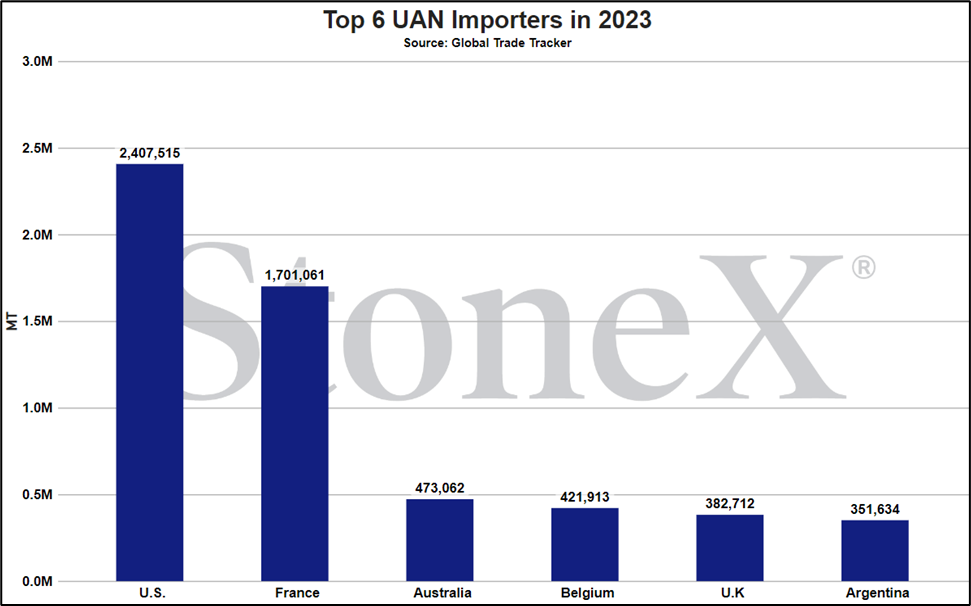
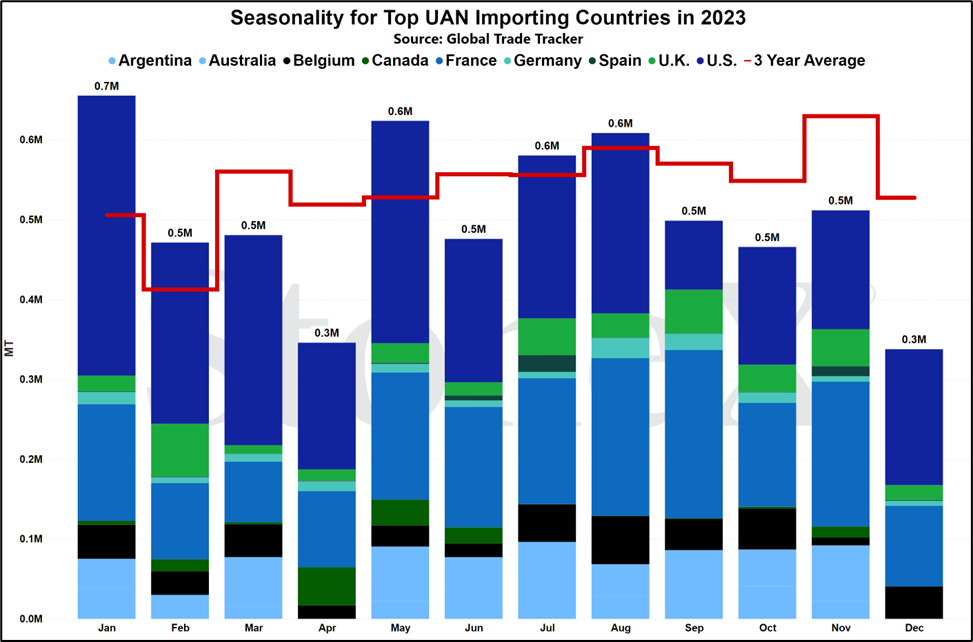
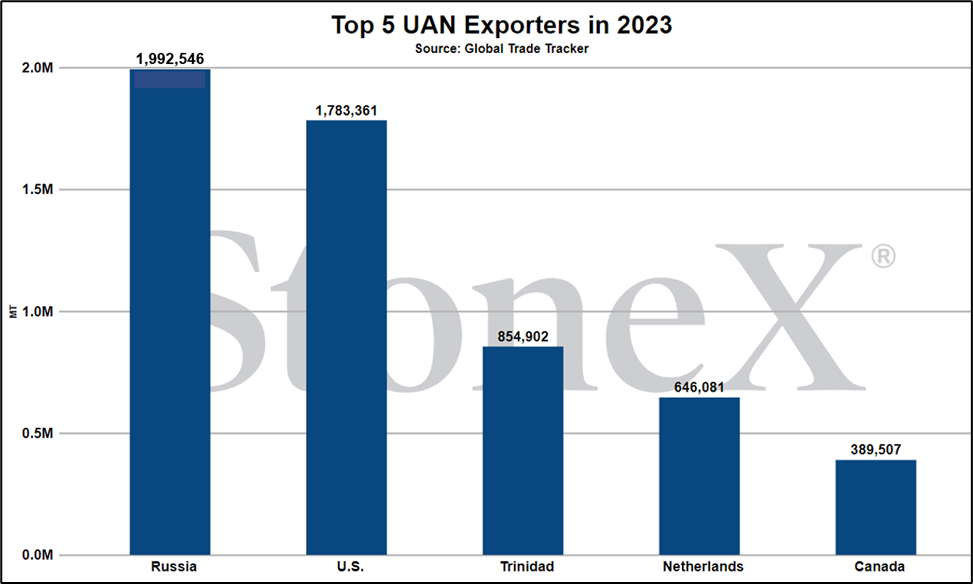
Russia/Ukraine peace progress raises UAN supply hopes, not likely to help short term
When President Trump took office during his first term, it almost feels as though he was shocked that he won and wondered what he was supposed to do. It took time before a strategy really too hold and he made progress.
That has not been the case with President Trump 2.0. He has come in sprinting. He and his team are making changes across a wide swath of things at a pace that his competition can barely keep up with. One of those focuses has been to create peace between Russia and Ukraine.
Nothing Trump has done has come without opposition and this has been no different. The left as well as Zelenskyy have pushed back against his strategy but as with most things Trump, he is proceeding anyway...and progress is being made. It might be small. It may not end with anything meaningful. However, it feels like more progress has been made in recent weeks than in the last couple years.
So what would this mean for UAN?
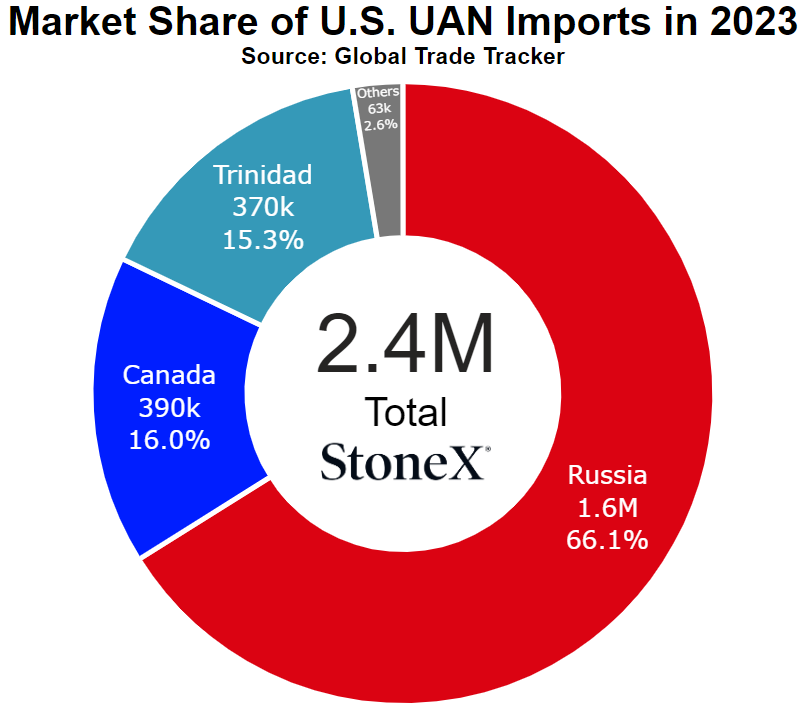
For Australian and Canada, it could mean returning to normal relations with Russia which could include Russian fertilizer shipments resuming. This would be a big win as it would mean more supply competition for buyers. Buyers in Australia have been almost solely reliant on U.S. supplies. Whatever happens to the U.S. market also happens to the Aussie market. If Russia were allowed to return, it would mean more competition which should help lower price ideas. For Canada, it would lessen reliance on the U.S. Russian tons have continued to flow to the U.S. which has helped competition, but Canada still needs to look to the U.S. for more tons than normal. So if Russia/Ukraine can find peace, we could see a return to normal shipments.
On the longer side, we look to European nitrogen production. Remember that the Nordstream pipeline saw shipments stop after Europe/Russia tensions came to a head. Russia just shut it down and said survive without us. While that was bad, the worse situation came after when an explosion rocked the pipe. That meant that even if both sides were to resume normal relations, the pipeline was still damaged and it remains that way today.
If peace is found and normal relations between European countries and Russian normalize, it will take time. First, agreements on gas supplies need to be reached. Then, Russia will need to start the difficult task of repairing the pipe which sits underwater. The interior of the pipeline has been exposed to the sea. Saltwater and unprepared metal do not do well together. Repairs would not be fast.
However, eventually one can hope that gas shipments would resume and European gas values fall back to normal ranges. It doesn't guarantee that European nitrogen plants that are currently offline come back to producing immediately. These plants are old. The political climate is still not a fan of older production. However, it significantly raises the chances.
For now, it is all speculation. We do not know if peace will be found. Even if it is, we do not know what the structure looks like. There are a lot of pieces that need to come together...
But we can be happy with the progress made.
What does this mean for farmers?
The short term situation for Australia/Canada could mean increased supply competitions as Russia could be allowed to resume shipments. Competition generally breeds aggressive pricing which lowers price ideas.
Longer term, it could mean European production coming back online which would be huge for the global complex. How long that would take, I'm not sure.
North American UAN supplies tight, not even spring yet
There could be a problem lingering right in front of our faces as N.A. approaches spring and we are not fully realizing it.
Spring application of UAN is still a little ways away. Most UAN demand will not occur until later April/May/June as farmers look to sidedress their crops.
So then why are we already hearing some regions not being able to find product to ship until April?
This has been the situation already occurring in the Southern Plains. There have been multiple reports of retailers attempting to buy additional UAN supplies, only to be told that terminals/manufacturing points are sold out until April.
From my perspective, this just shines more of a light of the problem UAN has been having.
First, exports have been big. U.S. manufacturers have been taking advantage of lower production rates in Europe. While some U.S. parties may be appalled the they would export to Europe rather than keep the tons homes, companies only care about the bottom line and if European buyers are willing to spend more, that is where the product goes.
Second, the U.S. got a boost of demand with Trinidad having production issues. Gas supply shortages forced Trinidad based facilities to slow/stop production until gas resumed. That left a supply hole. U.S. manufacturers stepped up.
Last, there have been a lot of small production hiccups. None of these move the needle significantly on their own but combined, it removed an estimated 200 - 300K tons of produced product.
So now we are approaching the spring season with lower supplies and growing demand on the back of rising corn acres. This does not guaranteed shortages. However, it does set the stage for prices to climb further.
Tight supplies + growing demand = usually means higher prices
What does this mean for farmers?
This means that if you need to buy your spring UAN, you should be having that conversation with your retailer sooner than later to make sure supplies are not a worry. Your supplier may already have your tons in place. Your supplier may already have your demand factored into their approach. Still, to make sure, it doesn't hurt to talk sooner than later. It doesn't mean you have to buy today. Just a situation where the more information shared, the more the market can prepare.
Second, it means that UAN should have more price staying power. If supplies are as tight as they seem, even if urea values were to fall, UAN can withstand it better. The market will likely be taking a "we need demand to step away" approach to pricing.
Biggest pieced of advice I can give today is to have those discussions. The final decision may be to wait, but better to have the conversation behind you.
NOLA/New Orleans, Louisiana
Number 2 global importer in 2022
Number 1 global exporter in 2022
Price Comparisons
Vs 30 days ago - 11% or approximately $30 higher
Vs 90 days ago - 31% or approximately $70 higher
Vs 6 months ago - 44% or approximately $90 higher
Vs 1 year ago - 20% or approximately $50 higher
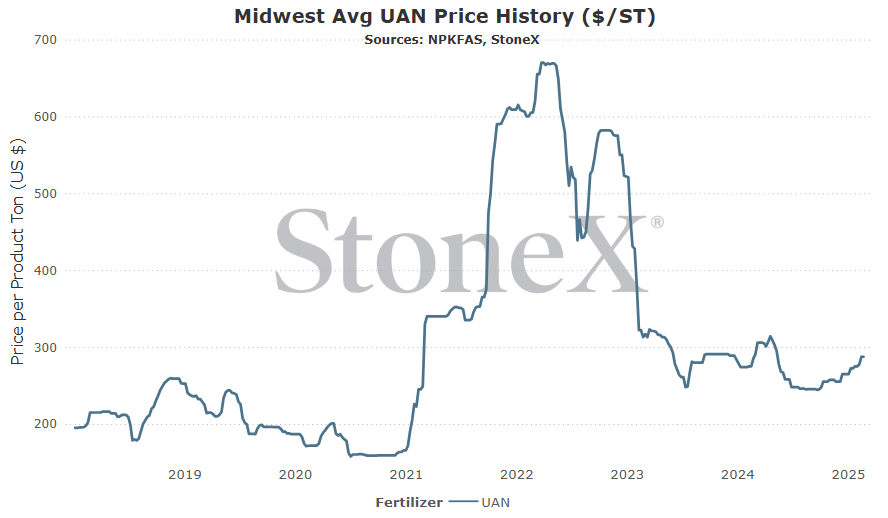
U.S. Midwest Average
Vs 30 days ago - 5% or approximately $13 higher
Vs 90 days ago - 12% or approximately $30 higher
Vs 6 months ago - 17% or approximately $42 higher
Vs 1 year ago - 1% or approximately $3 higher
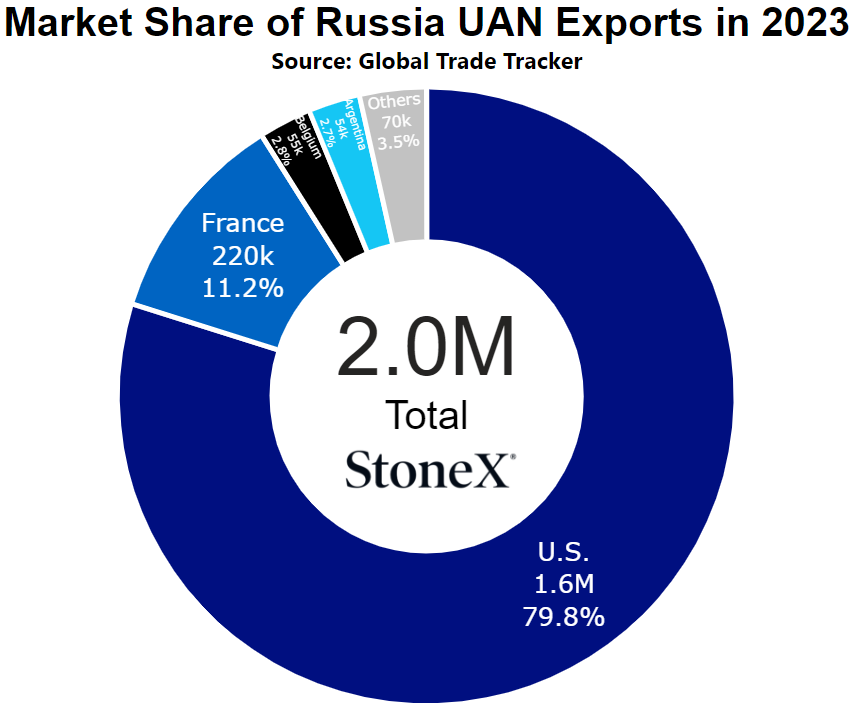
Black Sea (Russia)
Number 2 global exporter in 2022
Price comparisons
Vs 30 days ago - 15% or approximately $35 higher
Vs 90 days ago - 32% or approximately $65 higher
Vs 6 months ago - 52% or approximately $91 higher
Vs 1 year ago - 60% or approximately $100 higher
- European gas markets spike, causing production to slow further – there were a few days where I was very worried we were going to see more European nitrogen production facilities cease production. Gas prices were moving higher rapidly, putting a large amount of pressure n plant owners to make a hard decision of whether to continue or stop. Fortunately, gas prices have calmed...but they can spike again. If we get into a situation where more production starts to suffer, one should expect UAN prices to move higher globally knowing that Europe becomes a BIGGER buyer than before.
- Any deterioration of relations between U.S. / Russia – today, it appears that relations are improving as reports are pointing to progress being made toward peace. Does that guarantee an end to the Russian invasion of Ukraine? Of course not. We know that Trump reacts and if he doesn't make the progress hoped for, we could see him start enforcing even stricter tariff's on Russia. If those include all fertilizers, the U.S. / N.A. markets would lose their source of one of the few competitors to domestic manufacturers.
- If I/we are right on our bullish urea outlook – the urea/UAN price differential has been much tighter than I thought it would be by now. That has been a bonus, but it comes at a price. With the values being near identical on a price per pound of actual N basis, that means that any rally by urea is likely to be met by a similar move by UAN. The urea outlook remains firm and if we are right, it should mean higher UAN prices.
- If I/we are wrong on the urea outlook and values start to slide – if I were right on every market every single time, I wouldn't be writing this piece from an airport in Quebec City!!! If we are wrong and urea starts to slide, that will put pressure on UAN. Now, I do not think you will see UAN fall in tandem. Supplies are simply too tight which will give manufacturers the confidence to "ignore" the urea price slippage. However, it would still create pressure that could cause prices to fall.
- Canada/Australia and Russia relations improve on Ukraine peace – both nations have had their governments effectively block Russian fertilizer. That has pushed importers to turn to alternative supply routes which usually means higher prices. That has been the case. But, if peace can be found, normal relations between Canada/Australia and Russia would take a significant step forward. If relations normalize and import tariff's removed, normal supplies return which should help lower price ideas.
- Markets start to fear carryover to summer rather than spring tight supplies – given how tightly supplied the N.A. market appears today (some areas reporting inability to find new product to ship before April), this seems less likely in the short term...but eventually it will play a part. More likely in the later sidedress seasons up north.
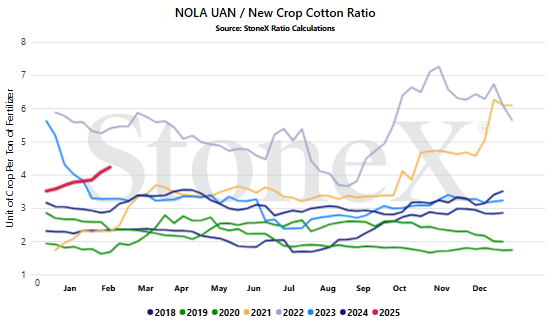
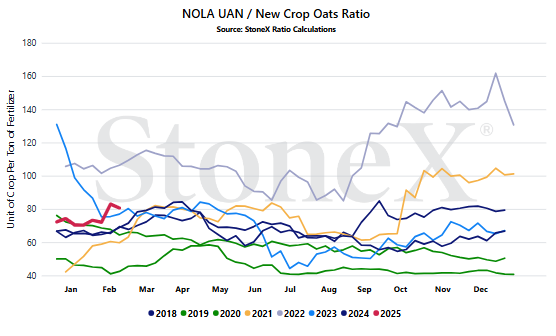
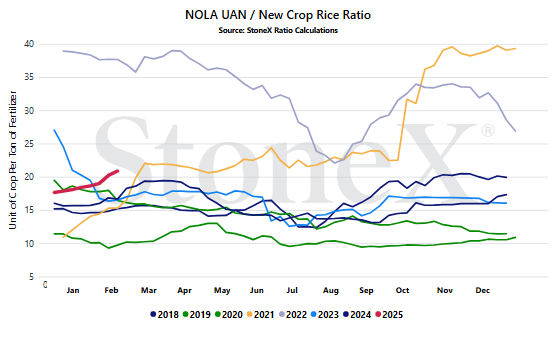
We believe that only looking at the flat price of either grains or fertilizer can be misleading:
-
Only selling grain can hurt you if fertilizer prices rise substantially
-
Only buying fertilizer can hurt you if grain prices fall
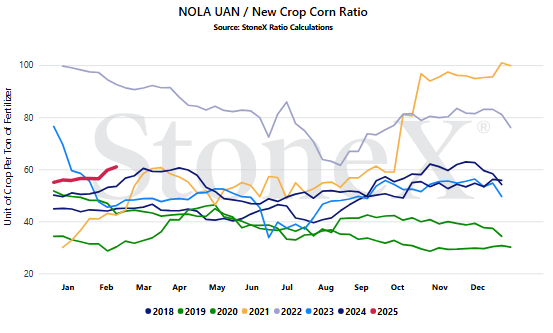
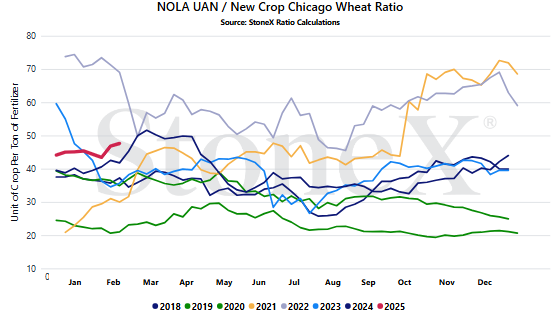
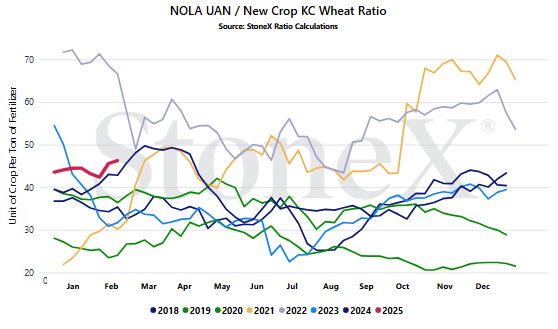
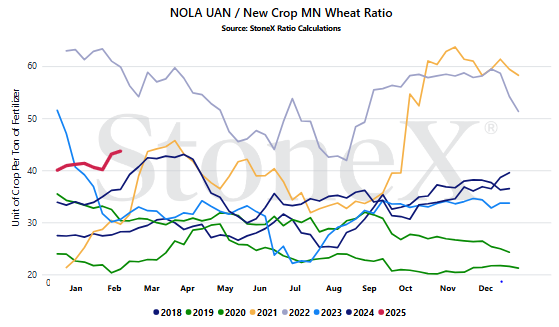
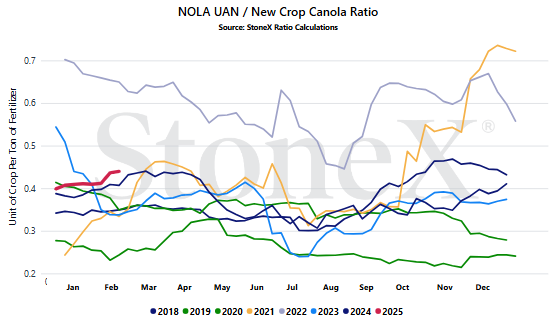
We look at the ratio "value" to get a better indication of where we are or how many bushels of X does it take to pay for 1 ton of fertilizer.
Would you rather:
-
Spend 100 bushels to pay for 1 ton of UAN
-
Spend 60 bushels to pay for 1 ton of UAN
When we compare the current ratio value against recent years, we start to see if we are high or low.
YOUR VALUES MAY LOOK DIFFERENT
This graph looks at the NOLA UAN price vs the flat grain price. There are no logistics on either product. Your location will look different due to fertilizer logistical costs, grain basis, etc.
- North American relations with Russia - Canada has effectively blocked Russian fertilizers from arriving directly, but that does not mean that Russian UAN does not matter. The U.S. has continued to see Russian product arriving and provided a much needed competition point for domestic manufacturers. While it doesn't solve the global S&D tight situation, it does cause UAN to "behave". It appears that the Trump/Putin relationship is working well with more talk of peace with Ukraine than has been seen since it began. It is possible that these conversations will find a true peace that could lead to normal relations once again. However, it could also fall out and see the U.S. look to punish Russia with more wide ranging tariff's. If that happens, the U.S. and N.A. lose their biggest domestic competitor which would make it easier for UAN values to spike.
- How much production has been lost - we know that there have been several smaller production hiccups this fertilizer year prior to the winter. That is normal. These plants go down naturally. All part of a high temp/stress situation. However, it is starting to sound as though more production was lost during the cold snaps than previously believed. The N.A. market was already tight on supplies as has been very prevalent in the Southern Plains market (folks struggle to find product to ship before April). These cold weather losses certainly have not improved the forecast...
- Urea values - at the end of the day, UAN takes a lot of its price que's from the urea marketplace. If urea values start to rally as I still think they will, that will give UAN plenty of runway to mirror it. The opposite can be true, but given how tightly supplied the market already is, I think the downside would be much stickier.
- Export opportunities vs domestic opportunities for N.A. manufacturers - at the end of the day, nitrogen manufacturers are going to sell their product to the highest bidder. There is nothing stating that tons produced in North America must stay in North America. Manufacturers have spent billions of dollars on their facilities, people, etc. If Europe experiences more production loss, they will be a more desperate buyer (i.e. willing to pay more). While I may not like it, it is reality.
StoneX Ratio Calculation
The ratio calculation is derived from Bloomberg historical grains values as well as fertilizer values from StoneX, NPKFAS, and Argus.
The calculation is simply dividing the fertilizer price by each grain price.
All data was sourced from StoneX unless otherwise noted.