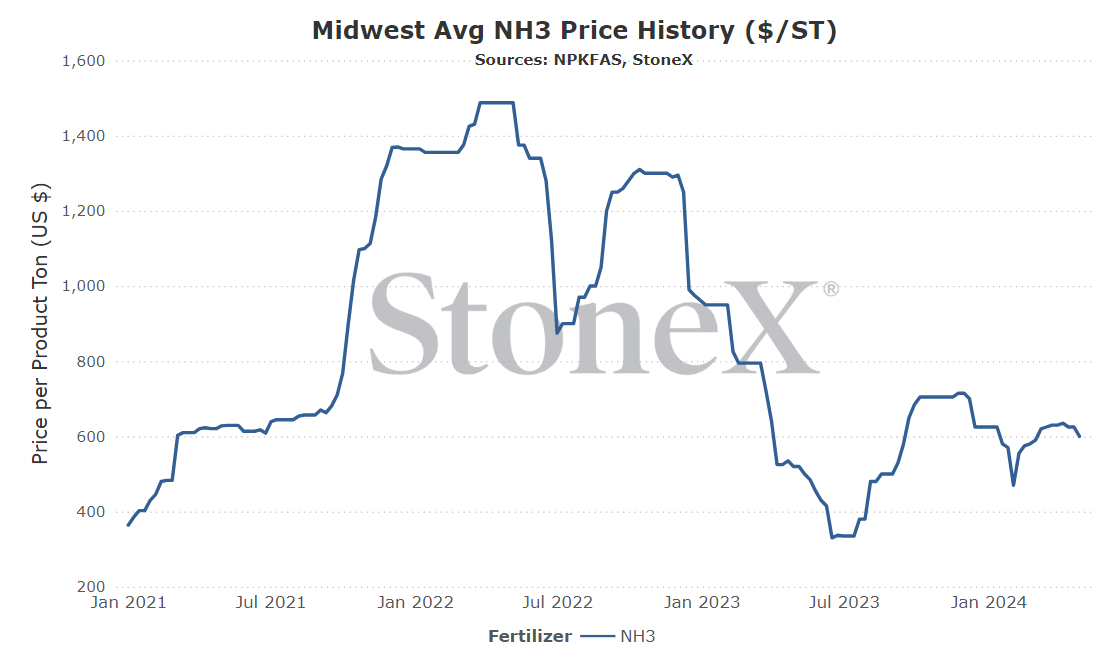
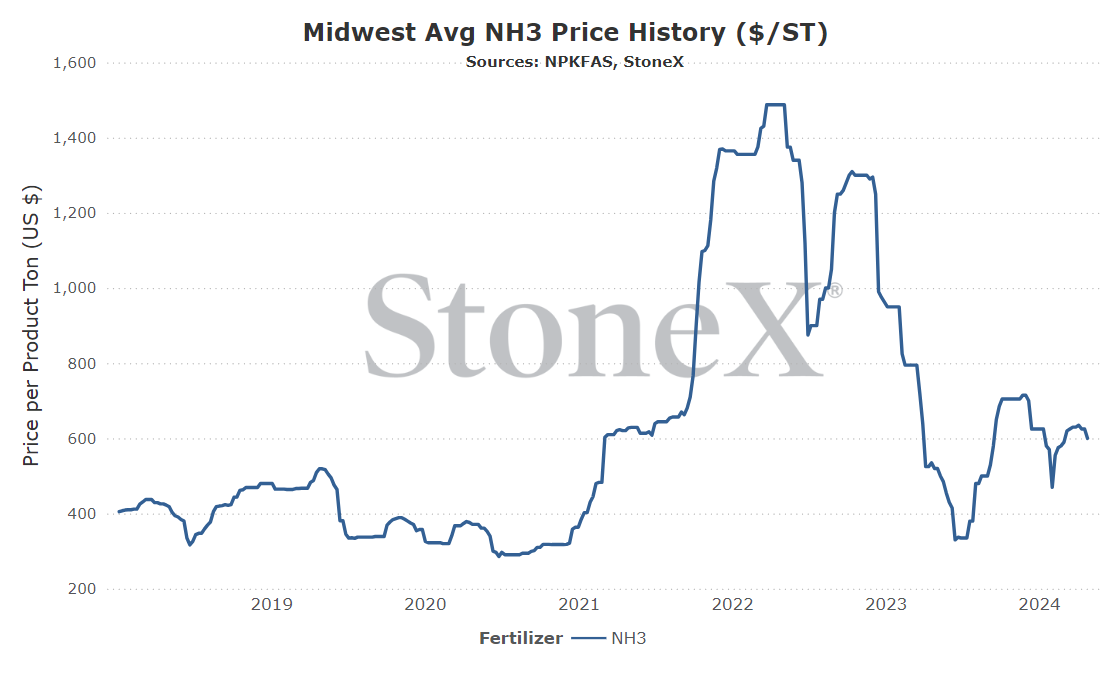
The first graph is the AVERAGE of the entire Midwest U.S. region. That means your local value WILL be different than what the graph reflects. Please do not take this into your retailer and say "why isn't my price the same as here". That is comparing apples to oranges. You might be on the cheaper or more expensive side of this graph. This doesn't take into account logistics/storage/interest/insurance/shrink/etc.
This graph looks at the price from a short ton and USD currency POV.
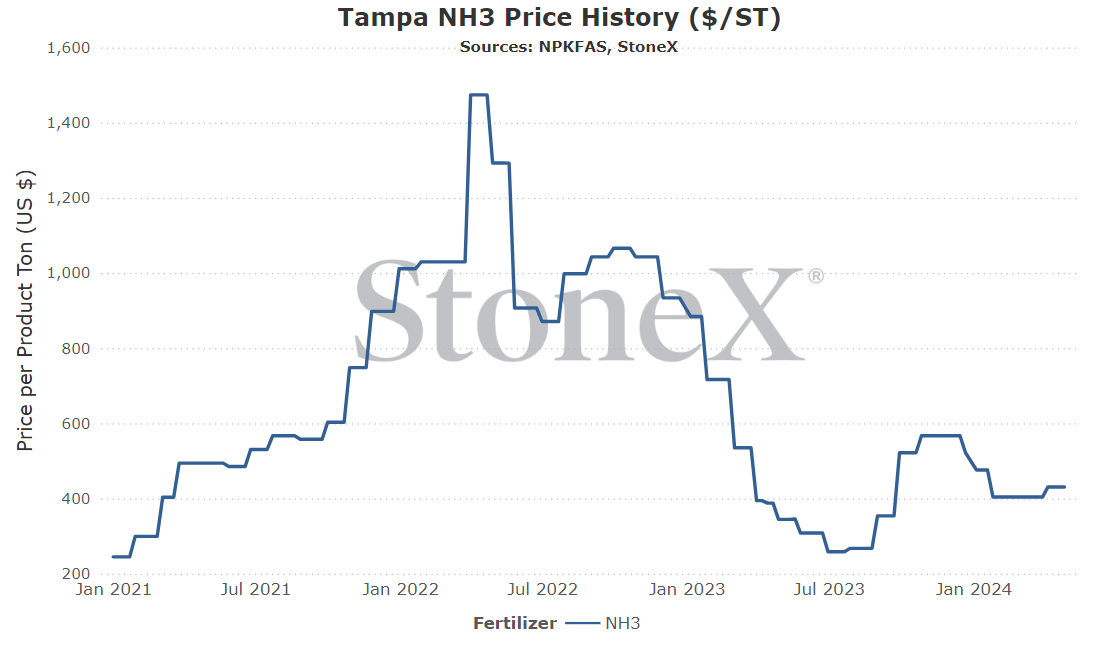
This second graph looks at the price set for Tampa NH3. This value does not have a high correlation to Midwest values. It is a talking point used when prices are rallying...yet somehow gets skipped on the way down. This price is more an indication of the global price. This price is set by two parties (purchaser - phosphate producer in Florida / seller - international producer providing NH3 to FL phosphate production).
This graph CAN be used as an indication of global market price direction/trends. This graph SHOULD NOT be used to determine a Midwest value. Tonnage is listed in short ton and currency in USD.
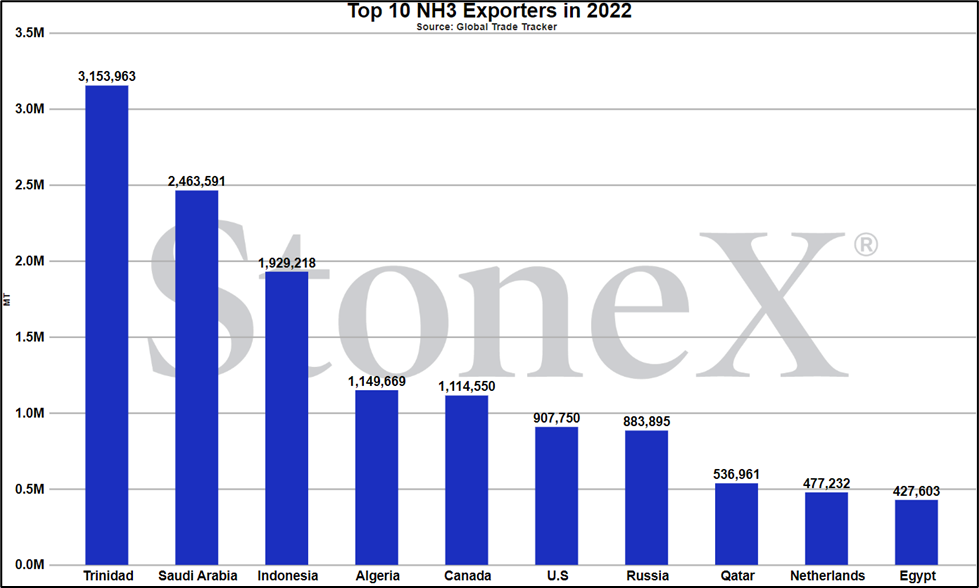
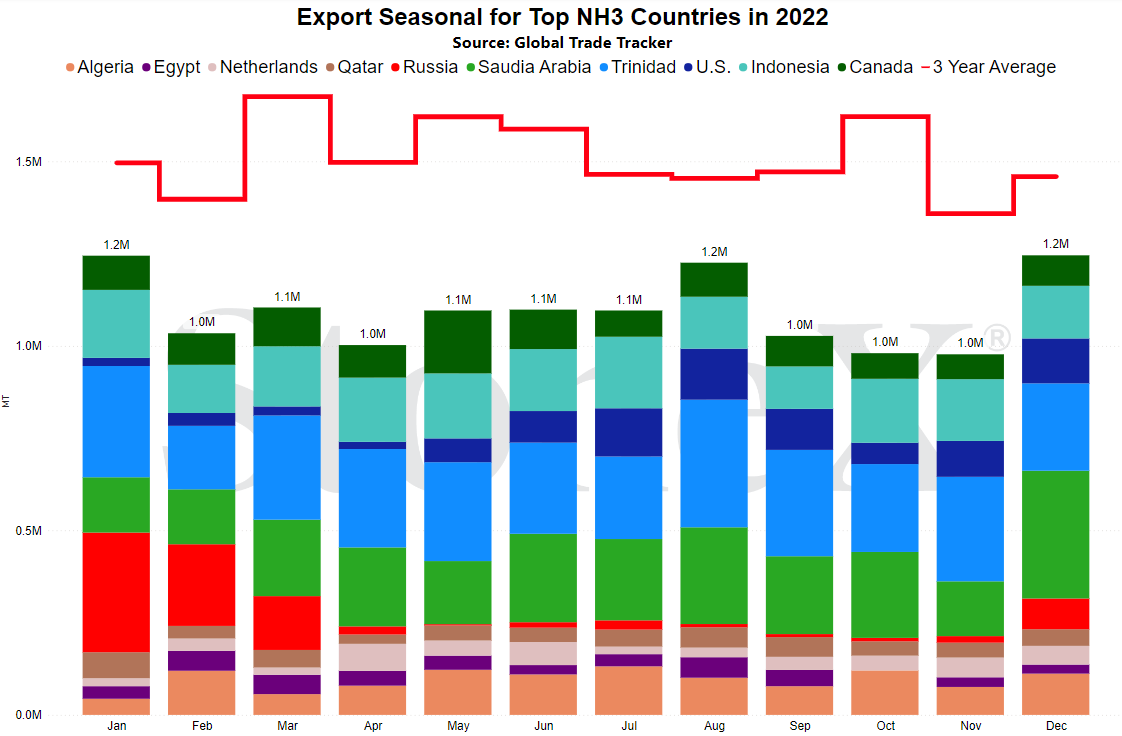
The world is still dealing without its largest annual exporter in Russia which should mean that values stay somewhat supported...but supported does not mean higher.
If Russian exports remain cut from the world, we still see the coming months being bearish. If Russia does return to exporting, then it becomes very bearish in our minds. The only thing that would offset this POV is if enough global nitrogen production facilities were to go down for repairs which is possible given the outlook.
North America
Preplant demand season is largely complete. That leaves the much smaller sidedress demand area that should see A LOT of competition by everyone trying to get rid of any inventories they can before summer resets hit.
The outlook for NH3 remains bearish as we head into sidedress season and much more once we hit the summer.
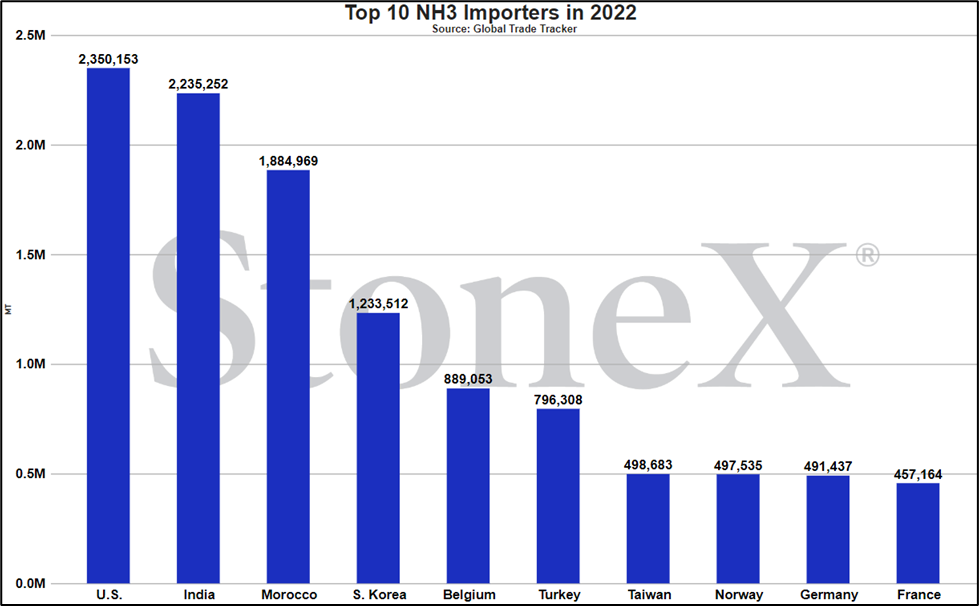
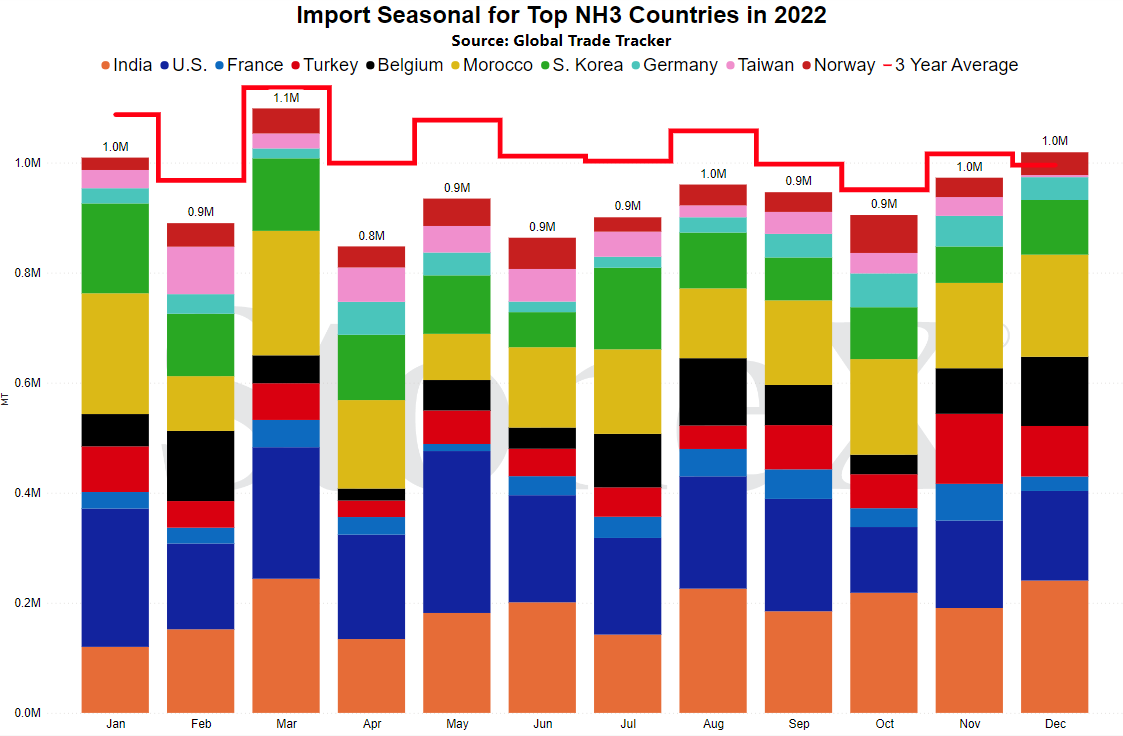
May Tampa NH3 drops $25 vs April
Well, cannot say that this was much of a surprise. The May Tampa NH3 price was announced at $25 lower than April, or $450. The only surprise in this announcement is that the price "only" went down $25.
Given the fact that global economies have still been somewhat sluggish (hurting industrial demand) and summer looms large, we had expected a lower value. However, the fact that Russian exports still have not returned and there have been some production issues (Saudi Arabia / U.S.), it isn't out of line.
Overall, the trend is where it was expected to be. The largest question remaining is how much downside is left in the marketplace going forward. Looking at last summer's reset values and the possibility of Russia returning...we may have a ways to go.
N.A. preplant largely done, targets now on smaller sidedress demand
At least for those areas that did not get inundated with storms over the weekend (nearly 4" here), NH3 is barely being thought about as planters roll in the fields. That means that most of springs demand is now in the rear view mirror...most except for the Eastern Cornbelt's sidedress season.
This season is much smaller in size to the fall and spring preplant...but is just as important to sellers as it represents the last chance of offloading product before the summer comes. This is why we have continued to expect lower values. Manufacturers start to get very aggressive this time of year as it is their last chance to lock in spring values which are typically higher priced than the summer.
On the bright side, this could mean lower prices on the farm. As "outside" tons start to flow into the area, local long positions start to feel the pressure and start to compete which creates a back and forth market where prices fall. A great example is when I spent a couple years working for a domestic nitrogen manufacturer. I handled the state of Illinois. Spring had been going very well. No real hiccups. Started to get to sidedress demand and started missing on some sales. After some research, I found out that I was competing with tons from Oklahoma. While surprised that tons were being shipped from that far away, it was what it was. Chatted with a couple retailers and quickly found out that not only was it coming from Oklahoma, it was coming from our own company. A quick jump across the desks and I was told "we produce product every day, we need to clear tons today to make room for the summer, and the netbacks we are getting today from long hauling are better than we expect this summer. Live with it.". Was I happy? No, but it taught an important lesson.
Current Midwest values, while down, are still significantly higher than where we expect to see this summer. That should mean that all N.A. manufacturers should be aggressive in finding any demand possible. Hopefully this will result in your local prices falling.
No new word on Russian return
The one story that the NH3 world is looking forward to...still has no new news.
Expectations remain that Russia will complete construction at their new export facility east of Crimea. Once online, it should mean the return of the world's largest exporter and should be a huge bear factor for the marketplace.
So why hasn't it come online yet?
Well, for starters, NH3 is not an easy product. Everything has to be just right before it can start to flow. This isn't like dry or liquid fertilizer which if there are issues, it just creates a clean up. NH3 has the potential to kill so builders have to be prudent and ensure that everything is build to spec. Also, Russia is a bit like China in that information shared is not always the most accurate. Many had believed, based on conversations, that the facility would be operational by April. That was likely lofty hopes with reality being a bit delayed.
We also have to keep in mind that the threat of attack by Ukraine looms large. Given the complexity of a facility like this, one small attack could be devastating.
While this has the ability to fundamentally change the world NH3 market, there is nothing new this month.
Summer expectations
To start, I expect that we will see lower than normal ending inventories as we complete fertilizer year 2024 and start fertilizer year 2025 (July 1). N.A. had a huge fall run that largely emptied the system. It was then met with a very short winter (only 2 months for many places) and then a fairly wide open spring season. Typically speaking, starting with low inventories for the year means that manufacturers can keep prices higher than they normally would. They know there is a lot of tank space available to fill.
Globally, I am taking a "I'll believe it when I see it" approach to Russia. There has been a lot of talk and expectation about their return...but little follow thru to date. This isn't to say I do not think they will return, I'm just losing patience!!! Until they do return, values should have some amount of support. Even when they do return, the world will still be in inventory catch up mode and there is always the threat of attack by Ukraine.
That said, I'll be happy if the market repeats what was seen last year. The summer 2023 fill programs were extremely aggressive to the point that it surprised us. When looked at vs the corn values where they were at that time, it created some of the best ratios we had seen. Today, grain values are lower but they can be and still have those NH3 values make sense. Russia returning could set off an emotional domino effect that could push prices lower, but it is hard to see that happening today.
As just mentioned, we expect/hope to see similar values as was pushed last summer.
U.S. Midwest Wholesale price average
Vs 30 days ago - -5% or approximately $30 lower
Vs 90 days ago - +5% or approximately $30 higher
Vs 6 months ago - -15% or approximately $105 lower
Vs 1 year ago - +15% or approximately $80 higher
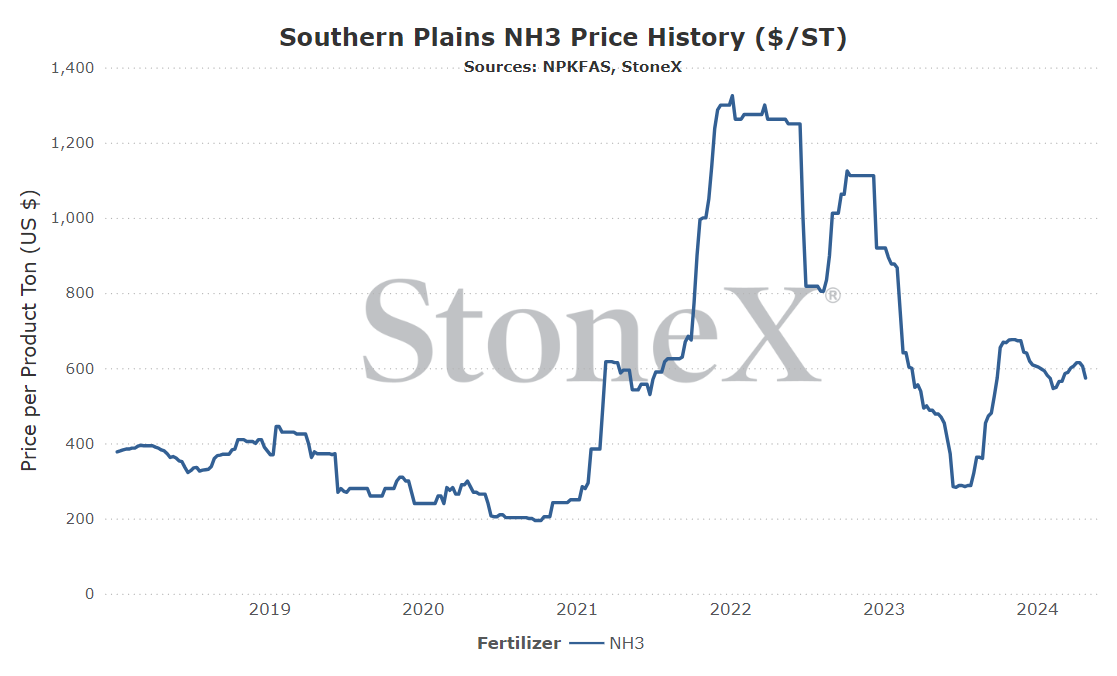
U.S. Southern Plains price average
Vs 30 days ago - -5% or approximately $33 lower
Vs 90 days ago - -1% or approximately $8 lower
Vs 6 months ago - -14% or approximately $94 lower
Vs 1 year ago - +18% or approximately $86 higher
- Russia still isn't back - when the world's leading exporter is gone from the market, that is a tall order to replace. In this case, it means that values remain much more supported than they would be if they were back. Their absence continues to be felt.
- N.A. inventories remain snug - the N.A. NH3 market had one heck of a year. Last fall was the 2nd largest since 2000. Given how the spring has gone, I would not be surprised if this fertilizer year (fall/spring combo) isn't a top 3. Even more impressive is how many have switched away from NH3 since 2000 and we are still this high. That should mean a market that is largely empty. That is a lot of space that manufacturers/distributors get to fill...and be choosy about.
- Russia should be back at some point - probably/maybe/likely. Pick your terminology but Russian exports should resume at some point and when they do, it is hard to see a scenario where global values do not come under pressure.
- Long summer looms large - yes, N.A. should be very low on inventory levels...but that does not mean there are not tons left to sell. With markets where they are today vs summer reset expectations, it makes sense to remain aggressive and sell every ton possible. The closer summer comes, the more intense the competition. The more intense the competition, hopefully the lower the price.
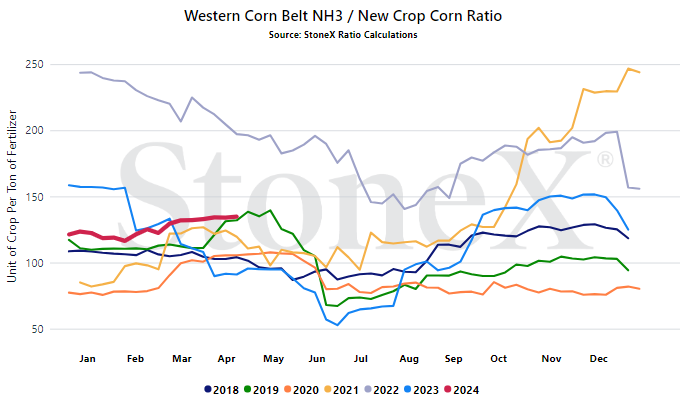
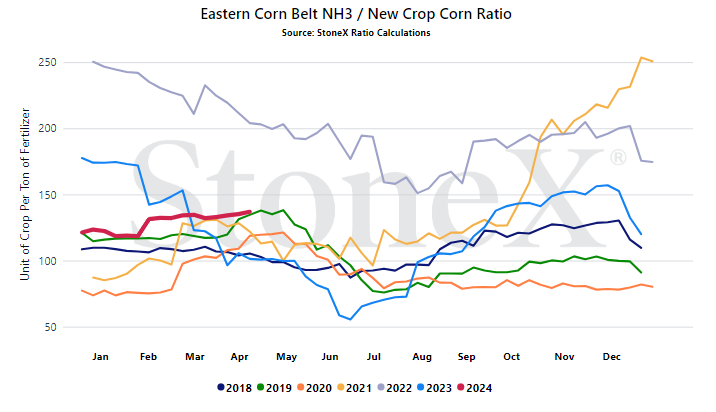
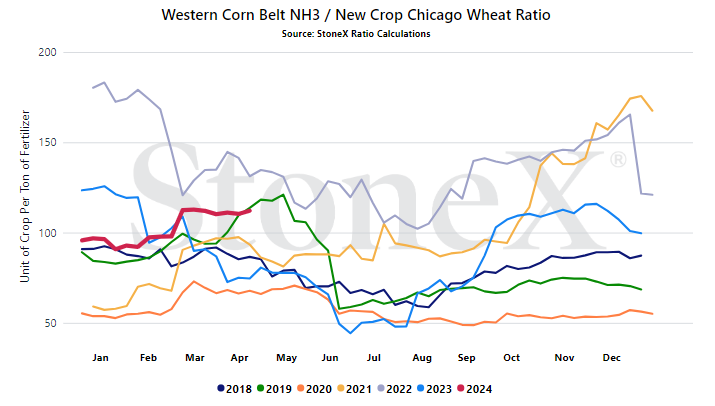
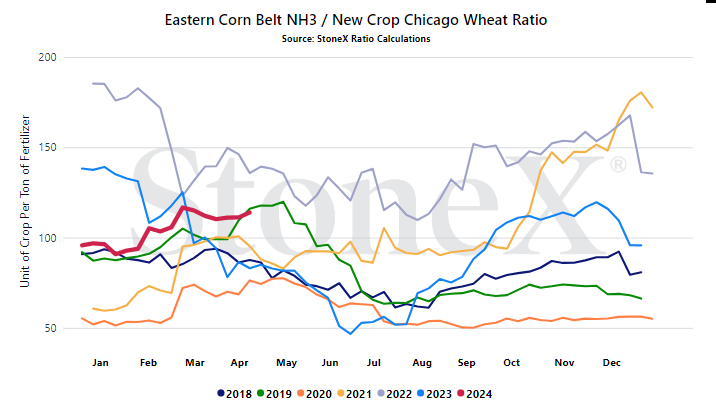
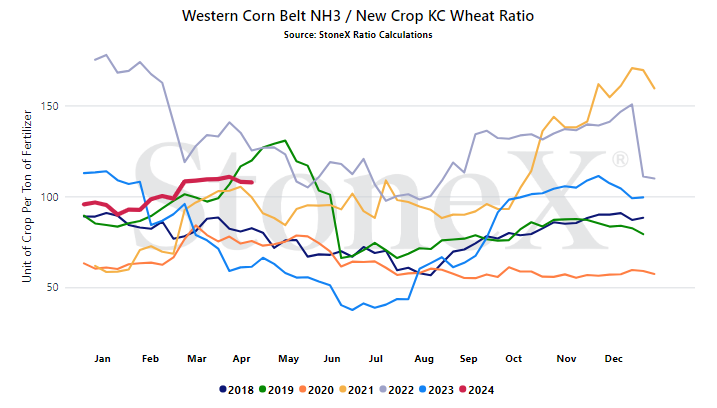
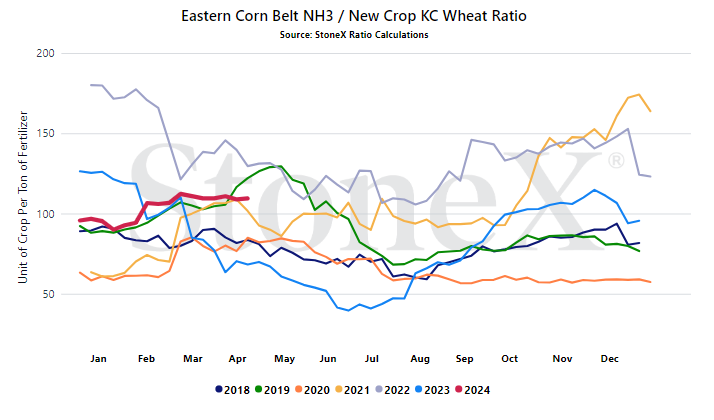
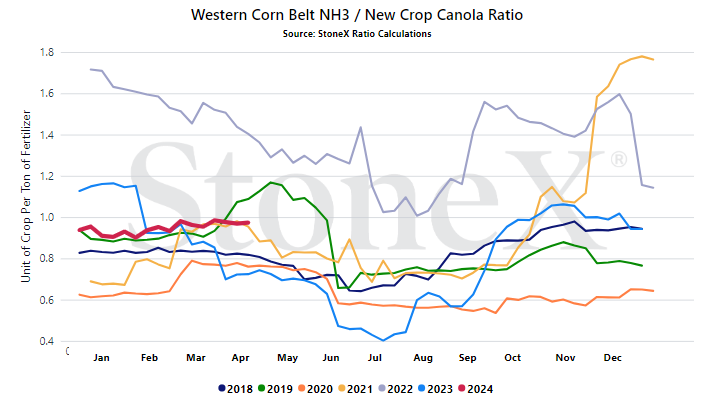
Where are the current urea/grain ratio values today
We believe that only looking at the flat price of either grains or fertilizer can be misleading:
-
Only selling grain can hurt you if fertilizer prices rise substantially
-
Only buying fertilizer can hurt you if grain prices fall
We look at the ratio "value" to get a better indication of where we are or how many bushels of X does it take to pay for 1 ton of fertilizer.
Would you rather:
-
Spend 150 bushels to pay for 1 ton of potash
-
Spend 100 bushels to pay for 1 ton of NH3
When we compare the current ratio value against recent years, we start to see if we are high or low.
YOUR VALUES MAY LOOK DIFFERENT
This graph looks at the NOLA NH3 price vs the flat grain price. There are no logistics on either product. Your location will look different due to fertilizer logistical costs, grain basis, etc.
- Russia - this remains my focal point. They are just that important to the global NH3 marketplace. If they return, watch out. Things could get interesting.
- Low ending inventories vs looming summer - N.A. is going to be very interesting to watch. We just had a huge fall/spring combo that should mean inventories are very low. That should mean values are supported. Then again, there is a lot of days/weeks/months between now and November which means a lot of product that will be produced. Competition should start to grow.
StoneX Ratio Calculation
The ratio calculation is derived from Bloomberg historical grains values as well as fertilizer values from StoneX, NPKFAS, and Argus.
The calculation is simply dividing the fertilizer price by each grain price.
All data was sourced from StoneX unless otherwise noted.