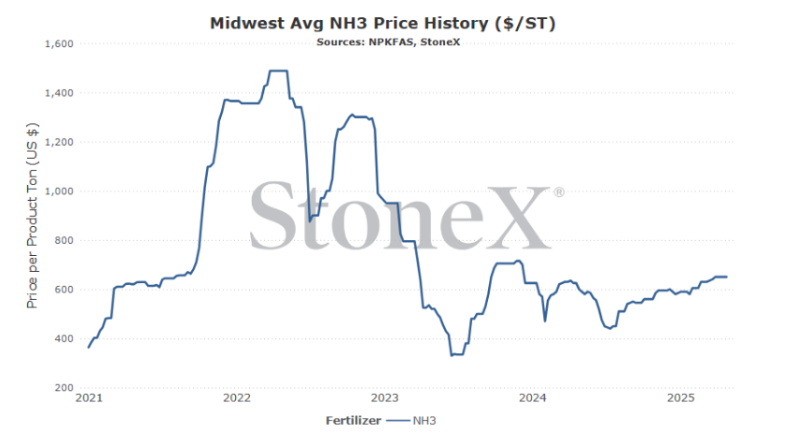
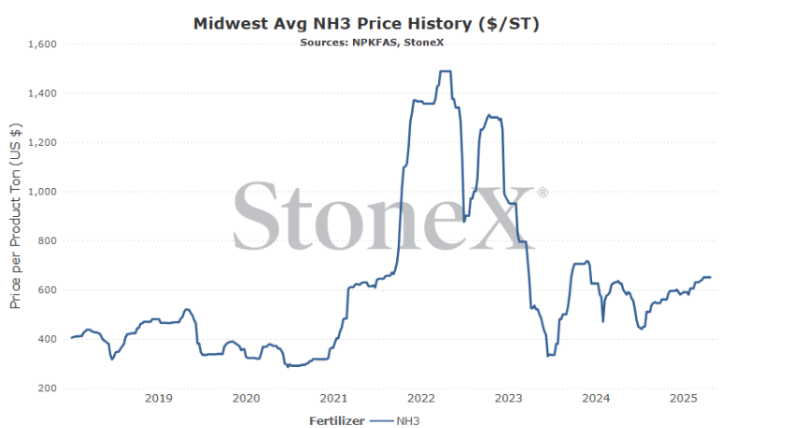
The first graph is the AVERAGE of the entire Midwest U.S. region. That means your local value WILL be different than what the graph reflects. Please do not take this into your retailer and say "why isn't my price the same as here". That is comparing apples to oranges. You might be on the cheaper or more expensive side of this graph. This doesn't take into account logistics/storage/interest/insurance/shrink/etc.
This graph looks at the price from a short ton and USD currency POV.
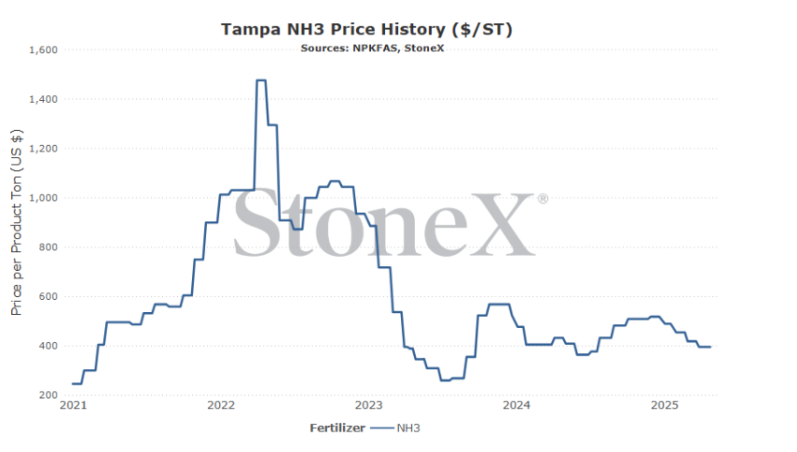
This second graph looks at the price set for Tampa NH3. This value does not have a high correlation to Midwest values. It is a talking point used when prices are rallying...yet somehow gets skipped on the way down. This price is more an indication of the global price. This price is set by two parties (purchaser - phosphate producer in Florida / seller - international producer providing NH3 to FL phosphate production).
This graph CAN be used as an indication of global market price direction/trends. This graph SHOULD NOT be used to determine a Midwest value. Tonnage is listed in short ton and currency in USD.
Normally by this time of year, you start to see sales competition heating up. Most of the preplant demand is firmly in the rear view mirror, planting is well underway, and the only thing left are the smaller pockets of demand for sidedress. That leads manufacturers to get aggressive on pricing those remaining areas in an attempt to further draw down ending supplies before the long summer.
Normally.
This year isn't normal. UAN is extremely hard to find. Urea values have been skyrocketing as demand switches over. Now, we are hearing more and more folks saying that NH3 is taking center stage for demand. Even for those that do not normally do a sidedress, they are considering it this year given the price savings. That could change "normal" price trends.
No doubt, the spring seasons was a success and helped to clear a lot of inventories. However, if enough demand switches to NH3, it is hard to see prices falling short term.
Eventually, we "should" see values drop as the focus shifts from spring to summer fill programs...but this spring is different. Demand is solid. Supplies are likely lower than normal. This should help support the market longer than we are used to.
At some point, the market will move beyond and have to have the difficult summer rest conversation...that just may take longer.
I'm hoping to see values start to fall in the next month, but I'm not confident.
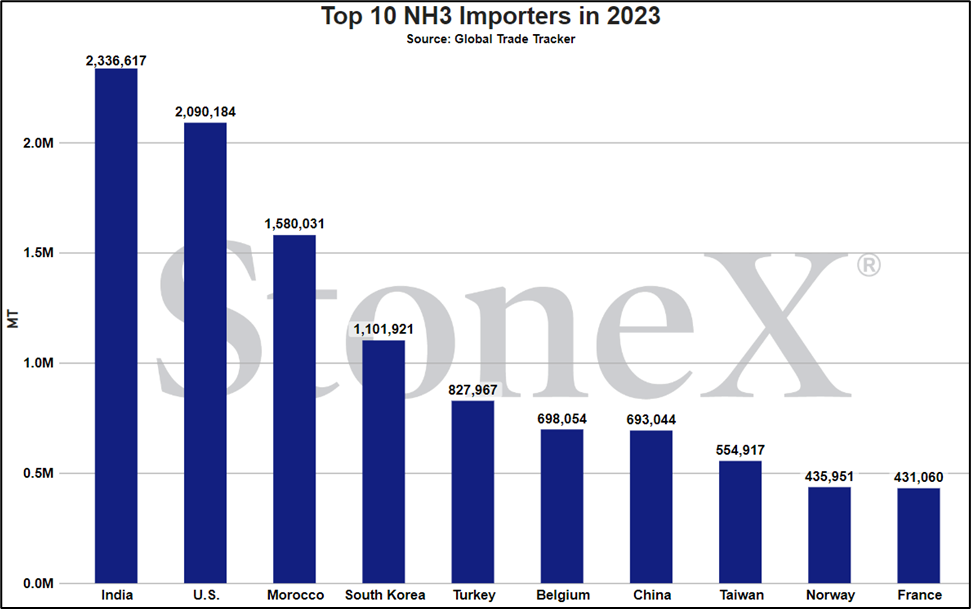
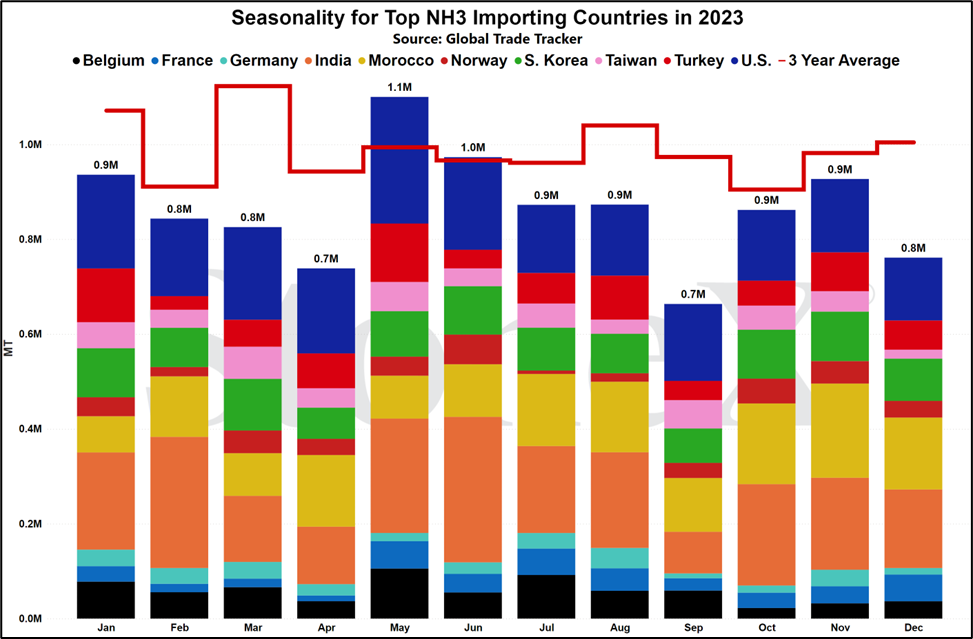
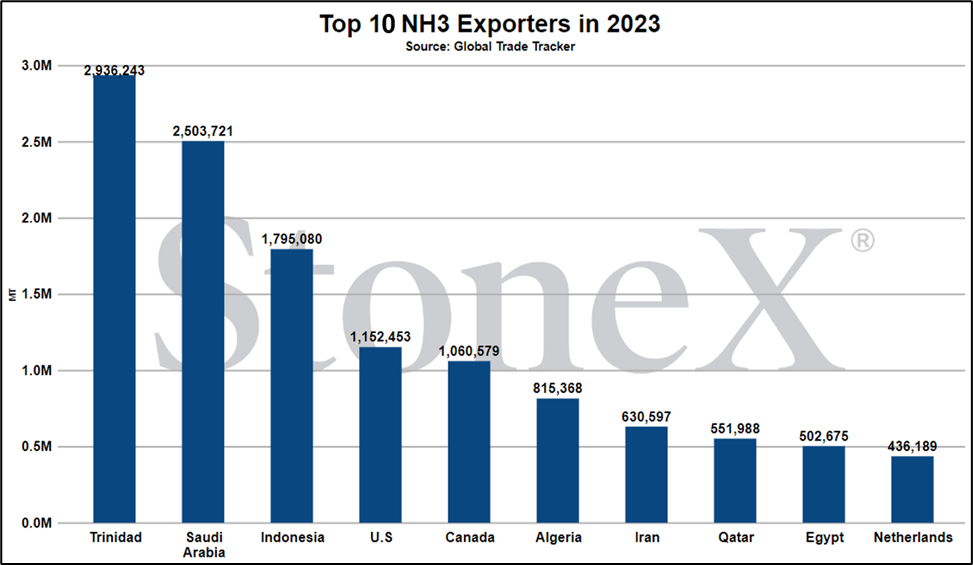
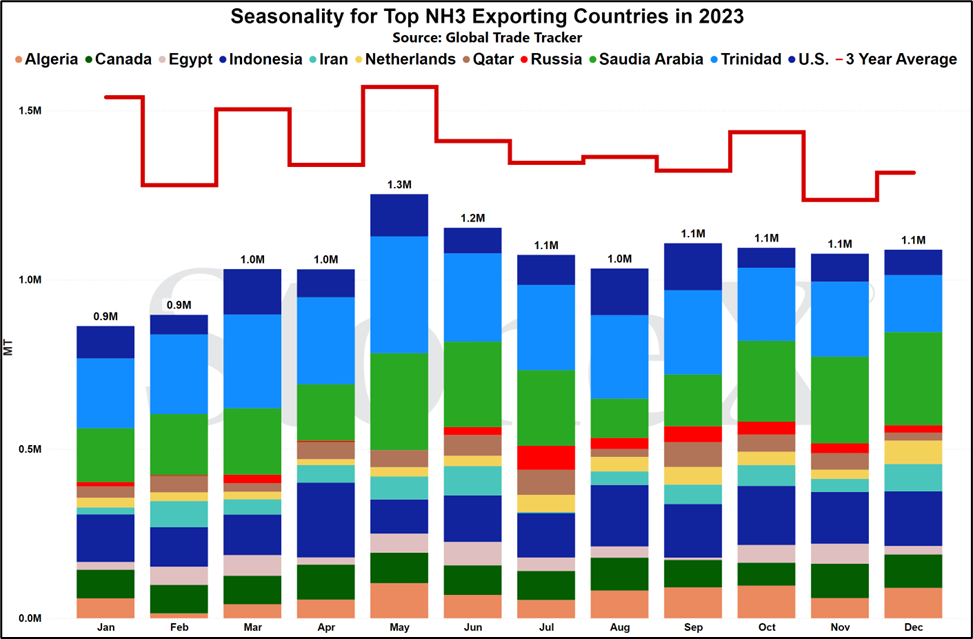
Global supplies remain mostly unchanged/tighter than normal
There has not been much to point to in terms of new happenings for global NH3.
Russian exports are still extremely low/non-existent as we haven't heard of their return. We continue to watch the news in hopes that their new facility in Taman will become operational. Recent agreements between Ukraine/Russia in terms of safe vessel passages would also help but to date, nothing new to report. That should mean the world's largest supplier of NH3 remains missing.
We believe that Trinidad continues to have input supply/production issues that is harming NH3 production/exports. News regarding tight natural gas supplies has been far and few between leading us to believe that the story of lower supplies continues. Fortunately, this should not be a long term event as supplies ebb and flow. We are just in an ebb cycle. Unfortunately, the longer they struggle, the less supply that is available to the world.
European production also continues to struggle with high gas pricing due to the lack of cheap Russian supplies. This is a story we do not expect to change in the near term. Even if normal relations were to return between Europe and Russia, repairs to the Nordstream pipeline are needed to return flows. That will not be a quick fix that far underwater.
Unfortunately, all of these events combine to raise the global NH3 price floor.
Fortunately, that does not mean that values cannot continue to fall from where they are today.
We need to continue to track these events. The longer they happen, the higher the price floor but if suddenly one or more were to start "correcting", watch out for bearish markets.
What does this mean for farmers?
Honestly, next to nothing.
Global NH3 markets have more to do with nitrogen production costs and industrial costs. For direct application farmers, domestic values have disconnected from the global story.
Still, worth watching because if world prices continue to trend lower, eventually domestic values will be forced to recognize them.
N.A. markets moves past preplant, focuses on sidedress and switched acres
With planting well underway across most of N.A., spring NH3 applications are now firmly in the rear view mirror.
Under normal conditions, this usually means NH3 prices starting to lower. The NH3 sidedress market is much smaller in regional and demand size. Given how late it happens, it becomes very attractive for domestic manufacturers to target.
One of the largest domestic nitrogen manufacturers fears is NH3 inventories. NH3 storage is a very finite asset. The last thing a nitrogen plant wants to do is consider shutting off all production because their NH3 storage is full and there is no demand in the marketplace. Given today's domestic margins, my guess is someone would be updating their resume if that happened.
So, it makes sense that these facilities target every piece of remaining demand by this time of year. Better to clear a few more tons that would otherwise be carried over. With fewer territories applying and buying, it becomes VERY competitive. Buyers can then start to play each supplier off each other. I'll buy at X, and they get it purchased. Next time, I'll buy at X less $5 - $10...and they get it purchased. They can continue to pressure the market.
But this isn't a normal spring, is it?
As you may have seen/heard, N.A. nitrogen is very tight. It has started with UAN where buyers are struggling to now find any product that can ship before June. That has cause urea values to skyrocket and inventories to shrink as demand switches over. Now, we are starting to hear more folks contemplate sidedress NH3 where it wouldn't normally happen. I cannot speak with any confidence of how easily this can happen. I've never done it or been around it in an area that doesn't normally do it but given how "cheap" and "well supplied" NH3 current is vs urea and UAN, it makes sense that more retailers/farmers consider the move.
If this trend continues, there is nowhere near as much of a need for prices to fall from competition. In this scenario, manufacturers have a lot more demand options and are more easily clearing inventories.
While this cannot last forever (eventually this will give way to summer), it certainly helps put suppliers are more firm footing.
What does this mean for farmers?
Normally, the switch from preplant demand to sidedress demand allows prices to correct lower as competition from suppliers heats up.
...normally...
This is not a normal spring. While I continue to hold out hope that later buyers will be rewarded, I'm not confident. The nitrogen market is too messed up today in a way never seen before. That doesn't mean that eventually summer price resets will win out, but for right now the market is seeing a lot more support than normal.
U.S. Midwest Wholesale price average
Vs 30 days ago - 0% or approximately $0
Vs 90 days ago - 7% or approximately $45 higher
Vs 6 months ago - 16% or approximately $90 higher
Vs 1 year ago - 8% or approximately $50 higher
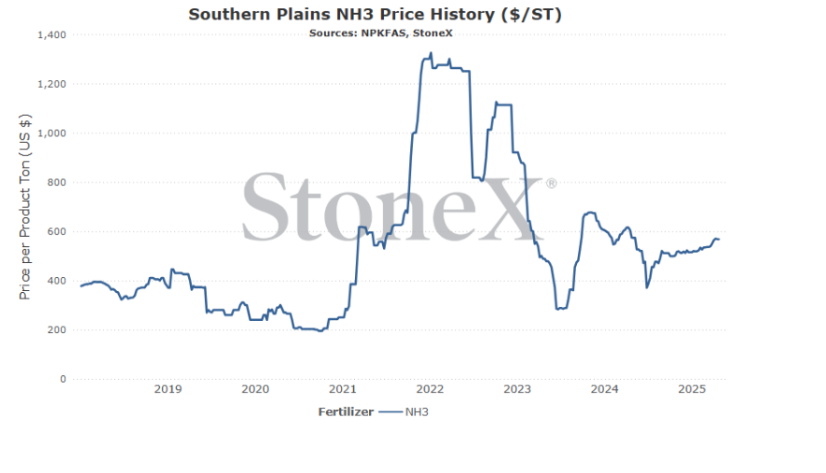
U.S. Southern Plains price average
Vs 30 days ago - 3% or approximately $18 higher
Vs 90 days ago - 9% or approximately $46 higher
Vs 6 months ago - 13% or approximately $66 higher
Vs 1 year ago --1% or approximately $6 lower
- Global supply issues persist - as long as we continue to see widespread production issues on NH3 globally, the price floor is going to be higher than normal. There are a lot of tons that should normally be supplied that are missing today. That does not mean price volatility gives way to nothing but higher prices, but it does mean that prices should not be able to dip as low as they normally would.
- N.A. demand spikes as farmers switch more to NH3 - this appears to be the scenario today. More and more farmers/retailers are looking to NH3 sidedress as a way to get around tight and high priced urea and UAN. If this happens in a big way, that will boost NH3 demand during a period that isn't used to it and could continue to push price ideas higher.
- Russia/Europe/Trinidad straighten out on production - of the 3, Trinidad is the one with the highest chance of improving. We see that as a short term production issue that will hopefully get fixed as it has done in the past. Russia is number 2 on the likely list as a lot of work/progress has been made to return. Europe, unfortunately, does not look likely...but is still a possibility. If/when any of the 3 returns, it is a boost of global supplies that should help pressure global price ideas.
- N.A. spring demand gives way to summer - right now, the market is in the heat of the battle. It is much easier to keep prices high when everyone is so busy they cannot think about pricing. However, eventually it will be too late to apply and the market will be forced to think about summer resets. Given the lack of farmer profitability this year as well as NH3's current high price, my guess is when the market finally has a chance to breath and look at where everything is, it will have them demanding lower prices.
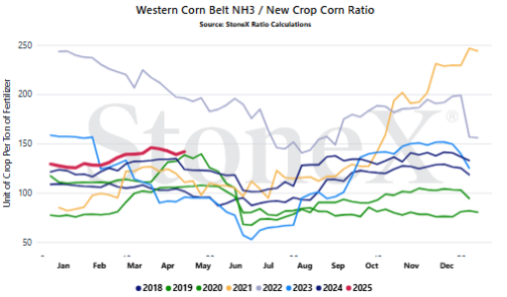
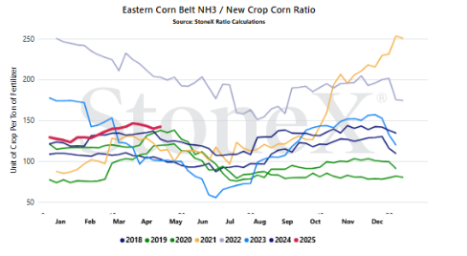
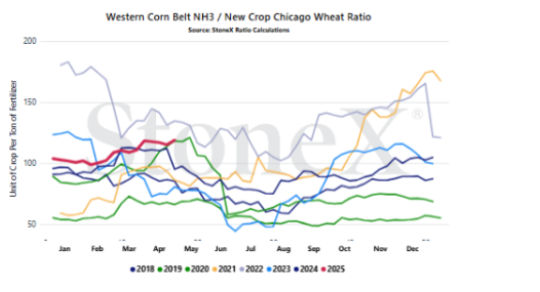
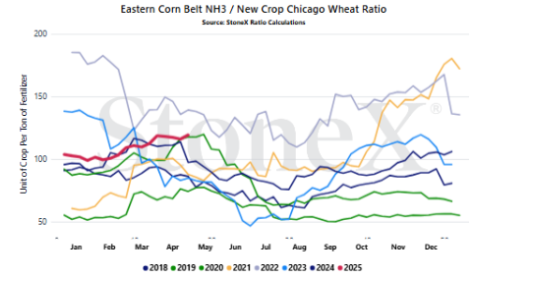
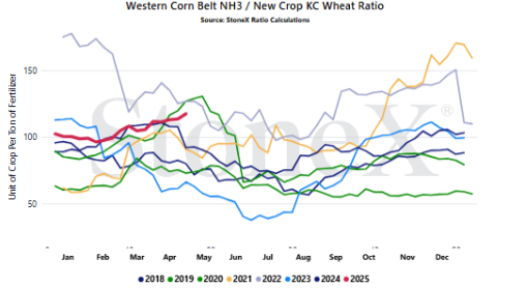
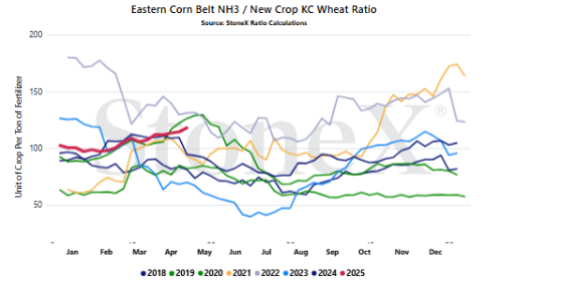
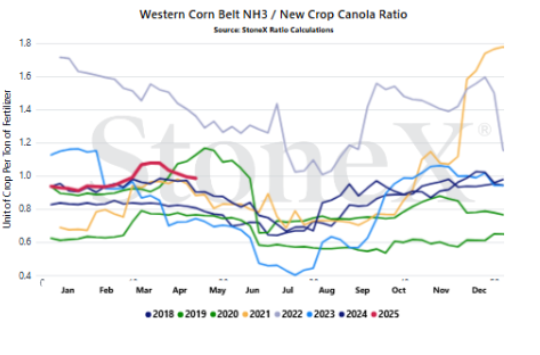
Where are the current NH3/grain ratio values today
We believe that only looking at the flat price of either grains or fertilizer can be misleading:
-
Only selling grain can hurt you if fertilizer prices rise substantially
-
Only buying fertilizer can hurt you if grain prices fall
We look at the ratio "value" to get a better indication of where we are or how many bushels of X does it take to pay for 1 ton of fertilizer.
Would you rather:
-
Spend 150 bushels to pay for 1 ton of potash
-
Spend 100 bushels to pay for 1 ton of NH3
When we compare the current ratio value against recent years, we start to see if we are high or low.
YOUR VALUES MAY LOOK DIFFERENT
This graph looks at the NOLA NH3 price vs the flat grain price. There are no logistics on either product. Your location will look different due to fertilizer logistical costs, grain basis, etc.
- Trinidad production rates - I list this first because I think it is the most likely event to happen short term. Trinidad's production has been hurting due to constrained natural gas flows. This is not a new event and normally works itself out. I'm hoping that follows historic stories and means they return which "should" pressure price ideas...however, nothing in life is guaranteed. The longer they are offline, the less supply available to the world.
- Russia's possible export return - the return of Russian NH3 (typical largest supplier to the world) is looking more promising. We continue to watch for any news regarding their Taman facility becoming operational. The fact that Ukraine/Russia have agreed to a safe vessel passage situation further helps the outlook (if it holds...). If/when Russia returns, it should mean very good things for global buyers.
- When does the N.A. market move from spring to summer - we are in the heat of a season that looks like it will last longer than normal given the overall nitrogen market. However, it will not last forever. At some point, as spring comes to a close, the market will need to start considering summer fill and fall prepay programs. They may be a little more emboldened on pricing given the situation, but buyers will have more to say on the matter. If they are too proud of prices, buyers may shun purchases and opt to wait. Enough of that happens and it can weigh on the market. On the flip side, maybe manufacturers will err toward lower prices in hopes of bringing demand forward. Going to be interesting...
- How do buyers react to NH3 price ideas this summer - ...which brings us to this. How will buyers react. There is normally just as much NH3 direct applied in the fall as there is in the spring. That does not mean that fall applicators have to go in the fall. If they see prices as too high, we could see a lot of folks drag their feet to take their chances next spring. If that happens, that pushes the pressure back on the manufacturer. It is still far too early to make these outlook calls, but it is something we need to start talking about.
StoneX Ratio Calculation
The ratio calculation is derived from Bloomberg historical grains values as well as fertilizer values from StoneX, NPKFAS, and Argus.
The calculation is simply dividing the fertilizer price by each grain price.
All data was sourced from StoneX unless otherwise noted.