Morning Ferrous Markets
Market Overview
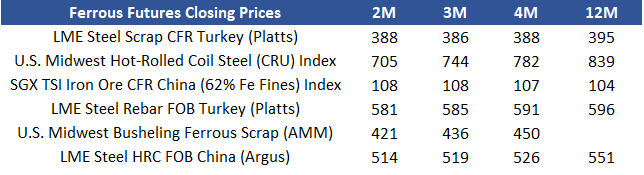
Iron ore futures rebounded on Thursday amid speculation that China will announce additional stimulus measures in its upcoming third plenum following disappointing June inflation data. The benchmark August iron ore on the Singapore Exchange rose by 2.1% to $107.5 per ton. Despite the rebound driven by stimulus expectations, the market remains under pressure due to widening losses among steelmakers, and rising steel inventories. In the U.S. Midwest Domestic HRC Futures market, the 4-month contract (HRC4) rose to 782, and the 12-month contract (HRC12) increased to 839. The U.S. has implemented new tariffs on steel and aluminum shipments from Mexico to curb Chinese transshipment. European LME Steel Scrap CFR futures saw stability, with the 3-month contract (JBO3) increasing slightly to 386, and the 12-month contract (JBO12) remaining at 394. US producer prices rose by 0.2% in June, slightly more than forecast, driven by higher margins at service providers.
Upcoming Data Releases


North American (US) HRC Steel Market
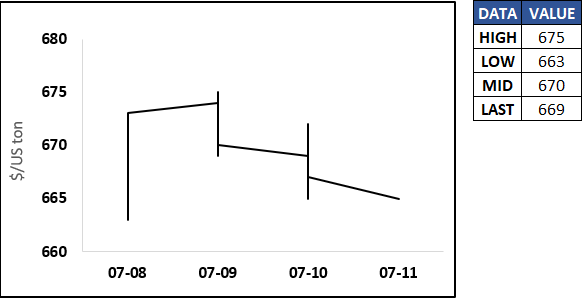
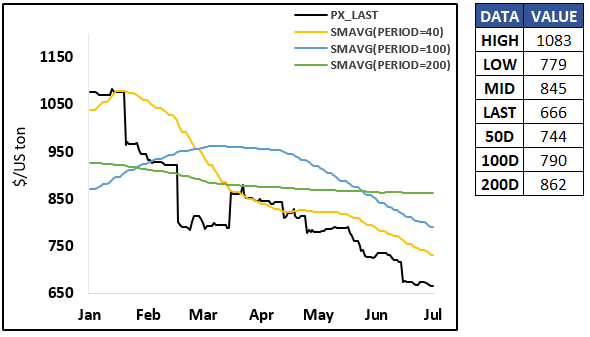
In the U.S. Midwest Domestic HRC Futures market, July prices remain even at 666, while the 4-month contract (HRC4) and 12-month contract (HRC12) rose slightly to 782 and 839, respectively. Recent developments include new U.S. tariffs on steel and aluminum shipments from Mexico to curb Chinese transshipment, aiming to protect domestic industries. The RSI values are generally mixed, but maintained from yesterday's readings indicating neither overbought, nor oversold. However, there remains excess capacity, increasing pipeline capacity, increasing exports, and lagging demand in domestic markets. JPM’s Bill Peterson sees steel prices moving lower over the near term due to infrastructure-related demand not expected to materialize until 2025, wind projects pushed out to 2026+ and excess inventory still in the system.
On the EAF side, input domestic market prices for shredded and P&S dropped by an average of $20/gt in June and have declined further in July. Shredded scrap is currently priced between $365 and $380/mt, depending on the region, while P&S is approximately $340/mt outside the Great Lakes. Prices for all obsolescent grades have been falling since February.
HRC Front Month 3 Day Trend
StoneX & Bloomberg
HRC Front Month 6 Month Price Trend
StoneX & Bloomberg
Chinese Steel & Iron Ore Markets
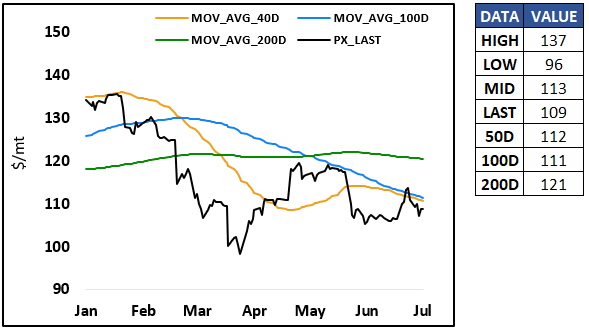
Iron ore futures rebounded on Thursday amid speculation that China will announce additional stimulus in its third plenum after disappointing June inflation data. The most-traded September iron ore contract on the Dalian Commodity Exchange increased by 0.43% to 825 yuan ($113.45) per metric ton, while the benchmark August iron ore on the Singapore Exchange rose by 2.1% to $107.5 per ton. Despite this rebound driven by stimulus bets, the iron ore market remains under pressure due to weak fundamentals, including widening losses among steelmakers, rising steel inventories, and signs of declining hot metal output.
In the Asian market, SGX TSI Iron Ore Futures showed varied performance across different contracts. The 3-month contract (SCO3) decreased by 2 points to 106, the 4-month contract (SCO4) remained unchanged at 106, and the 12-month contract (SCO12) dropped by 4 points to 101.
Key technical indicators for these contracts show mixed signals. The Moving Average Convergence Divergence (MACD) values indicate an improving trend across all observed contracts, while the Relative Strength Index (RSI) values range from 47.44 to 49.59, indicating the market is neither overbought nor oversold. The Directional Movement Index (DMI) values suggest varied trend strengths, with the DI+ ranging from 15.0 to 29.1 and the DI- ranging from 23.7 to 39.5. Prices are generally below the 200-day moving average, indicating a bearish long-term trend but with short-term improvements.
Overall, the market remains cautious with potential for further fluctuations based on upcoming economic policies from China.
SGX Iron Ore CFR China (62%) Futures
StoneX & Bloomberg
European Steel and Steel Scrap Markets
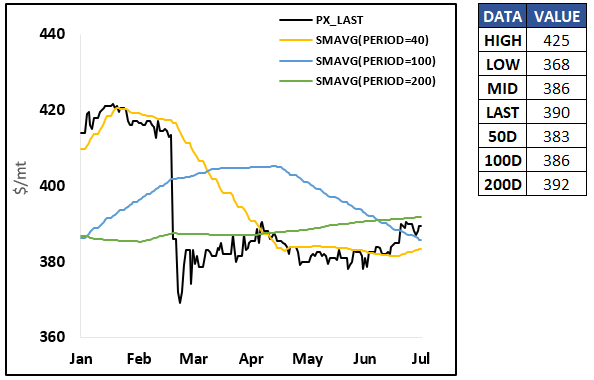
The Turkish scrap market has shown stability in export prices over the past few months, despite declines in domestic markets. The prices for the current futures contracts reflect this stability, with the LME Steel Scrap CFR August contract (JBO2) trading at $392/mt, October contract (JBO4) at $388/mt, and December contract (JBO6) at $396/mt. Export prices for HMS 80/20 have ranged between $380 and $390 per metric ton (mt) on a CFR basis. Shredded scrap and Plate & Structural (P&S) are included in cargoes at a premium of $20/mt, resulting in current prices of about $390/mt for shredded scrap and $410/mt CFR for P&S.
A scrap shortage in Northern Europe has prompted Turkey, the world's largest importer of scrap requiring 1.5 to 2 million mt per month, to turn to North America to fill the gap. Despite the expectation for cheaper prices in Turkey due to declining U.S. market prices, export prices have remained stable. North American scrap prices had been higher than export prices on an FOB basis over the past two to three months, but domestic price drops have allowed export prices to align more closely with domestic prices.
Looking forward, exporters predict a $5 increase in export prices, followed by potential declines as European summer vacations impact economic activity. Some sources expect stable export prices along the East Coast, keeping them steady despite drops in interior prices. Export prices are likely to remain stable until mid-September, with no significant increases expected until after the U.S. presidential election. The ongoing trend of stable export prices, despite falling domestic prices, is expected to continue in the short term.
Turkish Scrap 1st Month Futures
StoneX & Bloomberg
Current Prices