Quarterly Commodities Outlook is available for free now.  Download your report  →

StoneX logo

Northern Arc gains momentum in Brazilian foreign trade

By: StoneX Intelligence Brazil, StoneX Intelligence Brazil

Northern Arc gains momentum in Brazilian foreign trade 
 
Ana Luiza Lodi
Felipe Sawaia
felipe.sawaia@stonex.com
João Pedro Lopes
  Nuria Brito
  Luigi Bezzon
Logistical improvements provided an increase in grain and fertilizer flow through the Northern Arc, but animal protein has not yet followed the same trend 
 
Soybean

Brazil is the world's largest soybean exporter and should continue to occupy this position as production grows. 

Traditionally, most of Brazilian soybean leaves the country through ports in the Southeast and South, especially Santos, from where most of the oilseed is shipped out. 

However, these ports are far from the producing regions in the Center and North of the country. The state of Mato Grosso stands out as the largest national producer of soybeans, but its distance from ports is large, resulting in major price discounts for producers. 

Even though the more traditional ports continue to sell most of the Brazilian soybean, the terminals from the so-called Northern Arc have gained market share year after year. Investments in the terminals themselves, as well as in the logistics to reach them, such as paving highway BR-163, have allowed exports to growth in this region, by reducing the cost of transport. 

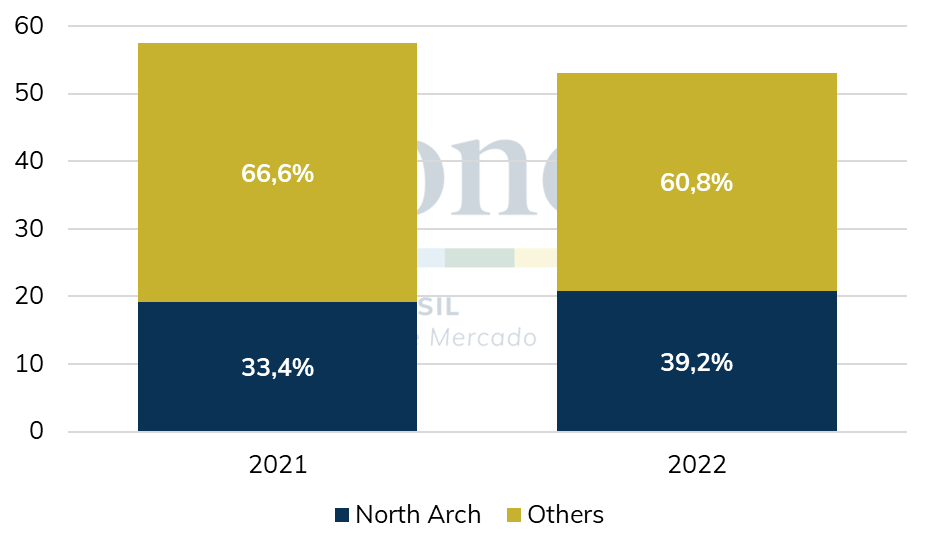
In 2022, it is observed that soybean exports are weaker than in the same period last year. In the first half of this year, 53 million tonnes were shipped, against 57.5 million in the first half of 2021. In addition to Brazilian production's drop this year because of the crop failures mainly in the South, there are concerns on the demand side, such as the Chinese appetite, as the country adopts zero tolerance against Covid-19, in addition to the macroeconomic context of a possible recession around the world. 

On the other hand, even with this drop in soybean exports in the first half of the year, Northern Arc ports increased their share of the total, both in relative and absolute terms. By June 2022, 20.8 million tonnes of soybeans had been shipped from there, or 39.2% of the total. In the same period of 2021, exports through the Northern Arc Norte accounted for 33.4% of the total, reaching a volume of 19.2 million tonnes. 

In any case, even though the Northern Arc is increasingly consolidated in Brazilian soybean exports, that does not mean that ports in the South and Southeast are losing their importance. Through the port of Santos alone, larger volumes of soybean were shipped than from the entire Northern Arc in the first half of 2022 and 2021. However, as the 2021/22 crop failure was concentrated in the south of the country, traditional ports ended up being more affected by the lower availability of the oilseed in 2022, with emphasis on lower shipments in Rio Grande and Paranaguá. 

Brazilian soybean exports in the first half of 2022 (million tonnes) 

 
image-20220802221113-1
Source: Comex Stat. Design: StoneX. 
 

Corn

Brazil stands out in the international corn trade, frequently being among the three main global exporters. Iran, Egypt, and Spain are major destinations for corn exported by Brazil and, therefore, given the greater proximity of these countries, it would be natural for an increase in flow through ports located in the Northern region of Brazil as the region's logistics infrastructure develops. 

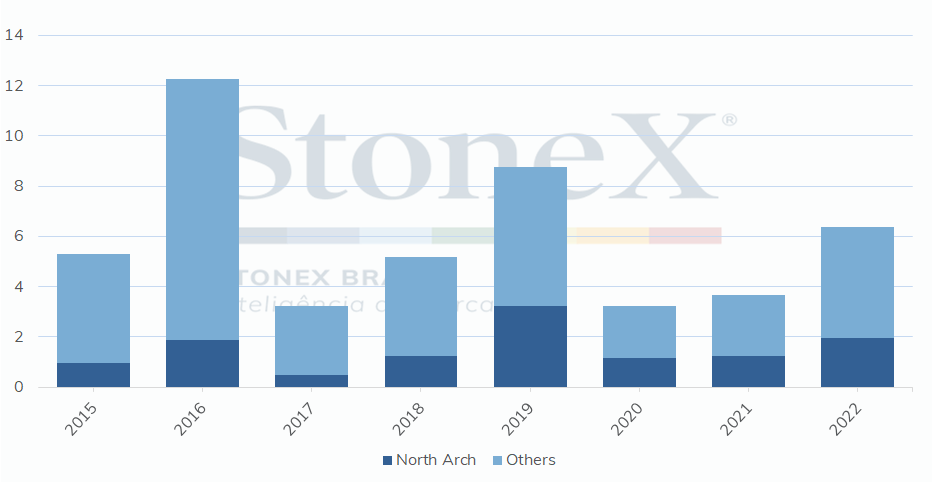
However, when we look at shipments for the first half of this year, one can get the impression that the country is not increasing its flows through the Northern Arc. In the first six months of 2022, 1.9 million tonnes of corn left the country through ports in the region, a volume that was 12.8% higher than the average of the last four years. However, the total volume shipped reached 6.4 million tonnes, 21.9% more than the average of the last four years, suggesting that the growth of shipments through the ports of the region was lower than the national average. 

On the other hand, it is important to make some considerations. Corn exports from Brazil are not truly relevant in the first half of the year, since most of the first crop's production, which is harvested at the beginning of the year, is used to supply the domestic market. In addition, most of the volume from the summer crop is produced in the South and Southeast regions. Therefore, it is not prudent to rely solely on data referring to the first half of the year to outline a profile of Brazilian shipments. 

In the calendar year, there has been a more expressive increase in shipments from the Northern Arc over the last few years. Between 2015 and 2018, Brazil exported an average of 6.2 million tonne of corn through the Northern Arc per year, while in 2019 and 2020 this volume exceeded 14 million. In addition to the growth in volume, it is also worth mentioning the increase in participation, which went from 24% between 2015 and 2018, to 33% in 2019 and 41% in 2020. In 2021, the volume of shipments through the Northern Arc declined, but this drop was observed in exports as a whole, a movement caused by the 2020/21 safrinha crop failure. However, despite the decline in shipments, the share of the Northern Arc rose to 47% that year. 

For 2022, the perspective is that shipments from the region will grow again. In recent years, more than 70% of the corn shipped through the Northern Arc came from Mato Grosso and, amid expectations of record production in the state in 2021/22, the trend is that the flow of corn through the region's ports will also be high. 

Brazilian corn exports in the first half of 2022 (million tonnes) 

 
image-20220802221154-2
Source: Comex Stat. Design: StoneX. 

Wheat

In the case of wheat imports, in recent years there has also been a growing participation in Northern Arc ports, especially Fortaleza and Salvador. In 2022 (Jan-July) the Northern Arc's share was 52% (1.54 million tonnes) in total imports. 

The increased share of ports in this region is of significant importance for the wheat logistics chain, as it facilitates distribution to mills in the Northeast region, which, after the Southeast, represents the largest consuming region in the country. 

Of the ports in this region, Fortaleza stands out with wheat imports of 583,000 tonnes accumulated in 2022 up until July, representing 18.2% of total wheat that entered Brazil considering all ports, and 38% considering the Northern Arc. Salvador comes in second, receiving about 343,000 tonnes, which corresponds to 10.7% of the total that entered Brazil and 22.3% of what went through the Northern Arc. 

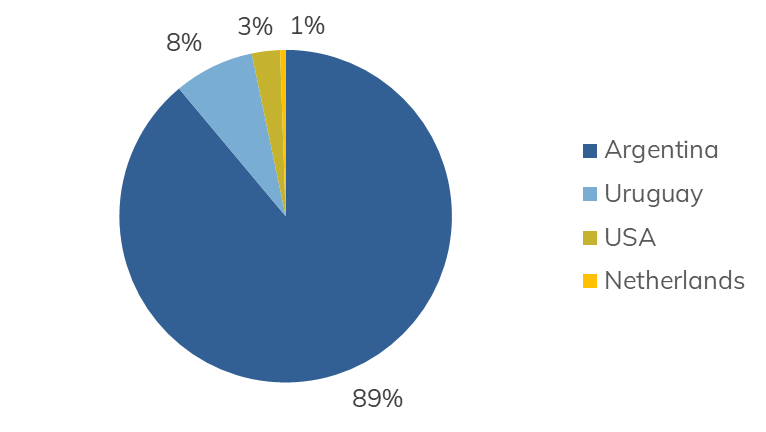
Regarding the origin of wheat cereal imported by the region's ports, most (89%) comes from Argentina, Brazil's main supplier. Compared to the total amount of wheat that enters Brazil, the port of Fortaleza receives 16.5% of Argentine wheat, second only to the port of Santos, which receives 19%.  

Origin of wheat imports (January-July/2022) – Northern Arc

image-20220802221250-3

Source: Comex Stat. NOTE: Northern Arc ports include Fortaleza, Salvador, Suape, Natal, Belém, Cabedelo, São Luís, Recife, Porto de Manaus and Maceió. Design: StoneX. 

Fertilizers

Taking advantage of the so-called “return freight,” imports of inputs for crops have also gained space in the Northern Arc ports over the last few months. Generally, when importers close the purchase of fertilizers and pesticides, they use the inverse logistics of exporting grains to internalize the purchased product. 

In practical terms, the truck or train that arrives loaded with products to unload at ports usually returns to the interior of the country loaded with inputs that will be used in the crops. Therefore, as most of the acquisitions of these inputs occur through barter, that is, with the grain serving as a “bargaining currency” in the negotiation, agents are able to predict where the grains will be sent to, and from there define the destination port of these inputs. 

As for grains, although the Center-South is the main route for input internalization, the ports of the Northern Arc, such as Santarém (PA), Belém (PA) and São Luís (MA) have increased their relative participation as the region's logistics chain is becoming more sophisticated, expanding storage capacity, and improving infrastructure. 

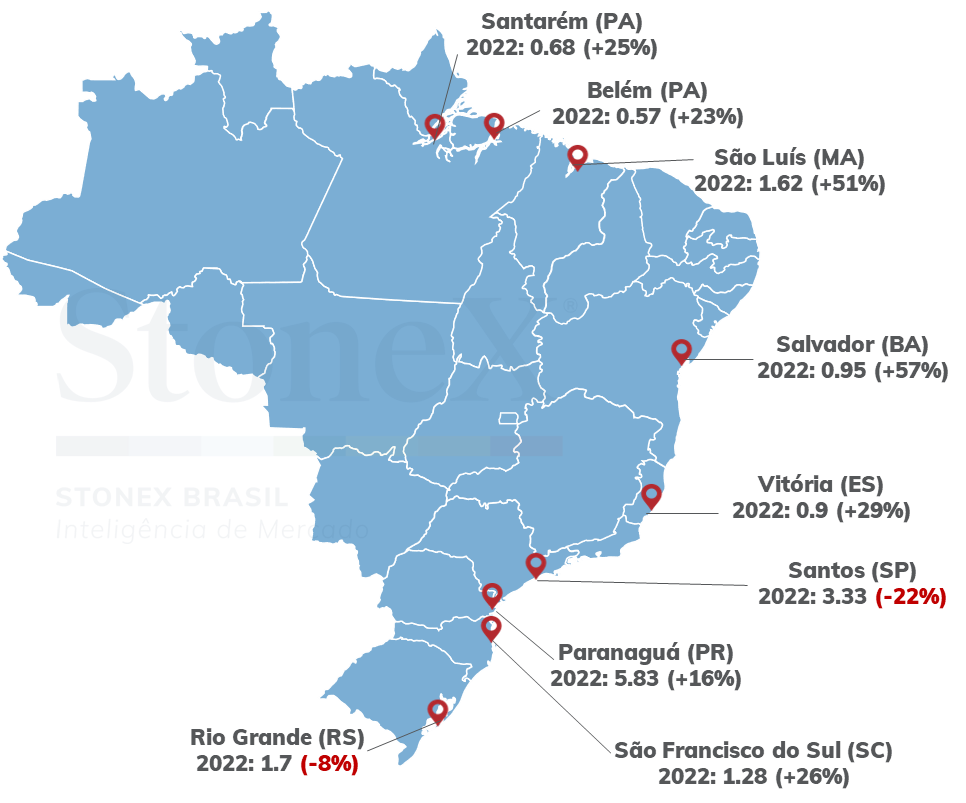
In the first half of this year, fertilizer imports were a record for the period, totaling more than 17.2 million tonnes. Of this volume, 25% were unloaded at ports in the Northern Arc, while the majority, 75%, came through terminals in the South/Southeast. However, the volume imported through the Northern Arc had a 39% increase this year, compared to the first half of last year, while imports from the South/Southeast advanced only 3%. 

Brazilian fertilizer imports in the first half of 2022 from the main ports (million tonnes)  

 
image-20220802221342-4
Source: Comex Stat. Design: StoneX. 
 
Beef

Just like in the grain and oilseed sector, a large part of Brazilian beef exports originates in nearby states or in the North region itself. In the first six months of 2022, for example, shipments from Mato Grosso, Rondônia, Pará, Tocantins and Maranhão totaled 41.3% of the total. In this sense, it was to be expected that the logistical improvements described above would be boosting the growth of beef shipments in ports of the Northern Arc, similarly to what happens with soybean, corn, and other agricultural products. 

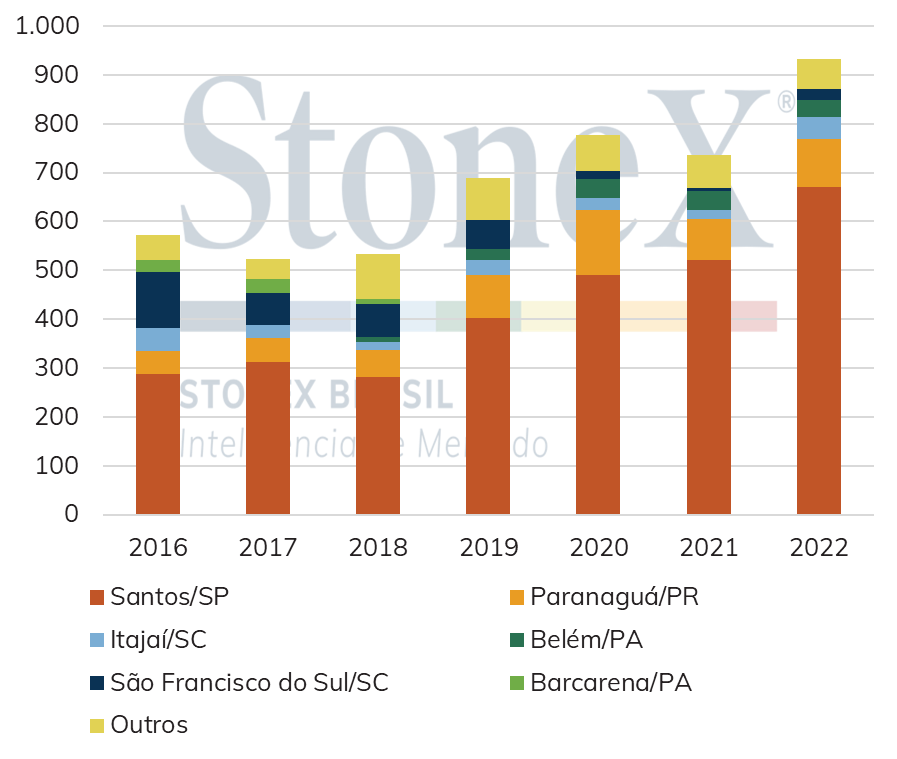
However, this is not what is seen. Once again using the period of the first six months of this year, only 3.7% of shipments took place in ports in the Northern region, with almost all of this percentage coming from the Port of Belém. Out of the rest, the vast majority of beef exports were concentrated in the Port of Santos (71.9%), followed by Paranaguá (10.6%), Itajaí (4.8%) and a few other ports, mostly in the Southern region of the country. 

The main reason why meatpackers do not choose Northern Arc ports even when transport costs are lower is that they do not have the necessary infrastructure to store large quantities of refrigerated products. To maintain the meat's quality, it must be kept either in refrigerated chambers or in reefer containers, a specific type of container that allows temperature control. In the ports of the Northern region, there is a very limited number of cameras and outlets, which are necessary to keep the reefers containers working. 

For example, a study carried out by ESALQ in late 2017 found that the Port of Santos had 7,179 outlets for reefer containers and five cold rooms. The Port of Belém, the best equipped in the Northern Arc, had only 56 outlets and only one cold room. 

Even when a meatpacker manages to guarantee that its product will be stored in one of the ports of the Northern region, it still faces a series of difficulties not seen in the South and Southeast regions. We highlight the low frequency of ships, the reduced number of specialized workers and delays in shipments. These factors increase logistical costs as they result in high expenses with labor and as containers need to be held up, which are inhibiting factors for the use of the Northern Arc. 

Brazilian beef exports in the first half of 2022 by port (million tonnes)  
image 45316
Source: Comex Stat. Design: StoneX. 
 
  • Grains & Oilseeds

The StoneX Group Inc. group of companies provides financial services worldwide through its subsidiaries, including physical commodities, securities, exchange-traded and over-the-counter derivatives, risk management, global payments and foreign exchange products in accordance with applicable law in the jurisdictions where services are provided. References to over-the-counter (“OTC”) products or swaps are made on behalf of StoneX Markets LLC (“SXM”), a member of the National Futures Association (“NFA”) and provisionally registered with the U.S. Commodity Futures Trading Commission (“CFTC”) as a swap dealer. SXM’s products are designed only for individuals or firms who qualify under CFTC rules as an ‘Eligible Contract Participant’ (“ECP”) and who have been accepted as customers of SXM. StoneX Financial Inc. (“SFI”) is a member of FINRA/NFA/SIPC and registered with the MSRB. SFI is registered with the U.S. Securities and Exchange Commission (“SEC”) as a Broker-Dealer and with the CFTC as a Futures Commission Merchant and Commodity Trading Adviser. References to securities trading are made on behalf of the BD Division of SFI and are intended only for an audience of institutional clients as defined by FINRA Rule 4512(c). References to exchange-traded futures and options are made on behalf of the FCM Division of SFI . StoneX is a trading name of StoneX Financial Ltd (“SFL”). SFL is registered in England and Wales, Company No. 5616586. SFL is authorized and regulated by the Financial Conduct Authority [FRN 446717] to provide to professional and eligible customers including: arrangement, execution and, where required, clearing derivative transactions in exchange traded futures and options. SFL is also authorised to engage in the arrangement and execution of transactions in certain OTC products, certain securities trading, precious metals trading and payment services to eligible customers. SFL is authorised & regulated by the Financial Conduct Authority under the Payment Services Regulations 2017 for the provision of payment services. SFL is a category 1 ring-dealing member of the London Metal Exchange. In addition SFL also engages in other physically delivered commodities business and other general business activities which are unregulated and not required to be authorised by the Financial Conduct Authority. StoneX Group Inc. acts as agent for SFL in New York with respect to its payments services business. StoneX APAC Pte. Ltd. acts as agent for SFL in Singapore with respect to its payments services business. ‘StoneX’ is the trade name used by StoneX Group Inc. and all its associated entities and subsidiaries.
 
Trading swaps and over-the-counter derivatives, exchange-traded derivatives and options and securities involves substantial risk and is not suitable for all investors. Past performance of any futures or option is not indicative of future success. Indicators are not a trading system and are not published as a specific trade recommendation. The information herein is not a recommendation to trade nor investment research or an offer to buy or sell any derivative or security. It does not take into account your particular investment objectives, financial situation or needs and does not create a binding obligation on any of the StoneX group of companies to enter into any transaction with you. You are advised to perform an independent investigation of any transaction to determine whether any transaction is suitable for you. No part of this material may be copied, photocopied or duplicated in any form by any means or redistributed without the prior written consent of StoneX Group Inc.
 
© 2026 StoneX Group Inc. All Rights Reserved.

Satellite view of Earth at night showing illuminated cities across Asia and the Middle East

Discover more insights

Our subscribers have access to comprehensive market analysis from StoneX spanning commodities, equities, currencies and more.

Related articles for Grains & Oilseeds

Perspective: Morning Commentary for August 11

August 11 – It was generally a quiet night for the markets until early this morning when a headline hit that Iran and Oman were close to reaching a deal. Stock futures rallied, while the dollar index followed Treasury yields lower, along with active selling in the energy- and food-based commodities. The headline had limited impact though in a world that has become skeptical of promises of peace. Stock futures remain steady to firmer at this hour, while the VIX trades near 16 – just above 2026 lows. The dollar index is trading near 99.8 this morning, after recovering from its early morning selloff over the following hour of trade. Yields on 10-year Treasuries are trading near 4.69%, while yields on 2-year Treasuries trade near 4.22%. WTI crude oil is trading near $82 per barrel at this hour, while Brent trades near $88. The grain and oilseed markets are mostly weaker, after failing to recover from this morning’s early selloff that started in the crude oil market.

Arlan Suderman
Arlan Suderman
  • Grains & Oilseeds
  • Energy
  • Dairy
  • Renewable Fuels
  • Cocoa
  • Coffee
  • Cotton
  • Sugar
  • Meats & Livestock
  • Forest Products

Perspective: Morning Commentary for August 10

August 10 – The world commodity markets and economy remains at risk amid two wars this morning. Tensions continue to escalate in both the Middle East and the Black Sea – risking pulling other countries into the conflicts. Stocks are down modestly this morning as we start a week of trade in which we’ll see key inflation and retail sales data following a weak jobs report this past Friday. Yet, stocks continue to trade just below record high levels, with the VIX trading near 2026 lows just above 15. The dollar index is trading near 99.7. Yields on 10-year Treasuries are trading near 4.68%, while yields on 2-year Treasuries are trading near 4.23%. The energy and food-based markets are firmer today amid the escalated risks. WTI crude oil is trading near $80, while Brent trades near $85 per barrel. Double-digit gains in the winter wheat markets lead the way for higher grain and oilseed prices.

Arlan Suderman
Arlan Suderman
  • Grains & Oilseeds
  • Energy
  • Dairy
  • Renewable Fuels
  • Cocoa
  • Coffee
  • Cotton
  • Sugar
  • Meats & Livestock
  • Forest Products

Perspective: Mid-Day Commentary for August 7

August 7 – Stocks are looking to end a strong week on a strong note, with the major indexes all in the green at the time of writing. The VIX touched a nearly seven-month low earlier in the session and remains muted as it hovers just below the 15-mark as this morning’s ugly labor market data helps ease hawkish Fed jitters. The dollar has rebounded from its nearly two-month low earlier in the session but remains in the red on the day, trading at 99.55 at the time of writing. Treasuries have had a very volatile day, with yields tanking following this morning’s Non-Farm Payrolls release but bouncing back into midday, with 30-year yields now trading at 5.209%, 10-year yields trading at 4.654%, and 2-year yields trading at 4.204%. Crude oil has risen from the morning lows as traders eye the weekend market closure for potential geopolitical developments, with nearby WTI now down only 0.2% on the day to trade around $78.10 and nearby Brent breaking into the green, up 1.25% on the day to trade above $83.50. The ags are largely mixed, with the grains and oilseeds mostly in the green, save for a mixed picture in the soy complex, while live and feeder cattle futures move in opposite directions, with the former adding to yesterday’s sharp losses and the latter attempting a rebound.

Mike Castle
Mike Castle
  • Grains & Oilseeds
StoneX: We open markets

Our market expertise, advanced platforms, global reach, culture of full transparency and commitment to our clients’ success all set us apart in the financial marketplace.

Reach

With access to 40+ derivatives exchanges, 180+ foreign exchange markets, nearly every global securities marketplace and numerous bi-lateral liquidity venues, StoneX’s digital network and deep relationships can take clients anywhere they want to go.

Transparency

As a publicly traded company meeting the highest standards of regulatory compliance in the markets we serve; our financials and record of accomplishment are matters of public record. StoneX’s commitment to “doing the right thing over the easy thing” sets us apart in the industry and helps us build respect, client trust and new partnerships.

Expertise

From our proprietary Market Intelligence platform, to “boots on the ground” expertise from award-winning traders and professionals, we connect our clients directly to actionable insights they can use to make more informed decisions and achieve their goals in the global markets.