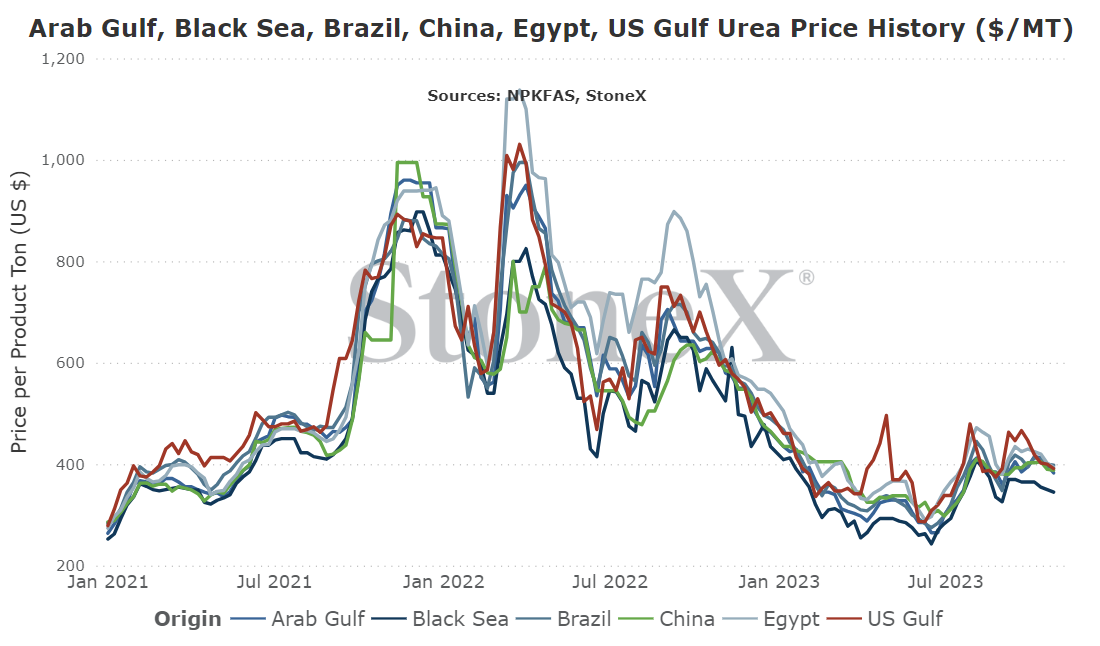
India stepped into the global urea purchase portal and locked up 1.65MMT. That is "million metric ton" in case you were wondering. That is a lot of tonnage...yet the impact was almost non-existent. If a 1.65MMT purchase isn't enough to rally price ideas, what will?
For the remainder of 2023, it feels like values will be flat to soft as a lack of demand at current price levels will put pressure on sellers.
However, a word of caution. I do not think we are talking about a downside price scenario in the triple digits. While anything is possible, I struggle to see that outcome. Now, a triple digit upside potential IS in the cards if the Israel/Palestine/Middle East situation balloons out of control. So this makes for an interesting outlook:
What has the bigger price potential - upside/bullish
What has the higher likelihood of happening - downside/bearish
It only takes one travesty to change the entire outlook of a fertilizer.
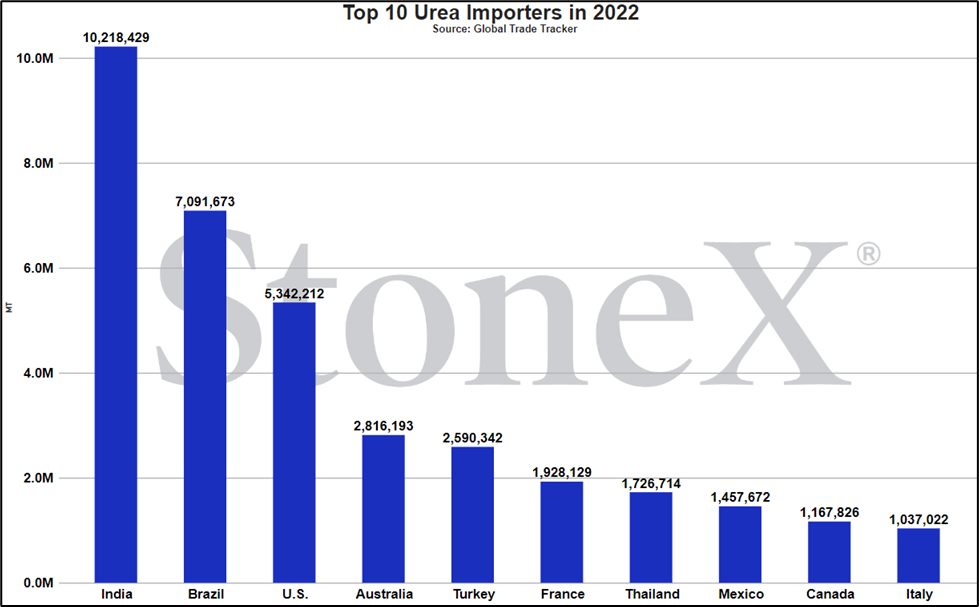
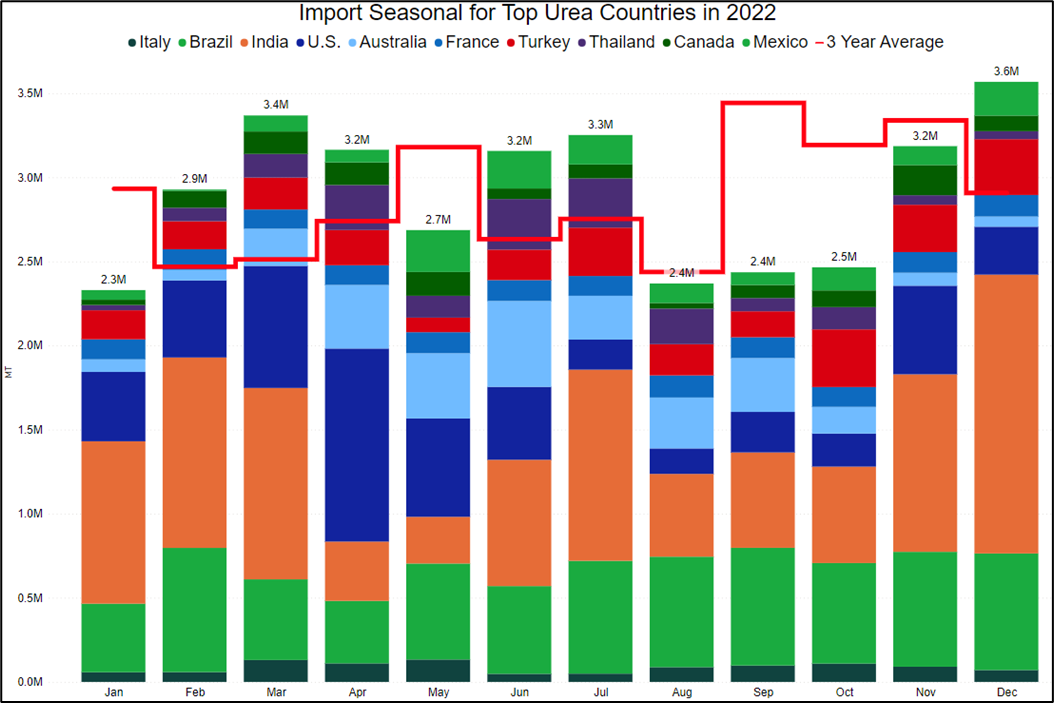
I sure wish this wasn't a topic that I was going to cover on every single fertilizer. If I wasn't covering it, it would mean it was because it didn't happen...unfortunately we live in a world where it did.
So the main question folks have had following the attacks by Palestine was "how does this impact the urea market". Directly, it didn't. Neither country produces urea so there is no impact to the direct urea S&D. However, it was the indirect situation that we have been watching.
Following Palestine attacking Israel, global energy markets took off higher Monday morning. That was no different for natural gas markets. We have spent so many months discussing European production rates and Dutch TTF values. Well, Dutch TTF values rose. Winter months had been sliding on lowered demand and full inventories. Just before the attack, prices had been seen dipping into the $13MMbtu range and we were getting excited that even more production would be coming online/operating rates increasing on cheaper inputs. That excitement was dashed very quickly.
Today, the urea market has been fortunate that Dutch TTF values have become stagnant in the $17 - $18MMbtu range. That input value is not so high that we expect any production to turn off. However, we also do not expect any further production restarts. Effectively, it stalled the marketplace.
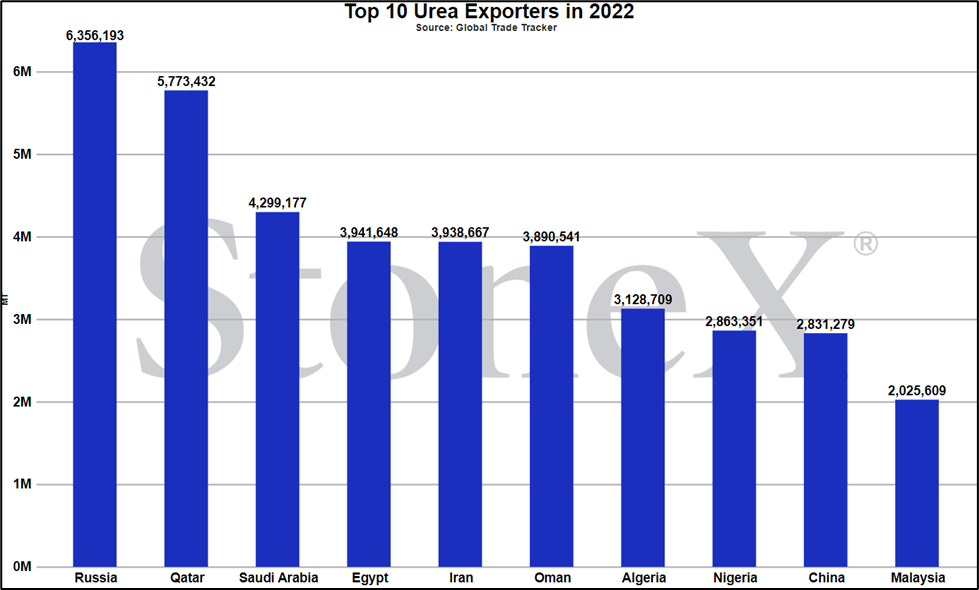
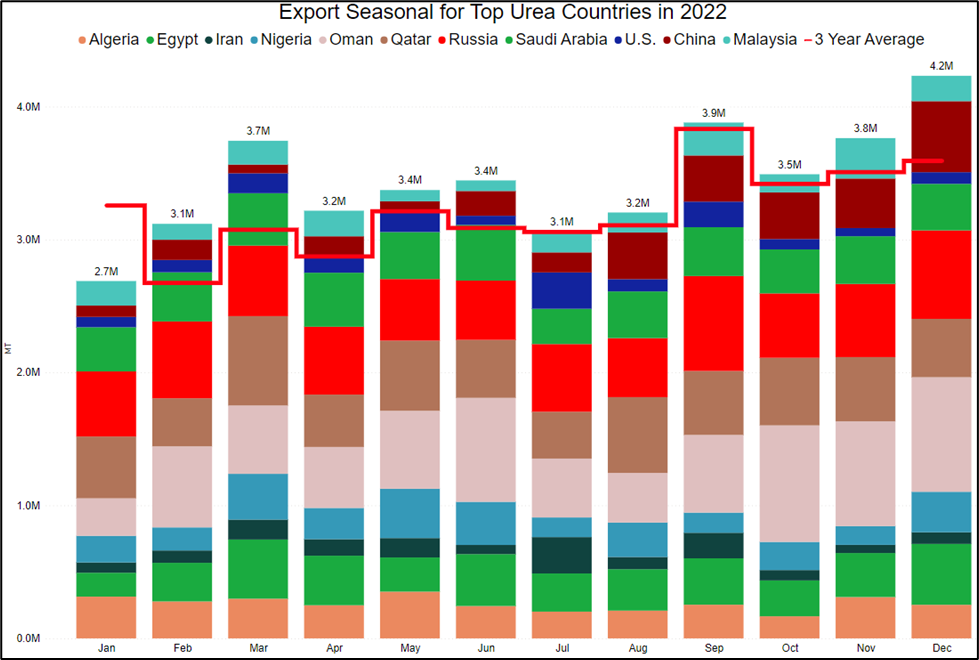
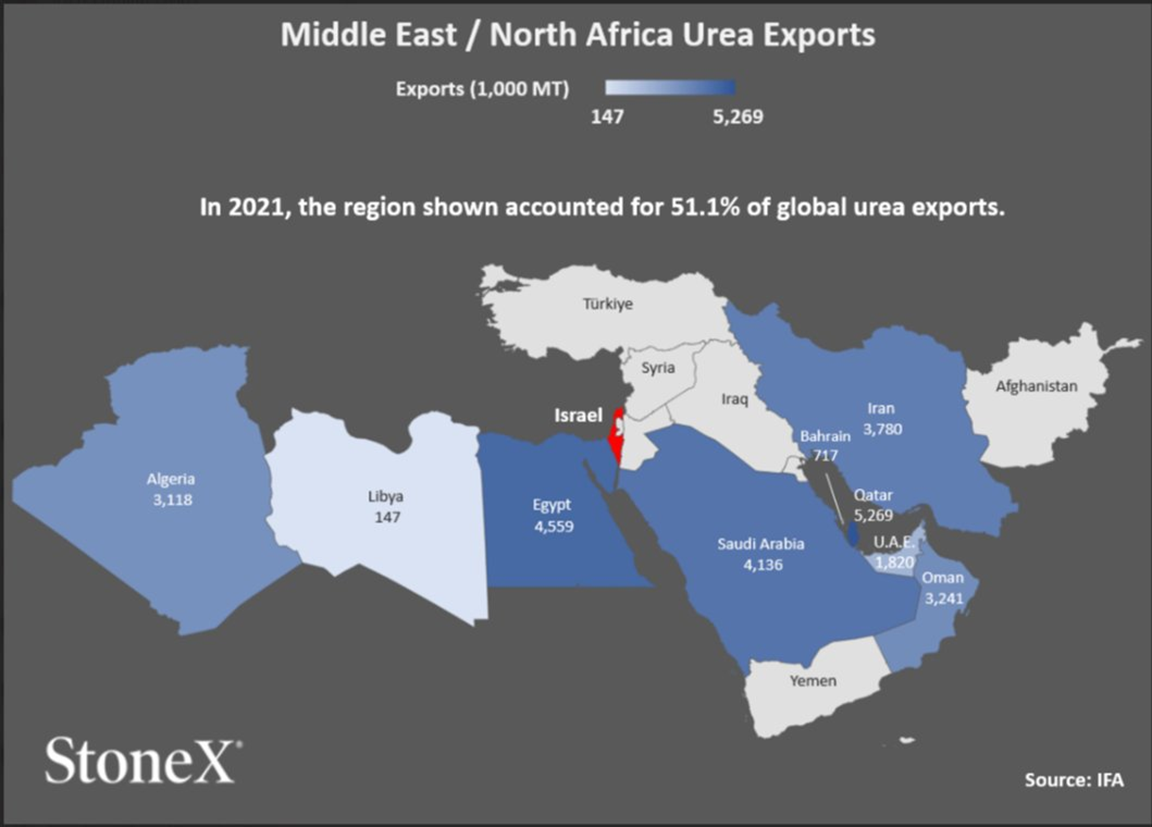
Going forward, this could change in an instant. There is the very real fear that we could see outside countries start attacking Israel which could plunge the region into a war. While we do not see this as a high likelihood event, we do see it as being a big impact event. Why? Take a look at the map below. If including North Africa and the Middle East, around half of all urea exports come from this small part of the world. 1 out of every 2 tons exported in the world comes from here. This is the big fear. This is the thing that could turn the global urea market on its head.
Before closing this out, let me reiterate that we DO NOT expect to lose all North African/Middle Eastern urea exports. It is just a scenario that we are watching. If Iran enters the mix, we will need to start watching all tonnage that goes thru the Persian Gulf before worrying about the rest of the region.
As always, events halfway around the world can and will impact your operation.
Another India urea purchase update!!
Yes, another month is coming and going with yet another piece on what India has done!!
As expected, India stepped in for another round of purchasing after falling short in their last tender. Going into this announcement, many had forecasted their needs to be "around" 1.5MMT. Things got interesting...and then very quiet at the conclusion!
When the offer information was shared, I was surprised by some of the details:
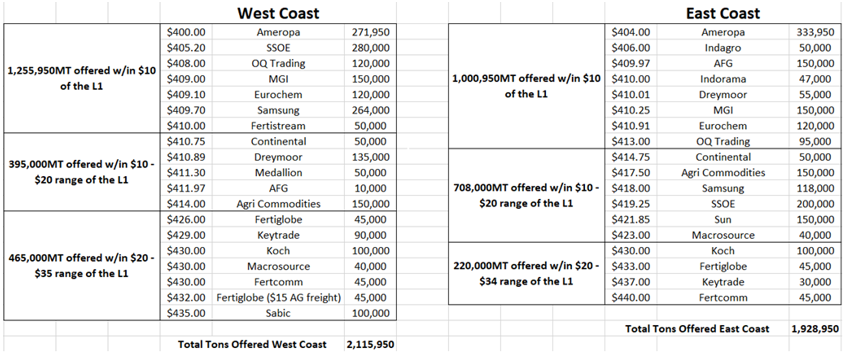
- Right around 4MMT were offered - this was a big quantity of tons offered. Quickly, many in the market started to theorize that India could end up with 1.8 - 2.0MMT secured in this tender.
- Price spreads were narrowed - in recent tenders, we have come to expect very wide price offers. Wide enough that it got tough to figure out where to do the "break out's" like is done below. This tender saw the price gap at only $35 and the east coast at $36. Again, this pushed the theory that India could/would get all they want and then some.
Just as the world got comfortable with the idea that they were going to lock up a lot of product, we found out that they "only" secured 1.15MMT in the first round of counterbids. It was surprising and the bull's tried to rally the market. In the end, it was premature. India counterbid all remaining offers and ended up at 1.65MMT. It was better than original expectations but less than revised/higher tonnage thoughts.
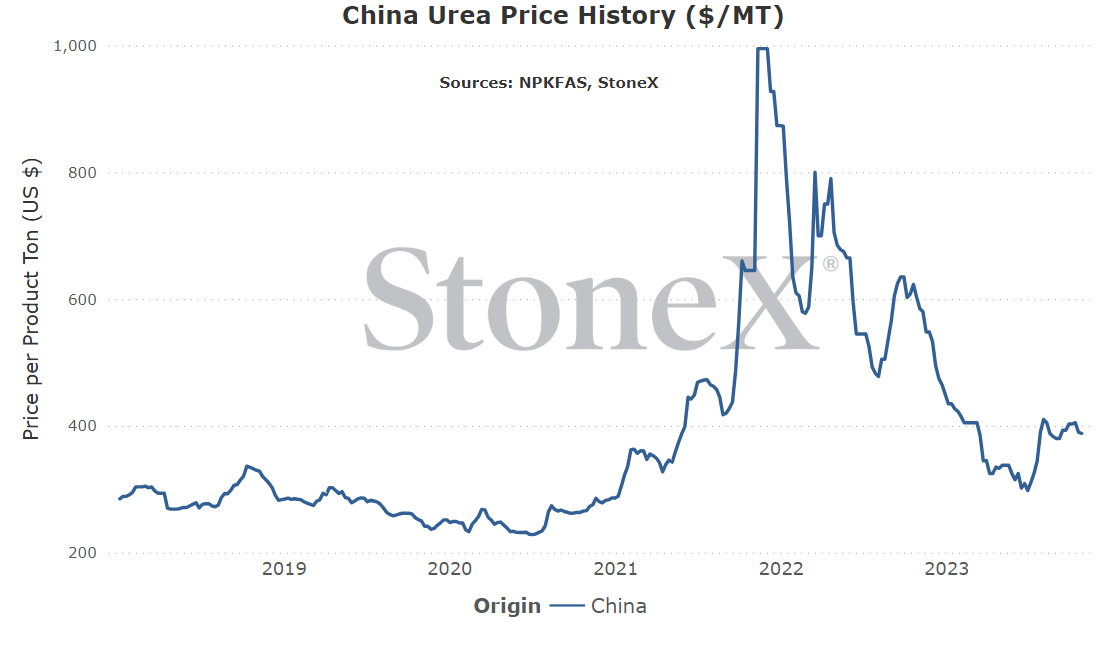
For those wondering, it does not appear that China is playing a large part as they have only been linked to around 4 - 5 vessels.
The global urea market has been VERY quiet following the conclusion. From my POV, I think folks are struggling with what happens next. This number of tons purchased should mean that India is content for much of 2023. There are still north of 2MMT that will be looking for homes and frankly, I struggle with any region really stepping up to buy before New Years (unless prices drop to attractive levels). For all the excitement and twists and turns of this tender, the result has been pretty mundane.
Given the last few years, that's a good thing!
What about China going forward?
If you have read the piece above, you already know that China played a very small part in the India purchase tender which is a surprise given that they secured so many tons. Will China be back to exporting? Are they gone for the short term?
This is merely my POV and plenty out there would likely argue, but I think China will be back in a bigger way in the coming months.
While they "disappointed" the market by not participating in the India tender, it seems as though it was more a government mandated situation than anything to do with S&D. Before offers were due, CIQ's (Chinese inspection and quarantine periods) were expanded to the point where it was going to be difficult/impossible for Chinese tons to ship in time to meet India's shipment period. However, we continue to hear that Chinese urea production rates remain very high. So why does that matter?
If production rates are very high and export are being halted, it means a lot of tons are staying domestic to fill Chinese warehouses. That works...for a while. What happens once those warehouses get full? Will they shut down production? It is a possibility...but I'm guessing it means production continues and exports have to ramp up to heavier rates per month.
By participating in the India tender, a chunk of tons could have been committed to a BRIC alliance member and a map drawn for what to do with produced tons for much of 2023. Instead, once they fill domestic warehouses, they may start exporting into a world that is taking a very lackadaisical approach to purchasing. That means buyers stay on the sidelines with the belief that imports will happen even with domestic pricing being cheaper than the world.
With all things China, we do not know what is going to happen. All we can do is theorize on what could happen and be prepared if it does.
Number 1 exporter (as a region, not as individual nations)
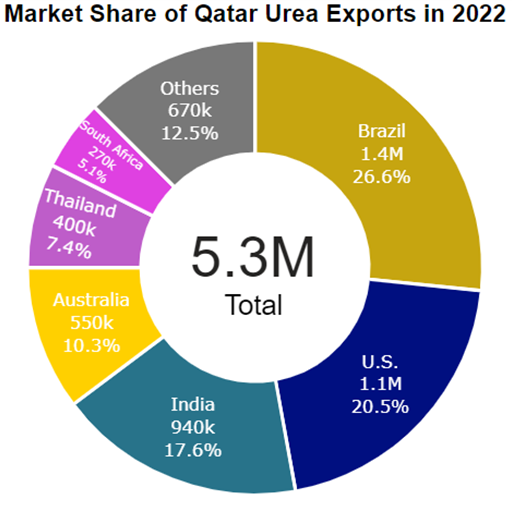
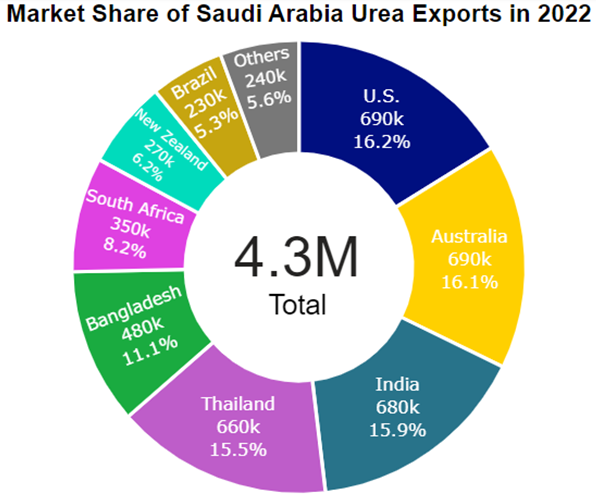
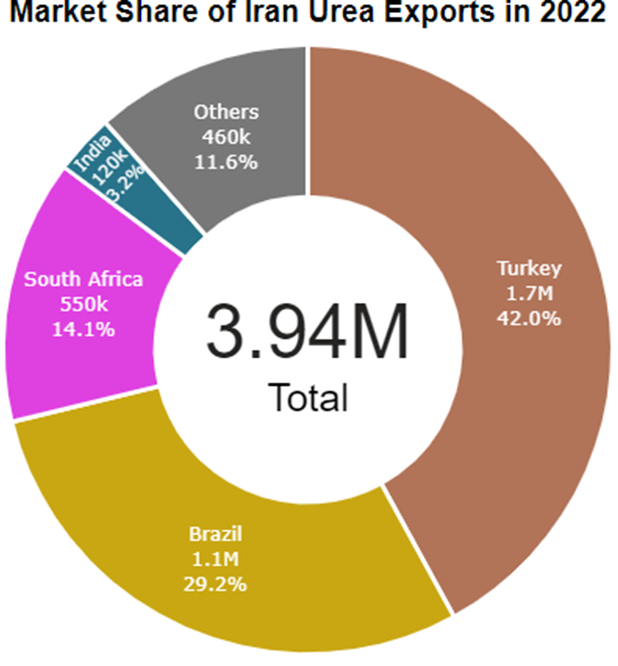
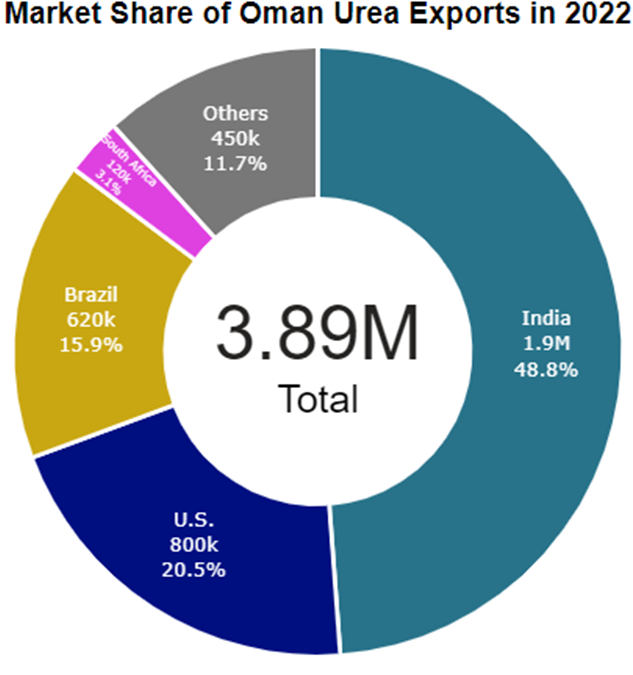
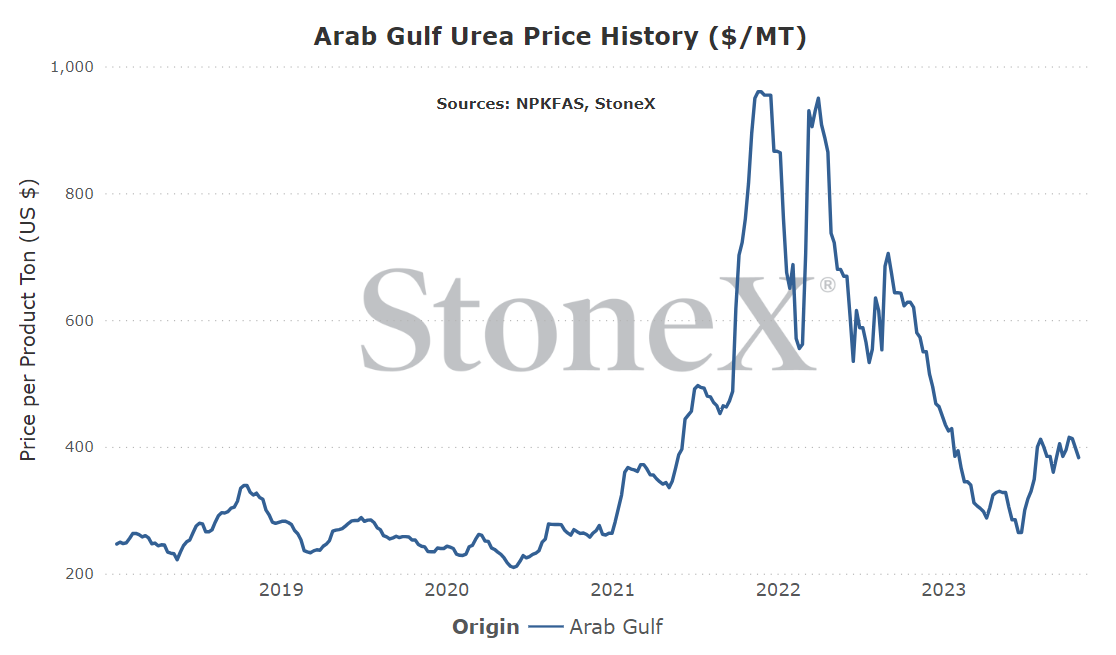
Vs 30 days ago - -3% or approximately $12 lower
Vs 90 days ago - -4% or approximately $17 lower
Vs 6 months ago - +17% or approximately $56 higher
Vs 1 year ago - -38% or approximately $237 lower
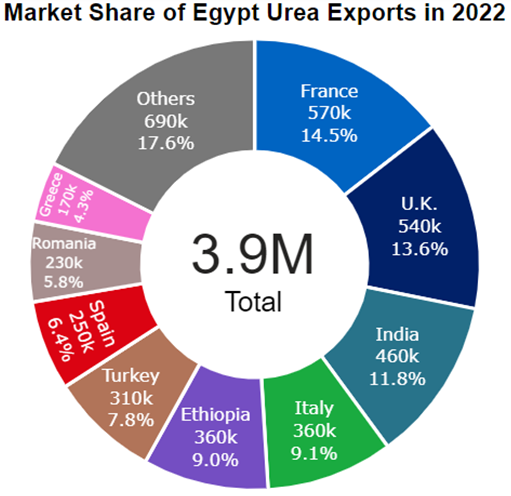
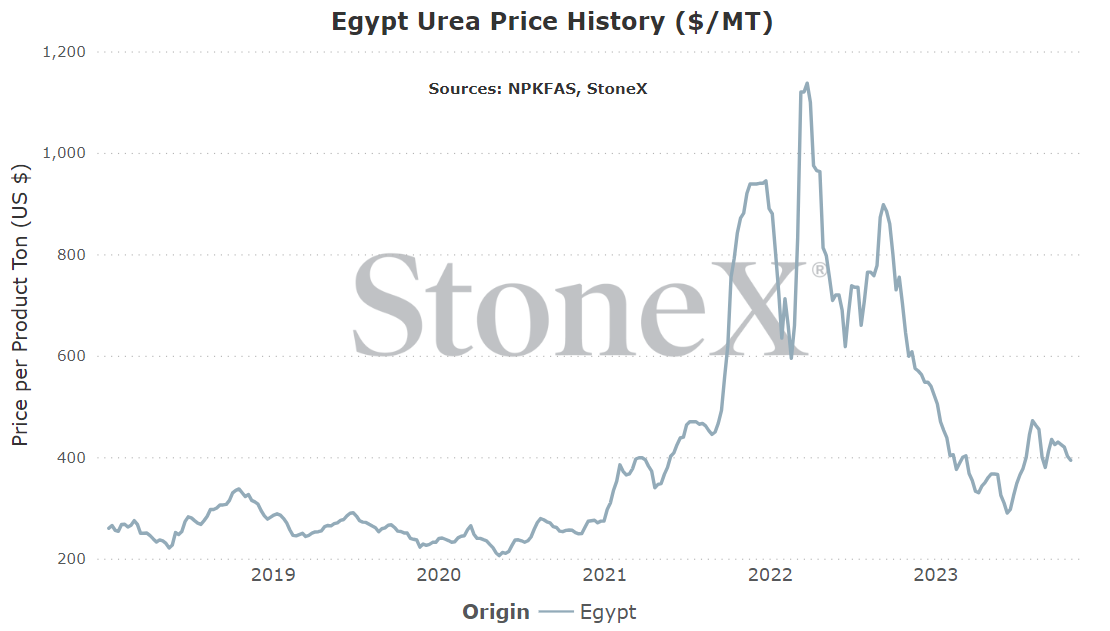
Egypt
Number 4 global exporter in 2022
Price comparisons
Vs 30 days ago - -8% or approximately $36 lower
Vs 90 days ago - -11% or approximately $50 lower
Vs 6 months ago - +9% or approximately $34 higher
Vs 1 year ago - -39% or approximately $251 lower
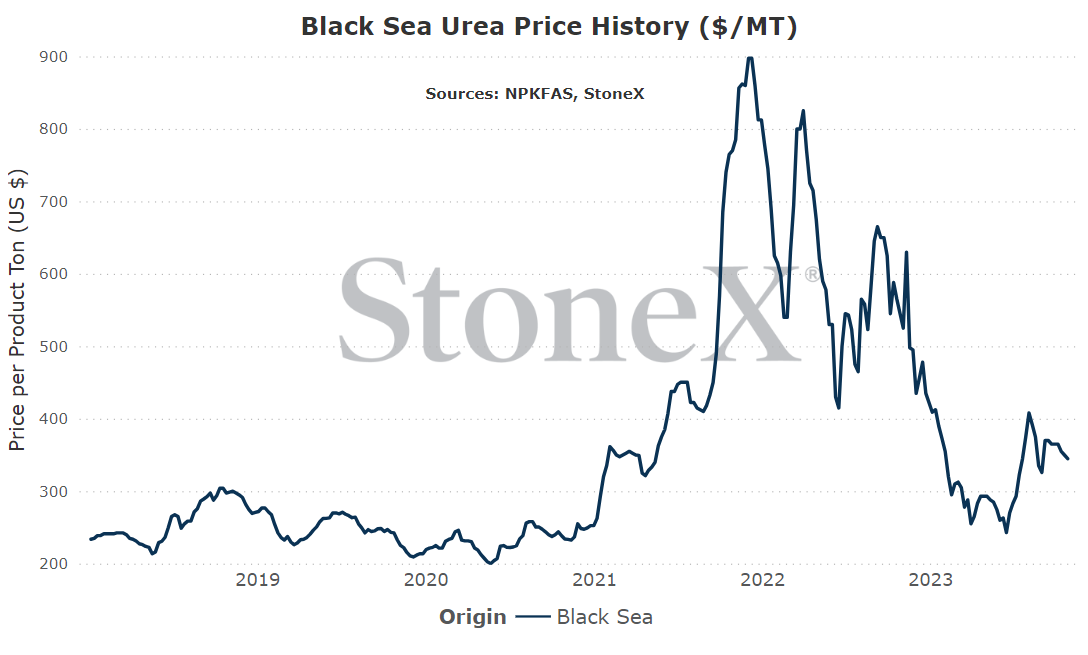
Black Sea
Number 1 global exporter in 2022
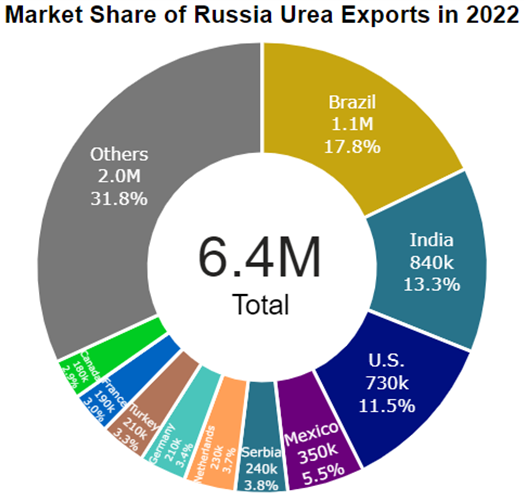
Price comparisons
Vs 30 days ago - -5% or approximately $20 lower
Vs 90 days ago - -8% or approximately $30 lower
Vs 6 months ago - +18% or approximately $53 higher
Vs 1 year ago - -37% or approximately $200 lower
China
Number 9 global exporter in 2022
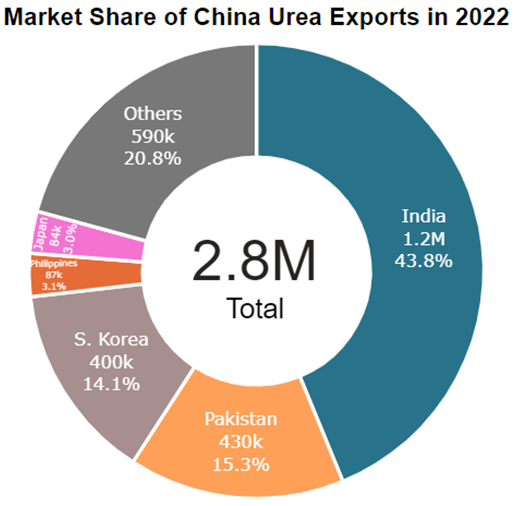
Price comparisons
Vs 30 days ago - -4% or approximately $15 lower
Vs 90 days ago - -1% or approximately $3 lower
Vs 6 months ago - +17% or approximately $55 higher
Vs 1 year ago - -36% or approximately $215 lower
- Global energy markets are on edge with Israel/Palestine war - today's world seems to be on the brink of World War 3. Any entrance of any other country outside of Israel/Palestine could create a daisy chain of events that we would struggle to slow or stop. As long as this fear is felt, global energy prices are going to remain elevated which is going to impact nitrogen as a whole.
- Downside price potential seems limited before demand steps in - this is a weird one because I am still leaning bearish on the short term price outlook...but I am not expecting a ton of downside price risk. It sounds as though we are not far off from a significant part of the market stepping in to take a layer. If that happens, it will buoy price ideas quickly.
- India couldn't hit their 1.5MMT goal in the first round of counter bids - whether I am surprised by this or not (I am, by the way) does not matter. They failed to secure their needed volume on the first round of counterbids. That is likely to embolden price ideas of the remaining offers.
- After India wraps up purchases, who else in the world wants to buy? - if India is able to secure their needed tonnage, my immediate question becomes "who is the global leading buyer?". I could see buyers attempting to push product away by lowering their values. It could/would create a very quiet period where prices struggle to hold. Interest rates start chewing into price ideas. It would be a recipe for lower values.
- Chinese production rates remain high which means they either export now or export much more heavily later - on the recent India tender, it appears that China did not participate. That means a missed opportunity in selling a large block of tons in one move. At the same time that exports are not occurring, we continue to hear that production rates remain high. That comb would mean that if they remain disengaged from the export market, they will fill domestic storage rather quickly and then be forced to export at a denser pace than if they had started now.
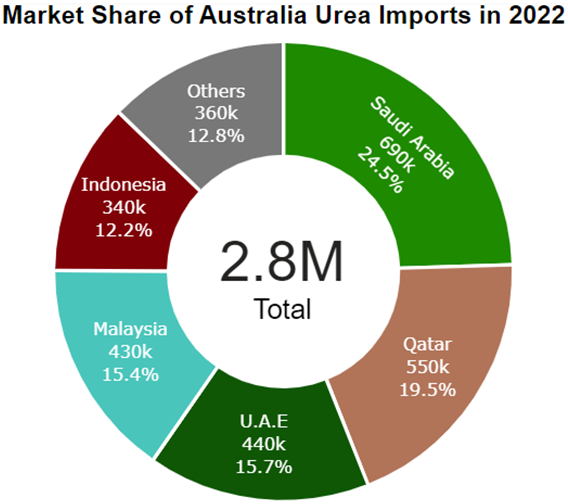
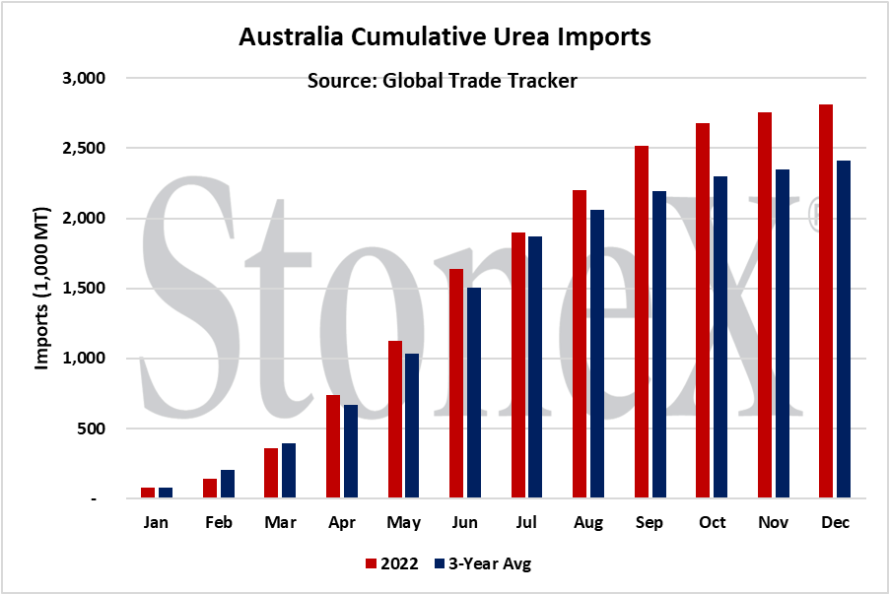
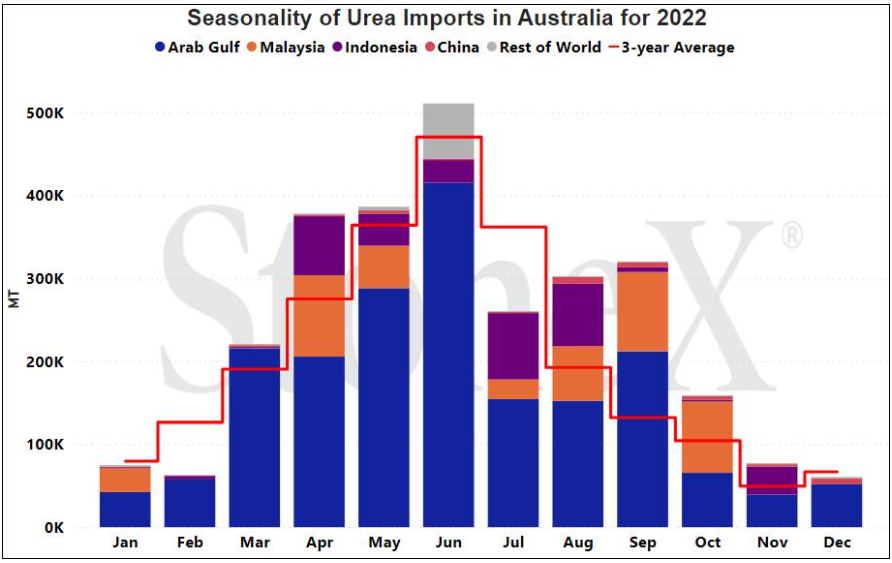
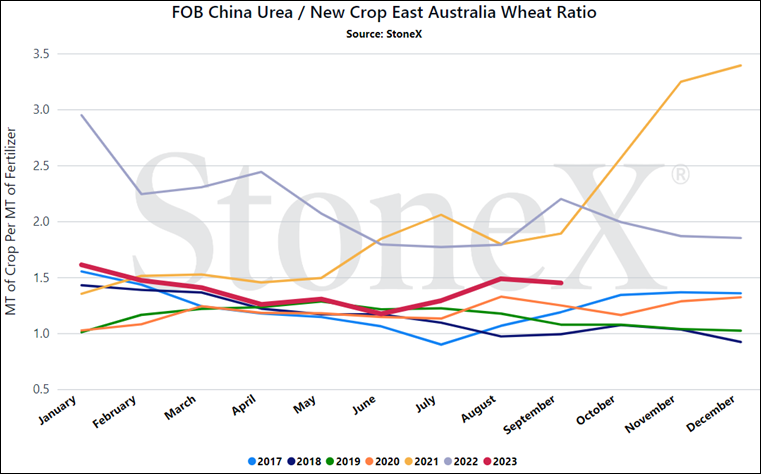
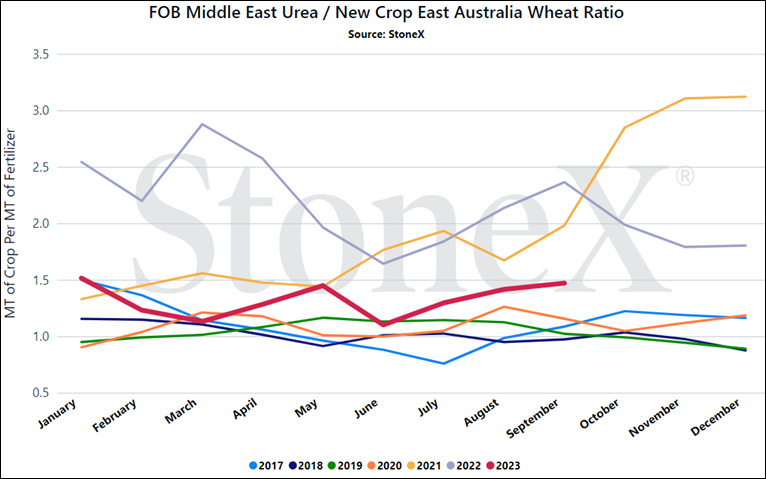
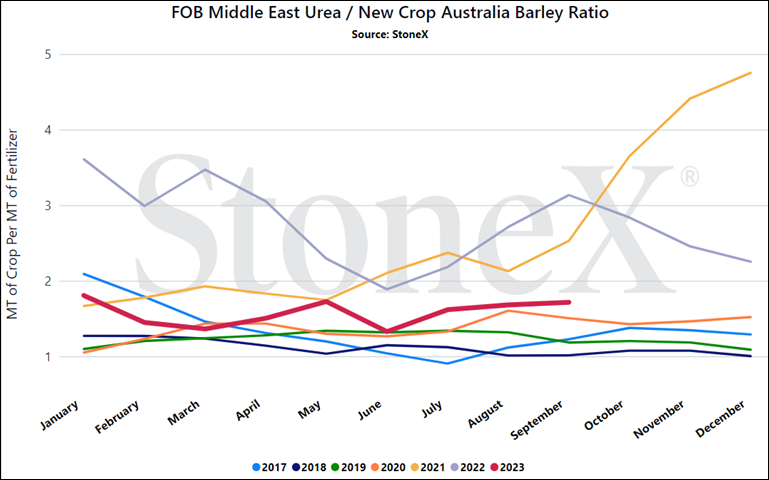
- Lot of calendar between now and next application cycle - viewing the current Australian market, it is important to remember that there is a lot of time between now and application season picking up again. With carry costs high and the price "feeling" elevated vs grains, there isn't much reason for demand to get excited. Puts weight on the distributors.
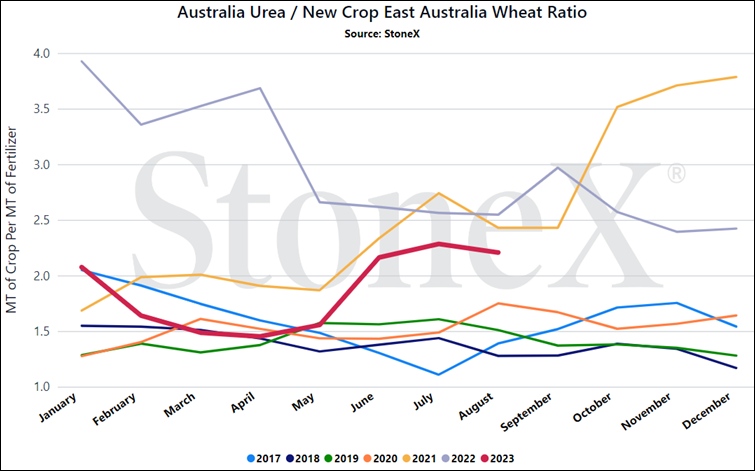
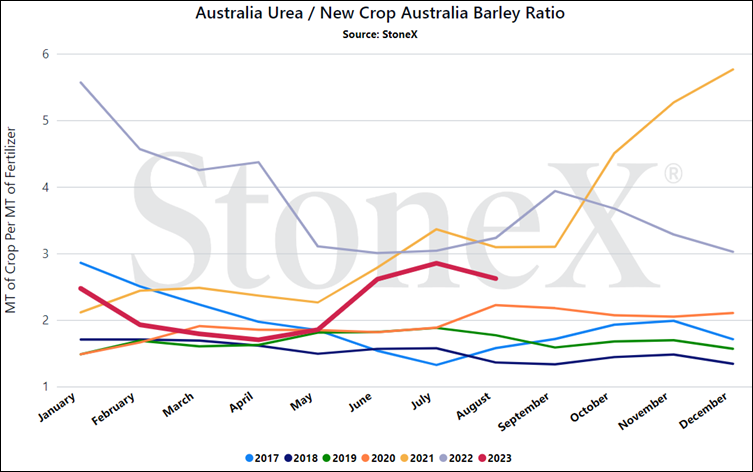
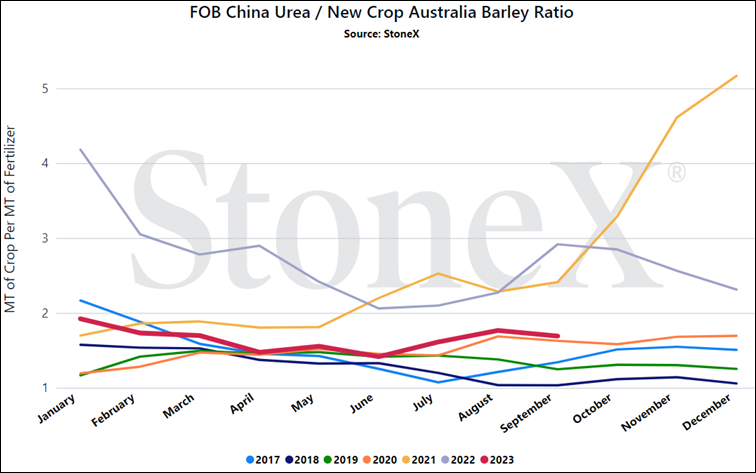
We believe that only looking at the flat price of either grains or fertilizer can be misleading:
-
Only selling grain can hurt you if fertilizer prices rise substantially
-
Only buying fertilizer can hurt you if grain prices fall
We look at the ratio "value" to get a better indication of where we are or how many bushels of X does it take to pay for 1 ton of fertilizer.
Would you rather:
-
Spend 5 ton of grain to pay for 1 ton of urea
-
Spend 2 ton of grain to pay for 1 ton of urea
When we compare the current ratio value against recent years, we start to see if we are high or low.
YOUR VALUES WILL LOOK DIFFERENT
This is looking at the relationship of Aussie grains vs several origin points around the world. Using those points do not reflect the Aussie marketplace as it doesn't take into account changing vessel freight rates, whether that vessel stops at 1, 2 or 3 ports, etc. These graphs should give a high level view of the relationship but your ratios at home are much more important to your decision making.
- Middle East region - the Middle East region continues to appear on the brink of a regionalized conflict...if not worse. If other countries start to enter the Israel/Palestine war, then a lot of global urea exports become a higher risk of being removed from the market. Consider this the current biggest "low probability/high impact" situation for the market.
- Chinese exports - will they export or will they not? For the short term, that answer can sway the market. However, eventually they may not have a choice. If production rates within China remain high and exports are not allowed, it means that Chinese storage facilities will be filled very quickly...turning China into an even larger/more potent exporter in the near future.
- European natural gas markets - there remains a much higher correlation between Dutch TTF values and global urea values. Today, Dutch TTF values have remained relatively stagnant. Not so high that anything is turning off but not so low that more production resumes. It remains in the middle ground...for now.
All data was sourced from StoneX unless otherwise noted.
This material should be construed as market commentary, merely observing economic, political and/or market conditions, and not intended to refer to any particular trading strategy, promotional element or quality of service provided by the FCM Division of StoneX Financial Inc. (“SFI”), StoneX Financial (Canada) Inc. (“SFFC”) or StoneX Markets LLC (“SXM”). SFI, SFFC and SXM are not responsible for any redistribution of this material by third parties, or any trading decisions taken by persons not intended to view this material. Information contained herein was obtained from sources believed to be reliable, but is not guaranteed as to its accuracy. Contact designated personnel from SFI, SFFC or SXM for specific trading advice to meet your trading preferences. These materials represent the opinions and viewpoints of the author, and do not necessarily reflect the viewpoints and trading strategies employed by SFI, SFFC or SXM. The FCM Division of StoneX Financial Inc., a subsidiary of StoneX Group Inc., is a member of the National Futures Association (“NFA”) and registered with the U.S. Commodity Futures Trading Commission (“CFTC”) as a futures commission merchant and commodity trading advisor. StoneX Financial (Canada) Inc. is currently registered as a Futures Commission Merchant or equivalent in all provinces of Canada and is a member of the Investment Industry Regulatory Organization of Canada.