Global
If not for the Israel/Palestine war, it would be difficult to pick a bull or bear side. Ultimately, I would have probably leaned the bullish side but I would not have felt comfortable with it.
Unfortunately, the war is a very real thing.
Continue to believe that global potash values will remain flat to firm in the near future with the upper end price range being an expanded conflict that affects Israeli potash operations.
North America
So we have a global outlook that leans bullish, North America started this fertilizer year (July 1) very low on starting inventories (most were empty), and values today are enough to expect a big fall application run if mother nature allows.
Barring a horrible fall weather window, continue to lean bullish on North American potash values.
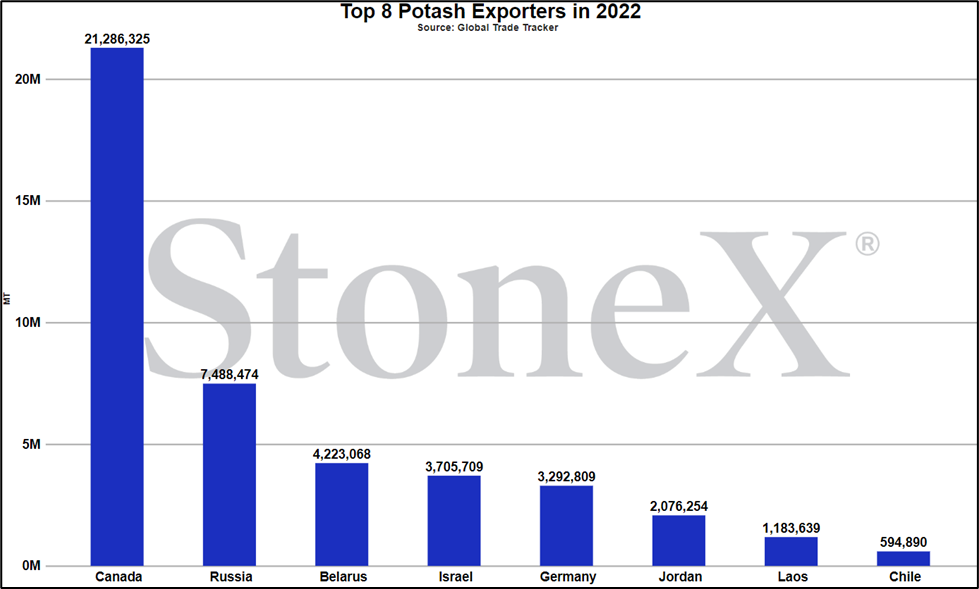
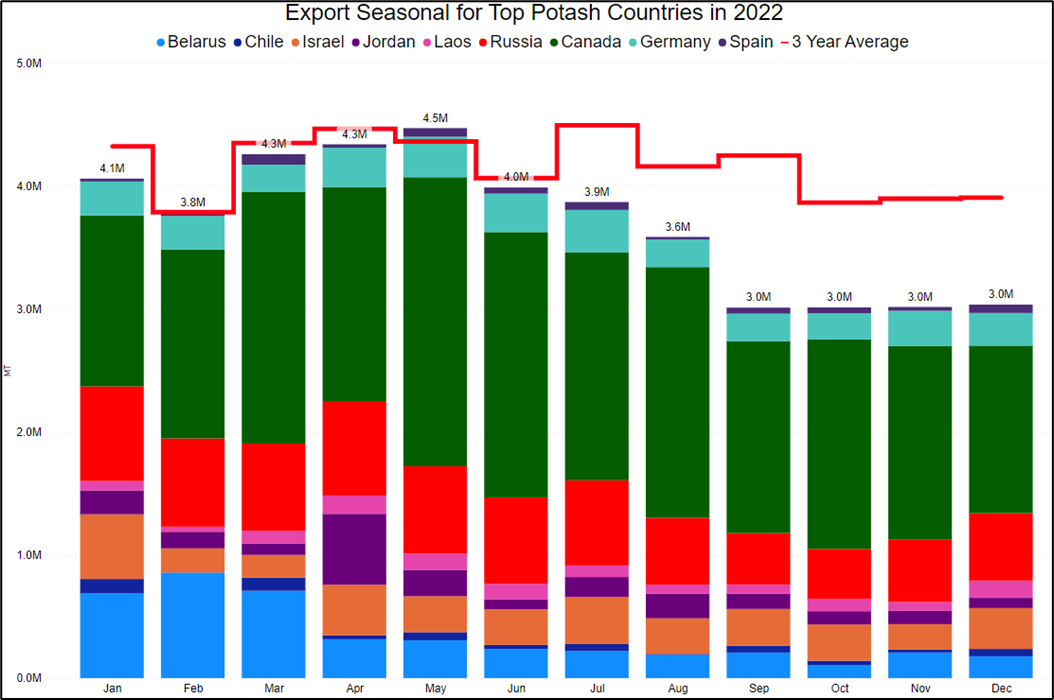
Palestine's attack on Israel puts 4th largest potash exporter in danger
If you have read thru the nitrogen product sections, you know that I have spent a lot of time discussing how the Palestine attack on Israel had indirect effects on nitrogen markets. Indirect does not mean no effect. It merely means that these countries do not product enough to sway global markets.
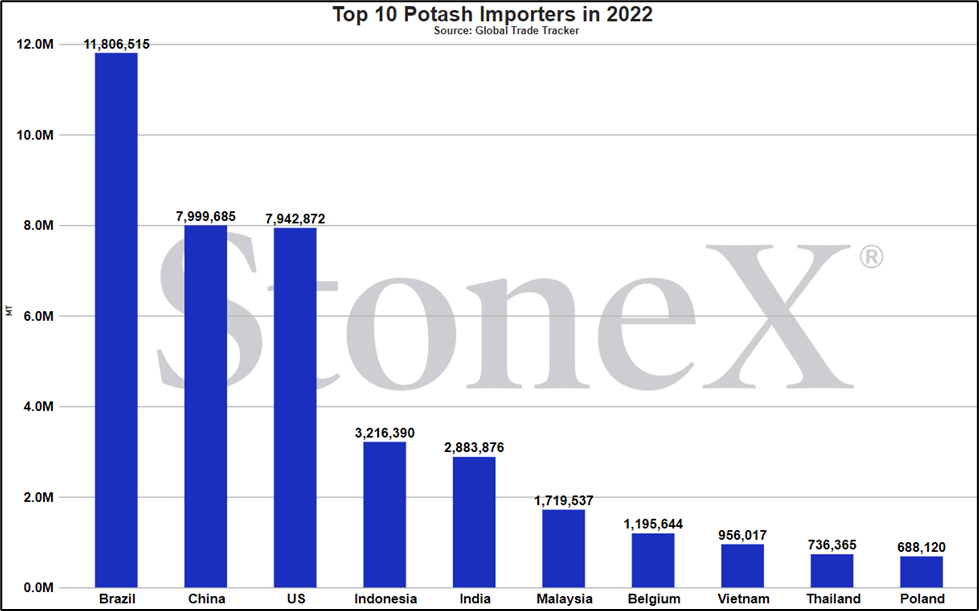
Potash is the only fertilizer that is different. Israel is the 4th largest exporter in the world which means a very real direct impact was possible.
Fortunately, it was not.
After the smoke cleared (not intended as a pun, certainly not in this situation), the global potash market quickly figured out that Israeli potash operations escaped unscathed. At first, it was the lack of market price movement around the world. Then, it was reports from within Israel that operations were left untouched.
However, that does not mean they are safe. The war continues and as we have seen and continue to fear, Palestine and its friendly countries do not appear to be giving up this fight. While the first round may have left potash operations standing, it may not be so lucky in the rounds to come.
Like most things, we need to continue to be weary of events around the world. The main focus should be on the humanitarian situation but from a fertilizer perspective, the focus should be on potash.
North American potash manufacturers float $20 price increase
For several months, I have been pointing to potash as a continued "solidly priced" fertilizer. Historically, the current price was solid. When compared against grain values, potash appeared well priced. When considering the low ending potash inventories coming out of last spring, the tight supply situation pointed to higher prices. Even today, values are good.
That is why it was of little surprise when a price increase was announced recently. It was only $20 but marked the first time in a while that an announced increase was stated. While the market has been slow to adopt the price rally, it underlines the manufacturers belief that prices are too low.
OK, I know they are not too low. Sorry, I didn't mean it!!
All this to say that I will not be surprised to see further announcements in the near future as we start the fall season. In fact, some have asked my opinion of purchasing potash today for spring inventories and frankly, I struggled with how to say to not do it. Values appear attractive, assuming grain prices hold and the fall demand season plays out as expected (i.e. mother nature allows the season to roll).
Time will tell what actually happens but barring something substantial changing, it is hard to see values falling near term.
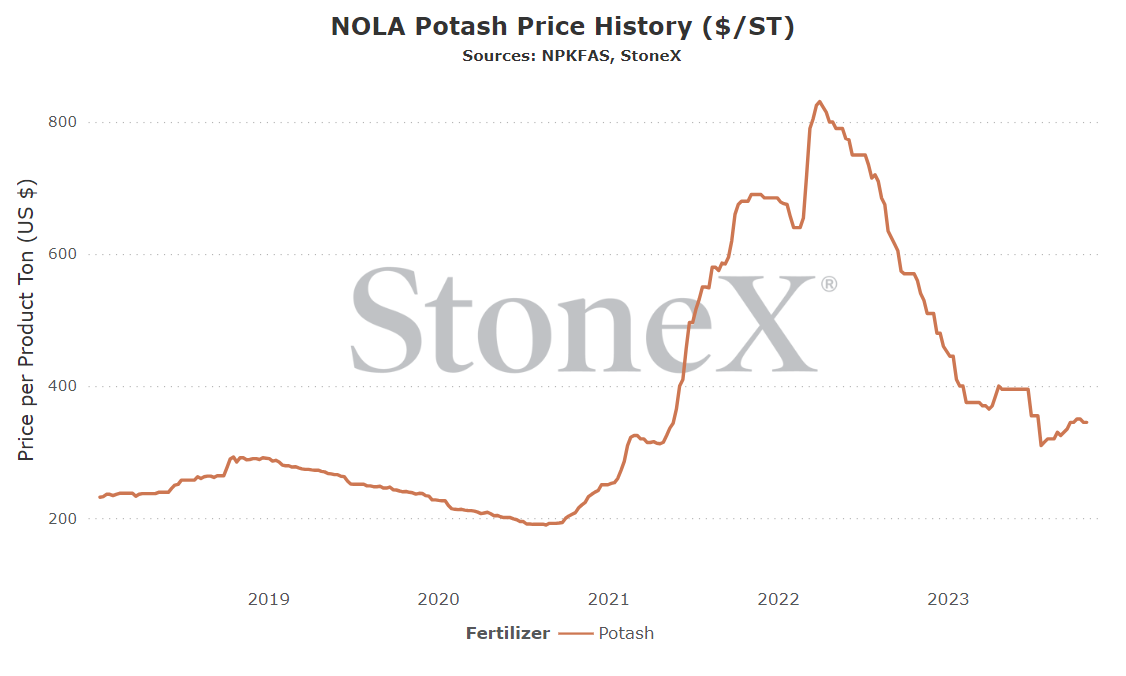
NOLA/New Orleans Louisiana
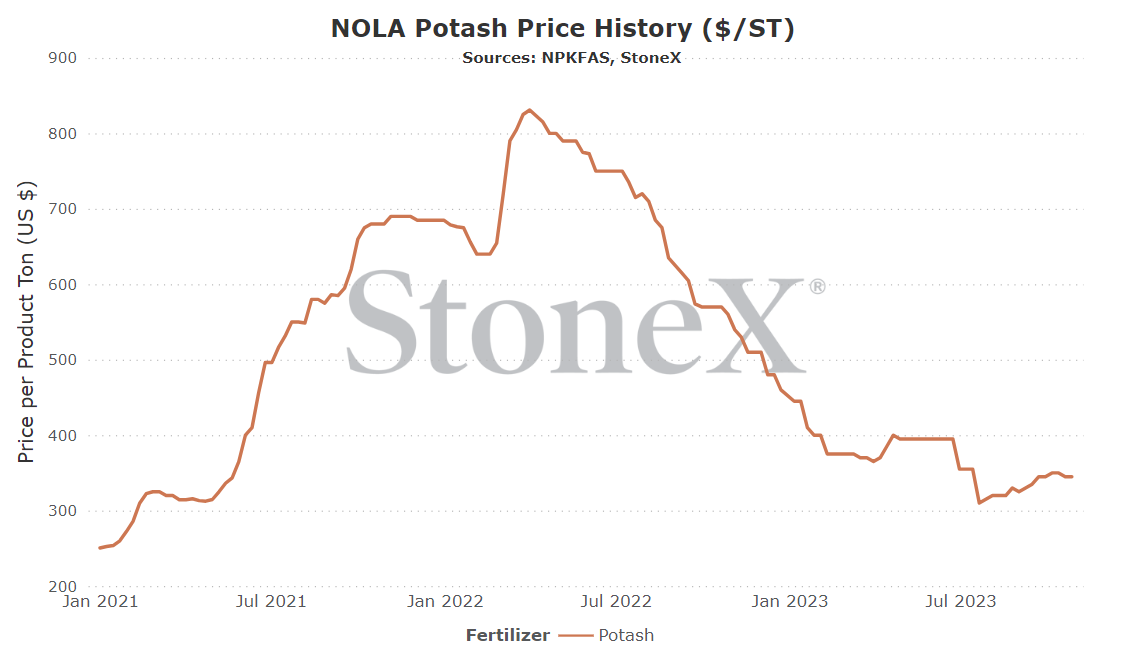
Vs 30 days ago - unchanged vs last month
Vs 90 days ago -+10% or approximately $30 higher
Vs 6 months ago - -13% or approximately $50 lower
Vs 1 year ago - -38% or approximately $215 lower
U.S. Midwest Average (average of several points across the Midwest)
Vs 30 days ago - +1% or approximately $4 higher
Vs 90 days ago - +8% or approximately $31 higher
Vs 6 months ago - -11% or approximately $50 lower
Vs 1 year ago - -37% or approximately $243 lower
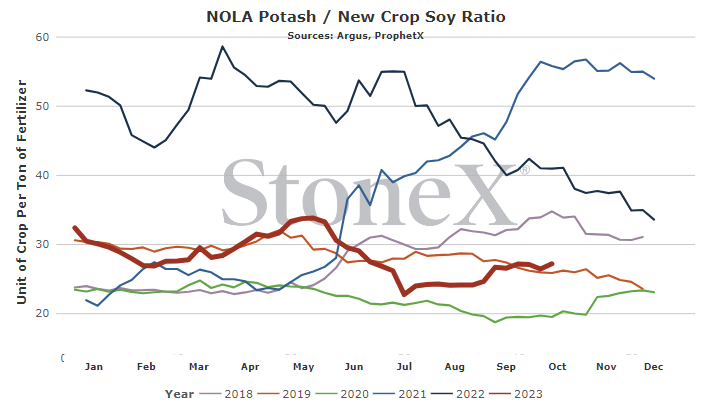
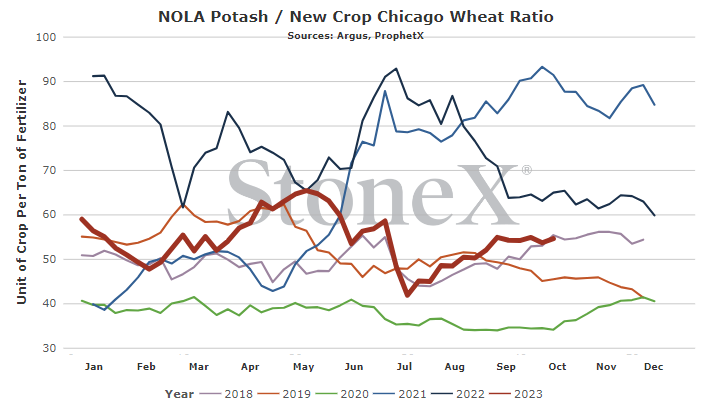
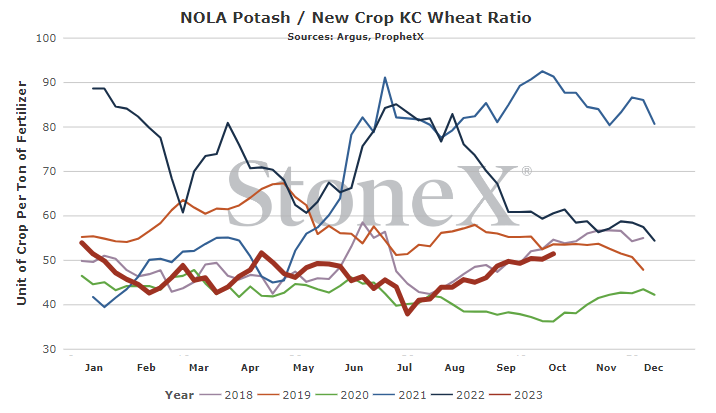
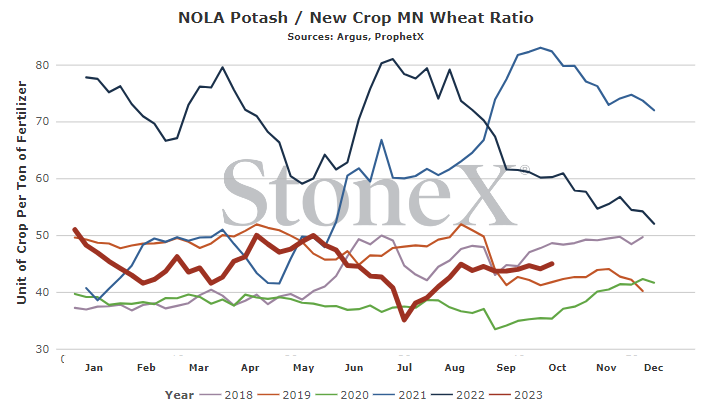
- Current values are attractive vs many grain values – I've been a fan of potash values since summer fill programs came out back in July. I'm still a fan. Historically, they are decent. Vs grain values, they are solid. I think fall demand will be solid (mother nature pending) and we will wipe out inventories. If we do, there is only 3 months between mid-December and mid-March. Not much time to refill the system...
- Israel/Palestine war could directly impact 4th largest exporter - on the list of things that could happen with the current Israel/Palestine war, major potash production being damaged is at the top. Take a look above at the world's largest exporters. While Israel is a far cry from Canada, they are no slouch coming in at number 4. If operations were impacted, it will likely have an affect around the world.
- N.A. manufacturers are floating price increases heading into fall – a couple weeks earlier, we saw the first potash manufacturer float a price increase. It was only for $20, but it was the first seen in a while. Frankly, we will not be surprised to see more floated to the market...and for some to stick as fall application ramps up.
- So far, Israeli potash operations have been left alone – we didn't see global potash values rise on the back of Israeli operations being feared attacked. However, the fact that nothing has happened to it means that guards can be let down and it lowers the chance of price increases.
- Longer term, potash still appears comfortably supplied - overall, potash feels comfortably supplied. With many expansions/new production being delayed or cancelled, it doesn't look like it will be insanely oversupplied as previously thought. However, some increases may still slip thru and keep the market well supplied.
- High interest rates/carry cost and perceived flat markets could keep buyers at bay – potash has been relatively flat from a price perspective. If that continues, it means the earlier you buy, the more interest costs eat into your margin. As a buyer, that sucks. Why not just drag your feet several more weeks/months and save that interest cost? If you have thought that, you are in good company as most demand has probably thought the same thing!
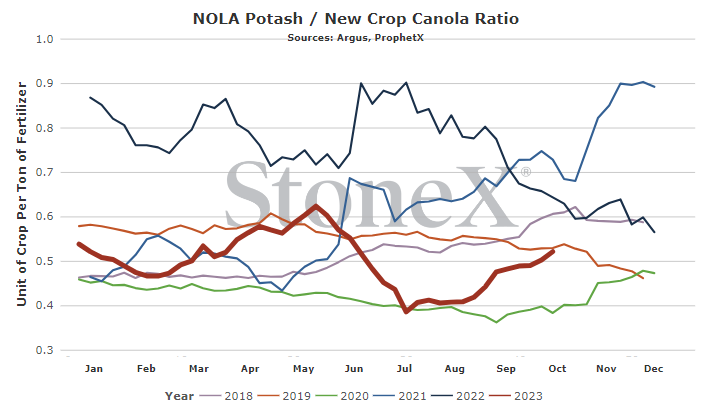
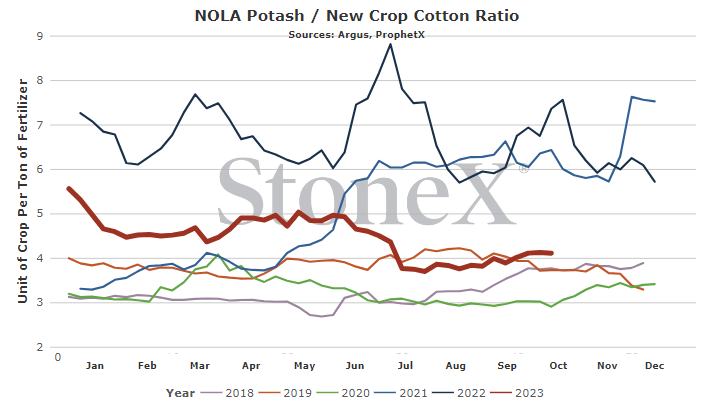
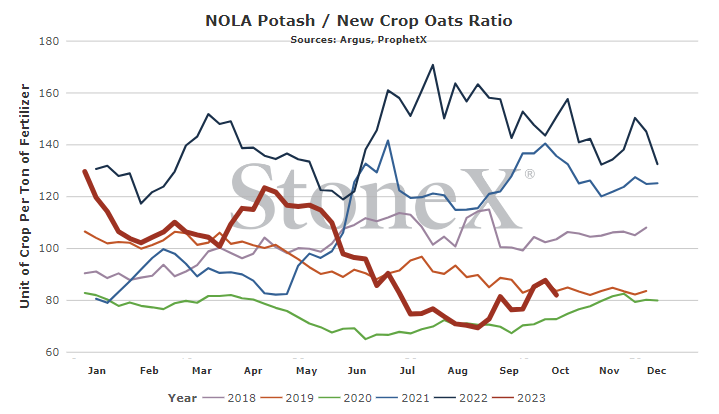
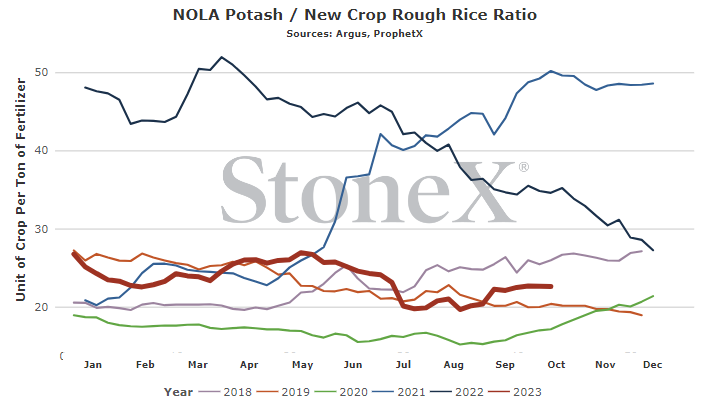
We believe that only looking at the flat price of either grains or fertilizer can be misleading:
-
Only selling grain can hurt you if fertilizer prices rise substantially
-
Only buying fertilizer can hurt you if grain prices fall
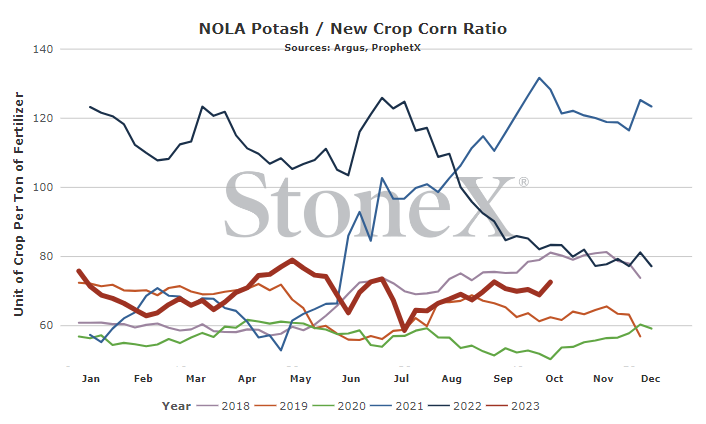
We look at the ratio "value" to get a better indication of where we are or how many bushels of X does it take to pay for 1 ton of fertilizer.
Would you rather:
-
Spend 120 bushels to pay for 1 ton of potash
-
Spend 60 bushels to pay for 1 ton of potash
When we compare the current ratio value against recent years, we start to see if we are high or low.
YOUR VALUES WILL LOOK DIFFERENT
This graph looks at the NOLA potash price vs the flat grain price. There are no logistics on either product. Your location will look different due to fertilizer logistical costs, grain basis, etc.
- Israel/Palestine war - this war means a great deal to the global potash market as Israel is the 4th largest exporter of potash. Thus far, there has been little to no impact to their potash industry. However, all it takes is one targeted rocket to change that story in a moment.
- North American fall demand - so far, it appears that the N.A. fall application run should be VERY good as the price remains very attractive vs grain values. However, that assumes mother nature allows it. If the run is good, inventories will be wiped out and a short 3 month period available to refill the warehouses. If the run is bad...there is no need for those 3 months.
All data was sourced from StoneX unless otherwise noted.
This material should be construed as market commentary, merely observing economic, political and/or market conditions, and not intended to refer to any particular trading strategy, promotional element or quality of service provided by the FCM Division of StoneX Financial Inc. (“SFI”), StoneX Financial (Canada) Inc. (“SFFC”) or StoneX Markets LLC (“SXM”). SFI, SFFC and SXM are not responsible for any redistribution of this material by third parties, or any trading decisions taken by persons not intended to view this material. Information contained herein was obtained from sources believed to be reliable, but is not guaranteed as to its accuracy. Contact designated personnel from SFI, SFFC or SXM for specific trading advice to meet your trading preferences. These materials represent the opinions and viewpoints of the author, and do not necessarily reflect the viewpoints and trading strategies employed by SFI, SFFC or SXM. The FCM Division of StoneX Financial Inc., a subsidiary of StoneX Group Inc., is a member of the National Futures Association (“NFA”) and registered with the U.S. Commodity Futures Trading Commission (“CFTC”) as a futures commission merchant and commodity trading advisor. StoneX Financial (Canada) Inc. is currently registered as a Futures Commission Merchant or equivalent in all provinces of Canada and is a member of the Investment Industry Regulatory Organization of Canada.