November '25 PHOSPHATES
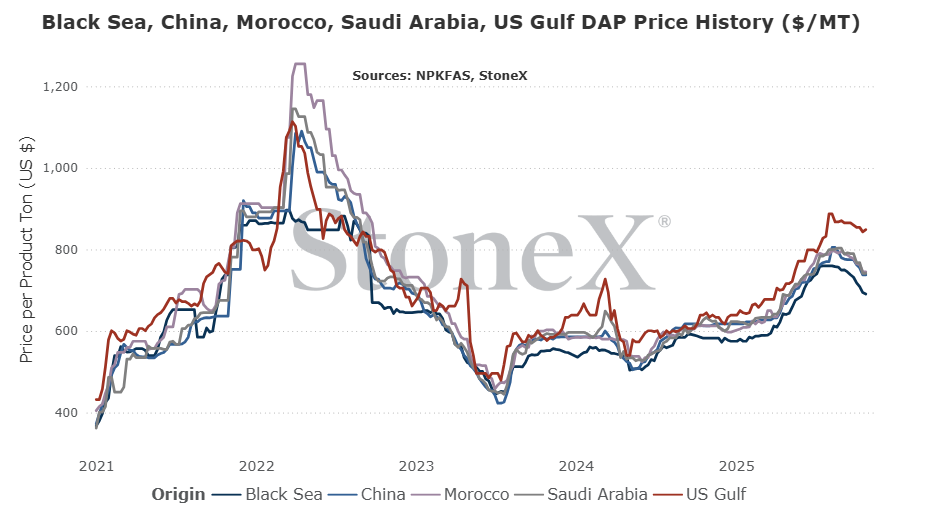
Major global phosphate export location price graphs
I will say this now and will say it going forward to eternity: these are the flat price graphs for each individual location. Your price where you are is going to be different. There are logistics. There is the cost of storage/interest/insurance/etc. These graphs should not be taken as "it shows the price at $700, why isn't my price $700". These graphs should be used to give an appreciation for price movements.
All values are in metric tons and USD currency.
What everyone wants to know first, what do we think will happen going forward
Global
Without any major global demand and Chinese exports continue to pepper the market, prices have fallen from their high's. This was most recently seen with an Indian purchase of a DAP vessel priced at $725 CFR vs their high at $810 CFR.
However, I'm worried this bearishness might be coming to an end.
On the supply side, the Chinese export submission date of October 15 came and went without any extension. That should mean that their exports start to slow to a crawl once again.
On the demand side, buyers cannot wait forever. I know that demand will be lower and delayed. However, it will not be zero and cannot entirely skip this year.
We could see global values lower for a short-time, but then I start to worry. The longer demand waits, the more it builds. The longer it builds, the more of a wave it creates when it finally steps forward. That doesn't even take into account Chinese exports starting to slow once again.
North America
Here is one of the times where my global outlook is different from my N.A. outlook.
Above, I talk about how short-term values could be lower for the world.
For North America, we could be walking into a buzzsaw.
All through the summer and early fall, the conversations have centered around demand destruction. It is too high priced in the face of too low priced grains. Something needs to be cut and phosphate is at the front of that line. However, my fear is that demand might be bigger than expected. For starters, the yields are being heard very large. That means big nutrient removal and for some fields, if not replaced, could mean lower yields next year. Then there is also the chance the U.S. government reopens and sends out checks. Phosphate could be the first recipient of those dollars. All this to say that we could be surprised by the amount of demand over the next 30 - 45 days.
If demand destruction holds up on its threats, prices should remain relatively stable through fall with few inventories in place across the Midwest. However, if demand is bigger than what is thought to be out there, we could be in trouble. Prices could rally just on the back of just in time logistics. In an absolute worst case scenario, phosphate could mirror what happened to UAN last spring...
If you decide you need phosphate, DO NOT WAIT TO TALK TO YOUR SUPPLIER. HOURS MAY MATTER.
General Global DAP/MAP Information
What has happened in the last 30 days?
Chinese exports improved, but outlook still bleak
The good news is that China continued to show phosphate exports in the month of September which has helped to lower global price ideas!!!
The bad news is that the October 15 end date for their export program came and went without any announcement of an extension which means November and December should see their exports slow to a crawl once again...which is a big reason why prices rallied so high in the first place.
I realize this is a story I hit on monthly but I want to make sure that those new to the newsletter are brought up to speed.
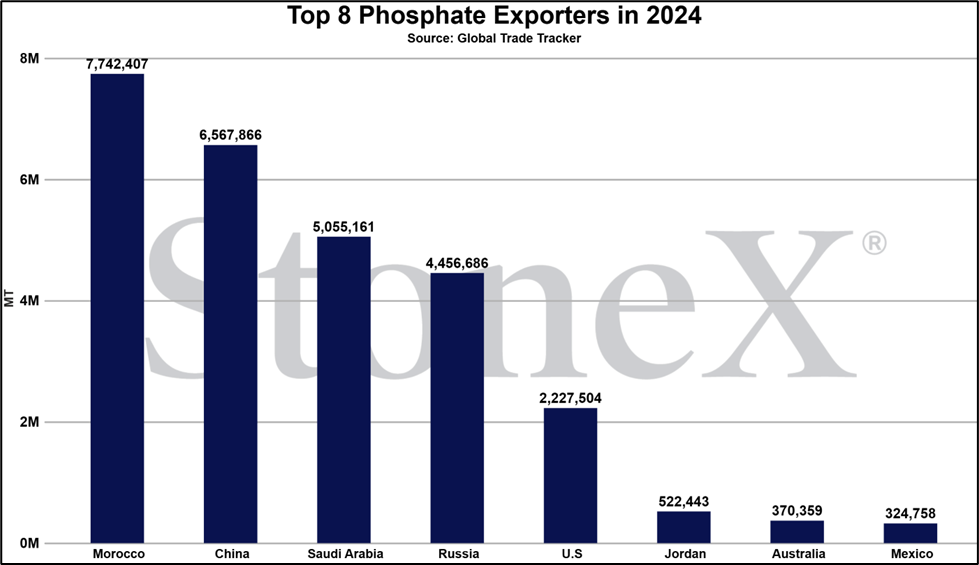
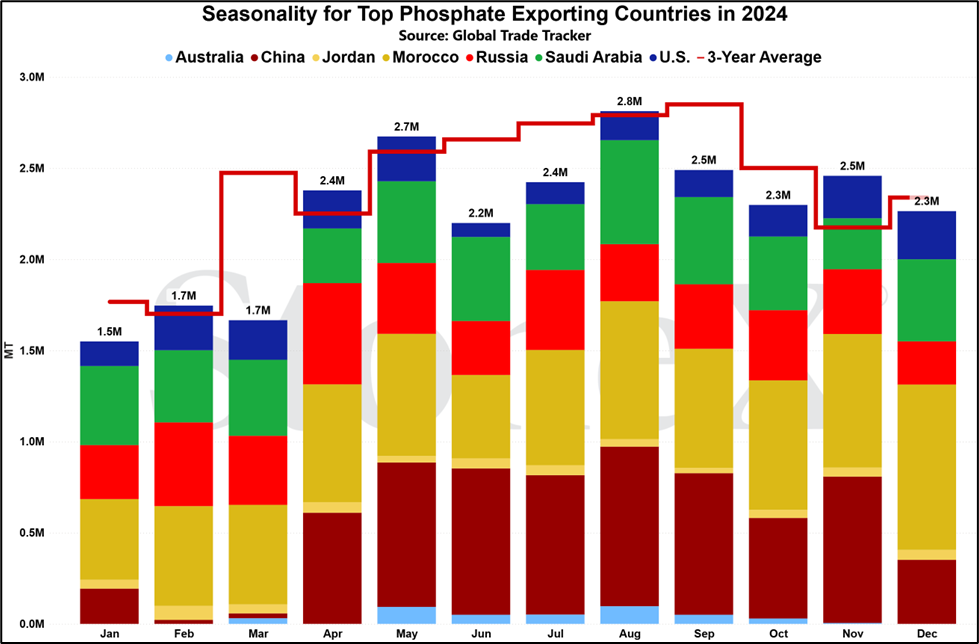
Historically speaking, China is the world's largest phosphate exporter. If you go back to 2021, China exported 10M tons vs the Morocco who came in 2nd with nearly 7M tons exported...then Russia happened. Russia was the 4th largest exporter with just over 4M tons exported. The decision was made that they were going to invade Ukraine and the world balked. Suddenly, many nations around the world threatened to cut ties/economies with them. Some nations (Canada/Australia/some in Europe) actually took the step to block their flows. Big international companies pulled out. It looked like we were on a path where Russian fertilizer exports may not exist any longer. The result was that global prices skyrocketed and supplies got very tight.
This is when the Chinese government stepped in.
The government saw that global phosphate supplies were getting tight and product getting expensive. It realized its role as an exporter and started to become fearful (from my POV). They saw a situation where exports could balloon out of hand and lead to a situation where there wasn't enough product for Chinese farmers. Rather than risk this outcome, they decided to start playing a heavy hand in the markets and when the Chinese government tells its citizens to do something, they do it.
The government had two goals for cutting back exports:
1. Ensure adequate domestic supplies
2. Ensure lower than global values for their farmers
Fortunately for Chinese farmers, this plan worked like a charm. Exports slowed and domestic values lowered.
Unfortunately for the rest of the world, this plan worked like a charm. Exports slowed and international values jumped even higher.
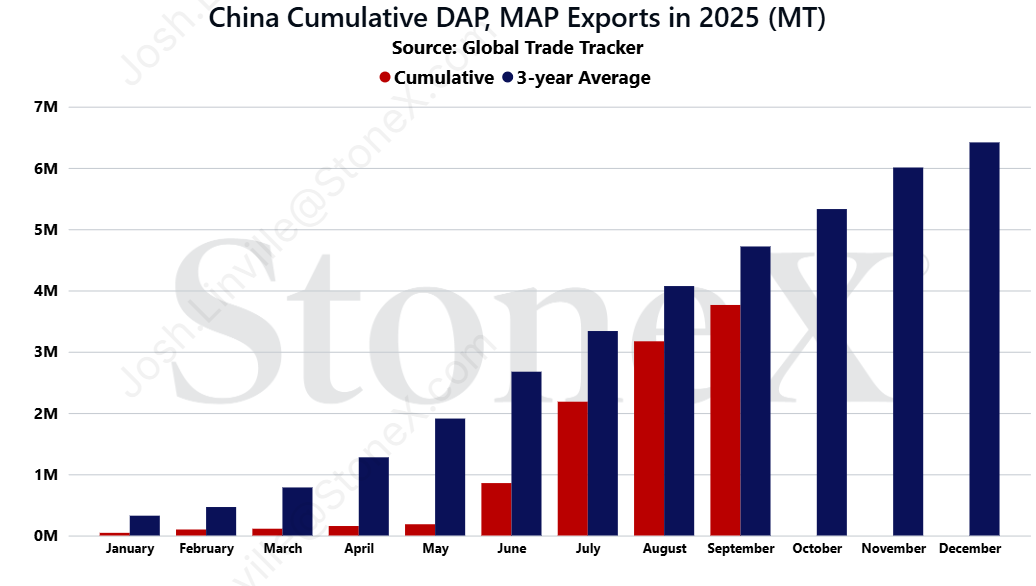
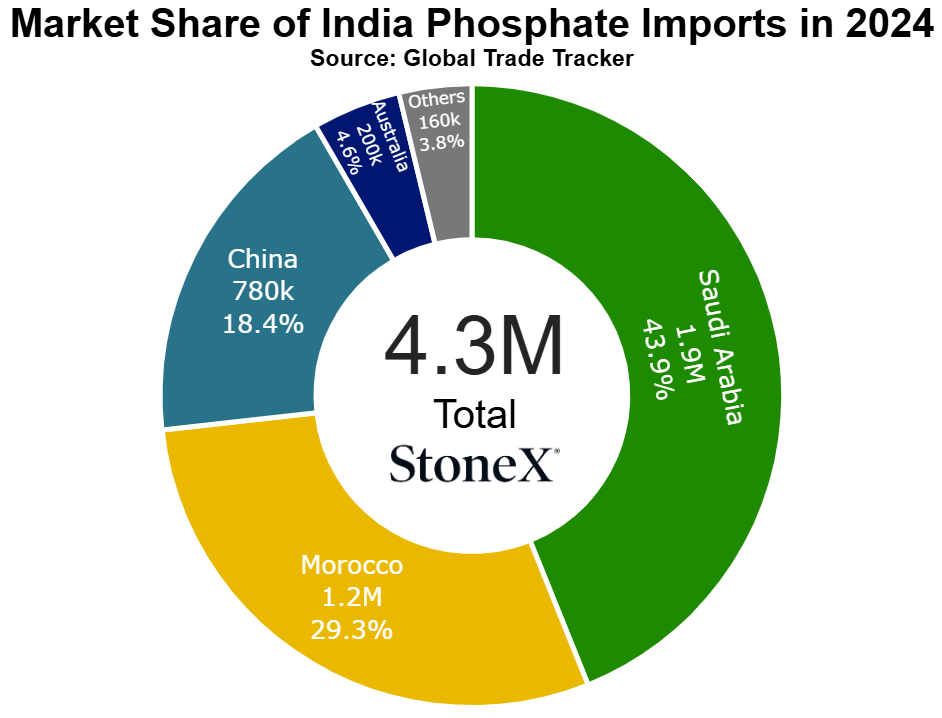
In 2024, China only exported 6.6M tons of DAP/MAP vs their 2021 total of 10M tons. That was a big hit that helped global values jump substantially (helped by India's buying patterns. 2025 is worse. January through September, the cumulative export total only hit 3.8M tons. If the world is lucky, that total will get to above 4M tons...still a far cry from normal. With their plan working so well, continued fears of Russia/Ukraine war fall out, and what we see as higher domestic demand due to ag and industrial uses, it is hard to see a short-term situation where China resumes their normal export flows and that is a problem.
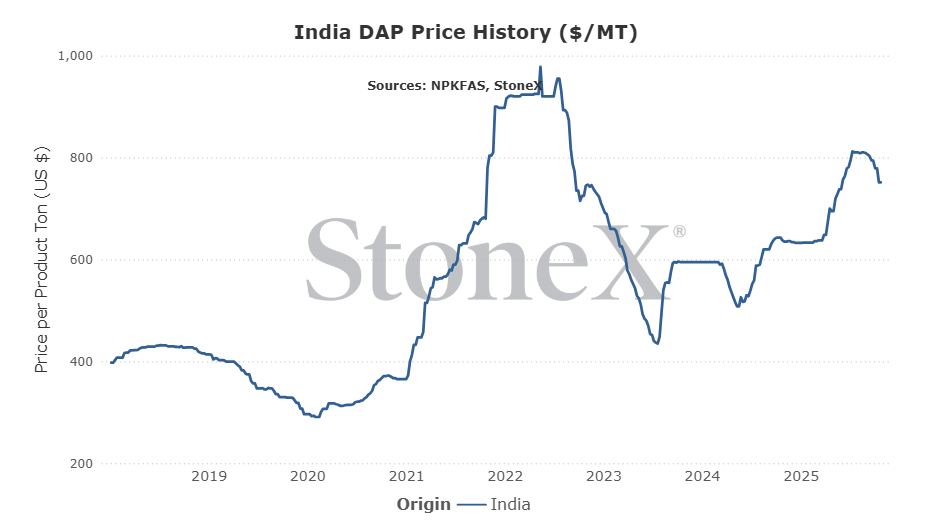
India, who has been the most common and visual buyer in the world, has seen their prices since 2024 climb from the $450's to a high of $810 (metric ton and USD). However, since they slowed their buying pace AND Chinese exports picked up, their value has fallen back to $725. My fear is that we are about to enter a period where reluctant global buyers have to finally start stepping in for their needs which obviously should boost demand. This will start to happen during the later part of 2025/early part of 2026 when Chinese exports start to slow to a crawl once again.
Why do we think China will slow down? The government had put into place an end date for their fertilizer export requests of October 15th. I had hoped they would extend it to the end of the year...but nothing has been heard. If that continues to be the story, October and November will still see exports, but they will likely slow as it moves into December and should be almost non-existent as they prepare for their own spring season.
To sum it up, it has been very nice to see global values backing off from their high's. Unfortunately, I am afraid we are about to see China's export flows slow down substantially and start seeing demand return...a nasty, bullish recipe.
Global demand has quieted, values lower as a result
Being able to discuss bearish points for phosphate this year has not been a common occurrence. I am going to enjoy this...for as long as it lasts.
Since phosphate values started their ride to significantly higher prices which started mid/later 2024, India has been a very common storyline. The global phosphate fully realized two things:
1. Chinese exports were a shell of their former self, leaving the world market much tighter supplied
2. India phosphate supplies were much lower than normal, meaning the government had to be desperate in their attempt to rebuild stockpiles to comfortable levels.
India FINALLY reached that threshold in recent months. After months and months of near daily buying, they were finally able to not only lock up enough spot tonnages but also secure large volume contracts that were also long term to more guarantee supplies. As soon as they got comfortable and their buying patters slowed, the global phosphate market got very quiet from a demand POV.
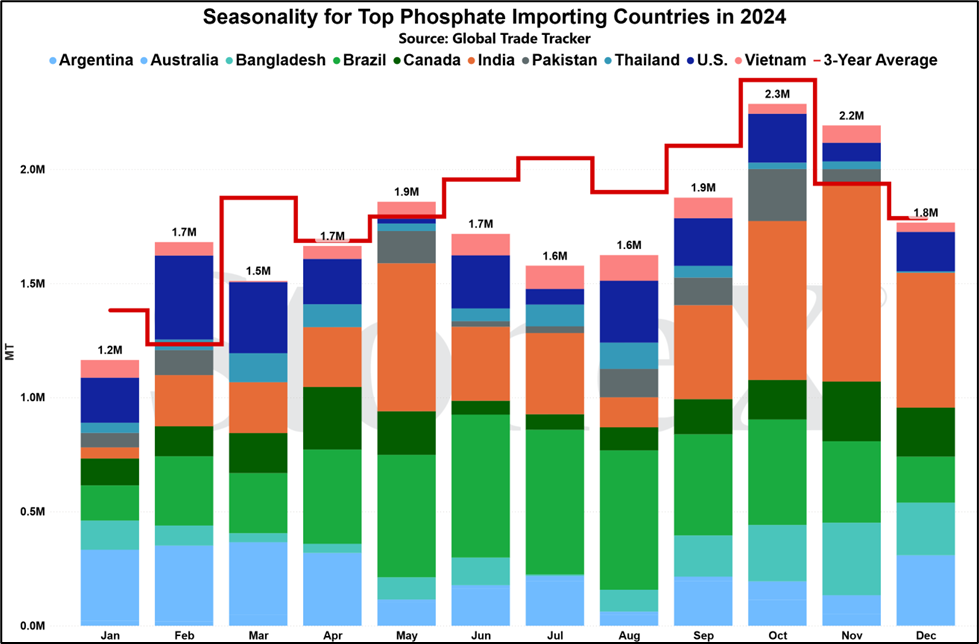
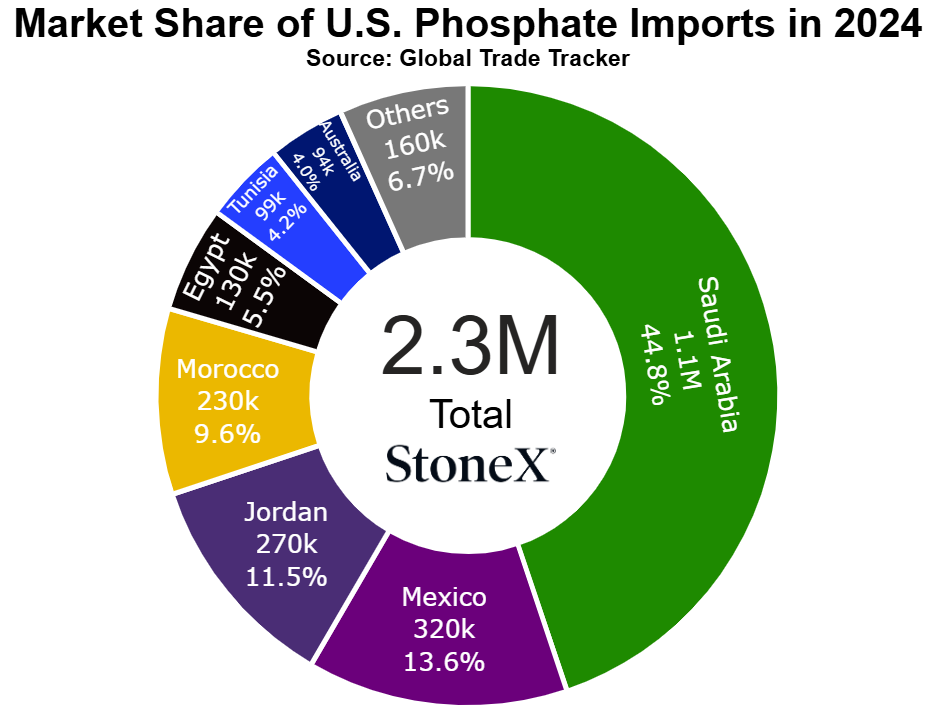
Now, just because it was quiet did not mean there still was not problems. The world is still having to contend with a lack of Chinese tons and no real option to replace them. However, no one else around the globe has been jumping up and down to get their hands on product. The U.S. would normally be a very natural destination, but their tariffs and duties have made it that global suppliers are more than content to look elsewhere. Australia would also be a natural destination as their application season is set to begin February/March (depending on the north/south locations). However, Aussie farmers are struggling just as much as everyone else and importers have seen the high prices as well as recent price weakness with India buying lower. No doubt they are dragging their feet as long as they possibly can in hopes that prices fall further.
As India has shown, global values have corrected. Their high water mark was $810/ton CFR. They recently purchased a vessel for $725/ton CFR. This is a massive value from a flat price perspective but still less than a 10% correction. Now the question is how long can demand stay away. The longer demand waits, the more pressure it can put on suppliers...but there is a possible penalty to be paid. The longer demand waits, the more demand builds. As that demand builds and builds, it makes the aftermath much worse when it steps forward. All of that pent up demand would likely hit on the same timeframe and suppliers would have a good time.
For now, price ideas have slipped in favor of farmers...for now.
N.A. fall run set to begin, demand could beat expectations and pressure S&D
We are finally on the starting line of fall application season. Time to see how this whole phosphate situation is going to play out.
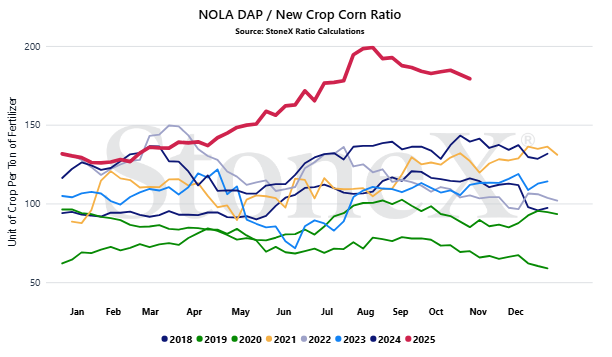
On the demand side, the message has been clear from farmers. The price is too damned high and the price of grains too damned low. The relationship is so poor that recent months has seen a brand new all-time high corn/DAP ratio set. Those ratios exceeded what happened in 2008...but the comparison is even worse. When you look back to 2008, grain values were much better than where they are today. Sure, the ratio value matters, but it is much easier to pull the trigger on high priced inputs when your income is substantially higher. Because of this poor situation, farmers have been threatening application rate cuts or delays...or as much as completely skipping for this cycle.
Then, on the supply side, the counter argument had continued to be made. The U.S. government continues to keep tariffs and duties on the 4 largest exporting countries in the world. U.S. sits as the 5th largest exporter, but production levels here have been poor. Normal production rates prior to early 2021 were in the 80%+ range. However, since that time, rates have plummeted. Q4 '24 dropped to an all-time low of 58%. Q1 '25 matched that rate. Q2 improved to 61% and we believe Q3 is at 63%. Those last two quarters show improvement, but forgive me for not getting excitement.
All of this to say that while the demand side has been fighting, it has been seeing an equal and opposite fight from the supply side in the form of low inventory availability.
To make matters worse, we have continued to see the phosphate supply chain be VERY reluctant to take heavy positions prior to fall. This is a situation that I cannot blame anyone. The end user (farmer) has been very vocal in warning that their demand will not be there. Not only that, but prices are extremely high and the fear that something might happen to cause them to freefall continues. Retailers can ill afford that risk.
This is where I am going to keep being very vocal.
IF YOU HAVE NOT BOUGHT YOUR FALL PHOSPHATE NEEDS BUT PLAN TO, HAVE THAT CONVERSATION SOONER THAN LATER.
Now, I am not going to sit here and "guarantee" that supplies will be incredibly tight and prices will go higher. At the end of the day, I do not know. What I do know is that the path to higher prices and extremely tight supplies is much shorter than normal. Overall supplies are tight on the back of a lack of imports and poor production rates. Inland supplies are tight on back of a lack of demand and unwillingness to take price risk.
If, and it is still a big if, we get into November and demand destruction is nowhere near as big as threatened, we could have a problem. The market has been operating and preparing for a substantially lower fall demand run. Some estimations have destruction at 25 - 50% of normal (I am in the closer to 25% camp). There are a lot of people saying that yields are very big which means there are a lot of nutrients being removed from the soil. If farmers ultimately decide that they need to replace these phosphate nutrients for fear of lower 2026 yield potentials, that just in time demand may find that the supplies are not there.
Does this guarantee a supply shortage in November/December? Absolutely not. I am merely trying to show that the chances are higher...but it still takes a few factors coming together.
I do not blame a single farmer who decides to lower/cut/delay their phosphate this year. It is a horrible price situation in the face of a poor 2025 and a poor 2026 forecast. Just please keep in mind that the market is tight so if you make that decision that you want product, do not wait on that phone call.
I truly hope the next 60 days come and go with no problems and everyone can tell me I am full of it.
How could U.S. subsidy checks to farmers change phosphate?
One of the biggest U.S. government questions that I have continued to have is: when will the government reopen?
The second biggest U.S. government question that I have continued to have is: how quickly can farmer subsidy checks be sent out?
The answer to that second question could change the look of the phosphate market.
As has been discussed so many times, farmers are struggling with poor cash flows. Profitability is no longer part of the equation. Farmers are struggling with many having to make the hard decision of what inputs get lowered/cut to cash flow the 2026 crop.
Phosphate, with its high historical price and its high price vs grain values, has been standing proudly at the front of that line.
So the next question is this: if subsidy checks get sent out which helps to boost farmers access to cash, will phosphate be one of the first inputs readded to the lineup?
I think the jury is still out. Farmers are going to continue to look for options to lower inputs where not needed. I think soil sampling will be a bigger part of the equation. However, we also continue to hear big yields out there. Big yields removes a lot of nutrients and if a farmers goal is to maintain big yield potential, those nutrients need to be available. Some fields can skip a year if past rates have been solid. Some fields can skirt by with decreased rates without much of a 2026 impact. However, a lot of fields will need replacement applications.
If, and hopefully when, those checks get cut, there could be a big demand wave coming for phosphate. If that is the case, as we have seen before, we could see phosphate values higher very quickly. Typically, when something like this happens, we warn that it is not changing the S&D so to be weary of the cool down effect after the demand run. In this case, where demand destruction is the expected scenario, the cash flow could represent an improving demand situation which WOULD change the S&D to the bullish side.
Again, this is all speculation as we do not know if the checks will even be sent (I really hope they are as farmers have been bearing the weight of many of these tariffs). If they are, be prepared. It could change phosphate quickly and violently...
Where are current values in relation to the past
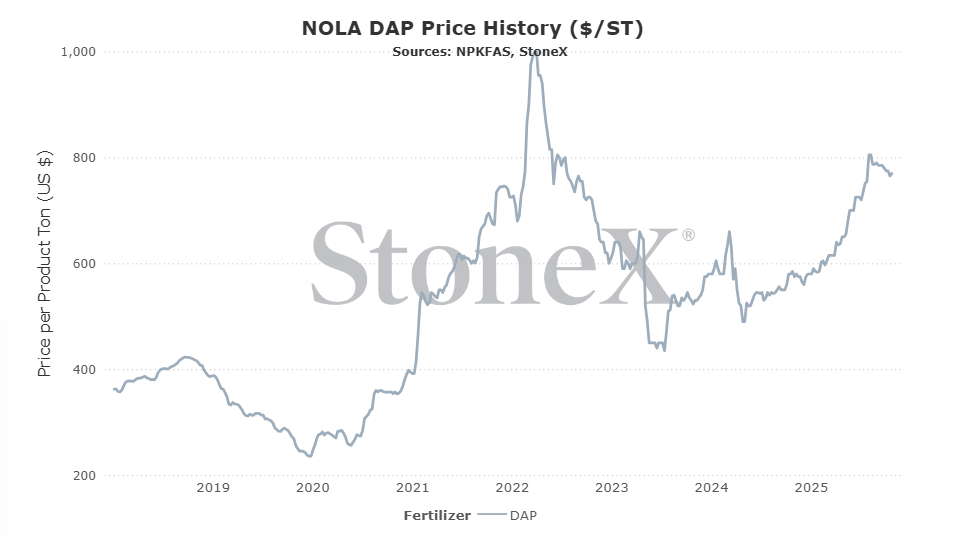
NOLA/New Orleans, Louisiana DAP price comparison
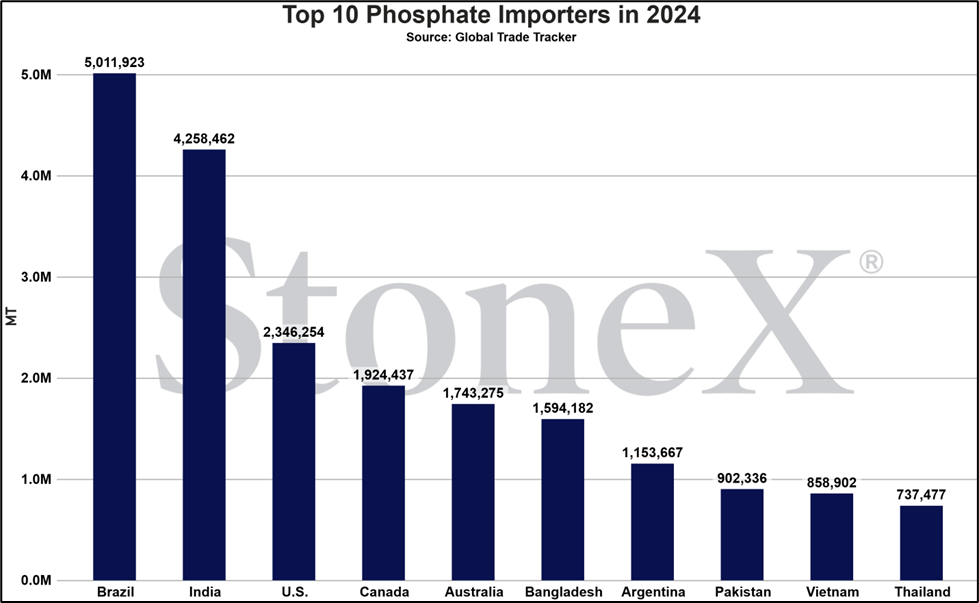
Number 5 global exporter in 2024
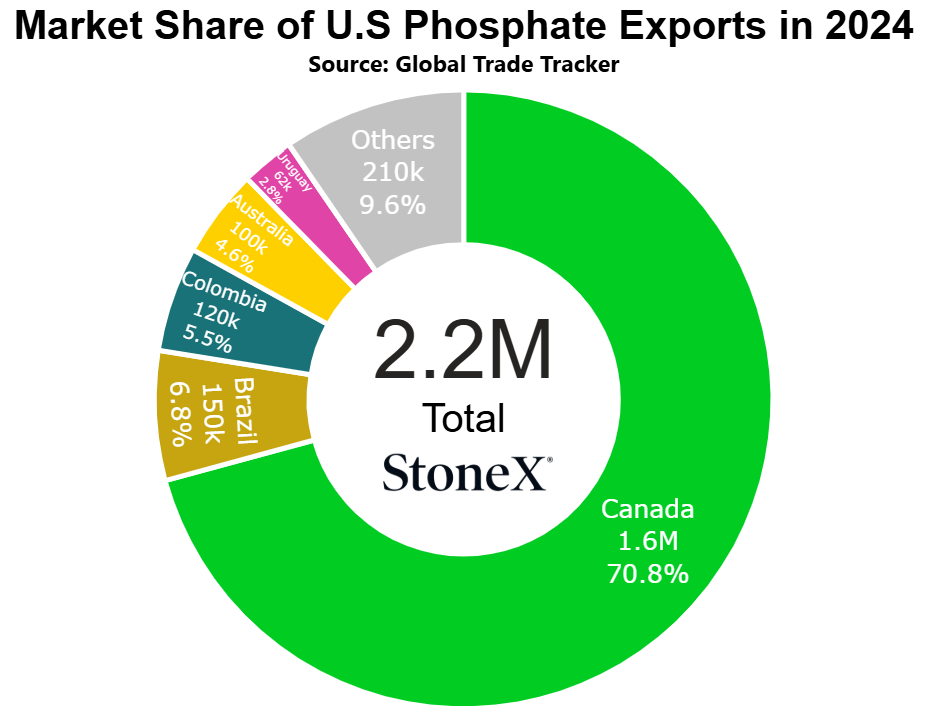
Number 3 global importer in 2024
Price comparisons
Vs 30 days ago - -1% or approximately $10 lower
Vs 90 days ago - -4% or approximately $35 lower
Vs 6 months ago - 18% or approximately $120 higher
Vs 1 year ago - 32% or approximately $185 higher
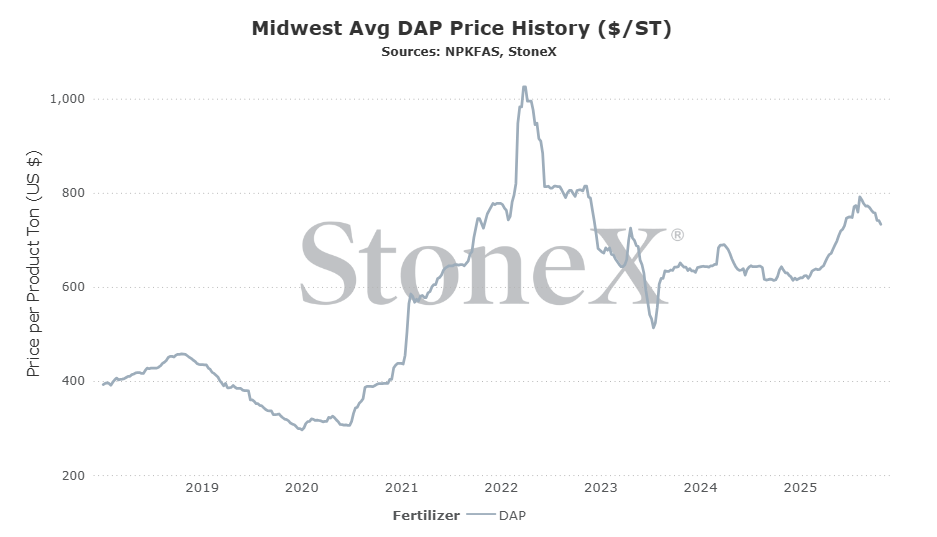
U.S. Midwest Average (using multiple points across Midwest) price comparison
Vs 30 days ago - -3% or approximately $25 lower
Vs 90 days ago - -3% or approximately $26 lower
Vs 6 months ago - 8% or approximately $52 higher
Vs 1 year ago - 14% or approximately $90 higher
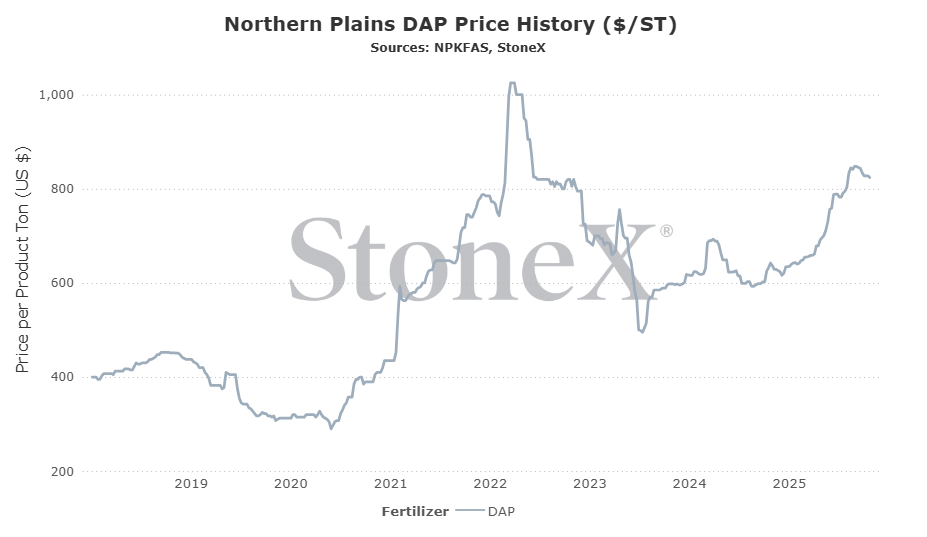
U.S. Northern Plains Average price comparison
Vs 30 days ago - -3% or approximately $25 lower
Vs 90 days ago - -3% or approximately $26 lower
Vs 6 months ago - 8% or approximately $52 lower
Vs 1 year ago - 14% or approximately $90 higher
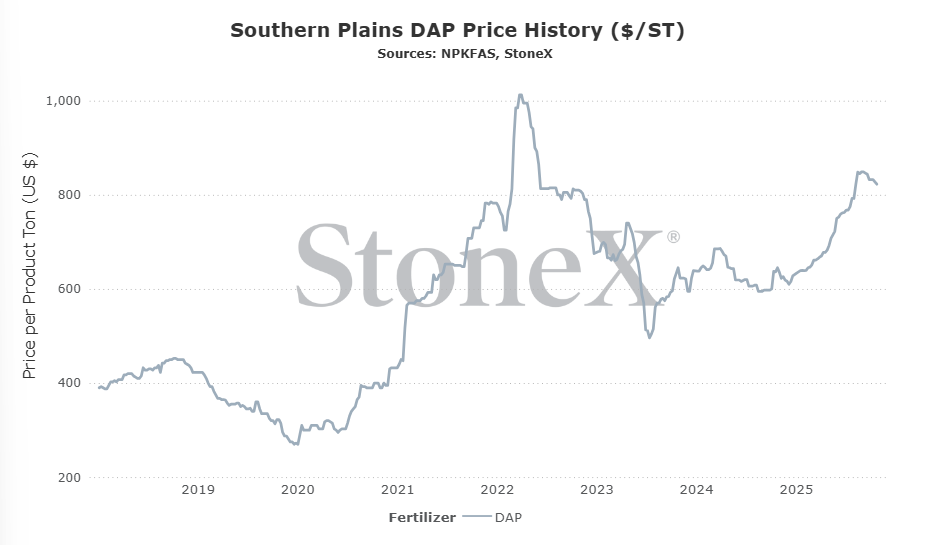
U.S. Southern Plains Average price comparison
Vs 30 days ago - -1% or approximately $10 lower
Vs 90 days ago - 4% or approximately $30 higher
Vs 6 months ago - 19% or approximately $130 higher
Vs 1 year ago - 28% or approximately $178 higher
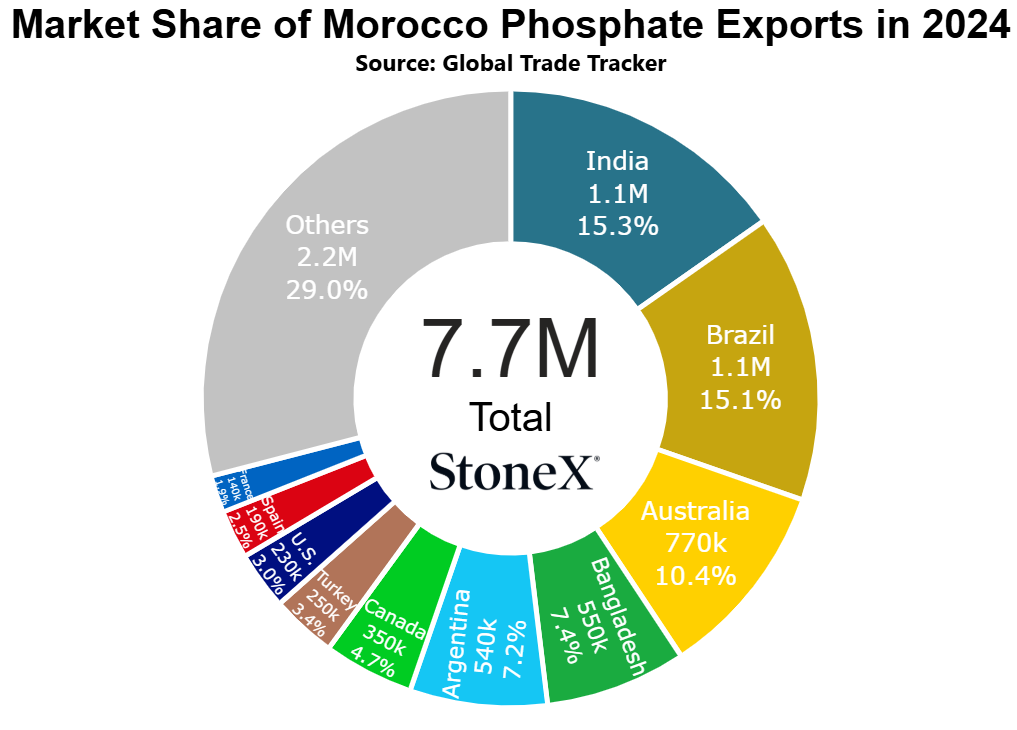
Morocco DAP price comparison
Number 1 global exporter in 2024
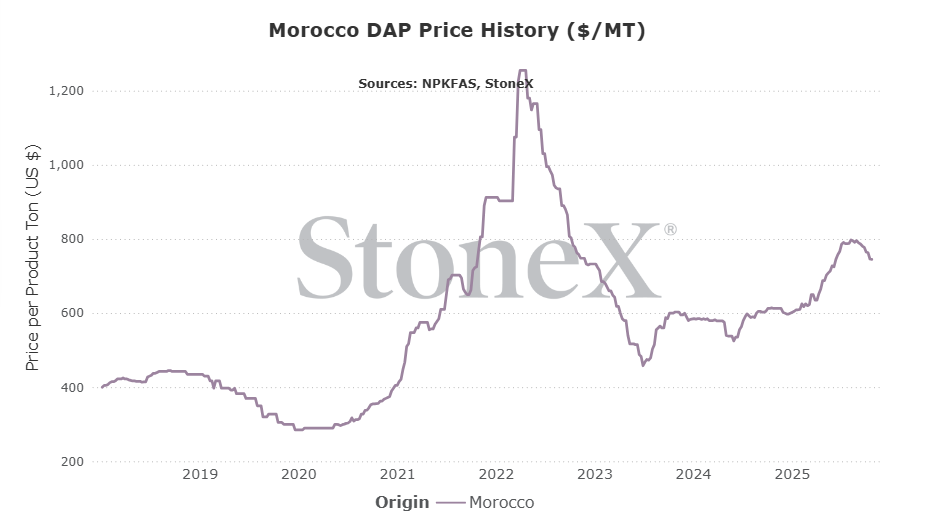
Price comparisons:
Vs 30 days ago - -4% or approximately $33 lower
Vs 90 days ago - -5% or approximately $43 lower
Vs 6 months ago - 8% or approximately $58 higher
Vs 1 year ago - 22% or approximately $133 higher
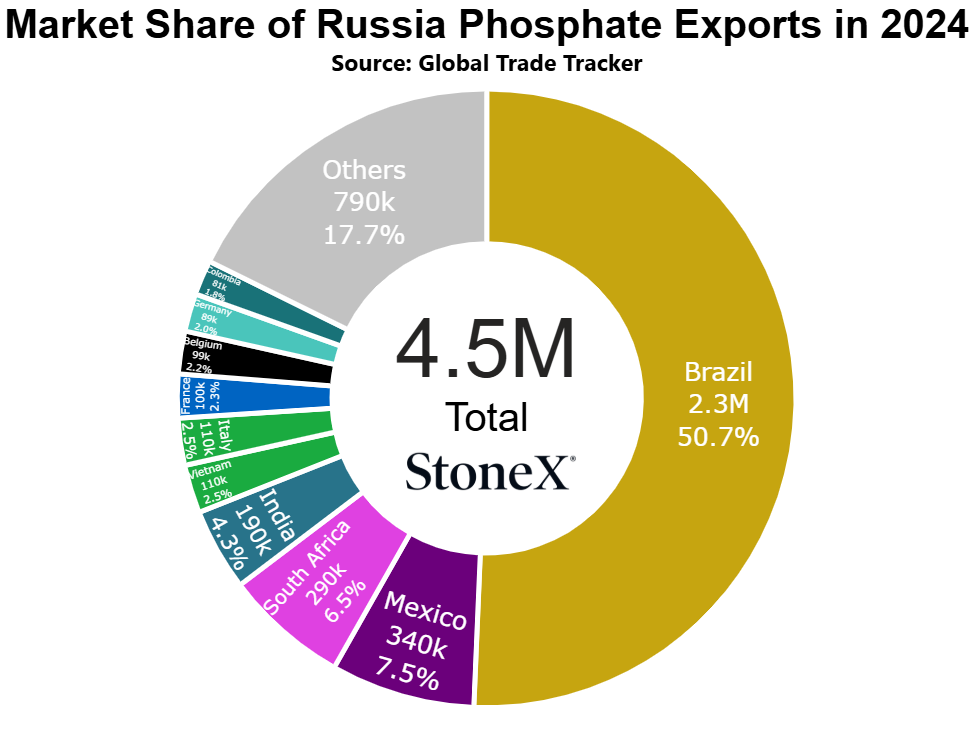
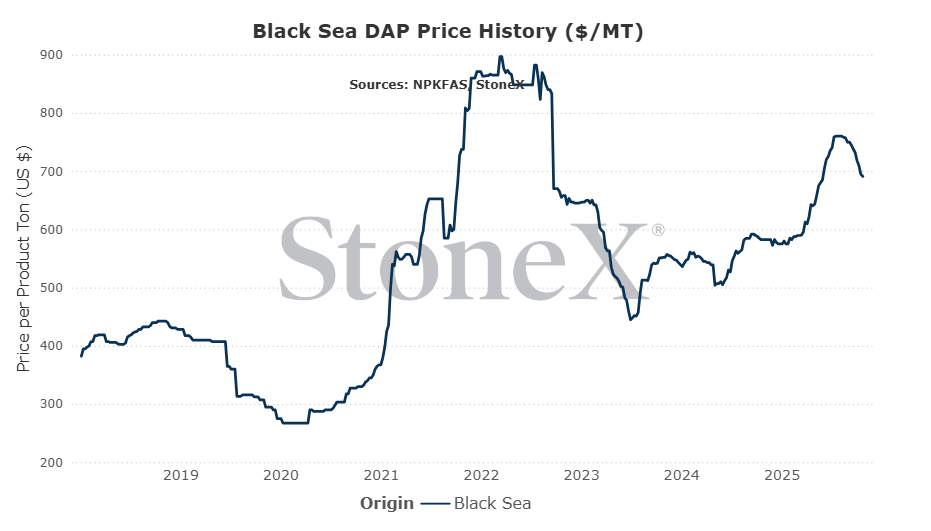
Black Sea DAP price comparison
Number 4 exporter of DAP/MAP in 2024
Price comparisons:
Vs 30 days ago - -6% or approximately $41 lower
Vs 90 days ago - -9% or approximately $69 lower
Vs 6 months ago - 7% or approximately $48 higher
Vs 1 year ago - 19% or approximately $109 higher
India DAP price comparison
Number 2 global importer in 2024
Price comparisons:
Vs 30 days ago - -5% or approximately $42 lower
Vs 90 days ago - -7% or approximately $59 lower
Vs 6 months ago - 8% or approximately $57 higher
Vs 1 year ago - 18% or approximately $114 higher
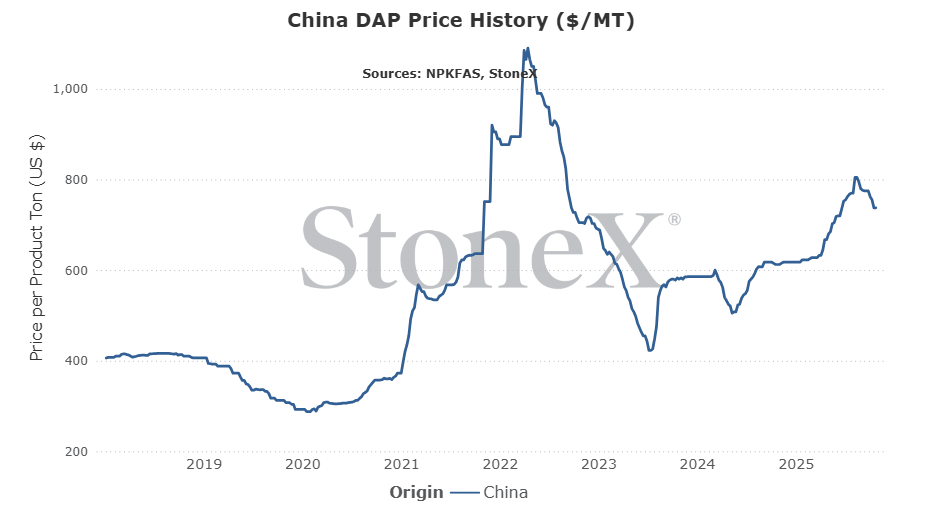
China DAP price comparison
Number 2 global exporter in 2024
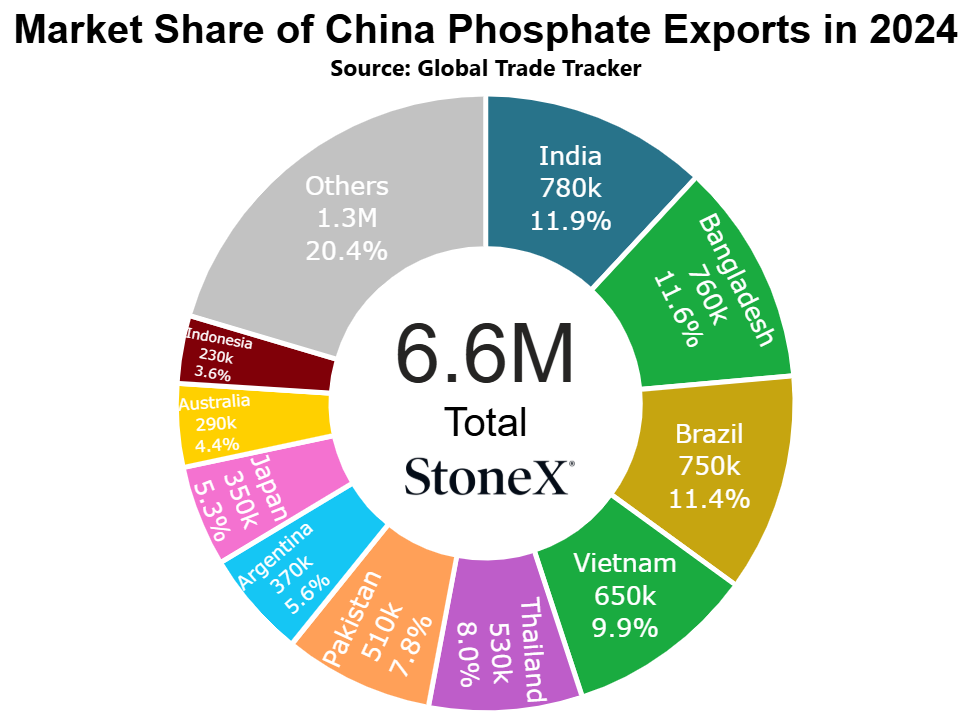
Price comparisons:
Vs 30 days ago - -5% or approximately $38 lower
Vs 90 days ago - -4% or approximately $33 lower
Vs 6 months ago - 8% or approximately $58 higher
Vs 1 year ago - 20% or approximately $125 higher
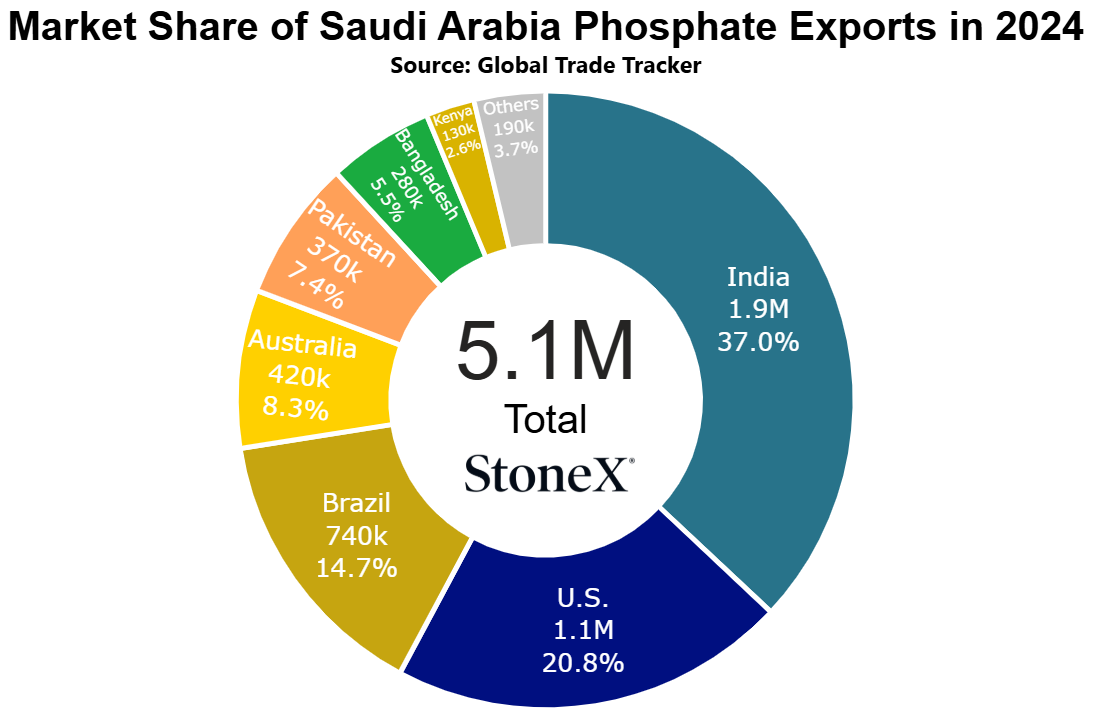
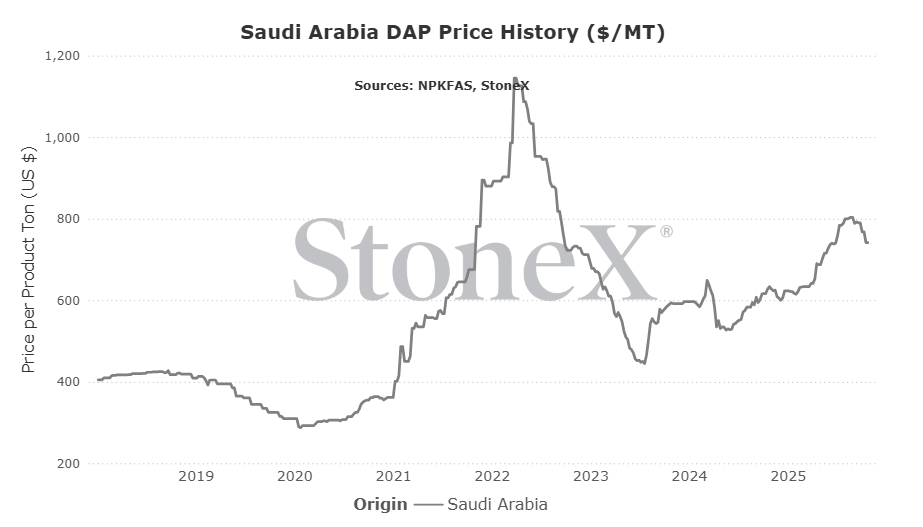
Saudi Arabia DAP price comparison
Number 3 global exporter in 2024
Price comparisons:
Vs 30 days ago - -6% or approximately $49 lower
Vs 90 days ago - -7% or approximately $58 lower
Vs 6 months ago - 8% or approximately $54 higher
Vs 1 year ago - 17% or approximately $108 higher
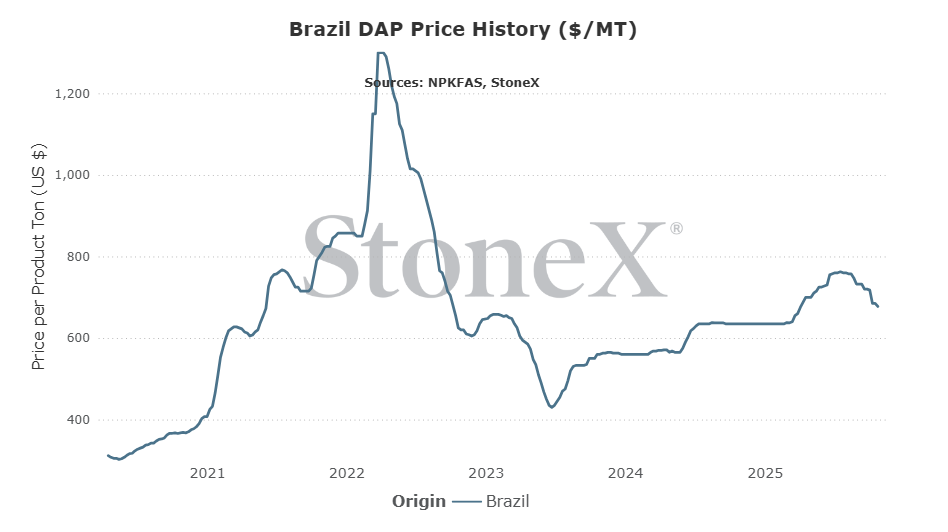
Brazil DAP price comparison
Number 1 global importer in 2024
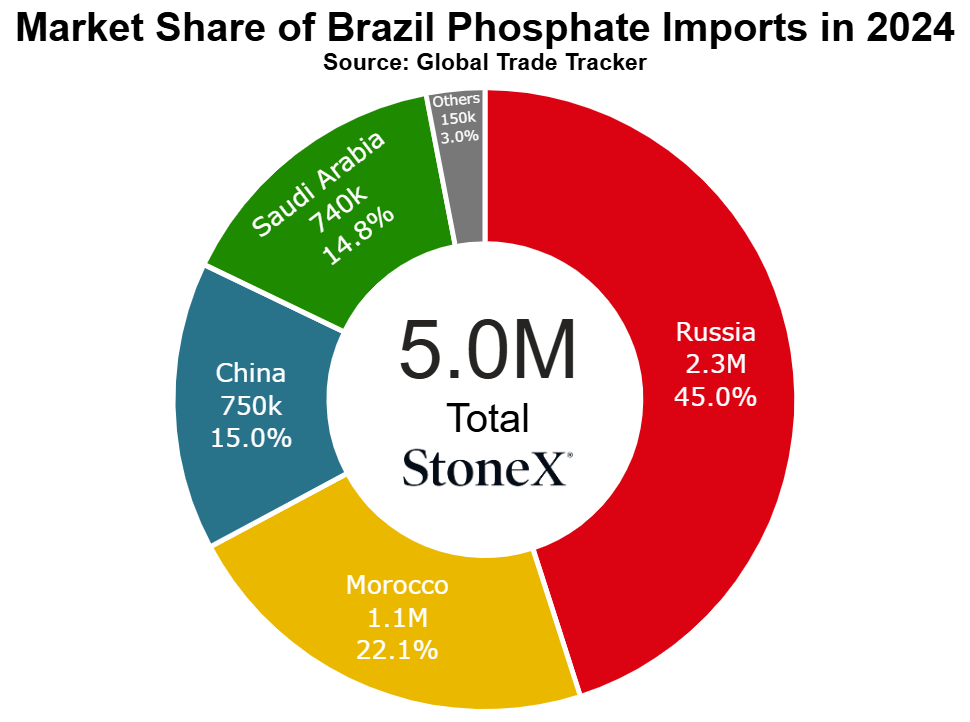
Price comparisons
Vs 30 days ago - -6% or approximately $43 lower
Vs 90 days ago - -11% or approximately $83 lower
Vs 6 months ago - -3% or approximately $23 lower
Vs 1 year ago - 7% or approximately $43 higher
Bull/Bear Factors
Because no market is ever guaranteed to go higher/lower, we try to consider the factors that can sway values so that we are able to act when they occur rather than react.
- Bullish Factors
- Chinese exports start to slow after no October 15 extension - the last month or two has seen global phosphate prices steady to lower in part to India's slowed buying patterns. A bigger part has been due to China actually exporting product once again. Now, this export increase was expected but the simple fact that the tons were showing up in the world caused things to slow down. There had been hope that the Chinese government would extend their export window past October 15 and would increase their export tonnage allowance. Unfortunately, that hope is starting to fade. No announcement has been heard. If there isn't one, we should see China's export flows slow to a near standstill in November/December. Bulls will have another reason to hold pricing high.
- Global buyers are forced to step forward - phosphate prices as high as they are causes buyers to step back and wait. Can you blame anyone for doing that? Phosphate values make little sense given current grain values. Farmers are struggling with cash flows due to high input/low grain prices. There is no reason to jump in early...but that can only last so long. Eventually, import/supply plans need to be made. Purchases have to be confirmed. The longer buyers wait, the more hurtful the impact on the other side.
- N.A. fall demand is bigger than expected - all summer, N.A. farmers have been threatening phosphate application rate cuts, and for damned good reasons. As mentioned above, inputs are too high and grain prices are too low. Something has to give. I do not think a single person that has threatened lower phosphate demand has lied. However, early fall application signs are not good. While the overall average may not be as high as some predict, there is a really big crop out there. What does a big crop do? It removes a lot of nutrients that need to be replaced in some manner or risk next years yield potential. We are hearing early reports that phosphate demand is higher than previously thought...and if that continues, supplies are going to struggle to keep up.
- U.S. government sends out relief checks to farmers - I do not normally do a 4th bull/bear factor, but I broke my rule for this month. As just stated above, farmers have threatened their phosphate demand first. It makes sense given how over priced it is vs most any comparison one can make. My fear is what will happen if the U.S. government opens and farmer relief checks are the first thing to be sent. If phosphate was the first removed, will it be the first returned? If that happens, the phosphate S&D has a big problem on its hands.
- Bearish Factors
- China surprises and extends/increases their export program - while this does not look probable today, I'm going to include it only because of the effect it would have. When Chinese phosphate exports were missing for the 1st half of 2025, values were firm. When Chinese phosphate exports returned in recent months, values fell flat to lower. Now that their exports are expected to slow/stop, it suddenly feels like a price floor has been found. If, and again this is a big if, China decides to export more, it could have the global marketplace marching lower.
- N.A. farmers follow thru with demand cuts/poor fall weather - if this happens, I truly hope it is done from a well thought out POV. My worst fear is that some will cut their phosphate rate to the point that it negatively impacts next years yield potential and a short-term cost savings cut ends up hurting worse next year in the form on less bushels. That aside, if farmers are able to follow through with demand cuts this fall, it can put the pressure back on manufacturers who produce product every single day.
- U.S. government removes import duties/tariffs for phosphate - this is my biggest likely event, but lowest impact situation. Given the attention farmers are getting from Washington D.C., my hope that they will remove tariffs/duties on imported phosphate is growing. It still isn't a big hope, but going from nothing to something is a step. If they suddenly shocked us and removed these import barriers, N.A. phosphate values should fall. However, I do not think it will be the silver bullet folks think it is. Unless we can get manufacturing back to normal, we will still need to import to meet "normal" demand. That means competing with the world buyers on limited tons due to China. Don't get me wrong, it would be a bearish event. I just do not want folks thinking it cuts the price $200 - $300+.
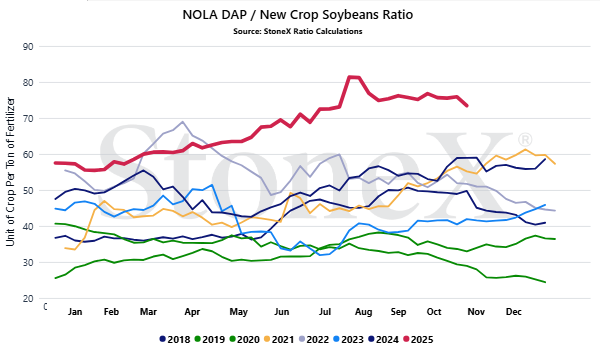
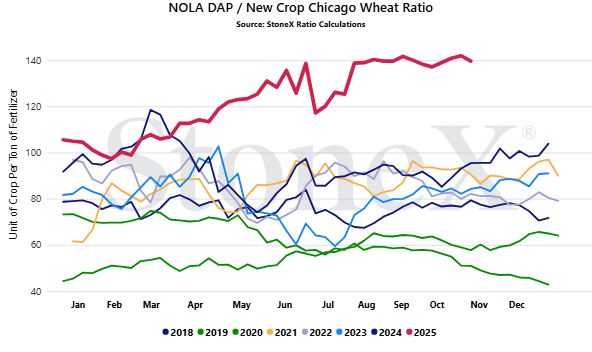
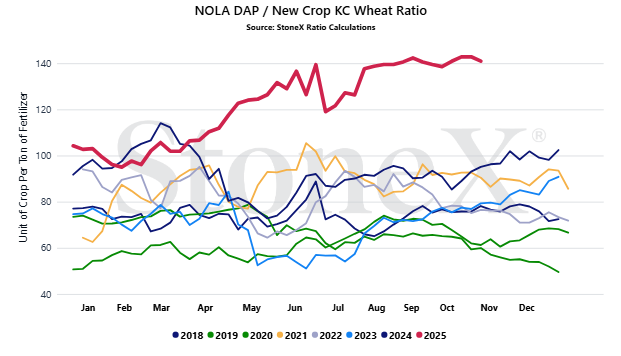
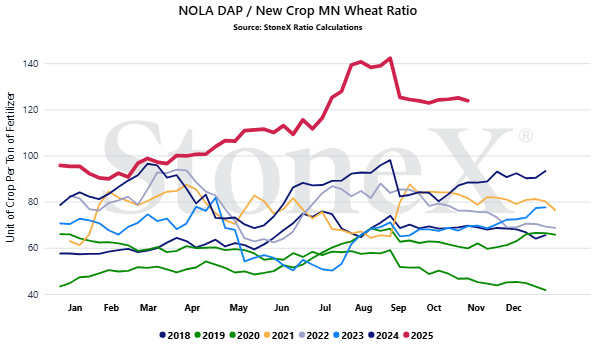
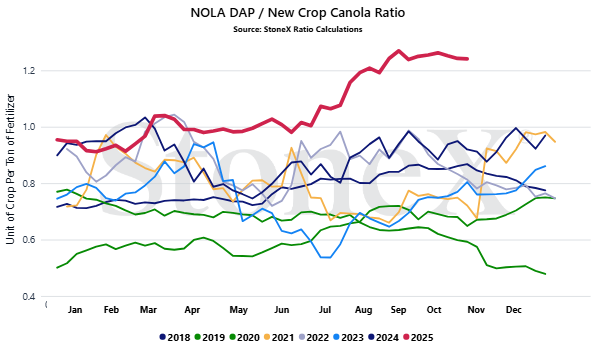
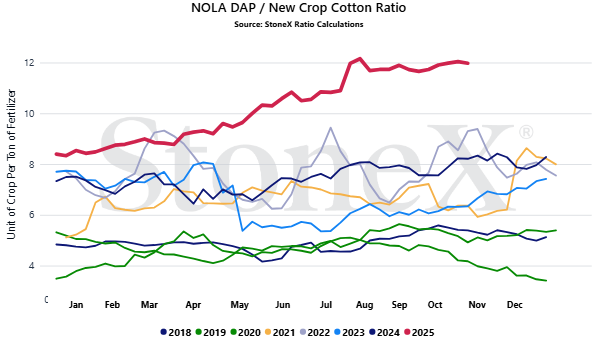
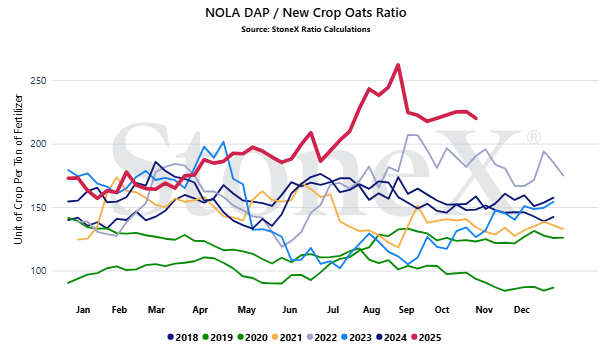
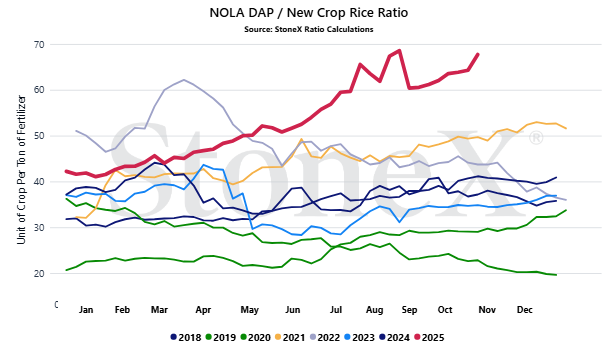
Where are the current phosphate/grain ratio values today?
We believe that only looking at the flat price of either grains or fertilizer can be misleading:
We look at the ratio "value" to get a better indication of where we are or how many bushels of X does it take to pay for 1 ton of fertilizer.
Would you rather:
When we compare the current ratio value against recent years, we start to see if we are high or low.
YOUR VALUES MAY LOOK DIFFERENT
This graph looks at the NOLA DAP price vs the flat grain price. There are no logistics on either product. Your location will look different due to fertilizer logistical costs, grain basis, etc.
- Josh Linville’s Focal Points
- China's export approach for the remainder of 2025/early 2026 - the biggest watch point for the global phosphate complex needs to continue being China. Historically speaking, China is the world's largest supplier/exporter of phosphate to the world. They are the largest part of why global values are so high today. Fortunately, the last few months have seen their exports flowing at lower rates. Unfortunately, October 15 (the governments self imposed last date to request exports) has come and gone with no extension. If this continues, exports should start slowing to a crawl for the remainder of 2025 and into 2026. There is still a small hope that the government will announce a late extension, but we are not holding our breath. What China does or does not do in terms of phosphate matters to every farmer in the world.
- Demand destruction due to high phosphate cost - the global phosphate complex has seen prices rally to extremely high values. This is in response to the lack of supplies due to China's export pull back. Global buyers have been threatening pulling back on their phosphate purchases this grain year. This is in response to phosphate values being obscenely overvalued vs almost every comparison that can be made. The market currently needs demand destruction to rebalance the S&D. However, it can also over do it...or not do it enough. Unfortunately, there is not a clean answer for this. Likely one of those "we will know after the fact" situations.
- U.S. economic barriers to imports - of the 5 largest phosphate exporting countries in the world, the U.S. has economic barriers on 4 of them. The U.S. is the 5th. There is hope in the market that the government will remove these barriers to give farmers access to sufficient supplies. It isn't a huge hope, but there is hope. If, and it is a massive if, the government does start removing tariffs/duties/etc., it will help to lower N.A. values but it will not be the silver bullet some think it could be. At least not from my seat. N.A. would still have to compete with the world for supplies. With global supply so tight, there is little reason to send product at a discount. Regardless, we would take any win we can get.
- U.S. production rates - N.A. still lives in a world where the U.S. is working to block the 4 largest phosphate exporters AND U.S. production continues to suffer. Q4 '24 and Q1 '25 set the lowest phosphate operating rate in history at 58%. Q2 '25 improved...to 61%. Q3 '25...63%. I mean, it is improvement, just not much. N.A. supplies remain very tight and there are no good answers to when production will return to normal. If they do, it will help weaken high price resolve...if.
- U.S. government checks to farmers - farmers across the U.S. are holding their breath for word of approval that the government will be sending out relief checks. This would be a great step as farmers continue to bear the brunt of government economic fights with the world. However, a word of caution. Many folks are saying that they intend to cut back and completely skip their phosphate applications given their own poor economics. We have seen this before. Folks say no...until the checks hit. Then we could see a surge of demand...and guess what the market will do then?
StoneX Ratio Calculation
The ratio calculation is derived from Bloomberg historical grains values as well as fertilizer values from StoneX, NPKFAS, and Argus.
The calculation is simply dividing the fertilizer price by each grain price.
All data was sourced from StoneX unless otherwise noted.