November '25 UREA
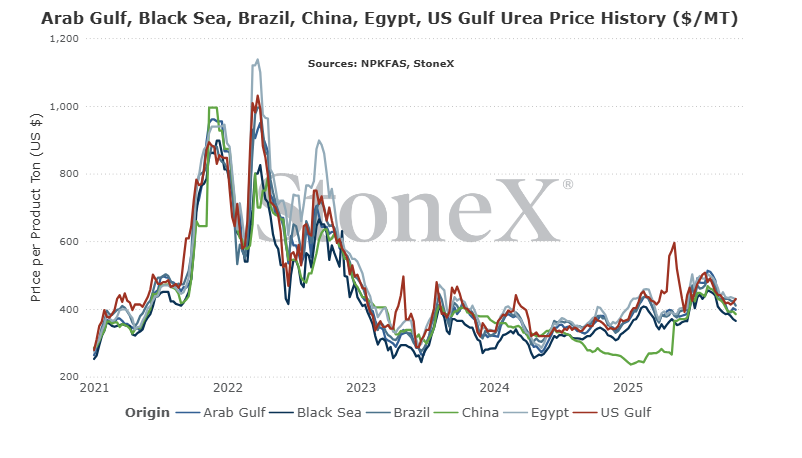
Major Global Urea Export Location Price Graphs
The intention of the below graphs are not to use to say "my price should be X based on this graph". These prices are derived from an FOB price point average. The intent is to show major global price movement trends. Your values will likely have significant basis difference (similar to your local grain price being different than the traded market price).
This graph is labeled as MT in USD currency.
What everyone wants to know first, what do we think will happen going forward
GLOBAL
Just before starting on this month's newsletter, it started to become clear that India was going to fall far short of their 2M ton goal in their purchase tender. That means another tender will be necessary to gather the tons they need to close the year. That gives the market a reason to be bullish and on the surface, I cannot argue against it.
However, once I stepped back and looked, I started to become a bit more bearish:
- Europe is still at 75% but that is unchanged
- Russia is exporting a lot more tons than normal
- China has far surpassed their 2024 export volume
- India has bought a lot recently, but is still in line with their normal fertilizer year totals
- The Middle East region is largely calm, meaning reliable production rates
I think at worst, the argument can be made that we are largely unchanged from this time last year. At best, we can argue that we are improved from a supply and demand standpoint from this time last year.
If we are largely in line to better, why then are Middle East values nearly $100 higher than last years Q4 low's?
Now, at the end of the day, the market will do what the market will do. There are times when the emotion of the market wins...but I am a believer that the fundamentals eventually win.
From where we are today, I wouldn't be surprised to see short-term values up, but I still think we see things softening if this new normal can keep hold.
NORTH AMERICA
We are still in that time of year where NOLA values need to track with world price trends. If global values rally and NOLA stays flat, we run the risk of exporting tons that we need. If global values go down and NOLA stays flat, then we could see massive increase in imports that have nowhere to go until spring. For this time of year, NOLA typically stays a $20 - $30 discount to world replacement.
All of that to say that NOLA should follow global price directions.
With the longer-term global outlook starting to turn bearish, I am hopeful that will equate to the same for NOLA. However, timing is everything. Spring may seem a long way off, but from a logistical standpoint, it is just around the corner.
General Global Urea Information
What has happened in the last 30 days?
China's exports surge, but no extension as hoped
For the first time since 2023, Chinese urea exports surged back to something similar of their historical past! While it was expected, it is still good to see it come true!
A bit of backstory for those that might be new to the newsletter.
Historically speaking, China used to export between 5 and 5.5M tons of urea per year. That accounted for around 10% of the global export marketplace...then the Russian invasion of Ukraine happened. Suddenly, the fertilizer world got turned on its head and thought Russian exports would cease to exist. Huge companies were pulling out, so it only made sense to believe that the world would also stop buying their fertilizer. The result was global values skyrocketing and supplies getting much tighter as the market became less willing to let go of normal supplies.
That is when the Chinese government stepped in. China knew that it was a big exporter of urea and if the global situation continued, they could accidently end up in a position where they export too much product which would leave their own farmers without supply. While I am no fan of communism, this is one of the times where you look at the action and think "well, that wasn't the worst idea in the world". The Chinese government started putting export restrictions in place in order to accomplish 2 goals:
1. Ensure adequate domestic supplies
2. Ensure lower domestic values vs the world
For Chinese farmers, this approach worked beautifully. Suddenly, domestic supplies were more than sufficient vs a world that was fighting over limited tons AND Chinese farmer urea values were some of the lowest across the globe.
Unfortunately, for the rest of the world, this approach worked beautifully. The rest of the world suddenly had to contend with lower supply availability which manufacturers/traders used to press values even higher.
Even though the fear that Russian exports would slow to a crawl were found to be completely false (they are exporting more today than ever), the Chinese government continues to keep a strong hand on their exports.
This came to a head last calendar year when their exports all but disappeared:
2021 - 5.3M tons exported
2022 - 2.8M tons exported
2023 - 4.25M tons exported
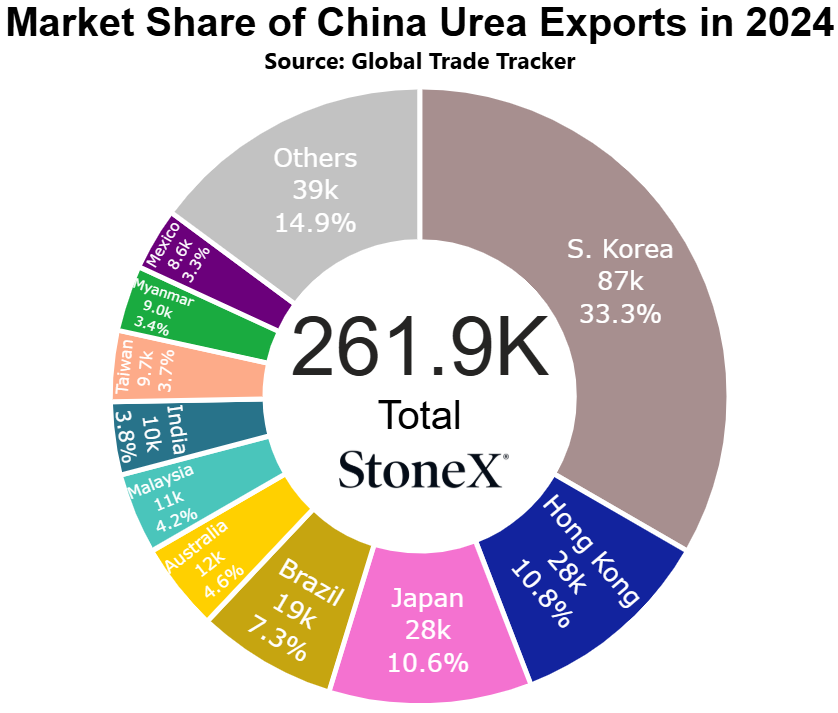
2024 - 262K tons exported...and I am rounding up
The near complete lack of Chinese exports was a big cause of high global values last year. Given the current global situation, there simply isn't enough excess production to make up the difference. Global supplies got tight and values went higher.
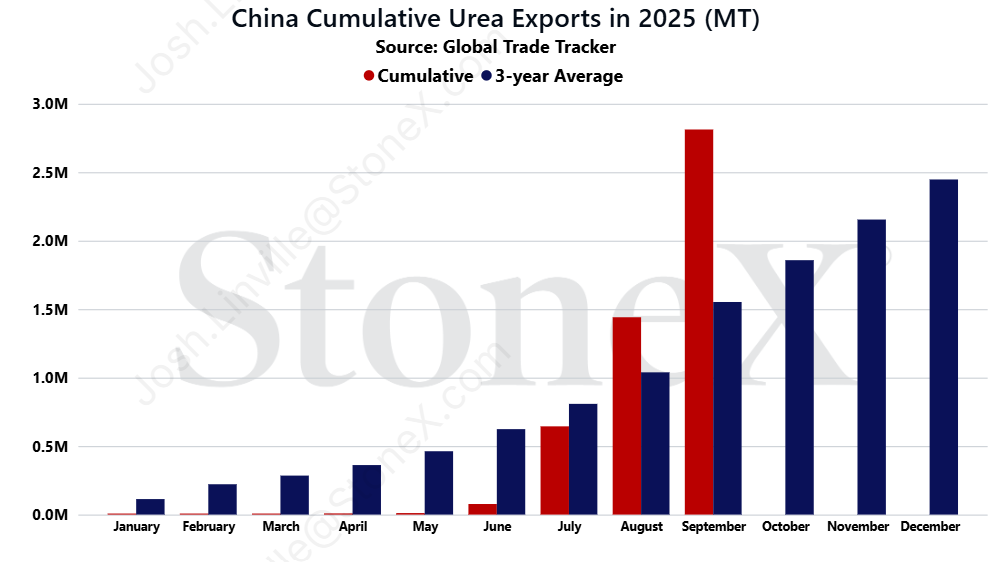
Now, for this month's good story. All year we have expected that Chinese exports would improve. The government started by saying they intended to export 2M tons. That number jumped to 3M tons later in the year and then finally to the current 4 - 4.25M tons. However, through June, nothing had been seen and worry grew. However, July's trade data showed a shift. Nearly 600K tons left China's shores. Then the cumulative total for August grew to nearly 1.5M and September blew it out of the water with a yearly total of 2.8M tons.
China is back and global values were falling...until they were not.
As all of this was happening, we had circled October 15 on our calendar. This was the date that the Chinese government was using as the end of their export program. Any tons not submitted for export by October 15th would be denied and forced to stay home. We had continued to hear reports/rumors that domestic Chinese urea stockpiles were sufficient and domestic values remained discounted. That raised our hope that the government would loosen the October 15 date as well as their tonnage total. Doing so would have likely helped global values fall further.
"Would have"
Today, we have heard nothing of an extension and hope is fading fast. We still believe some tons will continue to depart for October and November as they were likely approved prior to the cut off date, but then should fade fast in December.
Given China's importance on the global market, we will continue to watch for any signs of change as it can change the scope of the global urea market but today, nothing new has been heard. It appears China has been lost once again.
Global S&D feels improved vs last year...why are values so much higher?
This is a story that has been bugging me the last couple weeks. I know that everyone reading is probably thinking "oh Josh, you just now think urea prices are too high? Welcome to the party." That isn't it. I know values have been too high all year...however, I started doing some looking back and here is what I found.
Now, I am going to look at Middle East urea value comparisons vs my normal NOLA comparisons. With the U.S. tariffs in place, NOLA is going to act "differently" than normal. That means year on year comparisons can be made, but they will have an asterisk next to them. Middle East values do not have that same burden so lets use that.
Today - Middle East urea values are "around" $420 (metric ton / USD)
Late November 2024 - Middle East urea values were "around" mid $330's (metric ton / USD)
Today's urea prices are nearly $100 higher than last year. That must mean that the global S&D is even more messed up...but there lies my issue. Let's look at the major exporting locations around the world:
Middle East - a loose peace has been found, production is unchanged vs last year but lack of war should mean lack of war-time premiums. Also will hopefully mean more reliable winter production.
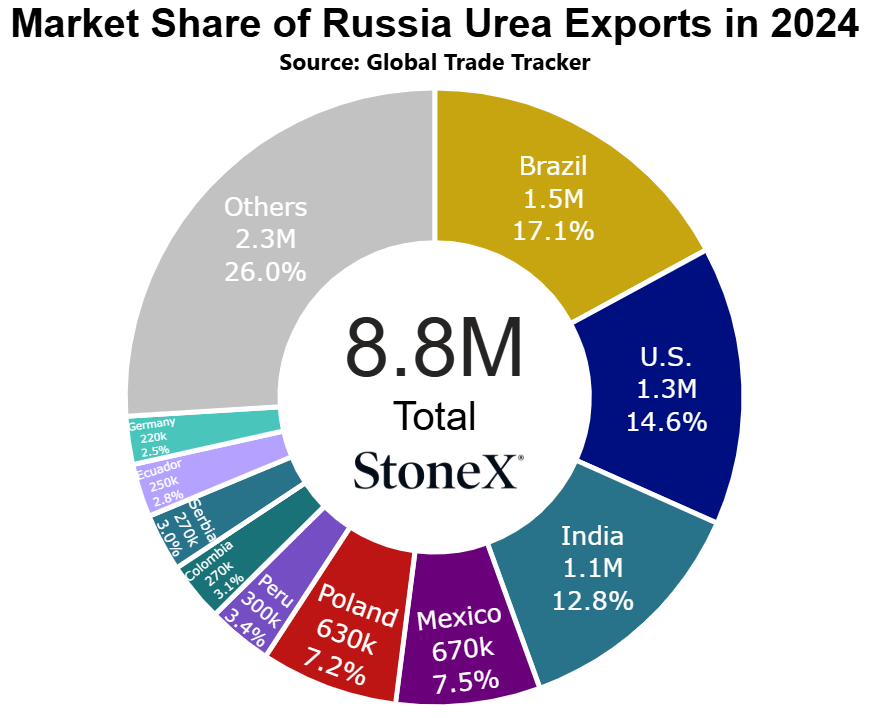
Russia - exports are well ahead of normal but year on year comparisons, Russian should be about the same
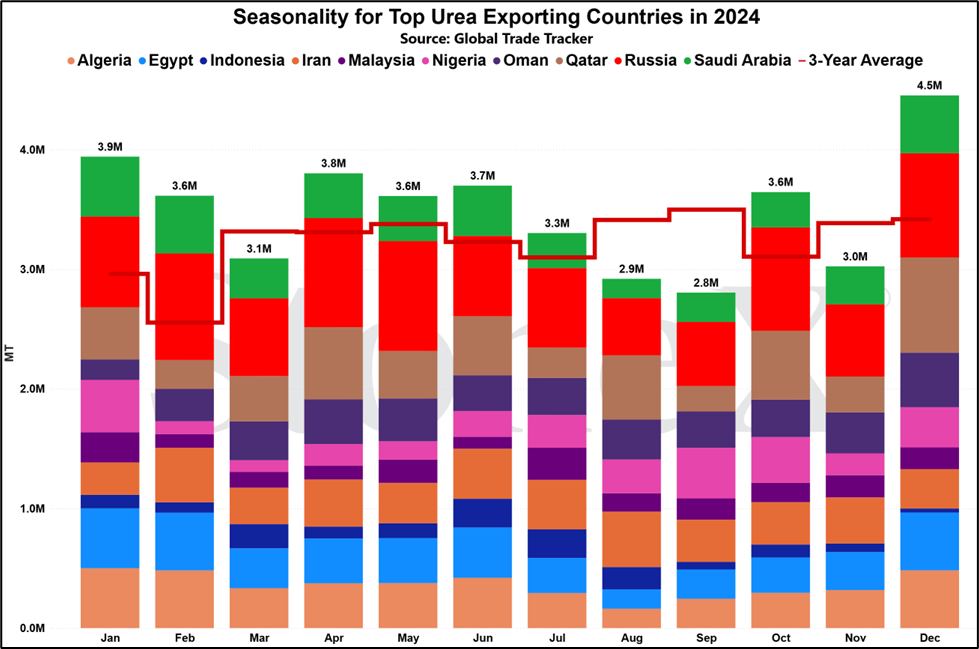
China - only exported 262K tons in 2024. January through September 2025, they exported 2.8M and we think this number will grow in October and November.
Europe - nitrogen production remains at 75% of normal, but that is unchanged vs last year
Asia - nothing outstanding for changes year on year in this region (not including China)
We could continue all the way down the list but this hits the highlights. So most of the majors range from unchanged to China's big bump higher in exports. China alone will likely add 3M tons to the mix.
OK, so it must be the demand side that is so much bigger. This is where India gets tossed into the fray. They have called a lot of purchase tenders this year and have "failed" many of them. Their June/July/August tenders locked up around 5M tons which is a lot for a short timeframe. That must be the reason for the higher prices. However, when looking at their fertilizer year (April through March), they really are not out of line. We expect they will end the year with around 8.7M tons secured. The last few years have seen "normal" in the 8M tons range (not including fertilizer year 2024 where they only locked up 6.9M tons).
This is where I struggle. Global supplies feel better than last year. Global demand doesn't seem out of line. All this and yet values are up nearly $100 over late 2024.
Please do not read this as a "guarantee that prices will fall dramatically". That is not the case. Today, the market is firm as manufacturers and bullish traders have their way. I am merely tossing out a bit of caution. Today, the math is not mathing in my head. Might be nothing...or might be a sign of things to come later this winter.
India's last 2025 fails to meet tonnage goal. New tender expected.
How did the October India urea purchase tender go?
Well, it was supposed to be the last one of 2025. That no longer appears to be the case.
On October 1, RCF (India's importer for this tender) announced the tender with the details that they were looking to secure 2M tons. By our estimations, 2M tons would likely take care of everything they needed to close out 2025. Their shipment period ran all the way through to December 10th. There was not much concern that they couldn't get the tons they wanted...as long as the market played nice.
Unfortunately, it did not.
First, offers were due on October 15th...the same date that China put into place to close out their export flows. The closer to offer date the market got, the lower its hope that China would extend their export window. That meant that as the offer date got closer, the fear of competing against Chinese tons fell, and that gave the market more reason to be bullish.
Then, the offer values were submitted. West Coast came in a bit cheaper than some expected, but not hugely out of line. There was a lot of product offered reasonably close to the lowest value. The East Coast lowest offer blew everyone out of the water. The E.C. L1 was a full $15 lower than the next lowest price. In fact, there were very few tons offered that were even within $20.
While all the offer price information was being digested, it became more and more apparent that China was not extending their export window.
Ultimately, offers likely saw the extremely low offer price for the east coast as well as the expected lack of Chinese participation/competition. One of our big questions had been "if offers refuse India, where will they go with their tons?" Turns out that offers refused India and are now answering that question with "well, we will go to India on their next tender".
With only 430K tons secured vs their 2M ton purchase goal, it is highly likely that we will see another tender announcement and it would behoove them to call this sooner than later. The longer they wait, the more competition they will have as the rest of the world cannot delay its spring demand forever (though it can feel that way). The sooner they call this next tender, the more they will have the market "to themselves".
Unfortunately, this situation has helped the global urea market firm in its price ideas and that is being felt nearly everywhere.
U.S. sanctions Russia but leaves fertilizer alone. What could have that meant?
Talk about U.S. / Canadian farmers dodging a bullet.
One of my worst urea fears looked like it was going to come true. With President Trump's patience with Russia running thin, I have been fearing waking up one morning to the news that he had decided to fully sanction Russia. Knowing that we cannot get into a direct fight with them, it is better/easier to wage an economic war that will cripple their economy which would ultimately undercut their ability to wage war against Ukraine.
Out of the blue, Treasury Secretary Bessent announced a coming announcement regarding Russian sanctions. That was it. There were no details. There was no insight. Just "sanctions are coming". My stomach dropped.
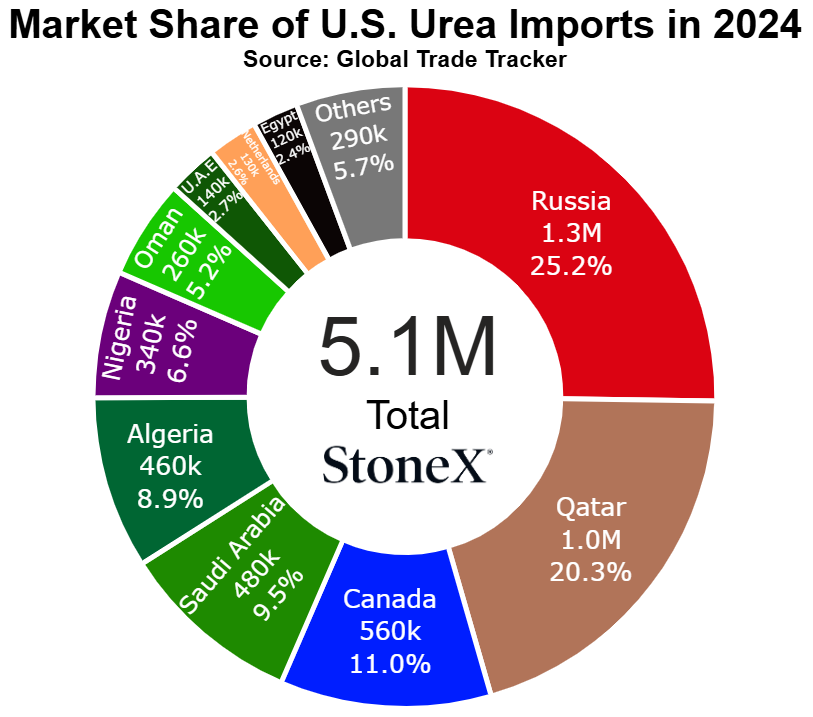
This is going to be a story that I repeat for UAN as well as potash given Russia's importance. For urea, Russia accounted for around a quarter of the U.S. urea import flow in 2024 which made them the largest single supplier.
See why I got worried?
Now, we need to consider how the market would have likely reacted.
For starters, there would have been a lot of bullishness. You simply cannot remove the largest supplier from the mix without that happening. There would be confusion. There would be fear. Emotion would reign supreme.
However, once the dust settled, I think a lot of the bullishness/premium that got baked into the market would subside. Remember that urea is one of the most commonly produced fertilizers in the world and is produced by a lot of different companies/countries/etc. I am not saying it would be easy to replace Russia with new trade routes, but of all the products for fertilizer, urea would be the easiest. Russian tons would be forced someplace new and the tons that would normally service that country would be displaced and likely sent toward the U.S.
Fortunately, the market woke up the next morning to the news that these sanctions were limited to oil. President Trump did not go for the kill shot to cover all goods coming from Russia. He opted to go for a very visible product that makes a very pointed statement. For today, urea is safe...for today.
Unfortunately, we need to continue to monitor this. If we wake up sometime in the near future and suddenly fertilizer is on the sanction list, I can all but guarantee that the market will respond. To make matters worse, the closer we get to spring season, the more important it is to watch. If we find out in January/February that they are blocking urea from Russia, that will leave very little time for the market to pivot to new supply origins. All said, the closer to spring sanctions occur, the more reactive prices will become.
Let's hope it doesn't come to that. Farmers can ill afford more price increases...

U.S. government prepares farmer subsidy payments. How will that change the market?
We are nearly a month into the U.S. government shut down as Republicans and Democrats struggle to find common ground. There is growing hope that the November 1 "run out date" for SNAP benefits will force a reopen, it is far from guaranteed. As dark as it may look, it will eventually reopen...and U.S. farmers are counting the days.
The Trump administration has heard the call from American farmers who are struggling with high inputs values and low grain values. Some of the situation can be tied back to the administrations economic fights with several key countries around the world. It only makes sense that subsidy checks are not only hoped for, they are currently expected shortly after the government reopens.
So what would that mean for the urea market?
From a strict S&D perspective, it should mean very little. We do not anticipate urea demand shrinking or growing based on subsidy payments. That demand should remain very stable and as such, prices should not be impacted.
Now, let's be realistic. We all know there will likely be a change because timing is everything.
We continue to believe that the N.A. urea supply situation is tighter than normal on the back of lower starting inventories for the fertilizer year, several North American nitrogen plants having planned downtime for repairs, etc. There just isn't as much out there as would normally be for this time of year...but the market has not cared. With farmers struggling as they are, demand has been quiet so tight supplies do not matter.
Now, imagine that supply situation on the back of a sudden demand wave.
If these subsidy checks go out as we expect them to, we think that fertilizer will see a lot of sudden investment since farmers have seen this before. A flood of cash hits the market, a lot of demand pops up, and suddenly it becomes much easier for prices to rally. Now, if this happens, there needs to be consideration for what happens this winter if the demand is already taken care of, but the nearby market will likely ignore that POV.
Today, even with recent weeks bullishness for urea due to lack of Chinese export window extension and India's tender failure, urea is still attractive vs NH3 and UAN. Farmers are still going to need to seek the lowest priced nitrogen they can to make ends meet in 2026. That "should" mean that urea gets a little more investment love. If these checks start getting sent out, keep an eye on values.
Urea values improve vs grains, but still very high
I want to start by saying that in no way in this piece am I trying to say that urea is cheap or right priced. To me, urea is still overvalued given the global complex. Sometimes, far too often at the expense of farmers, markets do not make sense and just stay high priced.
That aside, lets look at how urea has improved vs grain values. Specifically the ever import corn crop.
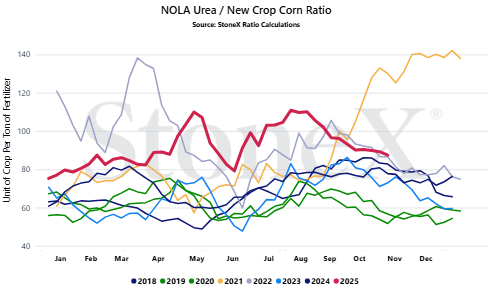
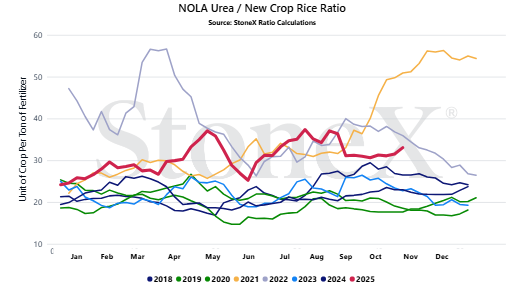
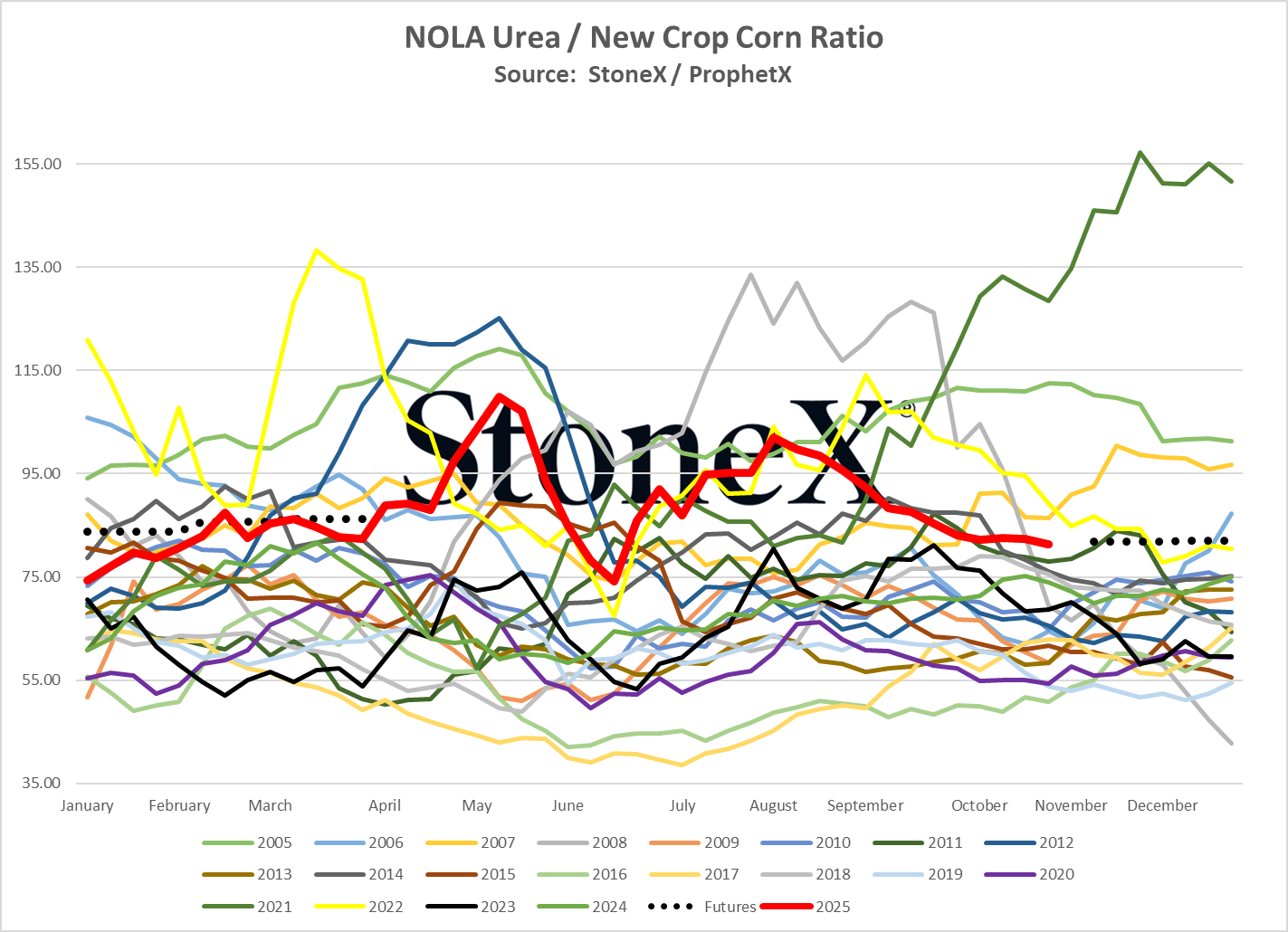
2025 has seen 2 peaks for the urea/corn ratio:
Early May - 110 bushels of corn per ton of urea
Late July - 102 bushels of corn per ton of urea
Today, the ratio is still high when we look at the values over many years, but it has dropped from the extreme high's that have been prevalent.
Please keep in mind, as always, that NOLA prices are going to be cheaper than your local price. This is a price of a ton of urea on a barge sitting in the gulf. It does not include any freight. It does not include any costs to unload. It does not include any costs to move it across the country, into storage, interest, shrink, application costs, etc.
That said, today:
NOLA urea - $400 (has rallied $25 or so from recent low)
December 2026 corn - $4.65
That gives a ratio of 86 bushels of corn to pay for 1-ton of urea.
Again, I know that is not cheap. I am merely pointing out the improvements from the worst points this year.
One more thing I would like to point out. As mentioned before, these are values that do not include any costs or basis. That is why it is so important to run these graphs/numbers with your local retailer/elevator. the numbers at home are the ones that truly count. I speak to a very wide audience. It would be impossible to run every ratio at every point around the world. This is a conversation/exercise that should be done locally to if the same opportunity exists or if something may still come.
For now, I'm going to continue to hold out hope for a corn rally and a urea bloodbath!
Where are current values in relation to the past
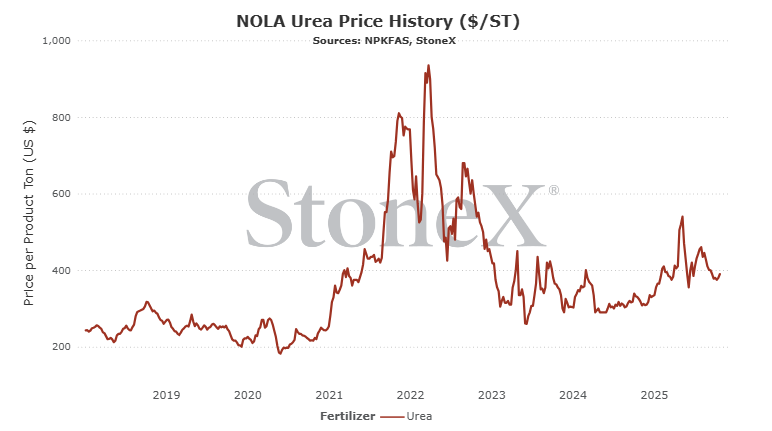
NOLA/New Orleans, Louisiana
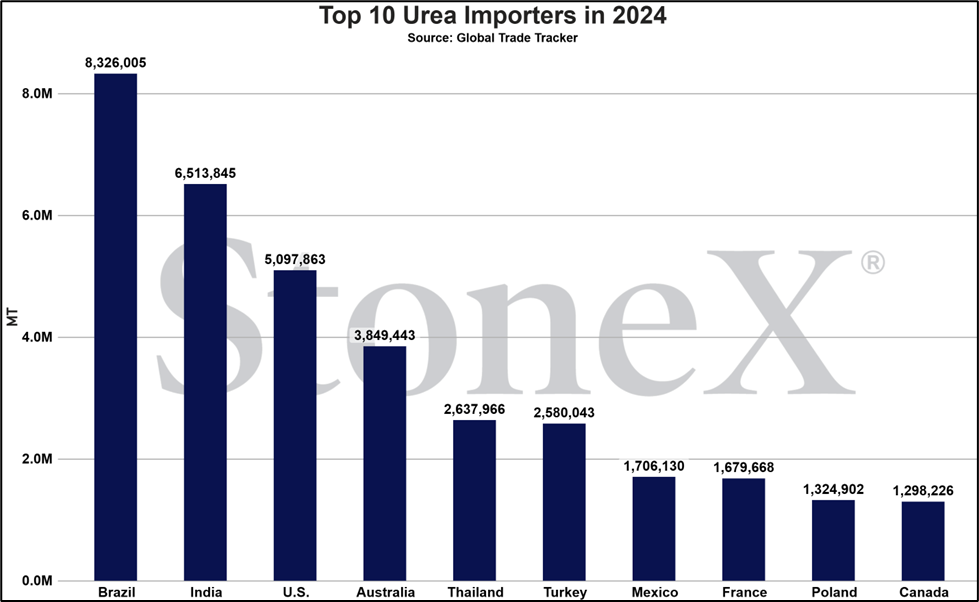
Number 3 global importer in 2024
Price comparisons
Vs 30 days ago - 3% or approximately $12 higher
Vs 90 days ago - -15% or approximately $70 lower
Vs 6 months ago - -25% or approximately $130 lower
Vs 1 year ago - 20% or approximately $65 lower
U.S. Midwest Average
Vs 30 days ago - -3% or approximately $20 lower
Vs 90 days ago - -15% or approximately $75 lower
Vs 6 months ago - -25% or approximately $141 lower
Vs 1 year ago - 12% or approximately $45 higher
U.S. Southern Plains Average
Vs 30 days ago - -2% or approximately $10 lower
Vs 90 days ago - -15% or approximately $75 lower
Vs 6 months ago - -23% or approximately $130 lower
Vs 1 year ago - 14% or approximately $53 higher
U.S. Northern Plains Average
Vs 30 days ago - -3% or approximately $14 lower
Vs 90 days ago - -15% or approximately $79 lower
Vs 6 months ago - -24% or approximately $139 lower
Vs 1 year ago - 15% or approximately $56 higher
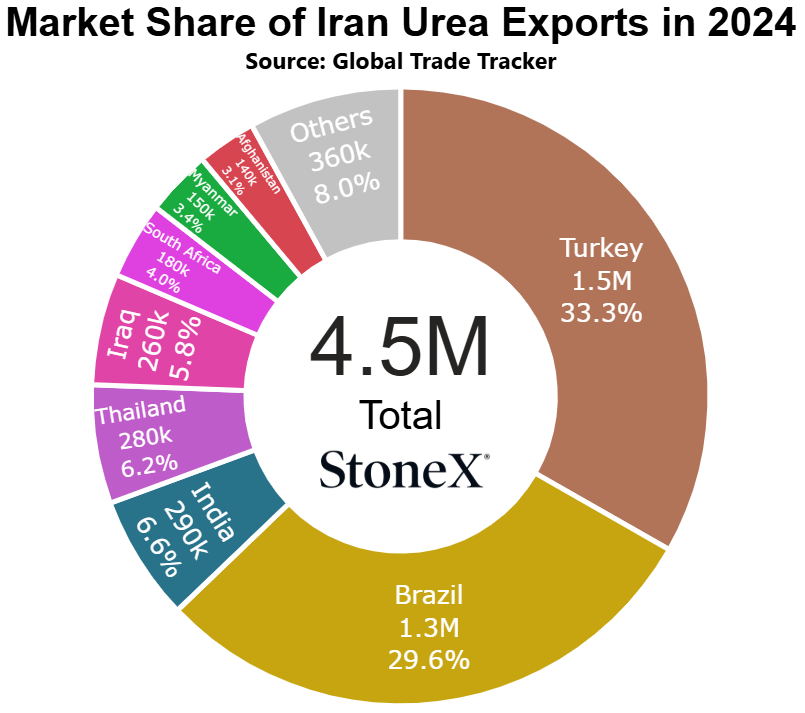
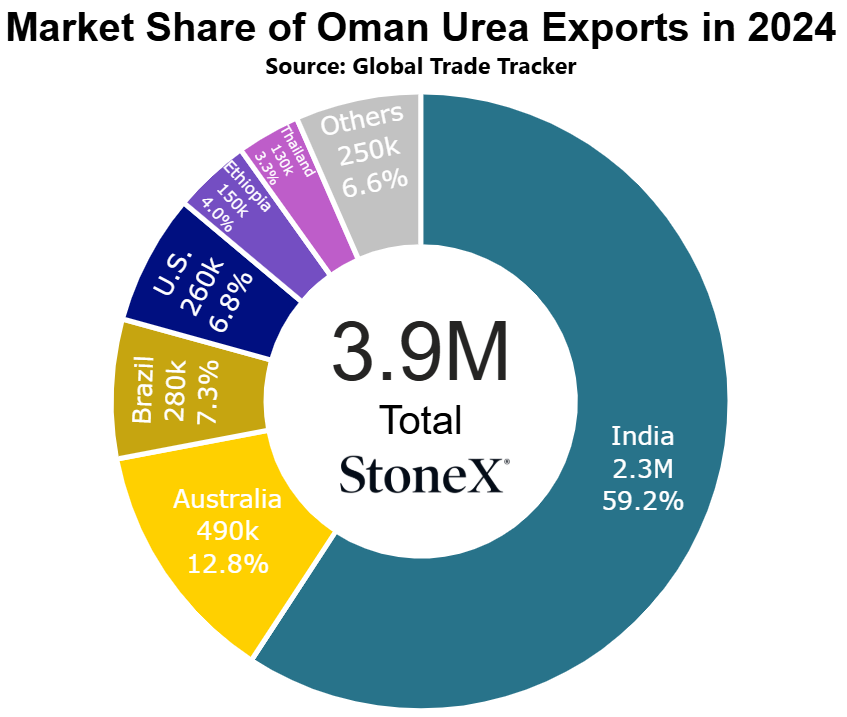
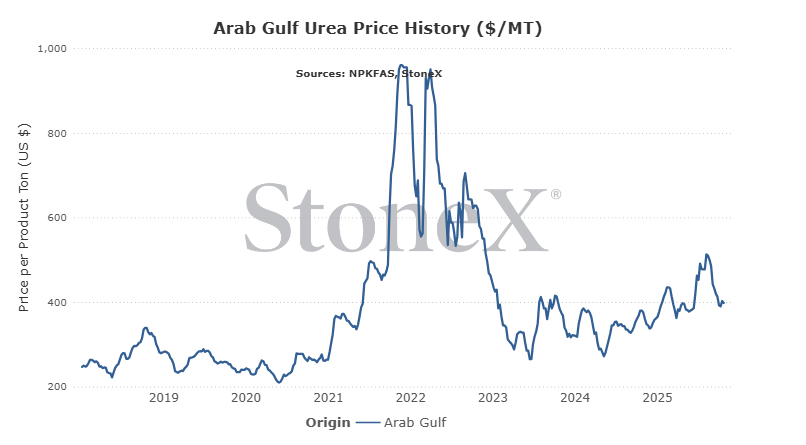
Middle East
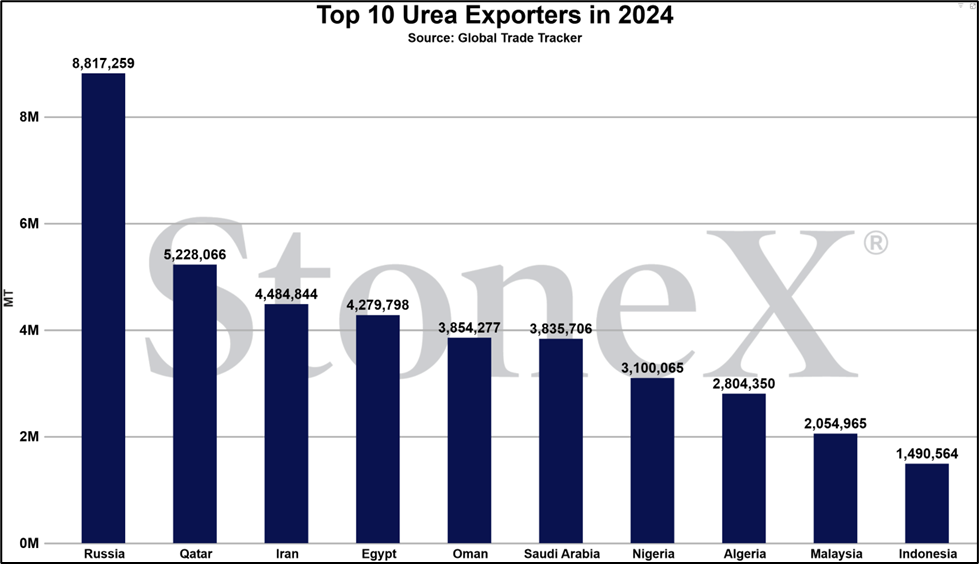
Number 1 exporter (as a region, not as individual nations)
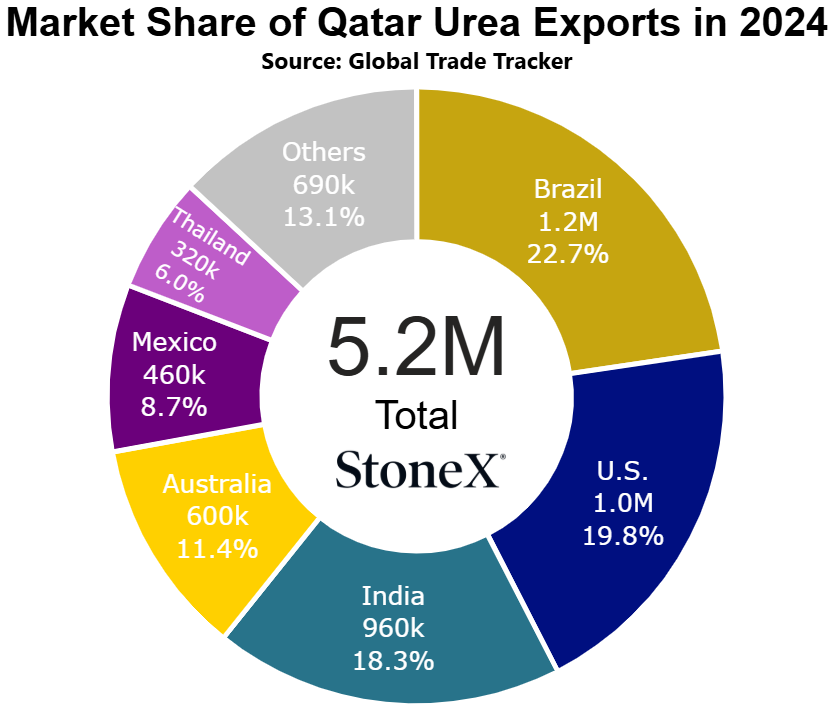
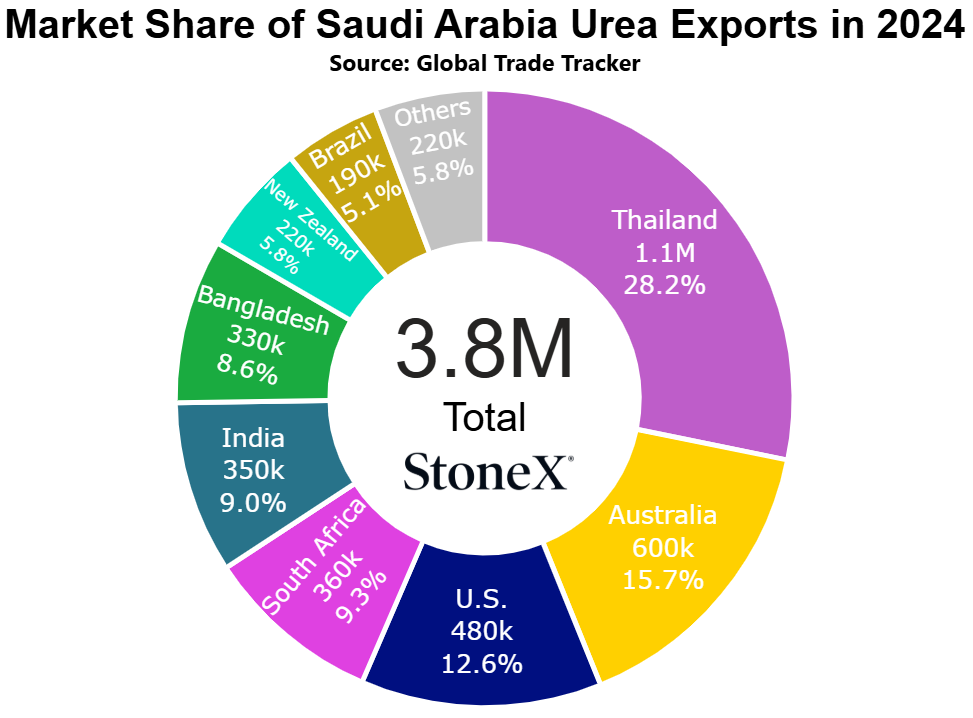
Vs 30 days ago - -4% or approximately $15 lower
Vs 90 days ago - -17% or approximately $80 lower
Vs 6 months ago - 1% or approximately $3 higher
Vs 1 year ago - 5% or approximately $18 higher
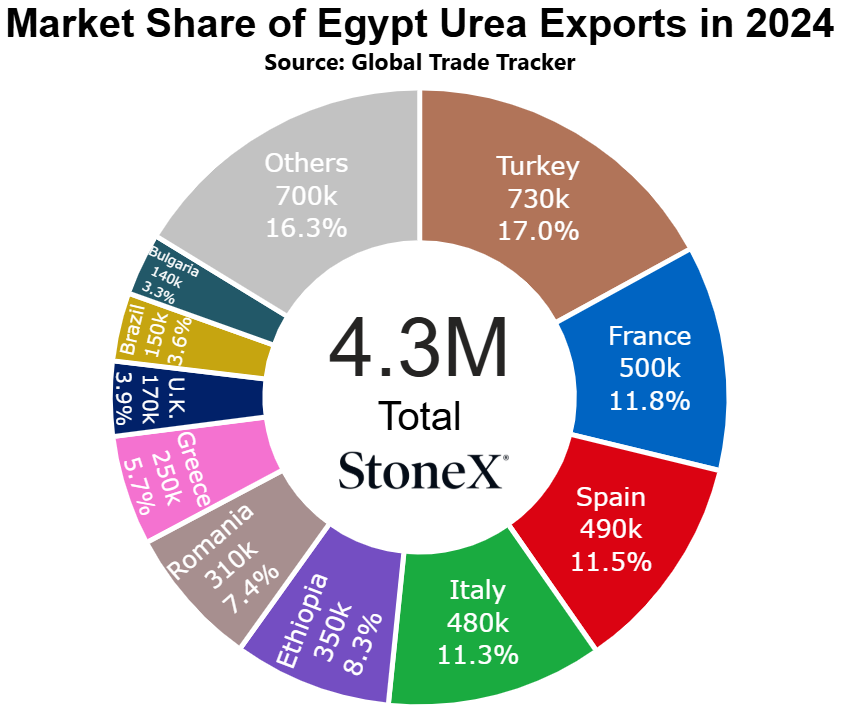
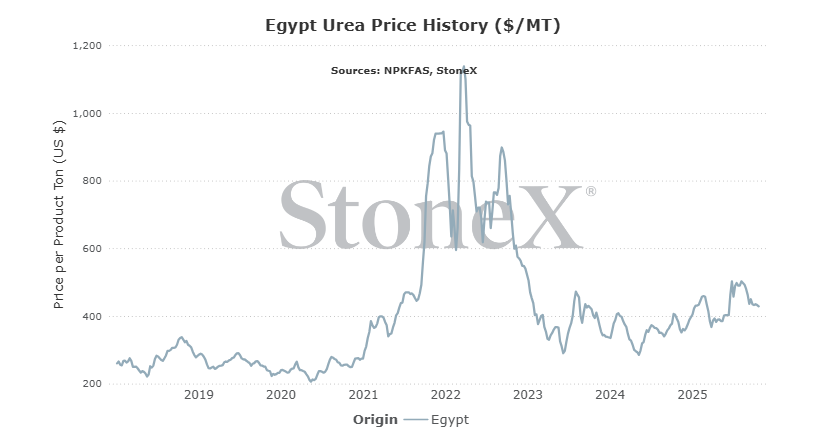
Egypt
Number 4 global exporter in 2024
Price comparisons
Vs 30 days ago - -1% or approximately $7 lower
Vs 90 days ago - -13% or approximately $62 lower
Vs 6 months ago - 10% or approximately $39 higher
Vs 1 year ago - 9% or approximately $36 higher
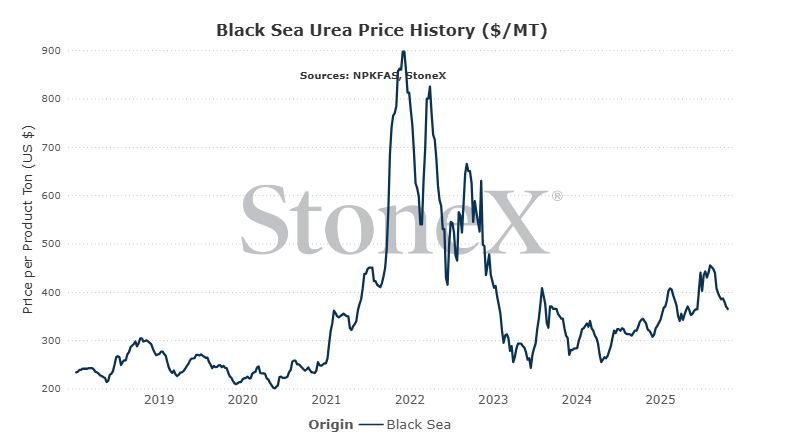
Black Sea
Number 1 global exporter in 2024
Price comparisons
Vs 30 days ago - -5% or approximately $20 lower
Vs 90 days ago - -17% or approximately $75 lower
Vs 6 months ago - -1% or approximately $5 lower
Vs 1 year ago - 7% or approximately $25 higher
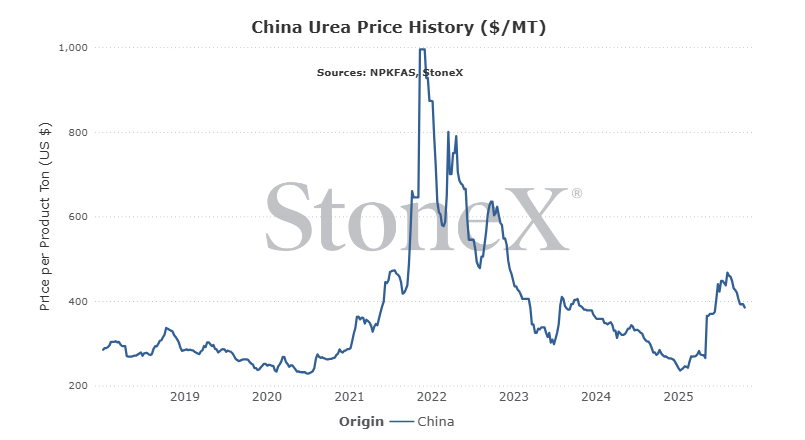
China
Number 5 global exporter in 2023, did not make the top 10 in 2024
Price comparisons
Vs 30 days ago - -5% or approximately $20 lower
Vs 90 days ago - -12% or approximately $53 lower
Vs 6 months ago - 45% or approximately $120 higher
Vs 1 year ago - 42% or approximately $113 higher
Brazil
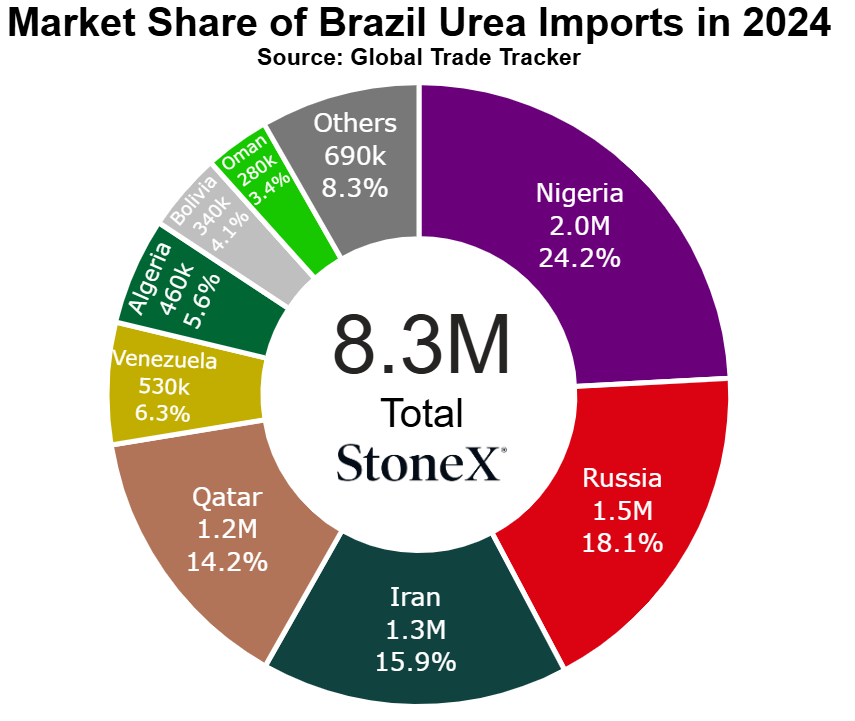
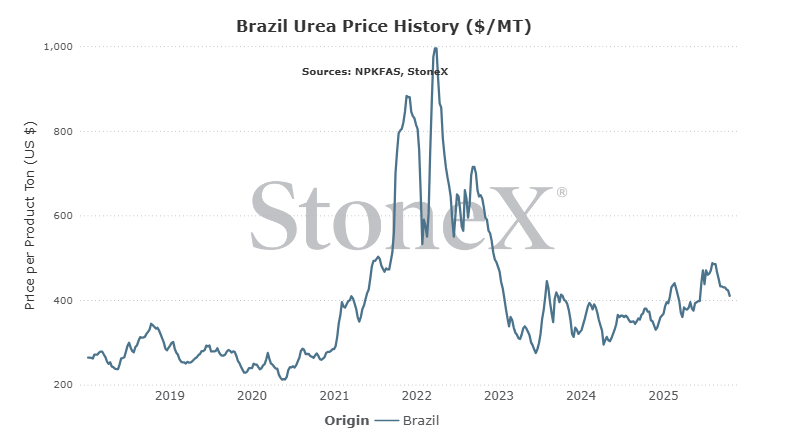
Number 1 global importer in 2024
Price comparisons
Vs 30 days ago - -5% or approximately $20 lower
Vs 90 days ago - -13% or approximately $60 lower
Vs 6 months ago - 4% or approximately $15 higher
Vs 1 year ago - 10% or approximately $38 higher
Bull/Bear Factors
Because no market is ever guaranteed to go higher/lower, we try to consider the factors that can sway values so that we are able to act when they occur rather than react.
- Bullish Factors
- No China export extension - global urea prices have weakened slightly over the last month or two in large part to China's export return. While their exports were expected, it still provided a lot of supply that was missing before. That helped markets calm down. Unfortunately for buyers, China's October 15 export date came and went with not official word of an extension. If that holds, exports will slow to a crawl once again and could be the rally cry of global bulls.
- Demand decides price is low enough, starts stepping forward - I am not saying that urea is cheap. It is far from it. However, there will be a price at which global buyers decide is low enough and will start to step forward to make spring preparations. Part of it is price. Part of it is timing. Ultimately, if/when demand decides to start stepping forward, that will give the global market a firm price floor to operate from.
- Both UAN and NH3 values remain high - UAN is a relatively small product on the world stage. NH3 is more an industrial product or input for nitrogen/phosphate production facilities meaning few areas that apply it directly. However, urea bulls will likely point to the other two higher priced products as a reason that urea should be higher. If enough of the market believes the story, it becomes reality.
- Bearish Factors
- Surprise Chinese urea export extension - while China's October 15 export end date came and went with no extension announced, it is still possible. There are still parts of the market that are watching and hoping that the Chinese government will come out and announce a short-term extension to their export flows. If this happens, it creates more supplies and competition for the global market which is a win for buyers.
- Farmers continue to struggle with poor cash flows, delayed demand - this is the story that will not end. Most farmers are struggling with poor economics. That means less cash flow to be used for 2026 crop inputs. The fertilizer market expects demand to come during normal periods...but that does not have to be the case. If the pain continues, demand can be delayed. Sure, that creates a demand tidal wave later down the road but in the meantime, the lack of buying puts pressure on manufacturers who need to clear volumes.
- Russia/Ukraine peace - I didn't want to list this because I still think it is a very low probability event, but the second that I skip listing it will be the time it happens. If there is peace between Russia and Ukraine, it would be a huge step to normal global nitrogen markets. Part of that could be European nitrogen production returning to normal. That would be a big supply boost that is sorely needed.
Where are the current urea/grain ratio values today
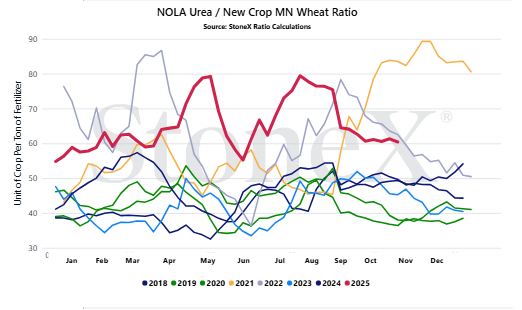
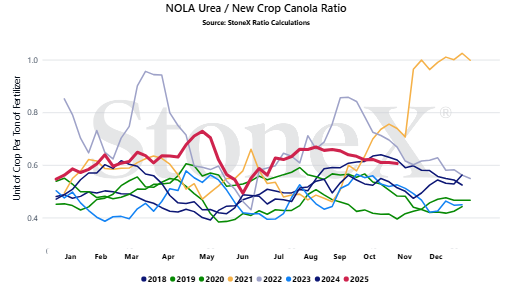
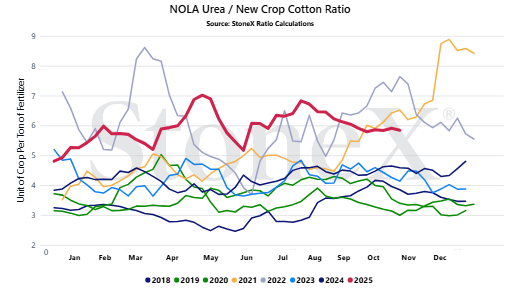
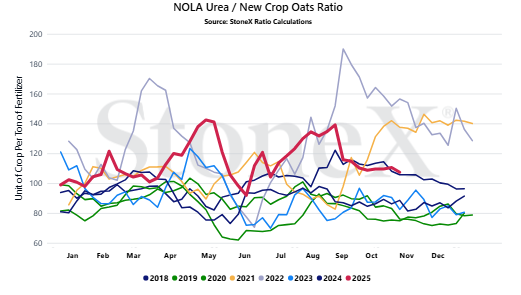
We believe that only looking at the flat price of either grains or fertilizer can be misleading:
- Only selling grain can hurt you if fertilizer prices rise substantially
- Only buying fertilizer can hurt you if grain prices fall
We look at the ratio "value" to get a better indication of where we are or how many bushels of X does it take to pay for 1 ton of fertilizer.
Would you rather:
- Spend 135 bushels to pay for 1 ton of urea
- Spend 55 bushels to pay for 1 ton of urea
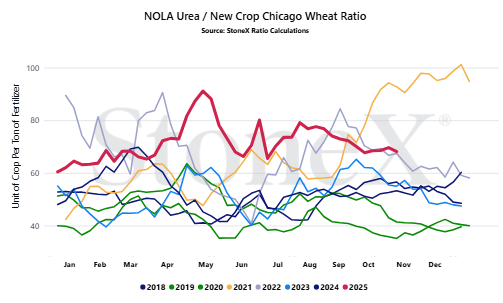
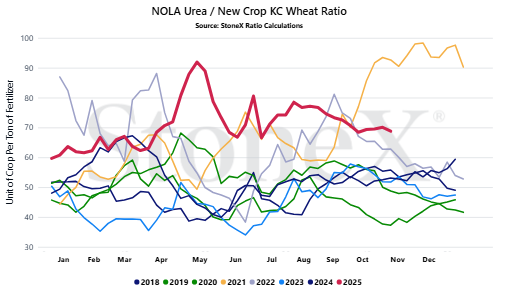
When we compare the current ratio value against recent years, we start to see if we are high or low.
YOUR VALUES WILL LOOK DIFFERENT
This graph looks at the NOLA urea price vs the flat grain price. There are no logistics on either product. Your location will look different due to fertilizer logistical costs, grain basis, etc.
- Josh Linville’s Focal Points
- China's export program for urea - this is the leader as we start November. China has exported a huge amount of tons July through September. Nearly 2.8M tons. That is massive after almost nothing being exported January '24 thru June '25 and played a key role in helping global values correct a bit lower. However, October 15 came and went without an extension. That likely means that late November/early December will see their export flows slow to a near stop which bulls will use to try and reason prices higher. On the other hand, there are still rumors that China may extend the window. What they do or do not do will have a major impact on the global urea marketplace.
- Any hope of peace between Russia and Ukraine - this is still a very low probability but high impact situation. It still does not look like there is going to be peace between these two nations near-term. However, if there is, we could see markets changing very quickly. Our focal point in the event that peace is found actually lies in Europe. If there is peace, we could see European gas market values fall which could allow offline nitrogen plants to consider restarting...if that is possible. The offline plants are old and have been down for a while. Still, even the hope of their return could have long positions running for the hills.
- Price of urea vs alternatives - global NH3 values continue to rise on the back of tight supplies and healthy demand. Most of the world does not directly apply NH3, but the nitrogen world will point to it when it goes their way. Global UAN values remain very high as well given the lack of supplies there. Urea is very well valued and could see a windfall of demand coming to it...eventually.
- Demand timing - this is what it all comes down to. When is demand going to come forward? Today, farmers are struggling with high inputs/low grain values. That means buying patterns have slowed substantially which is giving a bit of a shock to suppliers. However, for every action there is an equal reaction. In this case, the longer demand stays away, the more it builds (presuming no massive changes to demand, of course). Eventually, that demand has to come forward and the longer it will have needed to wait, the bigger the rush when it happens and the more suppliers can take advantage by moving prices up. It is a high-stakes game of chicken...
StoneX Ratio Calculation
The ratio calculation is derived from Bloomberg historical grains values as well as fertilizer values from StoneX, NPKFAS, and Argus.
The calculation is simply dividing the fertilizer price by each grain price.
All data was sourced from StoneX unless otherwise noted.