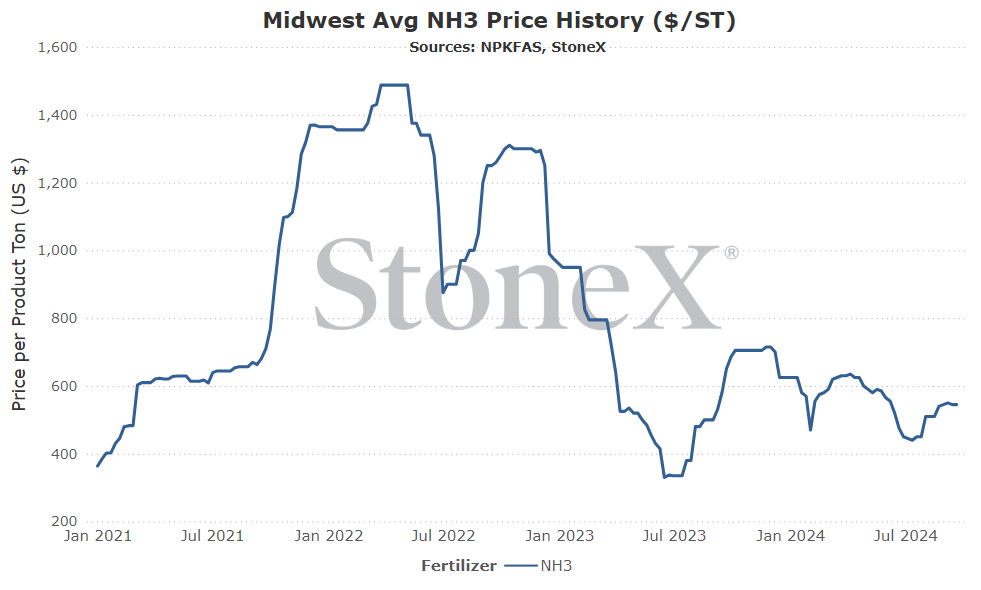
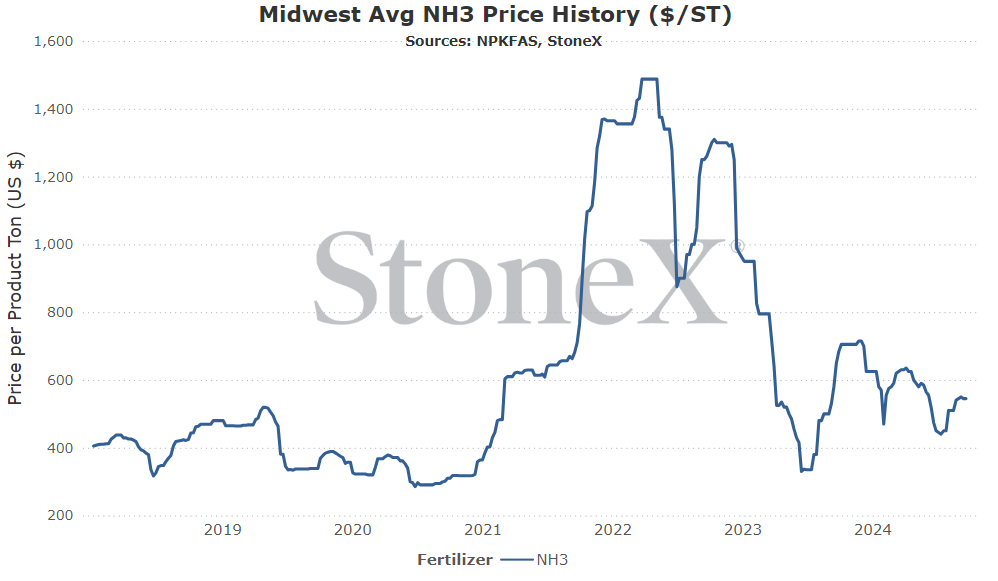
The first graph is the AVERAGE of the entire Midwest U.S. region. That means your local value WILL be different than what the graph reflects. Please do not take this into your retailer and say "why isn't my price the same as here". That is comparing apples to oranges. You might be on the cheaper or more expensive side of this graph. This doesn't take into account logistics/storage/interest/insurance/shrink/etc.
This graph looks at the price from a short ton and USD currency POV.
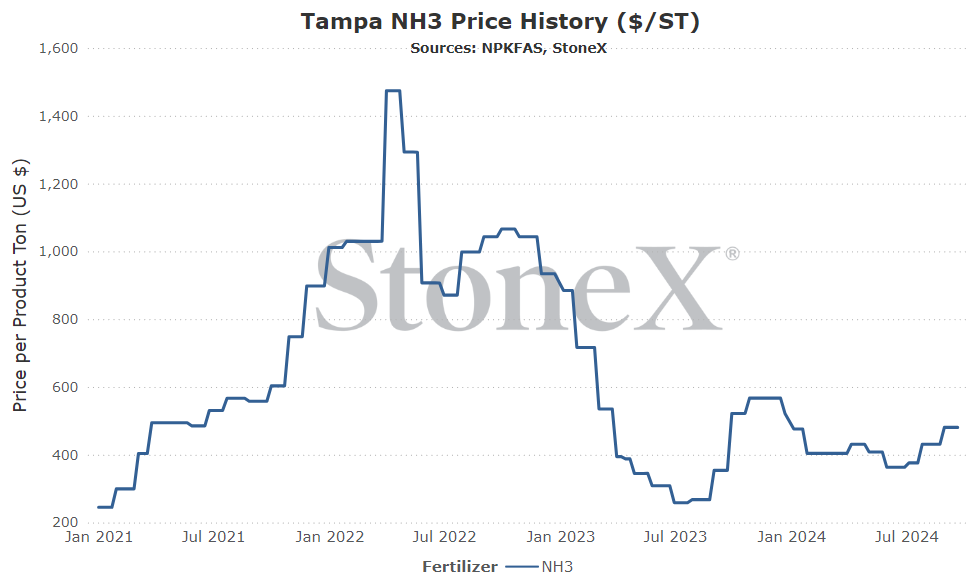
This second graph looks at the price set for Tampa NH3. This value does not have a high correlation to Midwest values. It is a talking point used when prices are rallying...yet somehow gets skipped on the way down. This price is more an indication of the global price. This price is set by two parties (purchaser - phosphate producer in Florida / seller - international producer providing NH3 to FL phosphate production).
This graph CAN be used as an indication of global market price direction/trends. This graph SHOULD NOT be used to determine a Midwest value. Tonnage is listed in short ton and currency in USD.
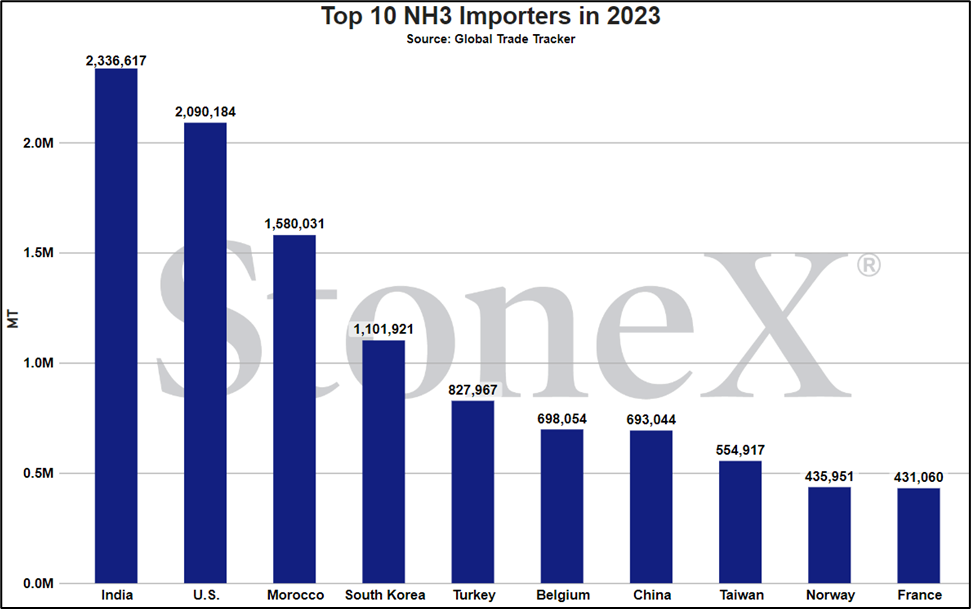
Another month and still no Russian export return. That means the globally leading NH3 exporter is still MIA. Then we have to consider recent Trinidad production issues due to tight natural gas supplies. THEN we have to consider that overall demand continues to look flat to last year...if not a bit higher as India needs to boost domestic phosphate production which requires what? Yeah, NH3.
Every time I think thru the global NH3 market, I struggle to see it as anything but supported for the next few months. Eventually, Russian exports will return...but when? Trinidad having further production issues wouldn't surprise me. The EU is unchanged with lower production rates.
While I do not think we will see prices rally like we have the last couple months, I still think sellers are in a better "position" which should mean higher.
North America
Fall direct application season is quickly approaching and right now, there is little to change our minds on demand. For corn acres, we are discussing whether we should keep it flat to our recent 91.5M acres or to increase to 92M acres. All signs are pointing to harvest being done and out of the way by November. Mother Nature can change her mind but all signs are positive today. Also, fall farmers like to stick with the fall whether due to timing/agronomic/historical reasons.
All of this to say that there are not many reasons why NH3 values need to fall. Demand remains solid. Manufacturers did a great job on putting on a solid sales book. Global outlooks remain firm. All of these should keep N.A. values in line to higher than where they are today.
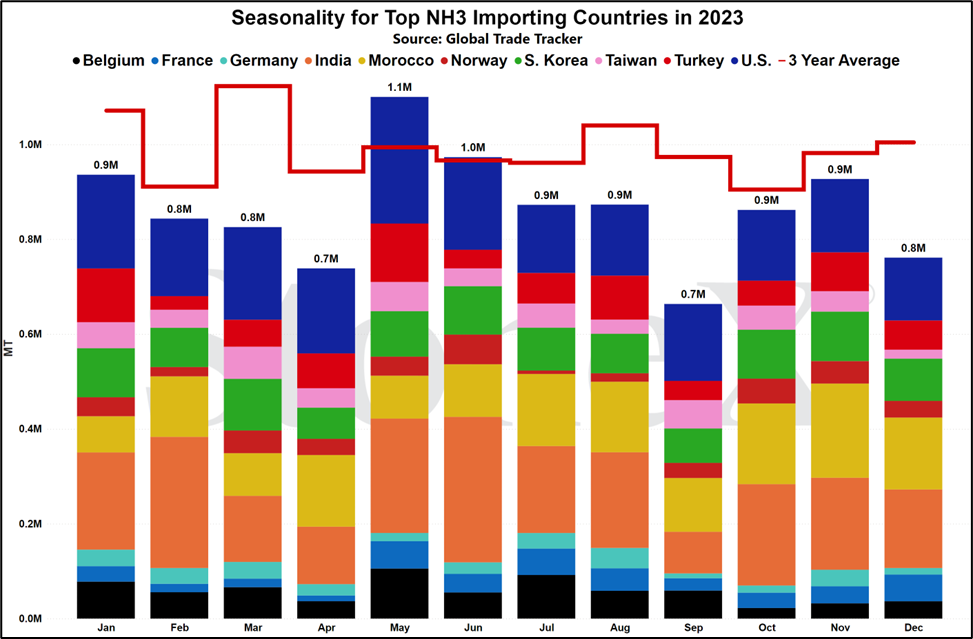
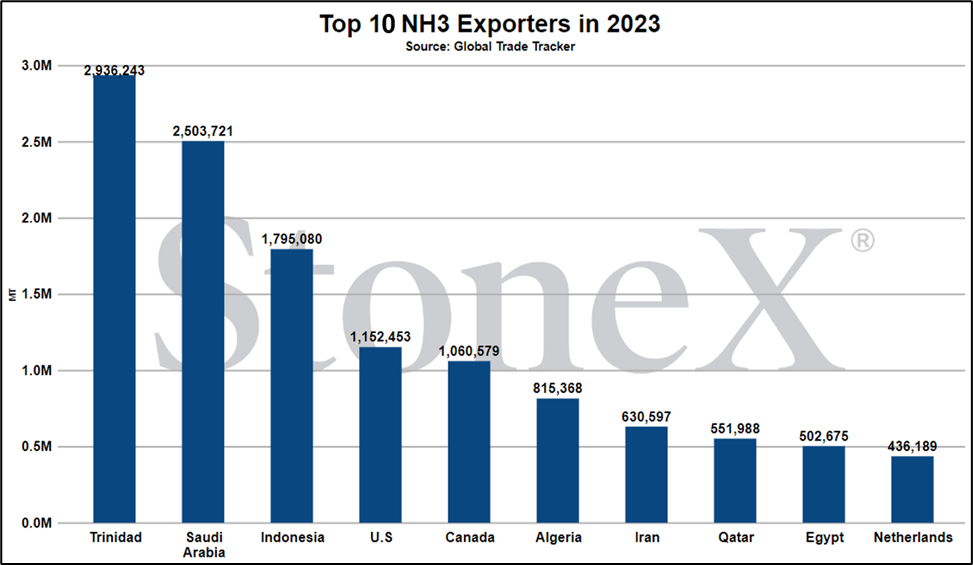
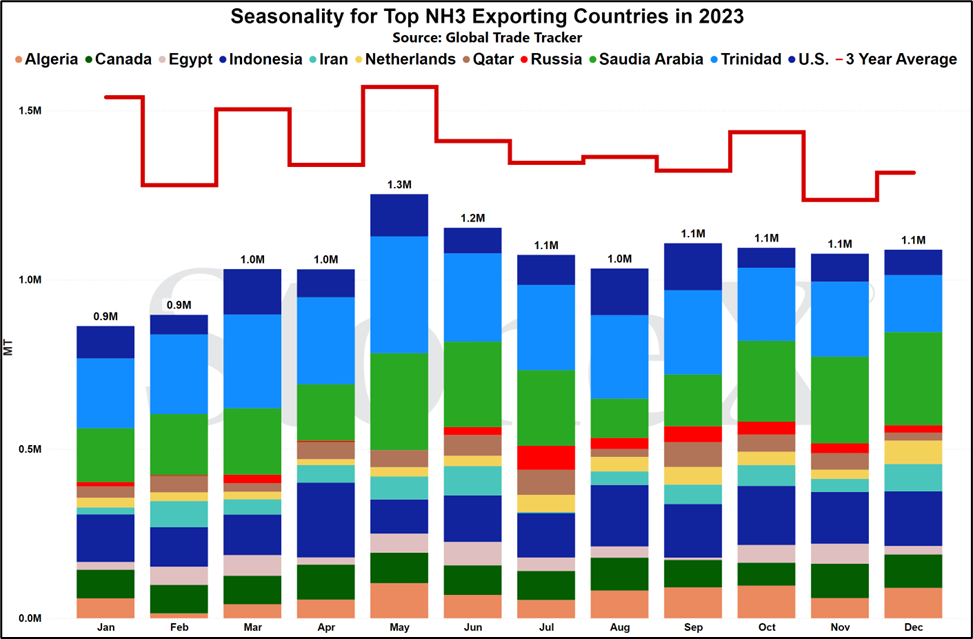
Trinidad production slows due to low gas supplies
For years, Trinidad has been a natural gas rich nation and has capitalized on those reserves by being a major exporter of nitrogen products. However, in recent years, a combination of supply hiccups and what almost feels like an overdeveloped industrial demand have caused nat gas supplies to tighten. When that happens, nitrogen fertilizer manufacturers can feel the squeeze and be forced to either slow or stop their production until supplies become plentiful again.
That is what happened in the last month. With gas supplies tightening, we started to hear reports of manufacturers having to slow down production to meet their available inputs. Less production equals less available supply. Less available supply equals less product available for export. Less product available for export means more export opportunities for other regions...
And that is what occurred. We quickly saw N.A. manufacturers pivot and start exporting more heavily to backfill the lost product. Not only that, but the world S&D saw its supply tighten a little more and for a market that is already fighting tight supplies (Russia still being gone), any little change is felt.
Fortunately, this should not be a long term issue. Earlier this year, Trinidad approved the development of previously untouched territorial waters. We quickly saw reports of investments/partnerships/etc. as companies raced to stake their claim. This should all result in increased production and supply...eventually. Unfortunately for today, those developments take time and while I am far from an expert in that field, I would venture a guess that we are talking in years, not months.
Short term, we do not expect these production issues to be massive or long lasting. They are typically short in nature but again, with the global NH3 market already tightly supplied with Russia's absence, any hiccup can and probably will be felt.
What does this mean for farmers?
This is just another reason for nitrogen markets as a whole to move higher. We continue to see nitrogen demand as being on part to slightly higher than last year. We also have a lot of supply issues across multiple nitrogen fertilizers. That sets the stage for even minor inconveniences to move a price idea.
India phosphate situation should boost their NH3 demand
For a lot more detail regarding India's phosphate situation, jump over to the phosphate newsletter. To put it simply, Indian DAP stockpiles have dwindled to very low levels and the government now appears to be in overdrive to rebuild those stocks for fear of their farmers wrath. We have recently seen the government "fixing" their subsidy program (again, more in the phosphate section) to allow importers to bring even more supply. At the same time, we believe there will be a major push to increase domestic phosphate production.
So what does this mean for NH3? In order to produce phosphate, you need NH3 and India relies on imports for those supplies.
Now, this isn't a huge, ground breaking change that is going to cause global values to climb triple digits...but it does lend yet another reason to think that NH3 values remain supported. The world is still continuing without Russian exports (typical world's number 1 exporter at 5M tons per year). Hiccups in Trinidad have suppliers a little more weary. Global demand continues to appear strong.
Again, this isn't a major event...but several small ones do change the outlook.
What does this mean for farmers?
This is yet another bullish factor that helps to support price ideas. If global values remain firm, domestic sellers will certainly point to it as a reason that their price needs to remain steady, if not higher.
Russia still absent from the world
It still amazes me how quickly we lost Russian exports.
Prior to their invasion of Ukraine, Russia was easily the world's number 1 exporter of NH3. On an annual basis, they would typically provide approximately 4.5 - 5M tons. 2nd place Trinidad was 1M+ lower on volumes.
Then the invasion happened and reality set in. The world quickly learned that Russia was very dependent on Ukraine for its NH3 exports. It would produce tons at "home", inject those tons into a pipeline that ran thru east/southeast Ukraine, and then load vessels out of ports in the Odessa region. It didn't take too long after the invasion for that pipeline to shut down. First, it was not used due to fighting in the area. War is already hell. Imagine also having to worry about a pipeline being damaged and gassing your entire platoon. Then, as Russian forces started to get pushed back, Russia retaliated by attacking the electrical infrastructure of Ukraine. For reference, this pipeline is long and it requires pump stations to keep the flows moving. Without electricity, there were no pump stations operational. Then, getting pushed even further back, we saw where the pipeline had been damaged. Whether this was intentional or not, it didn't matter. The damage was done.
So that brings us to today where Russia has been all but gone...but not forever. Construction continues on a new export facility based in Taman, Russia. This has been the facility that has been coming online shortly, sometime, someday, any day, eventually. We had been hearing that it would be operational earlier this year. Here we sit in October and still have not seen much flow. At this point, we are hoping for a 2025 return...and then what does that return look like? Ukraine has gotten very good at striking targets deep within Russian territory. Given Taman's proximity to Ukraine (just east of Crimea), it is very feasible that Ukraine could send an attack drone. Even if an attack caused minor damages, it would take a decent amount of time to fix given NH3's danger in its gas form.
Today, we continue to watch Russia from a "when will they return" standpoint. We believe that they will. 5M tons of NH3 exports is too much of an income flow to just give up on and when they do return, it should soften price ideas globally...but when that is will be anyone's guess.
What does this mean for farmers?
As long as Russia is absent, there is a massive supply hole in the world of NH3. That is where we sit today...but in brighter news, that should mean that when Russia returns, prices ideas should slip/fall. Suddenly, we see the biggest global player returning and long positions/other manufacturers should start getting more aggressive on their price ideas or run the risk of getting pushed out of their area.
When Russia returns, it should mean good things for farmers.
U.S. / N.A. fall application demand outlook remains firm
For N.A., we are a month away from fall NH3 direct application season starting, and the outlook still appears solid. Let me start by saying that we are still sensitive to farmers stories of needing to cut back/delay/etc. due to poor farm economics. There simply isn't anything I can theorize/say/etc. that changes that fact. Things are rough for 2024. They do not appear much better when looking to 2025.
That said, Mike/Quan/I recently discussed our 2025 crop acreage forecast...corn sits at 92M acres. Yes, I know that seems hard to comprehend given today's economics. Yes, that number can and most certainly will change before spring planting. However, when going thru all the factors, it seems all crops stink from an income POV so we are leaving our corn number there and basing our nitrogen demand forecast off of that.
So demand looks good. Then we look at harvest. So far, all signs are pointing to an on-time harvest completion which means it should not dig into NH3 application season.
Last, I/we believe fall application farmers will stick with fall application. Please do not read that sentence as my being crappy. Most farmers I know like to stick with their crop rotation and will ultimately continue to stick with it. Also, most farmers seem to fall into a few camps:
- Apply in the fall for agronomic reasons/benefits
- Apply in the fall for fear of not being able to do it all in the spring
- Apply in the fall or have to sit in the house all season watching neighboring farmers apply!!!
With that said, that is why we think this fall should be slightly larger than what is considered "average". Normally, we roll into a fall forecast assuming 2M tons of direct application. This year, we are forecasting slightly larger than 2.1M. That may not seem like a massive difference but for reference, last fall was one of the largest we have on record and it was around 2.4M. Small changes make big impacts.
Now, all of this ultimately depends on Mother Nature. Last fall saw farmers be gifted one of the best weather windows I can imagine. Just enough moisture to keep the soil workable while dry enough to give massive application windows. We didn't see winter truly start until very close to Christmas. We could see a similar pattern this fall...or we could see it wet constantly and freeze early. If Mother Nature doesn't allow application, NH3 could be free and it wouldn't make any difference.
This will be something that we truly do not have a feel for until the January edition but for now, we have high hopes for the coming run.
What does this mean for farmers?
If the fall N.A. run is wide open and large, it could mean that later parts of the season start to see higher prices and longer delivery times. We saw that a little last fall where facilities were emptied and then relied on just in time deliveries to meet demand. Fortunately, the market is very good at this and the impacts at the farmer level seemed to be minimal...but we are never far from a "disaster". I am not overly concerned about this story playing out unless/until we run straight thru November with few weather delays. If it stays that open, then any coming demand needs to make sure they are staying in contact with their retailer to make plans.
U.S. Midwest Wholesale price average
Vs 30 days ago - 1% or approximately $5 higher
Vs 90 days ago - 15% or approximately $70 higher
Vs 6 months ago - -13% or approximately $85 lower
Vs 1 year ago - -16% or approximately $105 lower
U.S. Southern Plains price average
Vs 30 days ago - 4% or approximately $20 higher
Vs 90 days ago - 7% or approximately $35 higher
Vs 6 months ago - -16% or approximately $95 lower
Vs 1 year ago --3% or approximately $15 lower
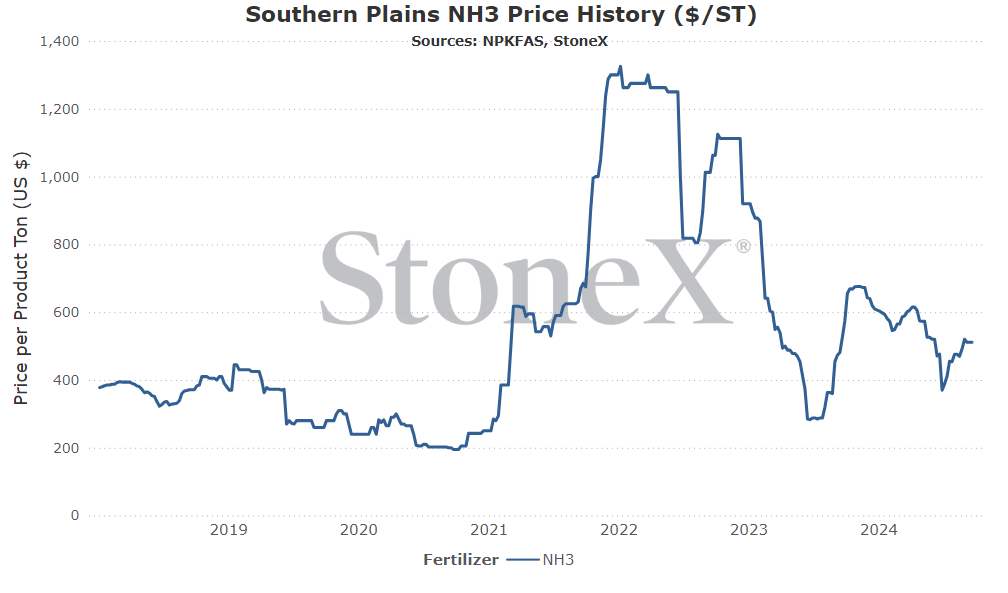
- Global production issues continue (Russia/EU/Trinidad) - the world continues to operate with the world's largest exporter in Russia as well as the EU region still operating at 75% rates due to high natural gas values. Trinidad recently having production hiccups due to lackluster gas supplies is just icing on the cake. All of these combine for less supply in a world that still sees solid demand.
- Indian demand increases to boost phosphate production - speaking of solid demand, India should continue to be a bigger consumer. Their phosphate story for the last few months has been a dwindling phosphate stockpile...and they need to catch up or face the wrath of the farmer. That means more import purchases but also means likely higher phosphate production rates and what does phosphate production need? NH3. Normally, this wouldn't be a huge deal but with the global supply issues currently in play...
- N.A. fall run even bigger than expected - normally, we would roll into the fall season expecting 2M tons to be applied across the Midwest. This year, it is very easy to want to lower that forecast due to poor farmer economics...but fall NH3 appliers REALLY like applying in the fall. There are various reasons but they all add up to sticking with the fall program. With that, not only are we not lowering our fall forecast sub 2M tons, we are increasing it to 2.1 - 2.2M. If we are right, we will go to Christmas with stockpiles very low...and spring season looming large.
- Return of Russian exports - it will happen someday...probably...maybe...most likely!!! We continue to hear that work keeps moving forward on their new Taman NH3 export facility. While we are not sure if it will have the capacity to return them to their former 5M tons exported per year glory, but anything at this point would help. Kind of like China is for phosphate and urea, Russia could/should play the part of boogeyman for NH3. If we suddenly see their vessels departing and being made for sale, it will send a shiver down the spine of global manufacturers/long positions which should cause prices to retreat.
- Mother nature - even if NH3 was free, it wouldn't matter for demand if Mother Nature said no. Ultimately speaking, the weather patterns call the shots. Last fall for the Midwest was about as good as it gets. Just enough rain to keep the soil in good shape for application but not so much that it kept farmers from pulling toolbars. It also remained open WELL into December. The hope is we repeat that this fall...but we have to remember that we just never know. If we have an extremely poor fall season, winter values will likely fall...before spring demand concerns (bullish) start to pop up.
- Much lower demand due to poor farmer economics - I want to preface this with the statement that "this is my lowest probability factor"...but that doesn't mean it is impossible. Lot of farmers are struggling. 2024 economics are poor. 2025 doesn't look great. After several years of decent incomes, it makes this current situation that much harder to digest. That "could" have some farmers who typically apply deciding to drag their feet and apply in the spring. We "could" see some farmers reduce their application rate. I struggle with believing this will actually happen...but it is something we need to watch.
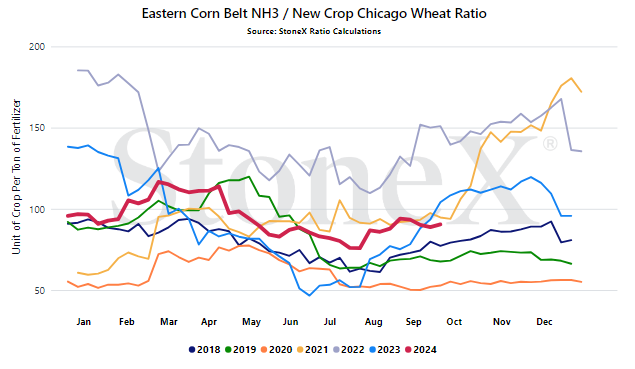
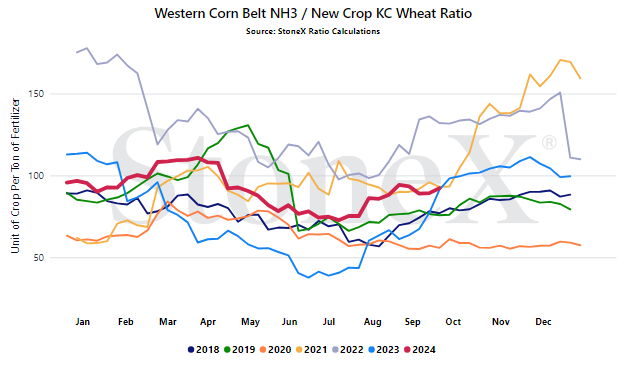
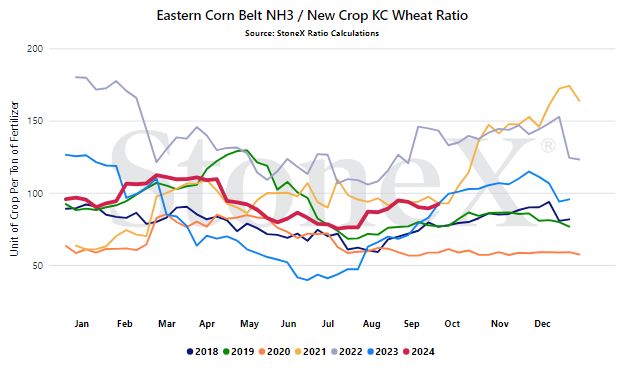
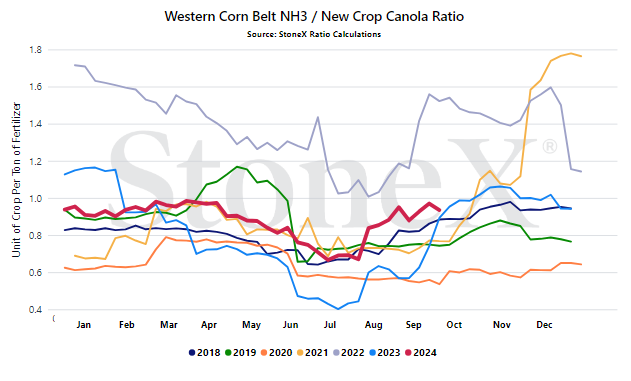
Where are the current NH3/grain ratio values today
We believe that only looking at the flat price of either grains or fertilizer can be misleading:
-
Only selling grain can hurt you if fertilizer prices rise substantially
-
Only buying fertilizer can hurt you if grain prices fall
We look at the ratio "value" to get a better indication of where we are or how many bushels of X does it take to pay for 1 ton of fertilizer.
Would you rather:
-
Spend 150 bushels to pay for 1 ton of potash
-
Spend 100 bushels to pay for 1 ton of NH3
When we compare the current ratio value against recent years, we start to see if we are high or low.
YOUR VALUES MAY LOOK DIFFERENT
This graph looks at the NOLA NH3 price vs the flat grain price. There are no logistics on either product. Your location will look different due to fertilizer logistical costs, grain basis, etc.
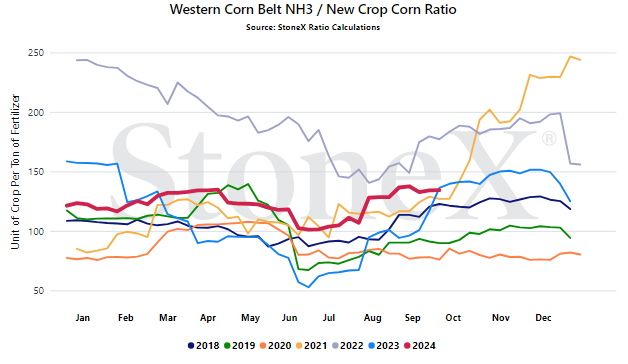
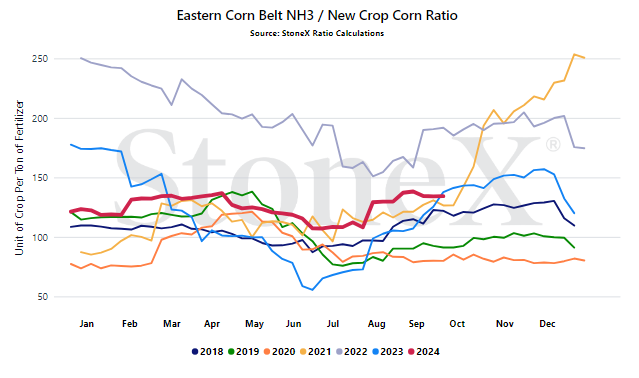
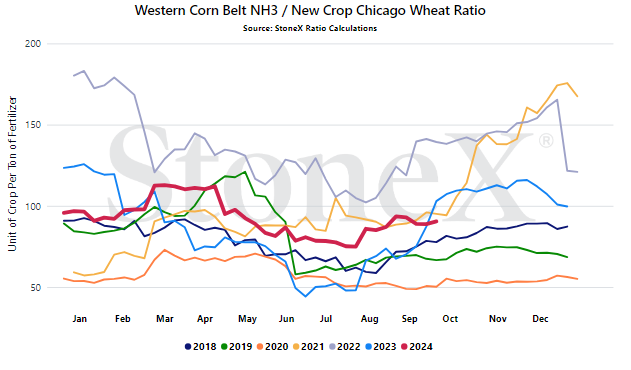
- Russia's return...or not - historically, they are the world's largest exporter. Their absence is felt around the world...which means that when they return that will also be felt around the world. We do not know when that happens, in what capacity that happens, or for how long they will be allowed to return. Still, they need to remain the main focal point for global NH3 markets.
- EU production rates - as long as the EU struggles with high natural gas values and lower operating rates, they will remain an "unnatural global buyer" of NH3. I doubt we see Dutch TTF natural gas values plummet anytime soon so I am not holding my breath that this story changes near term. However, it is still something that we need to remember as something that can change and if/when it does, it should impact global values.
- Trinidad hiccups/short term India demand - these two stories just add to the uncertainty surrounding global markets. Trinidad suffered production losses due to gas curtailments. That gave countries like the U.S. an opportunity to export even more than normal to backfill Trinidad losses. At the same time, India needing to refill phosphate reserves means they should be boosting domestic production rates...which requires more NH3 imports. There are certainly other global ebbs and flows to demand/supply but these two lead that list.
- N.A. fall success/failure - we are a month away. In about 30 days, N.A. farmers are going to be pulling toolbars across fields. How well/poor the season goes will impact the forward view of NH3. A poor fall run should cause winter values to fall as manufacturers fight for any open space...though the spring story would be "a lack of fall application means massive spring demand we will struggle to meet". On the flip side, a solid fall run like last fall should help keep winter prices level to higher as manufacturers effectively say "we will struggle to fill our own system, we do not have excess for your fill". Hopefully it is a great fall run just to get it out of the way...but Mother Nature will ultimately make that decision.
StoneX Ratio Calculation
The ratio calculation is derived from Bloomberg historical grains values as well as fertilizer values from StoneX, NPKFAS, and Argus.
The calculation is simply dividing the fertilizer price by each grain price.
All data was sourced from StoneX unless otherwise noted.