Global
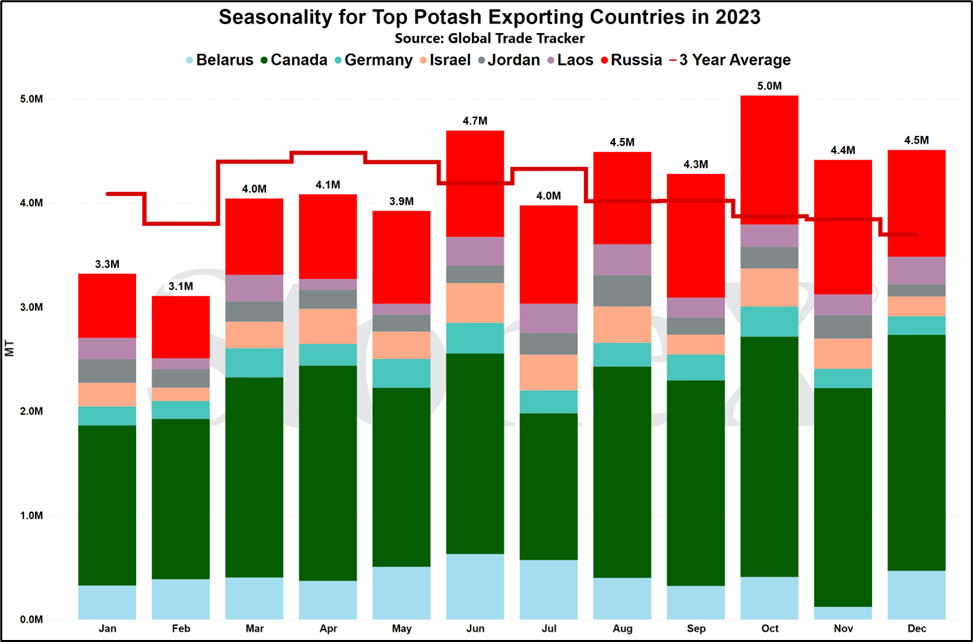
As I look around the world, I continue to see more than adequate supplies and the forecast continues to look even better. New production "should" continue to outpace demand growth. That means good things for buyers.
As long as there is no unforeseen situation that completely changes the outlook (hard to see today), global potash values should stay flat with a longer forecast on the downside. A market that has a very good supplies typically struggles to go higher.
North America
I want to preface the N.A. outlook with a statement: with fall season looming, do not think that logistics cannot or will not play a part. While the overall market may remain flat priced, you could see your price increase if/when demand starts to hit. The market knows demand is coming and the closer to season we get, the harder it is to get product in place.
That said:
Like the global outlook, it is hard to see the near-term potash market anything but flat. In fact, if it ends up being a poor fall (bad weather / farmers delaying to spring in case of poor economics), we could see values lower going into winter. That might cause some spring issues but we are not looking that far ahead today.

StoneX potash outlook continues to point to adequate supplies
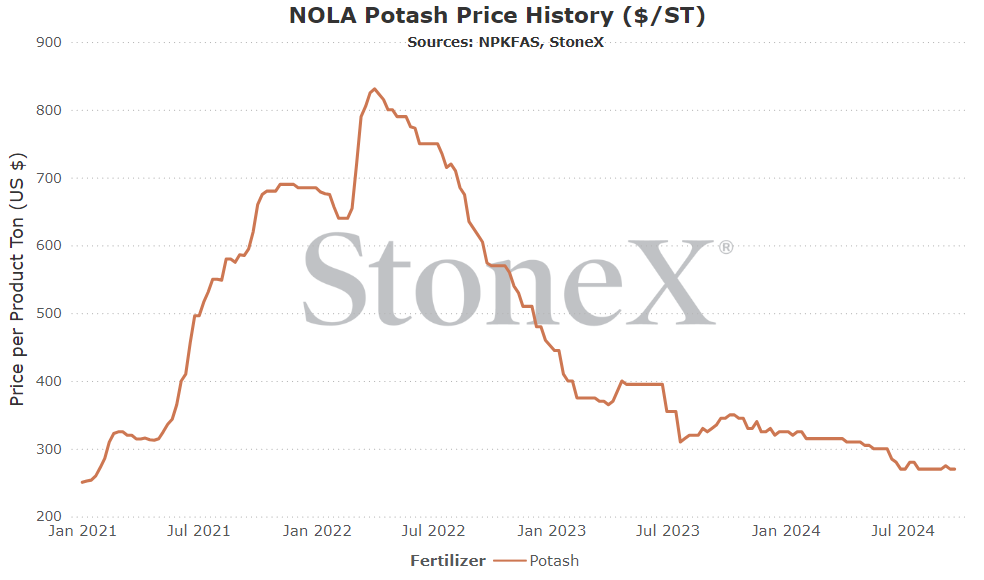
Now, the outlook is obviously much less than what was announced/expected in early 2022 when potash prices had spiked to their high's but that is the nature of these things. When prices are high and margins are fat, announcements come rapid fire. Everyone wants a piece of the action. However, at the end of the day, we knew that calmer/lower prices would prevail and a lot of those announcements would quietly move into the night.
But not all of them.
As we continue to look forward, we expect to see production increase:
- Canada - sounds like it is full steam ahead for BHP and their mine expansion that will add a lot of supply. Certainly would help some of the other Canadian production shortfalls we have seen lately.
- Russia - expansions continue to be expected there. With what sounds like plentiful reserves and "looser" guidelines for companies to follow, it makes sense that they become a bigger exporter.
- Belarus - perhaps this isn't an expansion of capacity, but we still expect to eventually see Belarusian exports get back to normal. Remember that after they allowed Russian troops to use their country to attack Kiev from the north, Lithuania cut them out. Just seems like a matter of time before new export route upgrades are complete.
- Laos - China does not want to do business with the west. For potash, that means Canada. Rather than rely on them, they continue to invest in Laos to increase their production rates. Not only does it reduce their dependence on the west, but it also helps them expand their sphere of influence.
All of these continue to add up to an outlook where we see plentiful potash supplies in the future.
How does this affect farmers?
If a commodity is well to over supplied, that usually keep prices very stable and low. In an oversupplied market, the theory is that the price will fall to a level that shuts off enough production to balance the S&D. Potash is inherently "cheap" so there could still be lower prices in the future if/when this theory plays out. Even if some of those listed above do not happen, we still see supplies being plentiful.
For fertilizer markets that have been very tightly supplied and volatile priced, potash is the shining start that "should" remain solidly priced and stable.
Will the low price of potash offset the high price of phosphate?
Before the mob descends on my office for calling potash "cheap", let me explain.
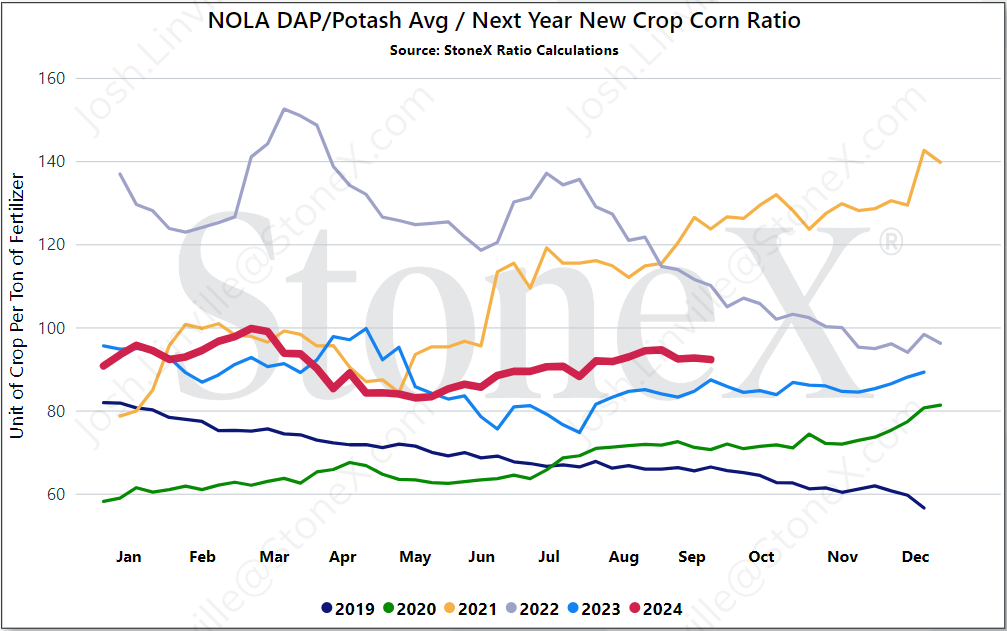
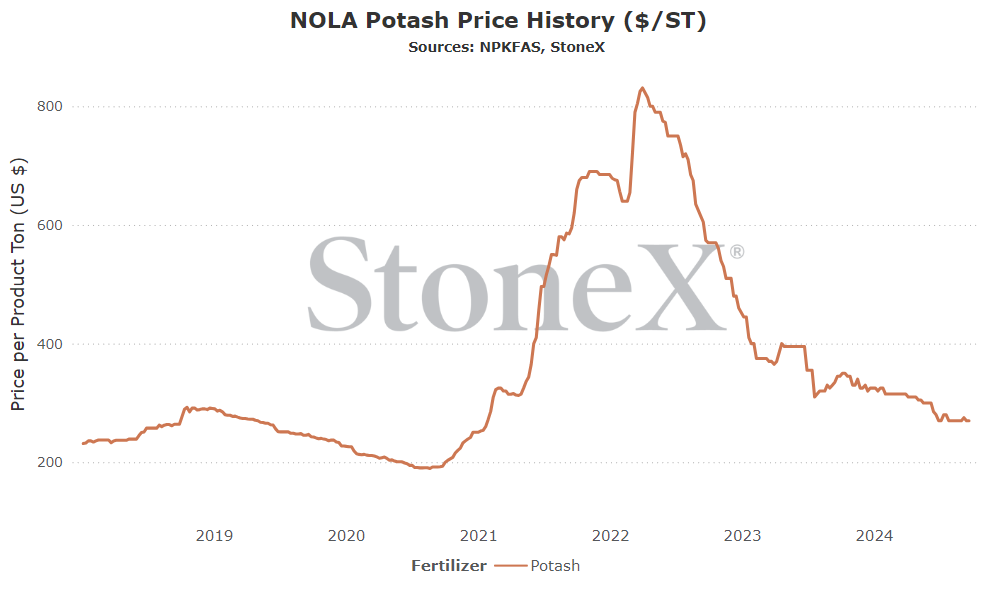
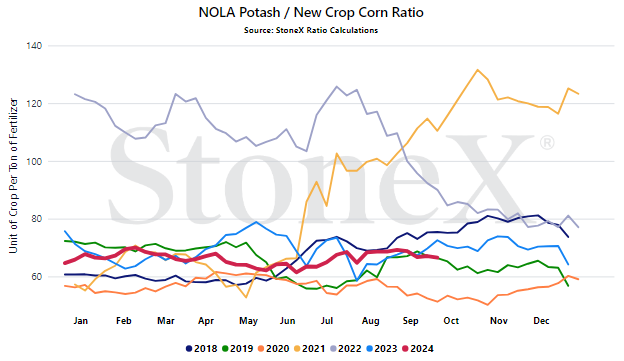
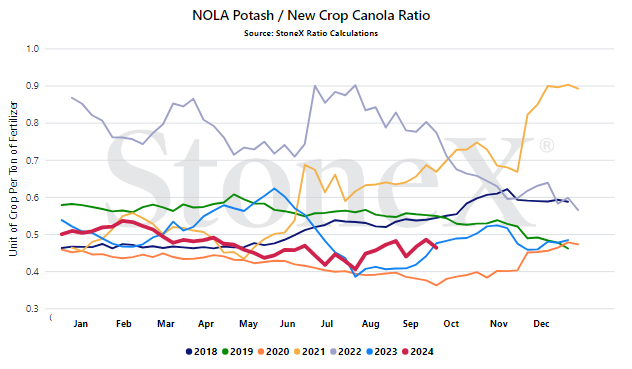
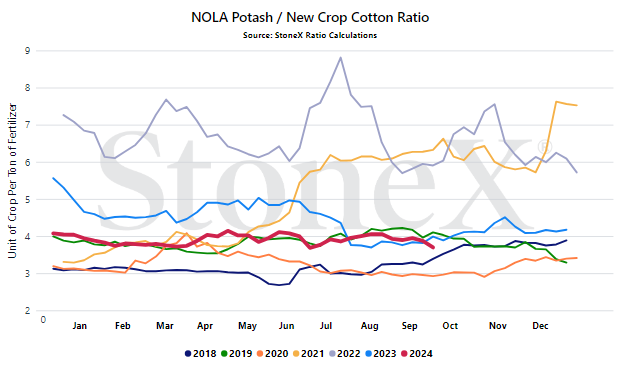
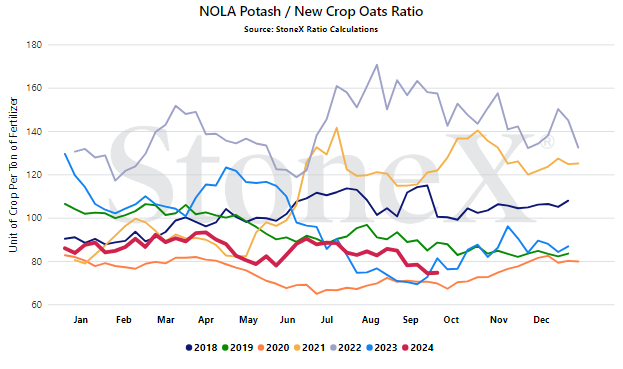
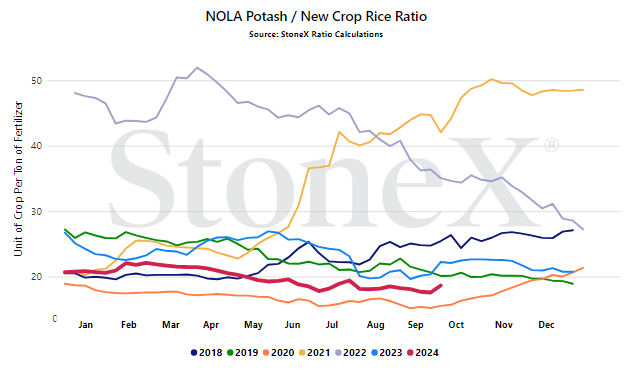
When I say cheap, I mean it is very well priced vs grain values. Once you go below and start looking at the ratio charts, you will see that current values are priced in the lower end of recent years meaning that farmers are spending far less bushels for each ton of potash purchased. Yes, potash is still higher priced vs historical "norms"...but then again, so to are a lot of grain values. So to is equipment...and seed...and chemical...you get the idea.
On the other side of the coin, phosphate is high priced vs almost every comparison I can think of which leads me to the question of which has more influence. Will the high price of phosphate end up cutting some potash demand or will the low price of potash end up increasing some phosphate demand?
A lot of folks that I have talked to all but refuse to make two application passes. It is an additional cost. It adds to soil compaction. It is all or nothing it seems. So, we actually started to look at the average of the potash and phosphate ratios. It assumes a 50/50 split between the two and I fully understand that will not fit everyone reading this but given that I never know who is reading, that was the best approach we could come up with.
The result is very middle of the road. It is nowhere near as high as 2021 and 2022, but still a premium to 2019/2020/2023. Doesn't get much more mundane than that!!
At this point, it is a hard call. I still lean toward the fall demand for both P & K will be bigger than expected. Yes, I think we will see some reductions but at the end of the day, we are going to have to maximize yields to offset low grain prices and that is hard to do without P & K. I can certainly be proven wrong but it is what I'm going with!
NOLA/New Orleans Louisiana
Vs 30 days ago - unchanged vs last month
Vs 90 days ago - -4% or approximately $10 lower
Vs 6 months ago - -14% or approximately $45 lower
Vs 1 year ago - -22% or approximately $75 lower
U.S. Midwest Average (average of several points across the Midwest)
Vs 30 days ago - -5% or approximately $19 lower
Vs 90 days ago - -10% or approximately $35 lower
Vs 6 months ago - -13% or approximately $51 lower
Vs 1 year ago - -19% or approximately $78 lower
- Belarus exports still not back to normal with no indication they will short term – before Russia invaded Ukraine, Belarus was one of the world's largest exporters. Nowhere near Canadian exports but still easily in the top 5. Their allowance of Russian troops to use their land to invade Ukraine from the north was met with swift action by Lithuania who cut Belarus's access to their typical potash export routes. After that, their exports fell to near zero. They have since been battling back, using rail to move product thru Russia but they are still far short of "normal". That means a large block of potash that is still missing from the world.
- Current potash values look "attractive" vs grain values, could be higher demand - I know, everything looks expensive when grain values are as low as they are today. That said, when you look at the ratio charts below, potash is fairly well price today and has been for a while. That causes us to believe that the coming fall demand is going to be solid. In fact, with phosphate prices so out of whack, there is a chance that we see heavier rates/demand as farmer pour the coals on potash in lieu of the phosphate (moving dollars around).
- Delayed buying could see on-time logistical cost increases – speaking of poor farm economics, that has caused buyers to drag their feet. Rightfully so. However, the longer the market waits, the harder it gets to move product into place. My saying is that eventually "just-in-time demand will meet just-in-time logistics". The more desperate the market gets to bringing product in on time, the more the supply side realizes and looks to capitalize. It is sort of like when the local elevator/ethanol facility needs grain badly. You want that higher price because you know they need you more than the other way around.
- Global supply outlook continues to look solid vs demand – the forecast for potash continues to be very well supplied. Actually, it is already well supplied and it just looks to improve. Laos continues to increase. Belarus continues to work back to normal. New production continues expected from Russia and China. Every new ton that surpasses demand is a win for the buyer. This is a longer term factor, but a factor nonetheless.
- Poor farm economics and high phosphate values may hurt potash demand - our hope is that potash demand will be solid given that it is well priced vs grain values. However, hard to overlook poor farm economics and high phosphate prices. Most farmers I know are not going to pay for two applications (one for phosphate and then another for potash). The cost is higher, there is soil compaction, etc. If the price of phosphate is so out of whack that farmers wait on the application, that could hurt potash as a result.
- Manufacturers ramp up production in an effort to force a competitor out – if global manufacturers sense any weakness from any of their competitors, we could see them make moves to try and "take them out". If dropping the price for a short period of time results in causing a competitor to go out of business, that could be a solid strategy. While the longer term POV would be that the lost tons would support price ideas, the short term POV is that lower prices would help buyers.
Where are the current potash/grain ratio values today
We believe that only looking at the flat price of either grains or fertilizer can be misleading:
-
Only selling grain can hurt you if fertilizer prices rise substantially
-
Only buying fertilizer can hurt you if grain prices fall
We look at the ratio "value" to get a better indication of where we are or how many bushels of X does it take to pay for 1 ton of fertilizer.
Would you rather:
-
Spend 120 bushels to pay for 1 ton of potash
-
Spend 60 bushels to pay for 1 ton of potash
When we compare the current ratio value against recent years, we start to see if we are high or low.
YOUR VALUES MAY LOOK DIFFERENT
This graph looks at the NOLA potash price vs the flat grain price. There are no logistics on either product. Your location will look different due to fertilizer logistical costs, grain basis, etc.
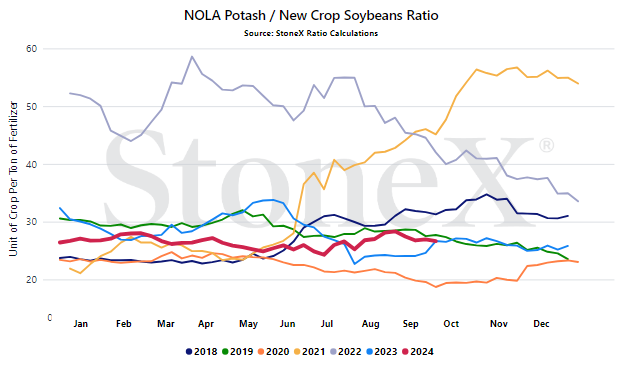
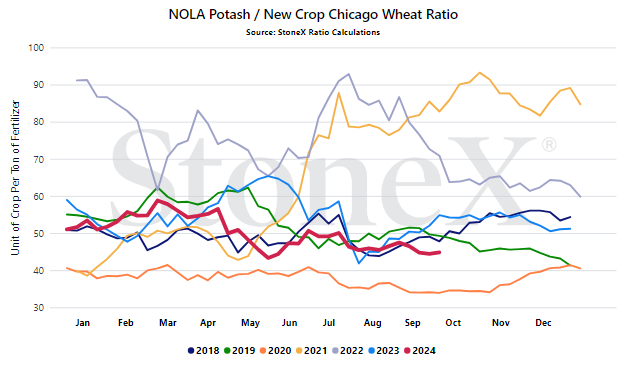
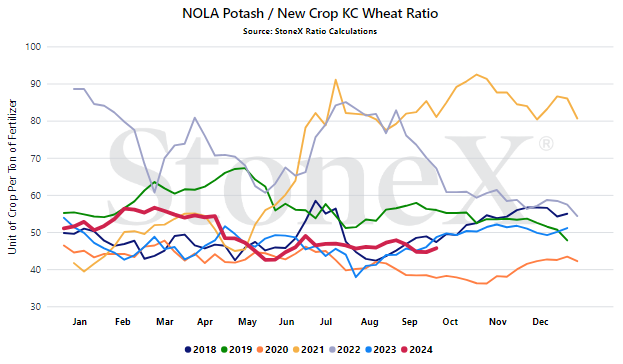
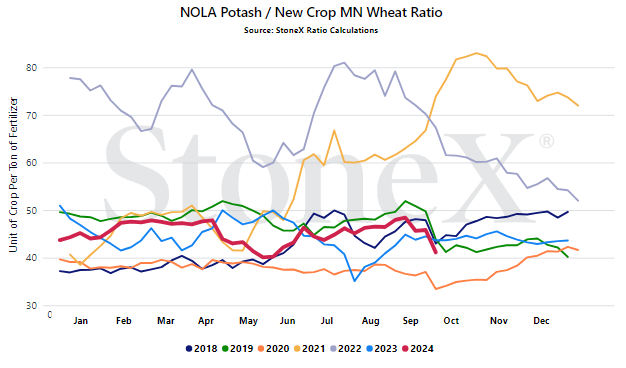
- Farmer reaction to high phosphate/low potash pricing - here is where I get a bit perplexed and why this is the highest point I am watching for the next 3 months. On the one hand, I think potash is very well priced vs historical pricing and vs grain values. That "should" mean higher demand. It is a solid opportunity to rebuild soil levels. However, on the other hand, I know that phosphate and potash are typically applied at the same time. It saves soil compaction and application costs. So then which side wins out? Does the high price of phosphate cause farmers to wait which hurts fall potash demand more than we expect? Does the low price of potash help offset the high price of phosphate and demand is as good or better than we expect? I flip my POV side depending on my mood when I wake up in the morning...
- Future new capacity/production expansions progress - eventually, the near term uncertainty that I spell out above will wane and I think the story of extremely adequate supplies will win out. We expect more production in Canada. We expect more production in Russia. Belarus is still nowhere near their historical export levels. Laos continues to expand on the back of Chinese investments. All of these add up to a market that is already well supplied becoming even better supplied. That is great news for buyers...eventually.
StoneX Ratio Calculation
The ratio calculation is derived from Bloomberg historical grains values as well as fertilizer values from StoneX, NPKFAS, and Argus.
The calculation is simply dividing the fertilizer price by each grain price.
All data was sourced from StoneX unless otherwise noted.