April 18 - Stocks firmed to post modest gains this morning, but now we're coming off those gains midday. The VIX pulled back to trade just above 17, while the dollar index is back to trading just above 106.0. Yields on 10-year Treasuries are trading near 4.64% as they firmed through the morning, while yields on 2-year Treasuries are trading near 4.98%. The key question before us now is, will they be able to sustain a move above 5.0% this time, after failing twice prior over the past week? Crude oil is nearly 1% higher at session highs. Corn and soybean prices continue to drift lower, while the hard wheat markets firm on deteriorating crop conditions in the Plains.
Existing home sales slipped to an annualized rate of 4.19 million units in March, down from 4.38 million in February, although that was slightly better than the 4.18 million anticipated by analysts. Existing home sales were down 4.3% month-on-month in March, and down 3.75 year-on-year. Yields on 10-year Treasuries were trending lower in the first half of March, but they pushed sharply higher following a hawkish statement emerging from the Federal Reserve's March policy meeting. Other data released this morning included the March index of leading economic indicators. It dropped 0.3% month-on-month in March, after rising 0.2% in February.
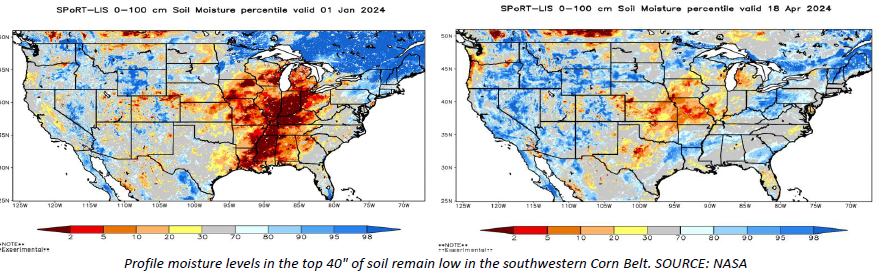
One of the keys to producing a large corn crop is moisture, and that means filling the soil profile with moisture before the growing season starts. You can grow a good crop without doing so, but that means that you have to have a steady flow of rain through the growing season to keep the crop well supplied. That's somewhat unusual, as we typically go through a period at some point in the summer when rainfall is lacking, relative to the crop's need. The graphic below on the left shows satellite-derived soil moisture levels in roughly the top 40" of soil on January 1st. It's no surprise that we were dealing with low water levels on the Mississippi River, with the soil profile so dry to start the year in the broader Mississippi River watershed. The graphic on the right is today's graphic, although it does not include today's rainfall. You can see the sharp improvement in soil moisture levels for much of the Mississippi River watershed, with some areas actually excessively wet. Nonetheless, more rain is needed over the southwestern Corn Belt, including key production areas in Iowa, Missouri and Kansas. The Kansas dryness is also a concern for the winter wheat crop in that region, which is currently moving into the critical reproductive phase.
NOAA released its updated summer outlook this morning, which increases the odds that we'll see above normal temperatures across much of the country during the period, with the highest chances for heat in the Rocky Mountains, Texas, and in New England. The outlook also has elevated odds of dryness in the Plains, that also reach into the western Midwest. The Midwestern dryness is expected to be something that develops as the summer progresses. It should be noted that NOAA's model is one of the more aggressive models for moving us into a La Nina weather pattern by this summer, which would support this move toward warmer and drier conditions in the Midwest. Many of the models have a modestly warmer outlook, and most tend to bring dryness into the Midwest from the west, but they differ on the timing on when that will occur. A shift of two to three weeks in either direction on the timing of when that dryness spreads east can make a big difference in either direction for this year's corn and soybean production. The bottom line is that this emphasizes the importance of filling the soil profile now, and then praying for those timely rains. The timely rains came last year, surprising the industry with much better-than-expected yields, but will they this year?