August 17 - Stocks are mixed late morning as traders fret about rising interest rates and talk of debt restructuring in China that could have contagion risks. The VIX is trading near 17 late morning, while the dollar index is trading near 103.4. Yields on 10-year Treasuries are trading near 4.31%, which represents a nearly 10-month high, while being just below 15-year highs. Yields on 2-year Treasuries are trading near 4.97%. Crude oil prices are nearly 2% higher late morning, while the grain and oilseed sector is mixed. Corn and soybean prices are trading higher today on hot dry forecasts for the Midwest in the second half of August, while wheat prices slip lower on the lack of any retaliation from Ukraine following yesterday's attack on Ukraine's export infrastructure by Russia. Both corn and soybean prices should see more headline influence coming from social media next week when the Pro Farmer Midwest Crop Tour takes place, with participants reporting conditions from the field throughout the week.
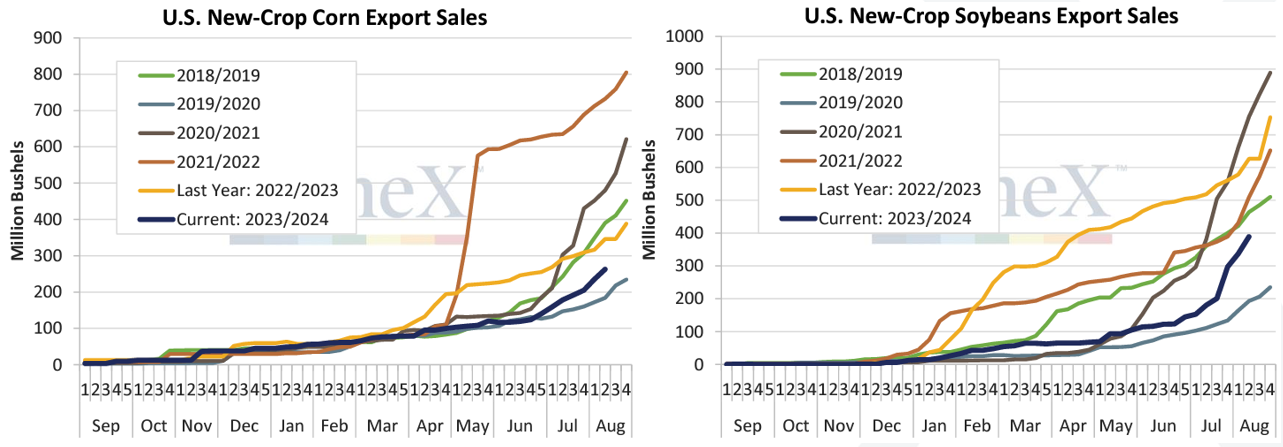
Exporters sold 9.2 million bushels of old-crop and 27.7 million bushels of new-crop corn in the week ending August 10, reflecting the ongoing problem of weak demand as Brazil now dominates the world corn market amid harvesting a record crop. I've already recounted how that has combined with soft Chinese demand to eat away at old-crop corn exports, with USDA cutting the current year target by 775 million bushels over the past year. But the focus is now on the new-crop marketing year that starts on September 1st. USDA reports that exporters have sold just 263 million bushels of new-crop corn, as shown in the graphic below, which is just a fraction of the pace seen at this point in recent years. Known sales to China total just 10.7 million bushels to this point, while China acquires its import needs almost exclusively from Brazil.
Exporters sold 3.4 million bushels of old- and 51.7 million bushels of new-crop soybeans in the week ending August 10, which sounds a lot better, but Chinese purchases would normally be a lot higher at this time of year. The fourth quarter of each year is our peak export season when China typically leans exclusively on U.S. supplies for its soybean needs. Brazil supplies have typically run dry by this time of year, leading China to lean heavily on U.S. soybeans for meeting its crush needs. But this past year's record large Brazilian soybean crop continues to flow on the market. Brazil farmers quit selling during the late July price break that saw a 40- to 50-cent basis jump that priced Brazilian soybeans above the U.S. market. It's estimated that Brazil farmers still owned about 40 mmt or 1.47 billion bushels of soybeans when they quit selling at a time when China already had most of its coverage booked for shipment through September. That led Chinese buyers to flip to the U.S. markets to book soybeans over the next couple of weeks, before the Brazilian farmer started selling again as the board rebounded. Today's data showed that China bought 34.5 million bushels of U.S. soybeans in the week ending August 10, but that was only about half of their purchase during the period, as Brazilian soybean prices fell to be competitive again during the week. New-crop soybean sales on the books total 389 million bushels as of August 10. That sounds impressive, but it's only about half of what we averaged over the past several years for this point in the year. Chinese new-crop purchases on the books total 172 million bushels, or 44% of new-crop sales on the books. China typically accounts for more than 60% of U.S. soybean exports. There are another 140 million bushels of sales listed to "unknown destinations," much of which will also likely go to China. Unfortunately, China already has booked 2 mmt of soybeans for October shipment when the U.S. typically owns the market, with it now starting to book November shipments. That can't be good for U.S. soybean shipments this fall.