December 12 - Stocks have been unable to sustain rally attempts this morning, leaving them in negative territory at midday. The VIX is trading closer to 13 at midday, while the dollar index remains solidly near 106.7. Yields on 10-year Treasuries are trading near 4.30%, which is at their highest level in more than two weeks, while yields on 2-year Treasuries are trading near 4.16%. Crude oil prices are 1% lower on demand concerns. Grain and oilseed prices are also weaker today, with prices pulling back after reaching significant chart objectives yesterday, following this morning's disappointing weekly export sales report from USDA for the week ending December 5. The past week's price strength won't help that either.
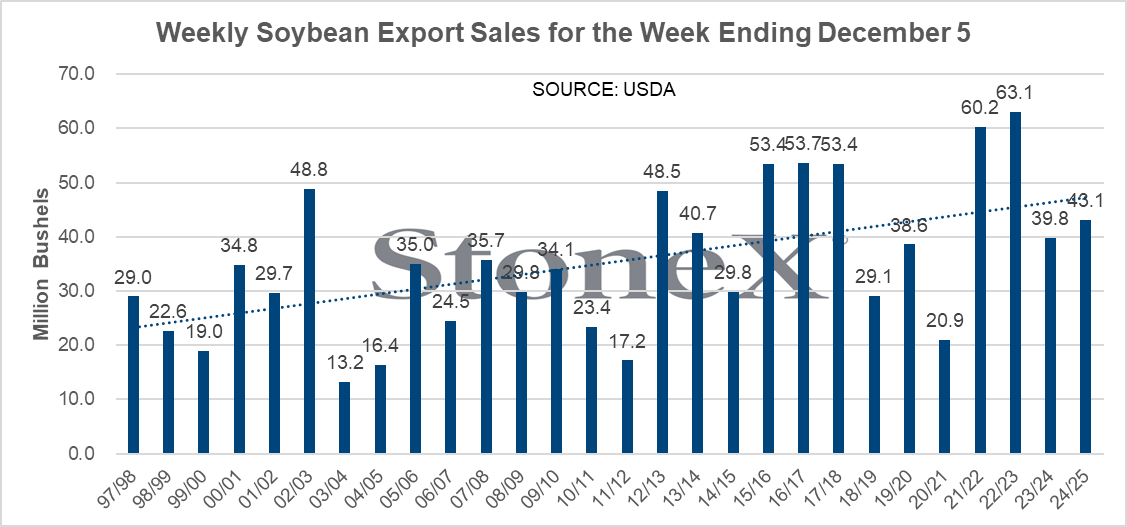
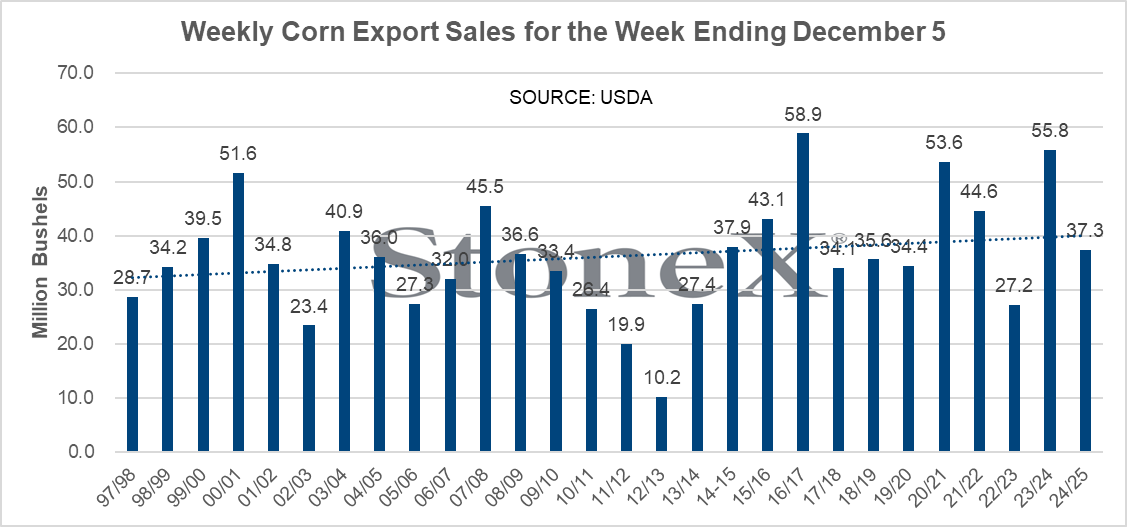
Export sales overall were a bit of a disappointment last week. USDA reports that export sales for the week ending December 5 included 43.1 million bushels of soybeans, 37.3 million bushels of corn, 10.7 million bushels of wheat and 0.2 million bushels of wheat. The previous week's sales included the largest sales of both corn and soybeans for the week on record over the past several decades. Those totals backed off notably this week, although they were still respectable. Milo sales remain quite sluggish, with China officially keeping a lid on imports, while wheat sales backed off as well.
Marketing year to date corn export sales total 1.383 billion bushels, up 314 million bushels from the previous year's pace, and up 204 million bushels from the seasonal pace needed to hit USDA's newly revised target. Mexico is typically our biggest customer, with 547 million bushels of commitments already on the books, up 39 million from the previous year's pace. It bought another 7.7 million bushels in this morning's report for the week ending December 5, but it was topped in the report this time by 10.2 million bushels sold to Columbia. That brought marketing year to date sales to Columbia to 115 million bushels, up 36 million from the previous year's pace. Sales to China remain nil, but marketing year to date sales to "unknown destinations" total 298 million bushels, up 176 million from the previous year's pace. We saw a similar situation in 2020, when prices were also at low levels, with buyers actively taking advantage of low futures and weak harvest basis to get ownership.
Marketing year to date soybean export sales total 1.370 billion bushels, up 147 million from the previous year's pace and 104 million bushels above the seasonal pace needed to hit USDA's target. China was again the featured buyer during the week at a net 25.9 million bushels, although 14.9 million of that total was a shift from previous sales to "unknown destinations." Because China is typically the headline buyer, it's natural to assume that it is responsible for why overall sales are so strong at this point, but marketing year to date sales to China total just 632 million bushels, which are the lowest in five years for the date. Sales to "unknown destinations" total 210 million bushels, but that is up just 34 million from the previous year's pace. Rather, it's a host of other nations that are bumping their purchases this year at multi-year low prices at a time when China has largely emptied Brazil's shelves ahead of the upcoming harvest. The fear is that those sales will quickly dry up over the next few weeks as cheaper new-crop supplies become available in Brazil. The one exception to that may be purchases by China to build its reserve. We've already seen those purchases in recent weeks, and those may increase in the weeks ahead as a goodwill gesture if President Xi Jinping decides to accept President-Elect Trump's invitation to attend his inauguration on January 20th.