December 23 - The holiday-shortened trade week started mixed, with stocks slipping from session highs as the morning progressed. However, stocks have recovered from mid-mornin weakness following weaker consumer confidence numbers, and concerns emerging from a Biden Administration trade probe into legacy Chinese semiconductors, raising fears of more tariffs before President-Elect Trump even takes office. The VIX is trading near 18 at this hour, while the dollar index is trading near 108.1. Yields on 10-year Treasuries are trading near 4.56%, while yields on 2-year Treasuries are trading near 4.33%. Crude oil prices are 1% lower, while the grain and oilseed markets are mixed to lower. Wheat prices continue to bounce this morning, while soybeans are pulling corn prices weaker.
The consumer confidence index fell to 104.7 in December, down from an upwardly revised 112.8 the previous month, and down from analyst expectations of 113.0. The present situation index fell 1.2 points to 140.2. It remains relatively high, but down slightly on the month. The expectations index looking at the short-term outlook for income, business, and labor market conditions saw the biggest drop - falling 12.6 points to 81.1. We had seen a surge in consumer confidence earlier this fall, but that strength has eroded amid the recent focus on tariffs from the new Administration. The survey also revealed a bit lower confidence in making major purchases, reflecting concerns over higher interest / mortgage rates.
Mexico raised its import tariffs by up to 35% for products impacting its domestic textile industry late last week. Finished textile products will now face a 35% tariff, while textile merchandise imports will see 15% import tariffs, until April 2026. The United States and Canada will be exempted from the tariffs. Mexico stated that the move was made to support the development of its textile industry, which it should do. But it also has the appearance of appeasing President-Elect Donald Trump ahead of the start of his second term in office. Mexico is also taking steps to stop the flow of cheap Chinese products flowing into the country. All of this appears to be an attempt to cooperate with Trump on his efforts to stop China from bypassing of U.S. tariffs coming to the United States, raising hopes that the efforts to cooperate will help Mexico to avoid the threatened 25% tariffs that would put U.S. grain and oilseed exports to Mexico at risk. I still expect an agreement with Canada by January 20th, with an agreement with Mexico soon thereafter as well.
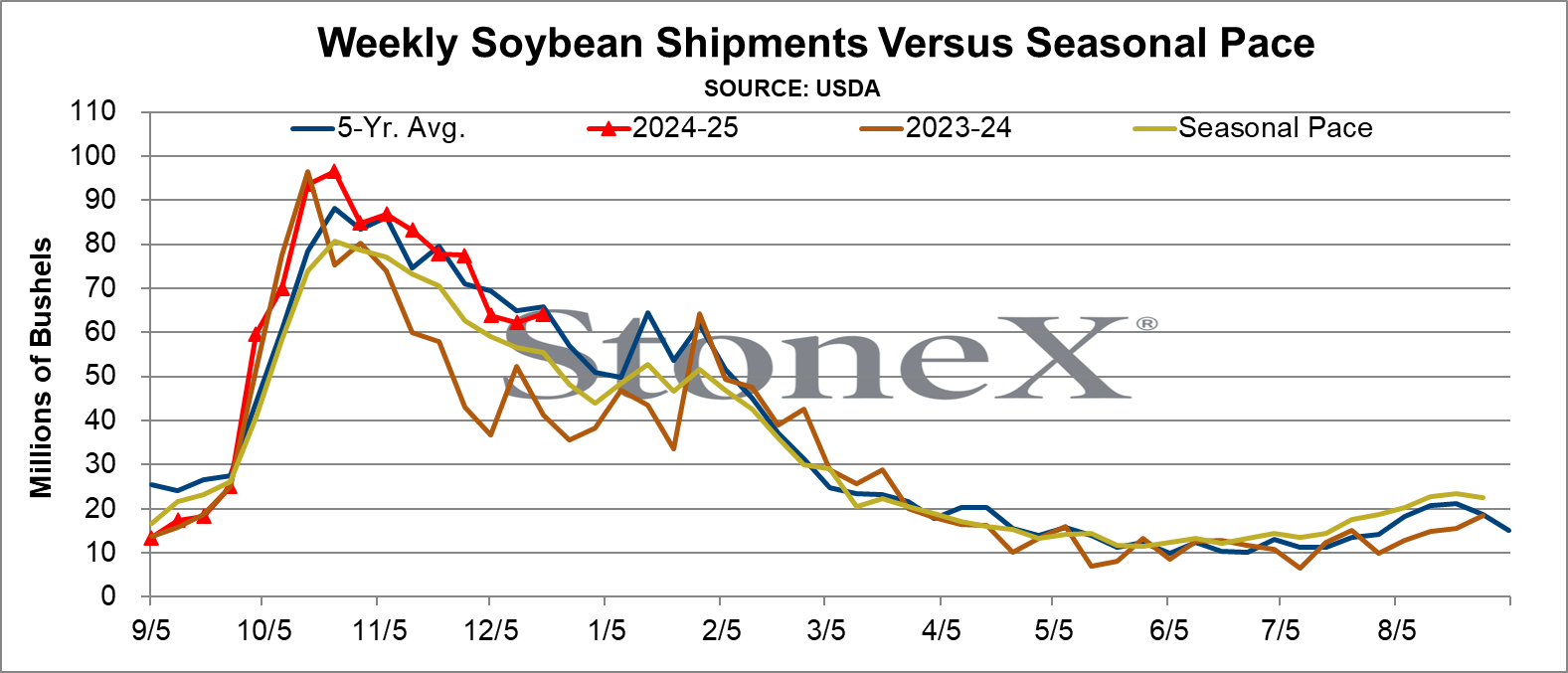
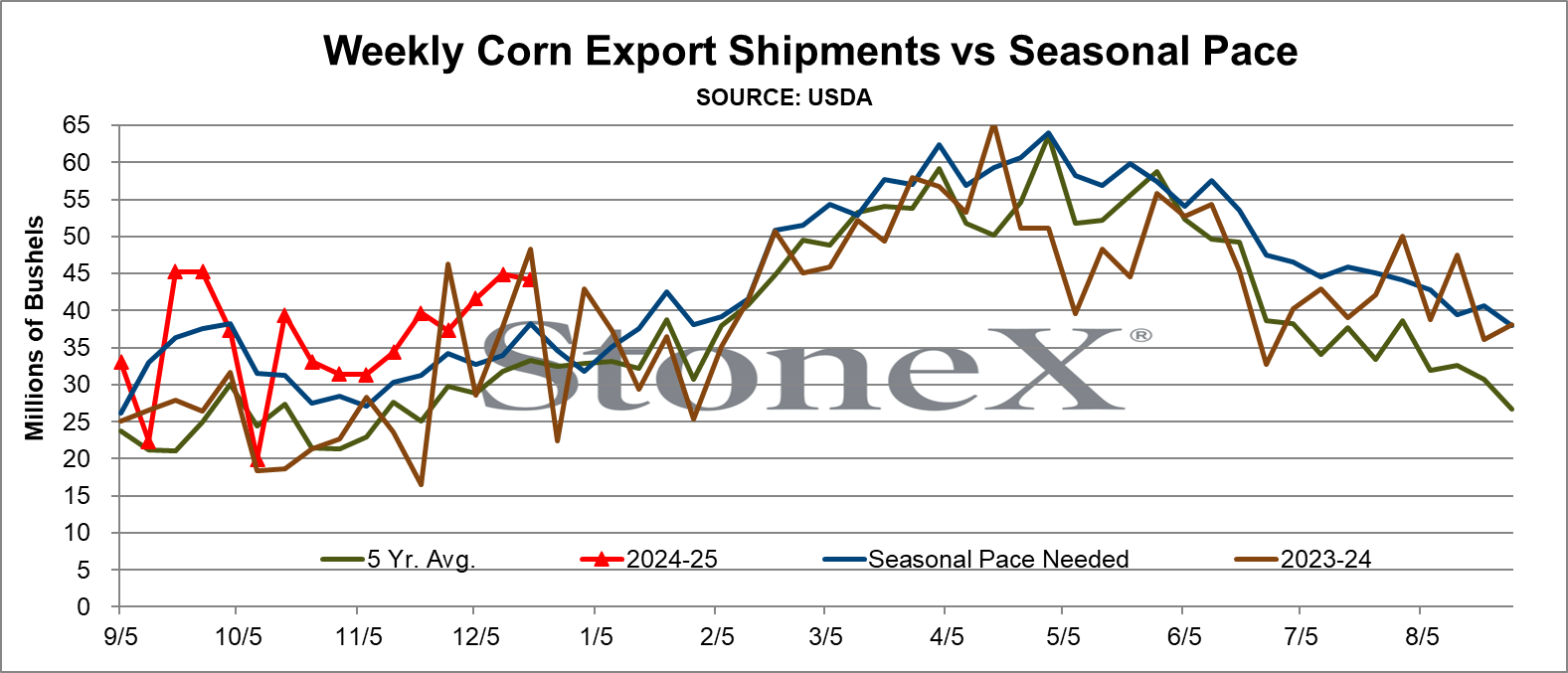
USDA inspected 64.2 million bushels of soybeans for export shipment in the week ending December 19, as shown below, along with 44.2 million bushels of corn, 14.8 million bushels of wheat, and 1.9 million bushels of grain sorghum. The portion of the above that was inspected for shipment to China included 25.1 million bushels of soybeans, and only miniscule amounts of the rest. Marketing year to date soybean export inspections to all destinations total 992 million bushels, up 173 million or 21% from the previous year's pace, and up 118 million bushels from the seasonal pace needed to hit USDA's target for the year. Marketing year to date corn export inspections to all destinations to date total 568 million bushels, up 120 million or 27% from the previous year's pace, and up 50 million bushels from the seasonal pace needed to hit USDA's target for the year. In fact, weekly corn export inspections exceeded the weekly seasonal pace needed to hit USDA's target in all but 3 weeks in this marketing year thus far. Whether we're able to sustain that pattern or not depends heavily on production prospects in South America over the next six months.