February 1 - Stocks are attempting to gain back some of yesterday's losses, with the major indexes remaining in the green at mid-day, while the VIX cools back around 14 after its slight spike yesterday. With so much focus on the Fed, bad news is back to being good news, as today's worse than expected U.S. jobs data is helping provide a boost on hopes of a dovish pivot in the months ahead. The U.S. dollar is fading through the day, off its morning highs as it falls below the 103 level at the time of writing. Treasuries are considerably weaker on the day, with 10-year yields at month-plus low around 3.85% and 2-year yields at 3-week lows around 4.19%. Crude oil is in the green today with the weaker dollar and continuing OPEC+ production cuts providing support as the nearby WTI contract rises to trade near $77/barrel. The ags are largely mixed, with the soy complex leading the way downward, while the cattle complex is seeing considerable strength on the back of yesterday's bullish inventory report.
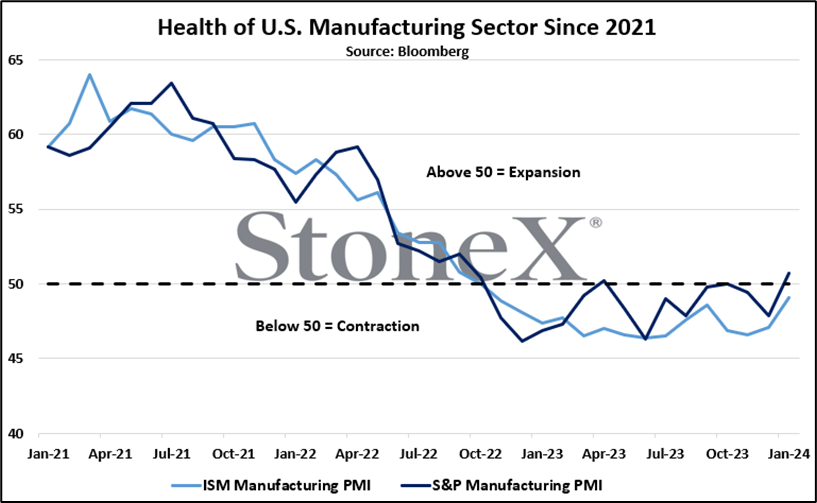
The U.S. manufacturing sector is showing signs of an attempted recovery from its persistent weakness, with today's January Manufacturing PMI reading from S&P hitting its highest level since September 2022 at 50.7, the first month of expansion seen since April. The ISM reading remained in contractionary territory at 49.1, but this was still a solid improvement from the 47.1 seen in the month prior and marked its highest reading since October 2022. Both indexes noted an improvement in new orders, a welcomed sign of improving demand, but also saw a noteworthy increase in price pressures, potentially a sign of stubborn inflation returning. The other noteworthy takeaway from today's data was a slowdown in the employment portion of the index, coinciding well with this morning's softer than expected jobs data. While this sounds negative on its surface, with the trade so closely focused on the Fed, any signs of weakness in the labor market will be looked at as further evidence of slowing wage inflation, providing ammunition to the doves for rate cuts in the months ahead.
Weakness in the manufacturing sector hasn't been limited to the U.S. either, as a multitude of countries continue to see contraction in their respective manufacturing sectors, according to data releases overnight and this morning. The struggling European manufacturing sector saw some silver linings like the U.S., continuing its recovery from lows hit last summer, though remaining well within contractionary territory, while neighboring Canada got opposite news as their Manufacturing PMI fell to 45.4, its lowest level since the pandemic-hit spring of 2020. China's Caixin Manufacturing PMI showed a surprisingly strong reading of 50.8 in January, matching the same level seen in December and remaining in expansionary territory for the third consecutive month. This is a bit contrary to China's official NBS Manufacturing PMI which came in at 49.2 the day prior, remaining in contraction for the fourth consecutive month as the larger, state-owned enterprises continue to struggle. Contrasting to weakness in China is the great strength seen in India's manufacturing sector, rising to its firmest pace of expansion since September and reflecting the current phenomenon of firms leaving China in favor of India and others due to the ongoing geopolitical tensions with the west. This serves as a highlight of another impact that geopolitics are having as the global economy evolves.
Mortgage rates in the U.S. cooled slightly this week according to Freddie Mac, with the average 30-year rate falling by 0.06% to 6.63% and the average 15-year rate falling by 0.02% to 5.94% after both saw upticks last week. This is a fair bit below their recent peaks this fall of roughly 8% and 7%, respectively, but still high enough to weigh on buyers. Sentiment has improved slightly in early 2024, however, with the housing market proving resilient, much like the broader U.S. economy. With housing costs accounting for such a large portion of the average American's budget, the health of the housing market does have implications for lingering inflationary pressures.