January 15 - Stocks surged on this morning's inflation data release, which showed hotter headline numbers, but the core numbers followed by the Federal Reserve continued to make progress toward the central bank's 2% mandate. Additional strength came from solid earnings results from some of our nation's biggest banks. Treasury yields dropped notably lower, allowing the dollar to fall as well, although the dollar was unable to sustain that decline with the euro dropping in value. The VIX is now trading near 17, while the dollar index is trading near 109.2. Yields on 10-year Treasuries are trading near 4.67%, after topping 4.80% yesterday, while yields on 2-year Treasuries are trading near 4.28%. Crude oil prices are nearly 3% higher on the positive economic outlook, and expectations for tighter sanctions on Russia and Iran, as well as possible tariffs on Canada. The grain and oilseed markets are generally mixed to weaker. We continue to see a little follow through buying for corn and soybeans following Friday's bullishly-construed USDA crop report, with additional support coming from concerns of dryness in Argentina and southern Brazil, while wheat struggles to find a reason to sustain a rally amid a glut of domestic supplies.
Donald Trump will again be sworn in as President of the United States on Monday. Ironically, that is also the Martin Luther King, Jr holiday, which means that the markets will be closed. Some pundits believe that we could see as many as 100 executive orders signed on day #1 of Trump 2.0. Many of those may have significant market implications, but the markets will be closed until that evening. That means that we could see a great deal of volatility in the markets on Monday night into Tuesday's session as traders parse out the impacts of the executive orders. Some may be seen as positive for some sectors, while others may be seen as negative. The big focus has been on tariffs, and how they will be administered. Will they be targeted or broad-stroked tariffs? Will they be phased in to spur negotiations, or implemented all at once? The markets will likely have far more information to digest than normal over the coming week and beyond, which could increase volatility.
Our Kansas City energy team notes that the likelihood of President-Elect Trump's threatened 25% tariffs on Canada are increasing, following Alberta Premier Danielle Smith's recent visit to Mar-A-Lago. More than half of U.S. crude oil imports come from Canada. Canadian oil sands production tends to be heavy crude, which works very well for U.S. refineries built for heavier crudes that we don't produce much of here in the States. The Midwest relies heavily on these heavy crude oil imports from Canada, purchasing roughly 1.8 million barrels per day for refining. There are some reports that the incoming Administration might scale in these tariffs, but the potential impact on crude oil supplies, and therefore prices, must be respected. Canada has announced a $901 million plan to address security concerns along the border, but Trump has thus far not backed away from the tariff threat, which could come as soon as Monday when he is inaugurated.
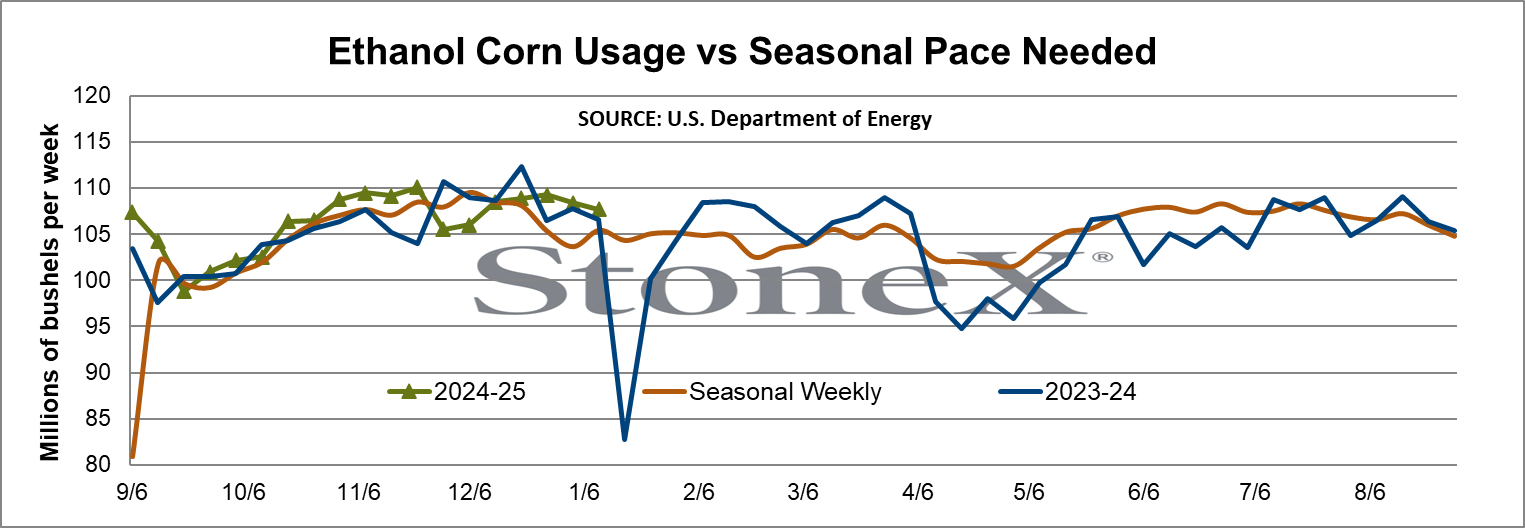
U.S. commercial crude oil stocks (excluding the Strategic Petroleum Reserves) fell by 2.0 million to 412.7 million barrels in the week ending January 10, putting them 6% below the five-year average for mid-January. Gasoline stocks rose by 5.9 million barrels, leaving them just slightly below typical levels for this time of year. Distillate stocks increased by 3.1 million barrels, but they are still 4% below seasonal levels. Ethanol stocks rose to 25.0 million barrels in the week ending January 10, up from 24.1 million the previous week, but down from 25.7 million barrels in the same week last year. Ethanol production slipped to 1,095K barrels per day last week, down from 1,102K bpd the previous week, but up from 1,054K bpd in the same week last year. The production of ethanol utilized an estimated 107.7 million bushels of corn last week, down from 108.4 million the previous week, but up from 106.6 million bushels the previous year. Marketing year to date estimated corn use for ethanol totals 2.005 billion bushels, down 10 million bushels from the previous year's pace, but 32 million bushels above the seasonal pace needed to hit USDA's target for the year.