July 25 – We are officially one week out from the U.S. tariff deadline of August 1st, with progress reportedly being made in trade talks with several major trading partners, though some still appear far off. Most notably, E.U. officials this morning stated that a framework deal could be reached this weekend, potentially eliminating some lingering uncertainty. We’ve seen this deadline moved back several times, so it will be interesting to see if any other major trading partners, like India for example, will have an increased sense of urgency to come to some form of an agreement in the week ahead. Next week will also bring us several closely watched data releases, with an update on U.S. labor market health from the JOLTs report due out Tuesday and Nonfarm Payrolls on Friday, as well as an updated look at inflation with the Fed’s preferred metric, PCE, set to be released Thursday. The FOMC will also be meeting next Tuesday & Wednesday (7/29 – 7/30), with Fed Chair Jerome Powell continuing to face public pressure and scrutiny from President Trump to rapidly lower rates, but the market pricing in only a 2.6% chance of a cut being announced when they wrap up Wednesday.
Regardless, the stock market is looking to end this week on a positive note with the major indexes all in the green at mid-day, while the VIX remains muted around the 15 level. The Nasdaq and S&P 500 have both touched fresh all-time highs yet again this morning, with the Dow Jones within roughly 300 points of doing the same. The dollar is adding to yesterday’s gains as it trades above the 97.8 level, up roughly 0.3% on the day. Treasuries are hovering just below unchanged at mid-day, with 10-year yields trading slightly above 4.40% and 2-year yields just above 3.92%. Crude oil has erased yesterday’s gains as nearby WTI trades back below the $65.30 level, while the ags are mostly in the red.
Core capital goods orders sank 0.7% month-on-month in June, down sharply from May’s upwardly revised 2.0% gain (was +1.7% previously) and well below trade estimates of a 0.2% rise. 2025 has seen much more volatility in this metric, often seen as a proxy for business spending plans, amid the back-and-forth of U.S. tariff policy. We saw a sharp uptick in the first quarter of this year as firms attempted to frontload ahead of anticipated tariffs, but lingering uncertainty moving forward may be preventing some firms from pulling the trigger on high-cost equipment investments.
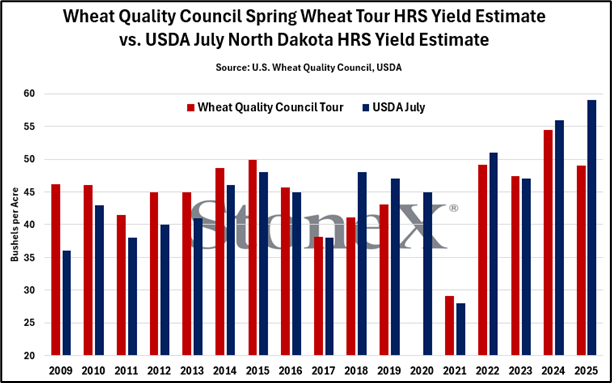
The Wheat Quality Council’s Spring Wheat and Durum Tour wrapped up yesterday following three days of sampling fields across North Dakota and parts of Minnesota, with the total weighted average yield being pegged at 48.3 bushels per acre, down notably from last year’s record 53.8 bushels per acre. This was a combination of hard red spring wheat yields seen at 49.0 bushels per acre and average durum yields at 37.0 bushels per acre, both of which were well below last year’s 54.5 and 45.3 bushels per acre, respectively. With this in mind, it will be interesting to see if USDA makes any downward adjustments to their state level yield estimates next month, with their estimate for North Dakota’s other spring wheat yield pegged at 59.0 on July’s report, a full 10 bushels per acre above the Tour’s estimate, as shown below. Executive Director of the North Dakota Wheat Commission, Jim Peterson, noted himself that the tour “probably points to the USDA yield for North Dakota spring wheat as overstated.”
North Dakota accounts for roughly half of U.S. spring wheat production on average, but perhaps the more compelling story of the current spring wheat growing season is taking place on either side of the state, with Minnesota’s crop in nearly the best condition on record while Montana’s crop was rated as the worst on record for the last few weeks before Monday’s 3% improvement. Conditions in Washington and Idaho have deteriorated since USDA’s last update as well, with potential downward adjustments in play there if drought conditions persist. Forecasts show expectations of a wet next two weeks for Montana and the Dakotas, potentially providing a boost to later planted spring wheat but also running the risk of deteriorating quality and/or delaying the start of harvest for earlier planted areas. Canada’s spring wheat crop is also seeing considerable variability, with southern portions of Alberta, Saskatchewan, and Manitoba catching widespread beneficial rains this week, though northern stretches of top producer Saskatchewan’s spring wheat belt continued to miss out. Alberta has plenty more rain in the forecast as well, though the hardest hit portions of Saskatchewan don’t see much in the way of rain chances until the 11-15-day window.