Today's Perspective Video: Commodities Face Pivotal Tariff Week
July 7 - President Trump posted on social media that he will impose 25% tariffs on both Japan and South Korea beginning August 1st. Both countries were thought to be working on agreements, but today's announcement suggests that President Trump was frustrated with the lack of progress. What about other countries? The White House continues to suggest that other countries are working to get agreements ahead of Wednesday's deadline to avoid returning to the April 2nd reciprocal tariff levels, but the next 36 hours should tell us a lot about how many get there and how many see higher tariff notices. That could lead to some market volatility in either and / or both directions as the investment world responds to various tariff headlines.
Stocks came under additional pressure on the report of the above tariffs on Japan and South Korea, fearing that this might be the first step toward a return to some level of volatility - perhaps not as extreme as April, but not necessarily enjoyable volatility. The VIX is modestly higher near 18 at midday, while the dollar index is firmer near 97.5. Yields on 10-year Treasuries are trading at two-week highs near 4.39% as fiscal policy takes on greater significance than monetary policy in that market, while yields on 2-year Treasuries are trading near 3.89%. Crude oil prices fell notably overnight on a larger than expected OPEC production increase for August, but prices have rallied today, erasing the losses and posting more than 1% gains on tight current supplies that suggest strengthening demand. Meanwhile, the grain and oilseed markets remain under heavy selling pressure. President Trump failed to make any trade announcement benefiting agriculture when he spoke in Iowa on Thursday evening, and weekend weather models look favorable for corn and soybean production, with traders now anticipating the possibility of above-trend yields that grow surplus stocks in the year ahead.
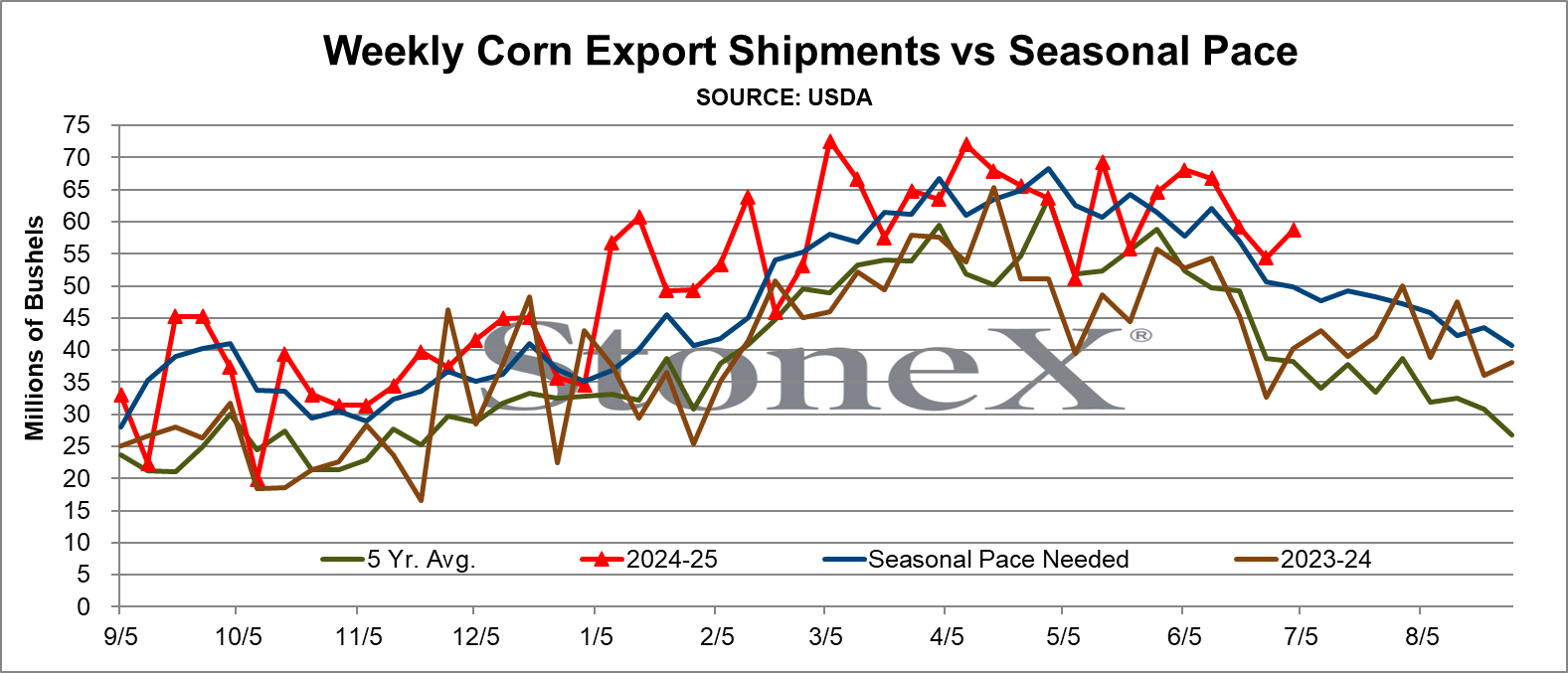
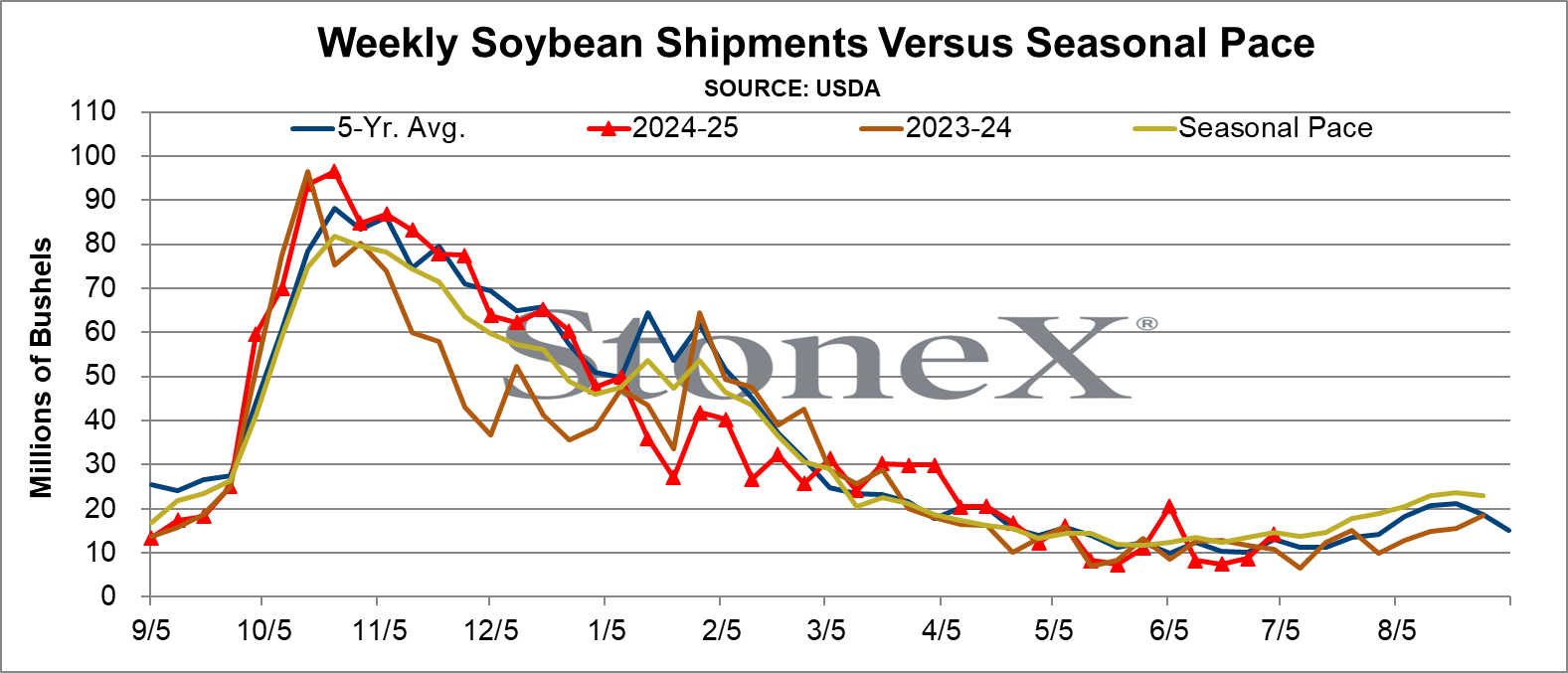
Today's weekly USDA export inspection report should tie the bow on expectations for the agency to raise its old-crop corn export target in Friday's WASDE crop report. USDA reports that it inspected 58.7 million bushels of corn for export shipment in the week ending July 3, as shown below, along with 14.3 million bushels of soybeans, 16.0 million bushels of wheat and 0.4 million bushels of grain sorghum. None of the above inspections were done for shipments to China, which has been the common theme this summer.
Marketing year to date corn export inspections total 2.222 billion bushels, up 509 million bushels or 30% from the previous year's pace, and the second highest for the date on record (2020/21). The total exceeds the seasonal pace needed to hit USDA's target by 148 million bushels, and the gap continues to grow. The inspection pace was stronger in the 2020-21 marketing year due to strong shipments to China, which have been largely absent in the current marketing year. Instead, Mexico is the big taker of U.S. corn now, rather than China. Marketing year to date soybean export inspections total 1.700 billion bushels, up 162 million bushels or 10% from the previous year's pace, and 66 million bushels above the seasonal pace needed to hit USDA's target. We're still not shipping any soybeans to China, but other countries are stepping up a bit, with China dominating the loadings in Brazil. Brazilian soybeans offloaded at Chinese ports in August are priced about 90 cents per bushel cheaper than soybeans from the U.S. Gulf. Gone are the days when Brazil would run out of soybeans in July, and China would return to U.S. shores for supplies. Brazil is expected to have cheaper supplies possibly into the fourth quarter this year, further reducing demand for U.S. soybeans.