June 14 - Stocks were generally mixed, while the commodity sector had a negative feel to it this morning, as traders brace for this afternoon's word from the Federal Reserve. Wall Street continues to expect a pause in rate hikes from the Federal Reserve today, with Fed fund futures trading 98% odds of such following this morning's better-than-expected inflation data from the wholesale level. The VIX is trading just above 14 at midday, while the dollar index is trading notably lower below 102.7 at fresh four-week lows. Yields on 10-year Treasuries are trading near 3.79%, while yields on 2-year Treasuries are trading near 4.63%. The broader commodity sector remains under pressure despite the weaker dollar, with crude oil prices down nearly 1%, and grain and oilseed prices mixed. This continues a pattern that we've seen unfold frequently over recent months, where optimism runs higher among equity traders than it does among commodity traders. Commodity traders continue to fret that the Fed's rate hikes will drive our economy into a recession that will reduce demand for commodities. Equity traders are increasingly convinced that we can avoid a significant recession, but commodity traders see nothing but poor demand. That bias continues to influence how commodities interpret supply and demand data.
The grain and oilseed sector struggled to sustain recent gains on weather concerns, with rains gradually filling in the holes over dry areas of the Midwest amid generally mild temperatures. Tuesday's rally fell short midday, resulting in a weak finish for the day in the sector. The bulls could point to dry soils across the Midwest and the continued rant of Russia threatening to withdraw from the Ukraine grain initiative, but the fact is that the market doesn't care right now. All it sees is dismal export demand and prospects for the weather to improve as we move deeper into the summer. Perception is reality, and the market needs to see proof otherwise. Does the market really want to take prices higher to ration demand on dry weather concerns, when demand already is weak? USDA cut corn exports by 50 million bushels on Friday, but it could probably justify another 100 million-bushel cut to demand for exports and ethanol combined. Soybean sales are in the tank as well, amid Brazil's big crop. There's still a legitimate risk that enough of the Midwest could remain dry to notably reduce this year's national average corn and soybean yields, but traders want to see proof. The rapid development of El Nino still argues for a milder summer with timely rains to support yields, but this is something that we'll be monitoring. Grain and oilseed prices managed to firm late morning, but conviction continues to be lacking.
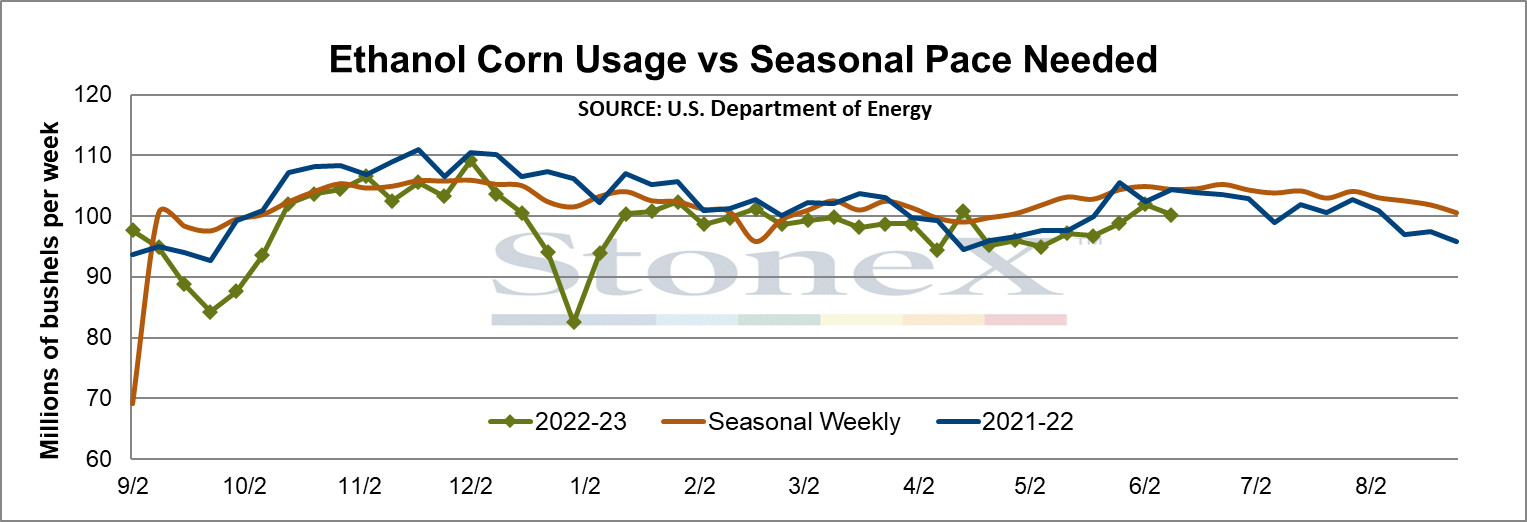
U.S. crude oil stocks (not counting the Strategic Petroleum Reserve) rose by 7.9 million in the week ending June 9 to 467.1 million barrels. That puts those stocks at a five-year high for early June. Gasoline stocks rose by 2.1 million barrels, leaving them roughly 7% below levels typically seen at this time of year. Distillate stocks also rose by 2.1 million barrels, putting them 14% below the five-year average for this week of the year. Ethanol stocks fell to 22.2 million barrels during the week, down from 22.9 million the previous week, and down from 23.2 million barrels in the same week last year. Ethanol production fell to 1,018K barrels per day last week, down from 1,036K bpd the previous week, and down from 1,060K bpd in the same week last year. The production of ethanol used an estimated 100.2 million bushels of corn last week, down from 102.0 million the previous week, and down from 104.4 million bushels the previous year. Marketing year to date estimated corn use for ethanol totals 3.962 billion bushels, down 188 million bushels or 4.5% from the previous year's pace, and down 46 million bushels from the seasonal pace needed to hit USDA's target for the year.