June 21 - The tech sector led the way lower on Wall Street this morning, as Federal Reserve Chair Jerome Powell testified before the House Financial Services Committee, stating that higher borrowing costs will likely be necessary to sufficiently slow the economy to bring inflation down to the 2% mandate. Yet, the VIX is trading near 13 at this hour, its lowest level in more than three years. The dollar index is trading near 102.2, while yields on 10-year Treasuries are trading near 3.76% and yields on 2-year Treasuries are trading near 4.73%. Crude oil prices are 2% higher on the weaker dollar, while grain and oilseed prices surge higher on the continued weather market as crop ratings tumble. Soyoil prices fell their daily limit lower though after the EPA disappointed the trade with its RVO requirements for the next three years, which fall far short of where the industry was headed. This is one more example of disappointing demand for the grain and oilseed sector, although traders are currently focused on supply threats due to drought over the central Midwest. High feed prices weighed heavily on feeder cattle demand this morning, with a softer cash cattle market also weighing on the protein sector today.
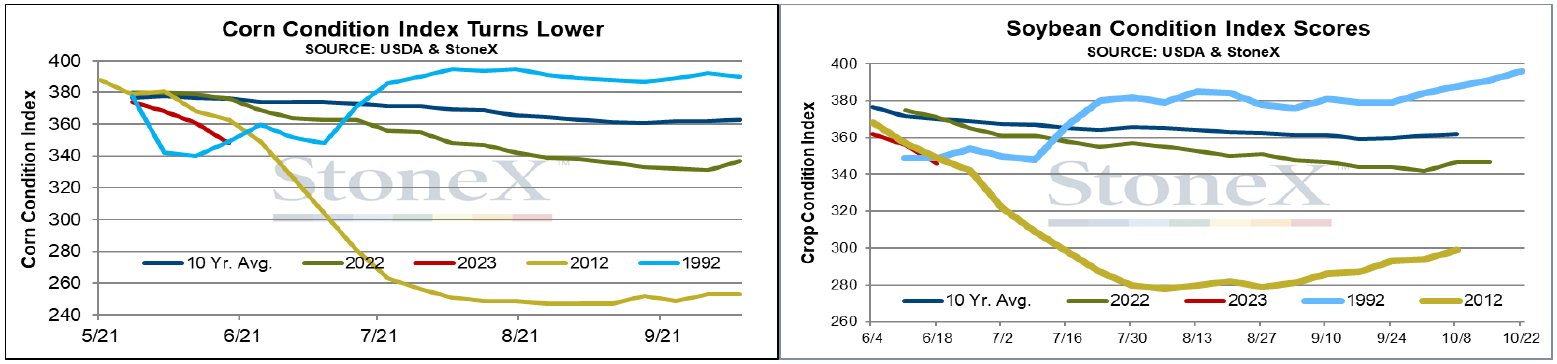
Crop condition index scores continue to sink as dry weather prevails in the central Midwest. Temperatures have been seasonably mild for much of the Midwest, which helps, but below-normal rainfall has continued across much of the Midwest over the past several months, with very dry conditions in the center of the Midwest. The graphics below show the path that condition index scores have taken thus far this year, compared to last year and compared to the 10-year average path. Note that ratings typically are highest in June, before trending lower into harvest, when they tend to take a little bounce as harvest results come in. I detailed in this morning's commentary that the correlation between June crop ratings and final yield is low, although the odds are starting to argue for a below-trend yield.
We've frequently heard references to 2012, because it is the most recent year when we had a "dome of doom" high pressure over the Midwest that brought heat and dryness to the Corn Belt. 1988 saw even lower ratings at this time of year, but I'll yield to the 2012 comparison to put it on both of the below graphics, since that's what most people currently have in their memory. This year is not currently expected to be hot like it was in 2012. It's a different setup in the atmosphere this year, which should give us more seasonable temperatures - perhaps cooler than normal - although persistent dryness does tend to support heat building. I've also included 1992 on the graphics below, because that too was a year with similar crop ratings in mid-June, but then the pattern changed cooler and wetter for much of the rest of the summer, producing above-trend corn and soybean yields - yes it can still happen. 1992 was the only year since 1986 - the year USDA started releasing crop ratings - that had similar crop ratings in mid-June that still produced above-trend corn and soybean yields. Both saw a couple of years of near-trend yields, but also below trend yields. The propensity was greatest for soybeans, which saw five years with similar mid-June ratings that produced below-trend yields. A scatter plot analysis suggests we're currently in the neighborhood of expecting the national yield to be down roughly 5% from trend for both corn and soybeans, although that could change substantially in either direction in the weeks ahead. USDA does not like to change its corn and soybean yields in its July WASDE crop report.
USDA has changed its corn yield estimate 8 times over the past 30 years in its July crop report, but not since 2012 when it dropped it 20 bushels. The other 7 changes were both sides of unchanged and generally just a few bushels. USDA has changed its soybean yield six times over the past 30 years in its July report, with five of those being reductions. It's most recent cut in July came in 2019 (1.0 bushel), while it cut the yield by 3.4 bushels in July 2012. My confidence is growing that USDA may make a modest reduction next month, although the cut will likely be smaller than 5%. However, it might also simultaneously make additional cuts to old-crop corn exports and ethanol demand targets.